Kevin Bailey is the founder and CEO of Dreamfuel, a high-performance coaching firm that bridges the gap between applied neuroscience and professional achievement for founders and sales teams. By leveraging his background as a three-time Inc. 500 founder and his academic work at King's College London, Bailey teaches individuals how to rewire their brains for resilience, focus, and elite results.
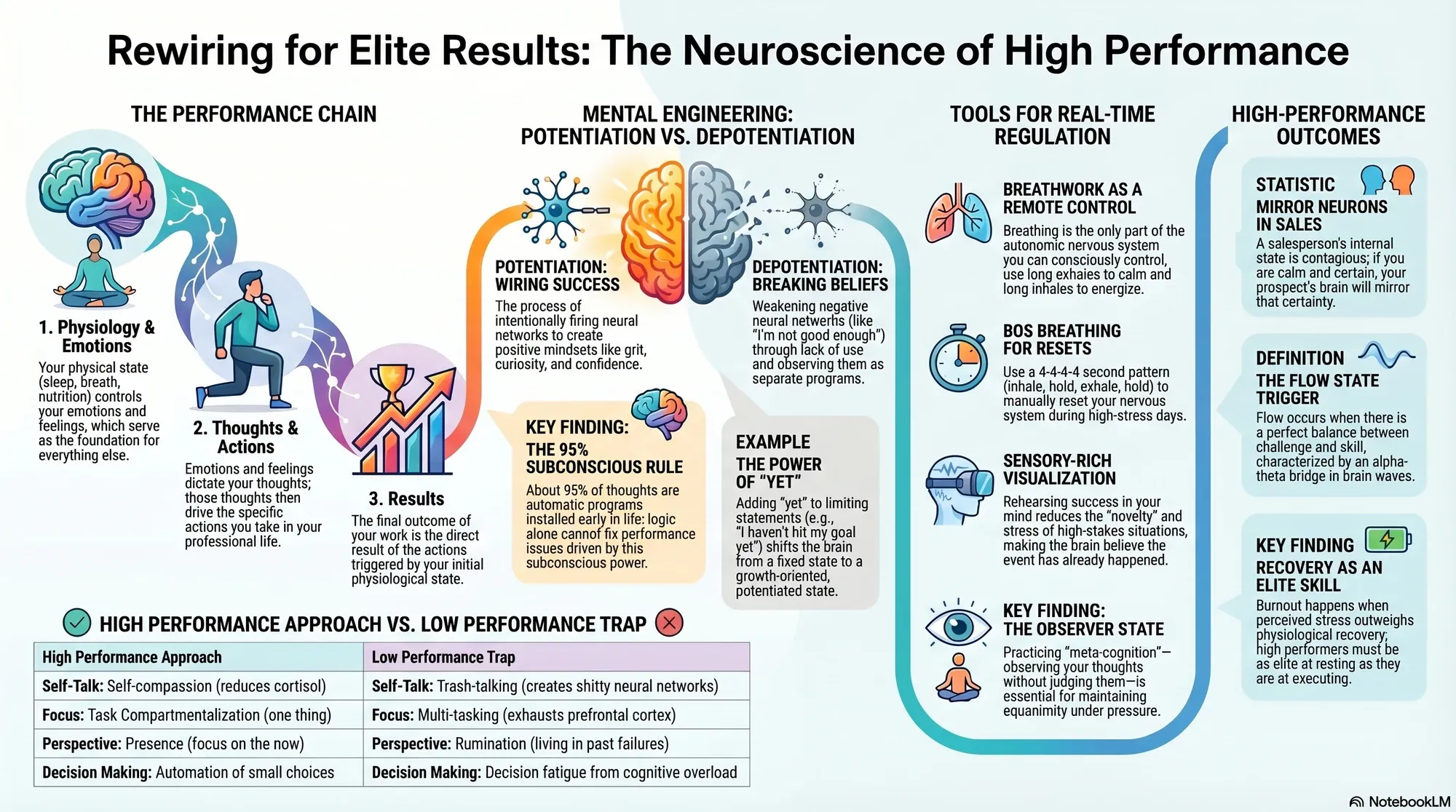
Part 1: The Performance Chain: Physiology and Foundations
- On the Performance Chain: "Your physiology controls your emotions and your feelings, your emotions and feelings control your thoughts, your thoughts control your actions, your actions control your results." — Source: Peak Performance Selling Podcast
- On Physiological Regulation: "Top executives don't just rely on good days. They train their nervous system to show up at their best, every single time." — Source: Dreamfuel
- On the Interdependence of States: "If you’re hungover or sick, that physiological state immediately triggers negative emotions and thoughts, showing why physiology is the base of the chain." — Source: Productly Speaking
- On Automatic Thoughts: "About 95% of our thoughts are automatic, stemming from subconscious programs installed early in life." — Source: The Dreamfuel Show
- On Breathwork as a Remote Control: "Breathing is the only part of the autonomic nervous system that you can consciously control to shift your physiological state in real-time." — Source: Powderkeg
- On Paced Breathing: "Long exhales are for calming the system, while long inhales are for energizing it." — Source: Explore84 Podcast
- On Physical Fitness for Leaders: "Treat mental performance and fitness as a critical business investment, identical to how you would treat physical health." — Source: Odyssey Magazine
- On Nervous System Training: "Elite performance is about consistency, and consistency is defined by how well you have trained your nervous system to handle pressure." — Source: CEO Within Podcast
- On Sleep and Performance: "You cannot coach your way out of a physiological deficit caused by chronic lack of sleep or poor nutrition." — Source: People Business Podcast
- On Body Awareness: "Developing the ability to feel where stress lives in your body is the first step toward regulating it." — Source: Revenue Leadership Podcast
Part 2: Potentiation: Wiring Your Success Mindset
- On Potentiation: "Potentiation is the process of creating and strengthening new, positive mindsets by intentionally firing those neural networks." — Source: Peak Performance Selling Podcast
- On Building Confidence: "If you want natural confidence, you have to get really excited about being confident to wire and fire those specific neural networks." — Source: Dreamfuel
- On Mental Repetition: "The brain doesn’t distinguish much between a real event and a vividly imagined one; repetition builds the neural hardware." — Source: UVIA
- On Gratitude Training: "Gratitude isn't just a nice feeling; it's a mental fitness exercise that creates a default neural pathway for resilience." — Source: Explore84 Podcast
- On Intentional Mindsets: "You can choose which mindsets you want to practice, whether it’s grit, curiosity, or calm, just like you choose which muscles to train at the gym." — Source: Odyssey Magazine
- On Neural Plasticity: "The brain is remarkably plastic throughout adulthood, meaning you are never 'stuck' with your current level of mental performance." — Source: King's College London Spotlight
- On Positive Reinforcement: "Celebrate small wins to release dopamine, which reinforces the neural pathways associated with that success." — Source: The Dreamfuel Show
- On Self-Talk: "Positive self-talk is the manual override for your subconscious programming." — Source: People Business Podcast
- On the Power of 'Yet': "Adding the word 'yet' to a limiting statement shifts the brain from a fixed state to a growth-oriented, potentiated state." — Source: Revenue Leadership Podcast
- On Daily Mindset Priming: "Start your day by deciding which one mindset will serve you best for the challenges ahead." — Source: Accidental Leader Podcast
Part 3: Depotentiation: Breaking Limiting Subconscious Programs
- On Depotentiation: "Depotentiation is the 'losing' of bad mindsets or limiting beliefs that no longer serve you." — Source: Peak Performance Selling Podcast
- On Childhood Programming: "Many of our limiting beliefs, like 'I'm not good enough' or 'Money is bad,' are pre-installed programs from our childhood." — Source: Productly Speaking
- On Identifying Blockages: "To break a limiting belief, you first have to observe it as a separate program rather than as the absolute truth." — Source: The Dreamfuel Show
- On Financial Scarcity: "The scarcity trap is often rooted in early life programming that establishes an invisible ceiling on your revenue." — Source: Dreamfuel Blog
- On Negative Neural Networks: "Limiting beliefs are actual physical networks in your mind that need to be weakened through lack of use." — Source: UVIA
- On Product Skepticism: "Believing your product is too expensive is a limiting belief that will physically change how you present it to customers." — Source: Peak Performance Selling Podcast
- On Self-Sabotage: "We often sabotage our success because our subconscious programming feels safer in the struggle than in the win." — Source: Explore84 Podcast
- On Rewriting the Script: "You can actively 'shred' over limiting beliefs by using visualization to replace those old fears with new outcomes." — Source: Productly Speaking
- On the Subconscious Mind: "The subconscious mind is millions of times more powerful than the conscious mind, which is why logic alone rarely fixes performance issues." — Source: Odyssey Magazine
- On Letting Go of the Past: "Rumination on past failures keeps those negative neural networks alive; depotentiation requires shifting focus to the future." — Source: Powderkeg
Part 4: Equanimity: Protecting Your Mental Energy
- On Equanimity: "Equanimity is the skill of preventing new negative mindsets from forming by maintaining composure under pressure." — Source: Peak Performance Selling Podcast
- On Trash-Talking Yourself: "Every time you trash talk yourself, you’re creating new neural networks of shitty beliefs; avoiding this is the practice of equanimity." — Source: Explore84 Podcast
- On Perceived Stress: "The vast majority of our stress is perceived stress—fear of a future that hasn't happened or regret over a past that can't be changed." — Source: Productly Speaking
- On Emotional Composure: "Equanimity isn't the absence of emotion; it's the absence of being controlled by your emotions." — Source: Dreamfuel
- On Protecting the Mind: "View your mind as a high-performance engine; you wouldn't put cheap fuel or dirt into it, so don't allow toxic thoughts to take root." — Source: People Business Podcast
- On Handling Setbacks: "In a high-pressure environment, equanimity allows you to respond to a crisis rather than reacting to it." — Source: Revenue Leadership Podcast
- On Mental Boundaries: "Set boundaries for when you will and won't think about work to give your nervous system time to recover." — Source: The Dreamfuel Show
- On Presence: "Staying in the present moment is the ultimate defense against the anxiety generated by the 'what ifs' of the future." — Source: Powderkeg
- On the Observer State: "Learn to observe your thoughts without judging them; this 'meta-cognition' is essential for maintaining equanimity." — Source: Odyssey Magazine
- On Daily Calm: "Integrate short 'micro-meditations' throughout the day to reset your nervous system and maintain a baseline of equanimity." — Source: Accidental Leader Podcast
Part 5: The Power of Visualization and Mental Rehearsal
- On Brain Rewiring: "Visualization helps to rewire the brain to believe that the successful event has already happened, boosting confidence and drive." — Source: UVIA
- On Neurotransmitter Release: "Vivid visualization releases motivating neurotransmitters like dopamine and hormones like noradrenaline, even before the real action starts." — Source: Dreamfuel
- On Correcting Mistakes Early: "Mental rehearsal allows you to encounter and solve potential problems in your mind before they ever happen in reality." — Source: Productly Speaking
- On Sensory Richness: "For visualization to work, you must involve all the senses—what you see, hear, and crucially, how you feel in that successful moment." — Source: Peak Performance Selling Podcast
- On Overcoming Fear: "Visualizing your fears and then visualizing yourself successfully navigating through them is a primary tool for building grit." — Source: Explore84 Podcast
- On Performance Preparation: "Elite athletes spend as much time mentally rehearsing their performance as they do physically training; business leaders should do the same." — Source: People Business Podcast
- On the 'Mental Edge': "Visualization gives you a 'mental edge' by reducing the novelty and stress of a high-stakes situation." — Source: Odyssey Magazine
- On Identity Shifting: "Visualize the person you want to become, not just the goals you want to achieve, to shift your core identity." — Source: The Dreamfuel Show
- On Consistency in Practice: "Visualization is a skill that improves with practice; five minutes a day is better than an hour once a month." — Source: Accidental Leader Podcast
- On Pre-Meeting Rituals: "Spend two minutes before a big sales call visualizing the client saying 'yes' to prime your brain for a positive interaction." — Source: Revenue Leadership Podcast
Part 6: Mastering the Sales Mindset Through Neuroscience
- On Rejection Resilience: "Sales rejection isn't personal; it's just a data point that your brain needs to learn how to process without triggering a threat response." — Source: No Smoke and Mirrors
- On Selling Under Pressure: "When a salesperson is stressed, the customer senses it through mirror neurons; calming your own physiology is the best way to calm the customer." — Source: Peak Performance Selling Podcast
- On Abundance in Sales: "An abundance mindset allows you to walk away from bad deals, which ironically makes you more attractive to good prospects." — Source: The Dreamfuel Show
- On Mirror Neurons: "Your internal state is contagious. If you are confident and certain, your prospect's brain will start to mirror that certainty." — Source: UVIA
- On Overcoming 'Sales Slumps': "A sales slump is often just a collection of negative neural networks that have become temporarily dominant." — Source: Dreamfuel
- On Listening Performance: "High stress reduces your ability to listen actively; by regulating your breathing, you can stay present and actually hear the prospect's needs." — Source: People Business Podcast
- On the Psychology of Price: "If you haven't depotentiated your own fears about money, you will always stumble when it comes time to talk about price." — Source: Productly Speaking
- On Goal Visualization: "Don't just visualize the quota; visualize the specific actions you take to hit the quota and the feeling of achievement at the end." — Source: Explore84 Podcast
- On Training the 'Ask': "The fear of asking for the business is a physiological response that can be desensitized through repeated mental exposure." — Source: Revenue Leadership Podcast
- On Sales as Service: "Reframing sales as a service to the customer helps move the brain out of a 'threat' state and into a 'contribution' state." — Source: Odyssey Magazine
Part 7: Burnout Prevention and Stress Regulation
- On the Burnout Trap: "Burnout often happens not when we work too hard, but when our perceived stress consistently outweighs our physiological recovery." — Source: Productly Speaking
- On Real vs. Perceived Stress: "Lifting a max weight is real stress; worrying about an email you haven't sent yet is perceived stress that still drains your battery." — Source: Powderkeg
- On Early Warning Signs: "Burnout doesn't happen overnight; it’s the result of ignoring dozens of small physiological signals that your system is overloaded." — Source: The Dreamfuel Show
- On Recovery as a Skill: "High performers must be as elite at recovery as they are at execution; your brain needs downtime to consolidate learning and reset." — Source: Dreamfuel
- On Emotional Exhaustion: "When you find yourself unable to feel empathy for your team or clients, you are already deep in the burnout zone." — Source: People Business Podcast
- On the Dangers of 'High Functioning' Anxiety: "Just because you are successful doesn't mean you aren't burning out; excitement can easily mask chronic stress until it's too late." — Source: Explore84 Podcast
- On Box Breathing for Reset: "Use box breathing—four seconds in, four hold, four out, four hold—to manually reset your nervous system in the middle of a high-stress day." — Source: YouTube / Dreamfuel Channel
- On Digital Detox: "The constant barrage of notifications keeps your brain in a low-level state of 'alert,' preventing true deep recovery." — Source: Odyssey Magazine
- On Active Recovery: "Active recovery like walking or meditation is often more effective than passive recovery like watching TV, which can still be overstimulating." — Source: Accidental Leader Podcast
- On Self-Compassion: "Replacing self-criticism with self-compassion reduces cortisol levels and actually makes you more resilient to future stress." — Source: Revenue Leadership Podcast
Part 8: High-Performance Habits and Routines
- On Morning Routines: "The first 30 minutes of your day set the neural tone for the next 16 hours." — Source: The Dreamfuel Show
- On Decision Fatigue: "Automate as many small decisions as possible to save your cognitive energy for the high-stakes work that matters." — Source: Dreamfuel
- On Evening Wind-Downs: "An elite morning starts the night before with a routine that tells your brain it's safe to power down." — Source: People Business Podcast
- On Micro-Habits: "You don't need an hour to improve your mental fitness; sixty seconds of intentional breathing can shift your entire day." — Source: Productly Speaking
- On Task Compartmentalization: "Focus on one thing at a time. Multi-tasking is just rapidly switching between tasks, which is exhausting for the prefrontal cortex." — Source: Odyssey Magazine
- On the Environment Factor: "Your physical environment cues your subconscious mind; keep your workspace clean to minimize cognitive load." — Source: Powderkeg
- On Peer Groups: "You are the average of the five people you spend the most time with because your brain is constantly mirroring their mindsets." — Source: Accidental Leader Podcast
- On Consistency Over Intensity: "Performing at 80% every day is significantly better than performing at 110% for two days and crashing for three." — Source: Peak Performance Selling Podcast
- On Scheduled Silence: "Incorporate blocks of silence into your calendar to allow your brain to process information and generate creative insights." — Source: Explore84 Podcast
- On Tracking Progress: "The simple act of tracking your mental fitness habits makes you more likely to stick with them through the release of dopamine." — Source: Revenue Leadership Podcast
Part 9: Flow State and Cognitive Optimization
- On Entering Flow: "To get into flow state, you must first recognize and eliminate the factors that pull you out of it." — Source: Productly Speaking
- On Flow Triggers: "Challenge and skill balance is the ultimate trigger for flow; if a task is too easy, you're bored; if it's too hard, you're anxious." — Source: Powderkeg
- On Deep Work: "Flow state requires an extended period of uninterrupted focus; even a single text message can reset your 'flow clock' back to zero." — Source: Dreamfuel
- On Brain Waves: "Flow state is characterized by an alpha-theta bridge in the brain, where creativity and productivity are at their peak." — Source: King's College London Spotlight
- On Eliminating Distractions: "Your environment is the biggest barrier to flow. If your phone is in your line of sight, you are already using cognitive energy to ignore it." — Source: People Business Podcast
- On Physical Pre-Triggers: "Engage in a quick physical activity, like five jumping jacks, to prime your nervous system for the focus required for flow." — Source: Accidental Leader Podcast
- On the Role of Dopamine: "Dopamine is the 'fuel' of flow; finding joy and curiosity in your work keeps the flow state sustained." — Source: The Dreamfuel Show
- On Recovery After Flow: "Flow is a high-energy state; you must prioritize deep rest after a heavy session of deep work to avoid overtaxing your system." — Source: Odyssey Magazine
- On Music for Focus: "Binaural beats or repetitive lo-fi music can help entrain the brain into the alpha waves necessary for deep focus." — Source: Explore84 Podcast
- On Visualization of Flow: "Spend a few moments before a deep work session visualizing yourself effortlessly sliding into a state of total concentration." — Source: Revenue Leadership Podcast
Part 10: The Founder's Journey and Abundance Mindset
- On the Hero's Journey: "Every quarter for a founder is a hero's journey—you will face trials, you will face failure, and you must return with new wisdom." — Source: The Dreamfuel Show
- On Shifting to Abundance: "Moving from a scarcity mindset to an abundance mindset is the single most important internal shift a founder can make." — Source: Dreamfuel Blog
- On Authentic Leadership: "Your team doesn't need a perfect leader; they need a leader who is emotionally regulated and mentally present." — Source: People Business Podcast
- On Integrity and Values: "High performance without integrity is just a fast track to burnout and long-term failure." — Source: Accidental Leader Podcast
- On Building with Friends: "Building a business with friends can be a superpower if you have the mental tools to navigate the inevitable emotional friction." — Source: The Dreamfuel Show
- On Managing Uncertainty: "The founder's job is to manage uncertainty, and you cannot do that effectively if your nervous system is in a constant state of panic." — Source: Productly Speaking
- On the Power of Purpose: "A clear 'why' provides the dopamine needed to push through the 'how' when things get difficult." — Source: Explore84 Podcast
- On Leading Lean Startups: "In a lean startup, your mental energy is your most valuable resource; don't waste it on things you cannot control." — Source: Revenue Leadership Podcast
- On Continuous Learning: "The most successful founders I know are the ones who view themselves as perpetual students of their own minds." — Source: Odyssey Magazine
- On the Ultimate Goal: "The ultimate goal of mental performance training isn't just to make more money; it's to enjoy the process of becoming the best version of yourself." — Source: The Dreamfuel Show