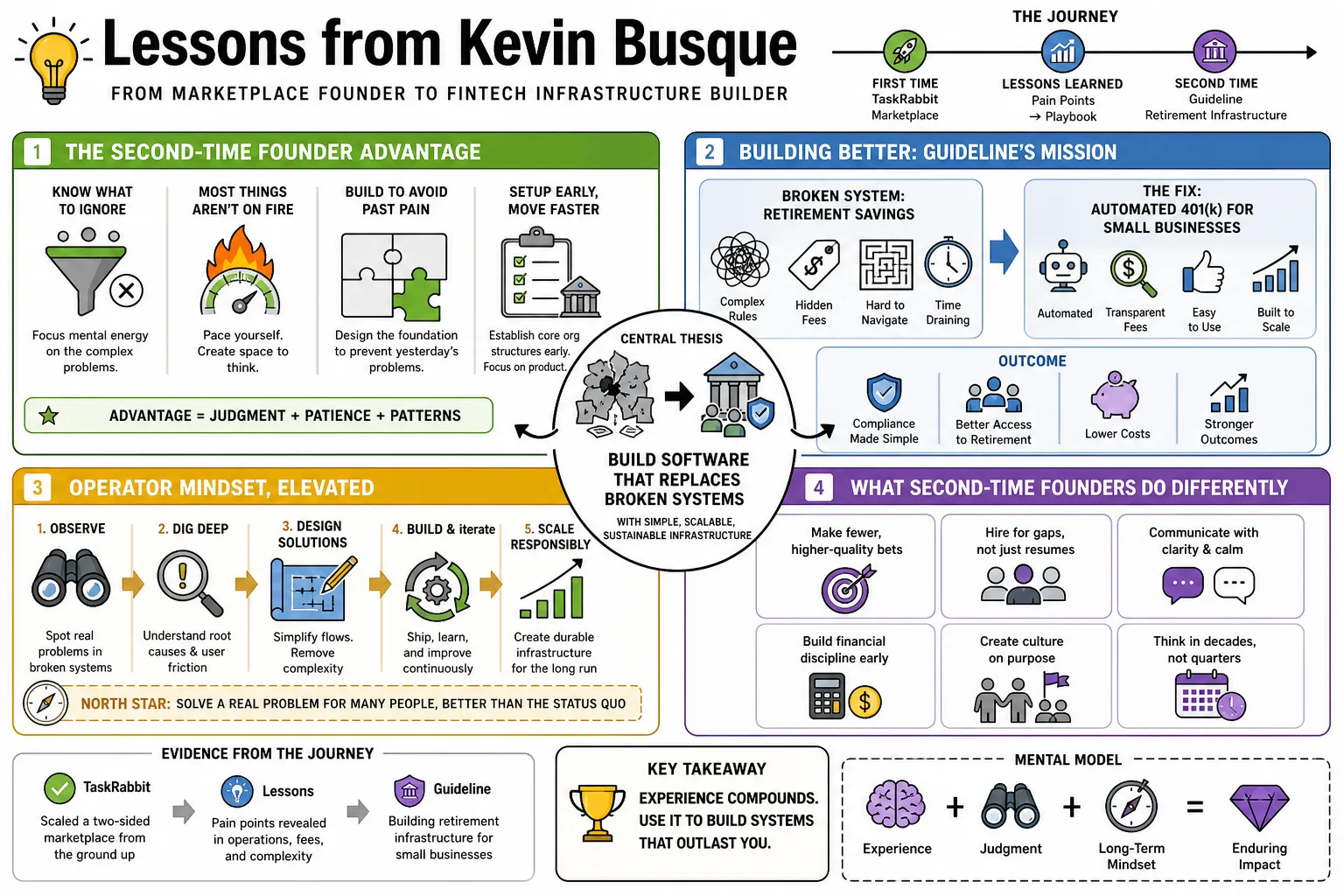
Lessons from Kevin Busque
Kevin Busque co-founded TaskRabbit and later started Guideline, a company providing automated 401(k) plans for small businesses. He builds software to replace broken systems, such as the complex fee structures in retirement savings. These insights follow his career from a first-time marketplace operator to a founder building sustainable financial infrastructure.
Part 1: The Second-Time Founder Experience
- On second-time founder advantage: Busque’s second-founder edge was pattern recognition: TaskRabbit exposed the retirement-benefits problem, and Guideline let him spend years researching the market before building. — Reference: First Round transcript on TaskRabbit lessons and pre-Guideline research
- On pacing oneself: Guideline’s early pace was deliberately slow: Busque spent a long time studying the problem, then built from a small first customer base before the channel engine scaled. — Reference: First Round transcript on research and early customer pacing
- On applying past lessons: "You take the specific pain points from your first company and build the foundation of your second company precisely to avoid them." — Source: LTSE
- On organizational maturity: "As a repeat founder, you don't waste time reinventing basic corporate structures; you set them up early so the team can focus on the product." — Source: LTSE
- On dealing with setbacks: "You develop a thicker skin. A bad month of growth doesn't mean the company is dying; it simply means you need to adjust the levers." — Source: Entrepreneur
- On leading teams again: Busque’s repeat-founder lesson was to notice when the company no longer needed him in every sale; that signal let him hand more ownership to the team. — Reference: First Round transcript on the handoff from founder-led selling
- On setting the initial vision: "The second time, you are much more explicit about the end state you want to achieve from day one, rather than figuring it out as you go." — Source: Rippling
- On navigating early growth: "Growth in a second company is often more deliberate. You aren't chasing vanity metrics; you are looking for sustainable unit economics." — Source: Rippling
- On founder confidence: Busque’s confidence showed up as transparency: he talked openly about Guideline’s model, educated the market on asset-based fees, and let word of mouth compound. — Reference: Sacra interview on transparency and word-of-mouth education
Part 2: Re-imagining the 401(k) and Retirement
- On the initial realization: The Guideline idea began when Busque saw only 36% 401(k) participation at TaskRabbit and traced the problem to paper enrollment, confusing choices, and weak onboarding. — Reference: First Round transcript on TaskRabbit 401(k) participation
- On market opportunity: Busque saw opportunity because incumbent 401(k) providers monetized assets, not access; small businesses without existing retirement wealth were structurally underserved. — Reference: Sacra interview on the underserved small-business 401(k) market
- On hidden fees: Busque’s fee insight was that opaque asset-based charges rewarded middlemen while savers compounded less; Guideline changed the model toward transparent employer-paid subscriptions. — Reference: First Round and Sacra interviews on 401(k) fee opacity
- On the legacy industry: "The space was ripe for disruption purely because of the low participation rates, driven entirely by confusing fees and complex paper processes." — Source: Fast Company
- On small business accessibility: "We set out to make it easier for small businesses to stay compliant, offer quality benefits, and give their teams a path to financial security." — Source: Guideline
- On investment strategy: Guideline’s investment-design lesson was simplicity: make enrollment and fund selection understandable enough that employees actually participate instead of abandoning the form. — Reference: First Round transcript on enrollment and investment-choice confusion
- On removing middlemen: "We believed that replacing middlemen with smart technology would make a real difference in people's lives. We proved that model and helped transform an industry." — Source: Guideline
- On setting an industry standard: "What began as our specific vision has become the blueprint others are now following. We set the standard, and the future of retirement is stronger for it." — Source: Coverager
- On full-stack ownership: "We make it really easy for them. It is completely turnkey because we own the entire software solution from top to bottom." — Source: Fast Company
- On the ultimate mission: "It has been a decade since my co-founders and I first set out to fix 401(k)s, and together we have fundamentally transformed an industry." — Source: Guideline
Part 3: Product Strategy vs. Sales Strategy
- On the best-mousetrap fallacy: Busque later framed Guideline’s sales mistake clearly: a superior product still loses when competitors shape the buying process before prospects understand it. — Reference: Rippling episode page on Busque’s sales-led growth mistake
- On recognizing limits: "There is a distinct ceiling to pure product-led growth. Eventually, you realize you are losing to inferior products purely because they have a stronger sales motion." — Source: Rippling
- On integrating sales: "You have to bring a strategic sales culture into an engineering-first team without breaking the underlying culture that built the great product in the first place." — Source: Rippling
- On early growth mistakes: Guideline’s early growth depended too much on founder network and education; the lesson was that repeatable sales capacity had to become a real company function. — Reference: First Round transcript on the first customers and sales handoff
- On the value of outbound efforts: "Sitting back and waiting for inbound leads only takes you so far. You have to actively educate the market on why your approach is better." — Source: Rippling
- On cross-functional alignment: Guideline’s payroll partnerships worked because product, data, compliance, and go-to-market had to line up around clean payroll data and a simpler customer workflow. — Reference: First Round transcript on payroll integrations and shared data
- On adjusting the go-to-market motion: "Transitioning from a self-serve motion to a managed sales motion requires fundamentally changing how you measure success internally." — Source: Rippling
- On founder-led sales: Busque’s first sales motion was personal and educational, but the company only scaled once the buying conversation could move beyond founder co-selling. — Reference: First Round transcript on founder-led early sales
- On pricing strategy: Guideline made pricing part of the product: employers paid subscription fees, participants avoided legacy-style asset drag, and the model aligned more closely with retirement outcomes. — Reference: Sacra interview on Guideline pricing and fee structure
Part 4: Data-Driven Decision Making
- On avoiding narrative building: "Relying purely on data is vastly more effective than attempting to construct a convenient narrative from scratch to justify a decision." — Source: LTSE
- On freeing mental energy: "Using data as your foundation frees up a founder’s mental energy. It allows you to focus on the complex challenges rather than endlessly debating opinions." — Source: LTSE
- On operational efficiency: In Busque’s model, efficiency came from clean data flows: payroll integrations made retirement-plan operations less manual and easier to administer at scale. — Reference: First Round transcript on payroll data and operational complexity
- On objective reality: Busque’s approach started with observable behavior: employees were not enrolling, fees were opaque, and the product had to fix what the data showed rather than what providers assumed. — Reference: First Round transcript on participation and fee data
- On tracking the right things: "You can measure everything, but you should only obsess over the three or four metrics that actually indicate the health of the core business." — Source: LTSE
- On customer behavior: "Ignore what customers say they want; look intensely at how they actually interact with the platform. The usage data rarely lies." — Source: LTSE
- On early validation: Guideline validated the model by using itself as the first customer, winning Plaid early, and finding sophisticated buyers who immediately understood the asset-fee problem. — Reference: First Round transcript on Guideline’s first customers
- On strategic pivots: Guideline’s strategic shift was from a simple direct product toward payroll-led distribution, while keeping the same thesis about transparent, automated 401(k)s. — Reference: First Round transcript on early product-market fit and payroll channels
- On continuous iteration: "You use data to make the big decisions and to make the thousands of micro-adjustments required to tune the engine every single week." — Source: LTSE
Part 5: Solving Hard Problems and Building the Foundation
- On doing the hard things first: "Tackling the most difficult technical or operational challenges during the earliest stages creates a massive competitive advantage." — Source: Medium
- On long-term sustainability: "If you build the hard compliance and regulatory backend before focusing on the flashy frontend, you set the company up for actual long-term survival." — Source: Medium
- On technological moats: "Our edge was that we built a proprietary record-keeping system from scratch. It was painful early on, but it became our deepest moat." — Source: Medium
- On avoiding shortcuts: Busque’s operating rule was to do the hard things first; Guideline built recordkeeping itself instead of wrapping a nicer interface around incumbent infrastructure. — Reference: Sacra interview on doing the hard things first
- On first principles thinking: Busque went back to the actual rules behind 401(k)s, then redesigned around what employers, savers, and regulators needed rather than copying legacy provider assumptions. — Reference: First Round transcript on reading the rules and rebuilding the model
- On infrastructure investments: Guideline’s infrastructure bet was to own recordkeeping, compliance testing, and filings, creating a technology advantage that was slow to build but hard to copy. — Reference: Sacra interview on full-stack 401(k) infrastructure
- On automating compliance: "We wanted to build software that automated the compliance entirely, removing the burden from the business owner." — Source: Fast Company
- On pacing development: Busque accepted a slower build because retirement infrastructure had to be correct; the payoff came when the same system could support many more customers. — Reference: Sacra interview on building core infrastructure before scale
- On technical debt: For Guideline, borrowing legacy infrastructure would have put debt inside the core value proposition, so Busque chose the harder route of owning the system directly. — Reference: Sacra interview on replacing legacy middlemen with owned infrastructure
- On the barrier to entry: "By choosing to build the hardest parts of the system ourselves, we effectively raised the barrier to entry so high that fast-followers couldn't simply copy our model." — Source: Medium
Part 6: Company Culture, Mission, and Hiring
- On artificial culture: "I firmly believe that culture should be organic and mission-driven. It cannot be artificially constructed with forced perks and superficial benefits." — Source: Medium
- On top-down dictation: "I generally do not like to take an active, top-down role in dictating exactly what a company's culture should be. It has to emerge from the team." — Source: Top Podcast
- On meaningful benefits: "Instead of ping-pong tables, provide high-quality benefits that attract top performers who are genuinely invested in the company's long-term mission." — Source: Medium
- On team resilience: "You have to build teams that can independently navigate challenges. You want a group that knows how to operate when things inevitably go wrong." — Source: Top Podcast
- On mission alignment: Guideline’s mission stayed close to Busque’s original frustration: make it easier for small businesses to offer retirement benefits and give employees a real path to financial security. — Reference: Guideline note on the Gusto acquisition and original mission
- On hiring for the stage: "The executives you need to get from zero to one are rarely the same executives you need to scale from one to ten. You have to hire for the specific stage you are in." — Source: Entrepreneur
- On shared values: "Our missions with partners like Gusto have always been aligned in championing small and growing businesses. That shared value makes collaboration seamless." — Source: 401k Specialist
- On organizational trust: "Trust within an organization isn't built through offsites; it is built by consistently delivering on the promises you make to your employees." — Source: Top Podcast
- On employee retention: Busque’s TaskRabbit lesson was practical: meaningful benefits create more lasting loyalty than perks, because they help employees with what matters outside the office. — Reference: Sacra interview on meaningful benefits and loyalty
- On managing growth: Guideline’s growth lesson is that scale changes the operating system: the company went from hundreds of customers to channel-driven volume that required stronger infrastructure and partnerships. — Reference: First Round transcript on Guideline’s scale-up and channel distribution
Part 7: Networking, Transparency, and Fundraising
- On avoiding stealth mode: "I am a strong proponent of talking to people about your ideas rather than operating in stealth mode. Secrecy usually isolates you from good feedback." — Source: Medium
- On the value of open conversations: "Sharing ideas openly leads to valuable connections. I credit random, transparent conversations for some of my most beneficial insights and business relationships." — Source: Medium
- On raising capital: "When you pitch investors, you shouldn't simply be selling the upside; you need to clearly articulate your deep understanding of the regulatory risks and how you have mitigated them." — Source: Entrepreneur
- On partner validation: "Gusto was our first fully integrated payroll partner and played a huge role in the early market validation of Guideline." — Source: 401k Specialist
- On choosing investors: "You want board members who have actually operated businesses. The best advice comes from people who have felt the pain of missing payroll." — Source: Entrepreneur
- On market education: "Part of our early job was actively educating the market on why the existing standard was fundamentally broken." — Source: Fast Company
- On strategic partnerships: "The right integration partner fundamentally improves your own product's user experience by removing friction." — Source: 401k Specialist
- On handling rejection: "Every pass from an investor early on usually highlights a blind spot in your model. If you listen closely, the rejections are a roadmap for what to fix." — Source: Medium
- On founder transparency: "Being honest about what is broken inside your company builds far more credibility with your board than pretending everything is executing perfectly." — Source: Medium
Part 8: Work-Life Balance and Founder Psychology
- On rigid structures: "I argue against the traditional, rigid structure of work-life balance for founders. Startup demands are unpredictable, so you need a flexible approach, rather than standard fixed hours." — Source: LTSE
- On finding grounding: "As a founder and a father, you have to find grounding routines to maintain perspective. Sometimes being there to tuck your kids in is what resets your brain." — Source: LTSE
- On mandatory time off: "We implemented a mandatory vacation policy because I learned the hard way that burnt-out employees make terrible long-term decisions for the company." — Source: Entrepreneur
- On the 'struggle': "You have to constantly remind yourself why you are building the company. That underlying mission is essential for surviving the inevitable, daily struggle of entrepreneurship." — Source: Entrepreneur
- On the illusion of balance: "Balance isn't about working exactly eight hours a day. It is about being fully present when you are working, and fully present when you are at home." — Source: LTSE
- On serial entrepreneurship: "Being married to the game means accepting that the baseline level of stress is just part of the operating environment. You learn to manage it." — Source: Simplecast
- On founder burnout: "If the founder is perpetually exhausted, the entire organization will eventually mirror that exhaustion. Taking care of yourself is a fiduciary responsibility to your team." — Source: LTSE
- On perspective shifts: "When you have your first major exit or failure, you realize that your identity isn't strictly tied to your title. That realization makes the next venture much more enjoyable." — Source: Simplecast
- On defining success: "At the end of the day, success isn't just the valuation. It is looking at the millions of people who now have a real path to retirement because of what we built." — Source: Guideline