Lessons from Kevin Simler
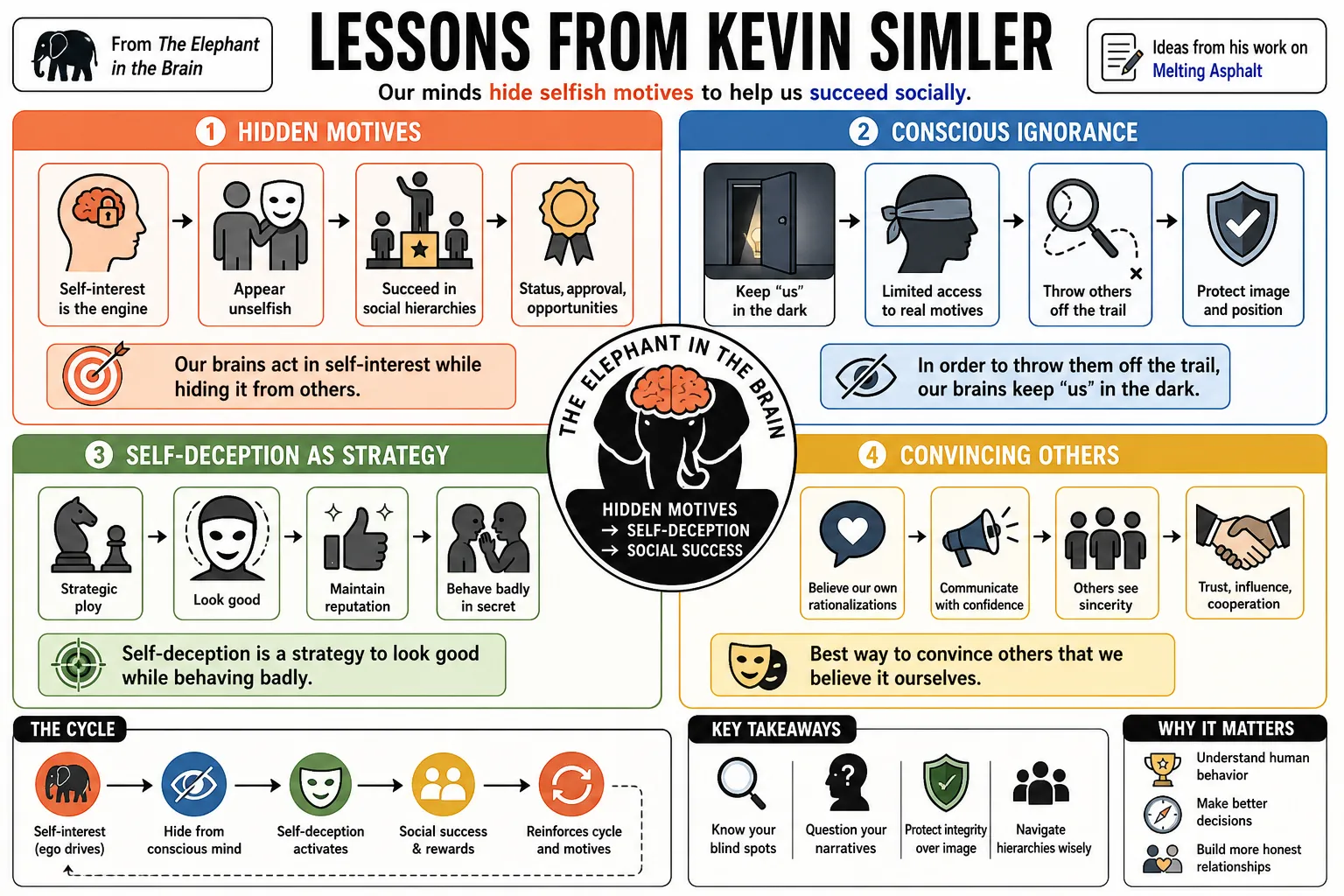
Writer and technologist Kevin Simler investigates the hidden motives behind human behavior. Through his blog Melting Asphalt and the co-authored book The Elephant in the Brain, he argues that our minds deliberately conceal selfish drives to help us succeed socially. This profile collects his observations on why people adopt irrational beliefs and rely on self-deception to navigate hierarchies.
Part 1: Hidden Motives and Self-Deception
- On hidden motives: "Our brains are built to act in our self-interest while at the same time trying hard not to appear selfish in front of other people." — Source: The Elephant in the Brain
- On conscious ignorance: "In order to throw them off the trail, our brains often keep 'us,' our conscious minds, in the dark." — Source: The Elephant in the Brain
- On concealing ugly motives: "The less we know of our own ugly motives, the easier they are to hide from others." — Source: The Elephant in the Brain
- On strategic self-deception: "Self-deception is therefore strategic, a ploy our brains use to look good while behaving badly." — Source: The Elephant in the Brain
- On convincing others: "Often the best way to convince others that we believe something is to actually believe it." — Source: The Elephant in the Brain
- On sabotaging information: "Our minds are built to sabotage information in order to come out ahead in social games." — Source: Melting Asphalt
- On calculating behavior: "When big parts of our minds are unaware of how we try to violate social norms, it's more difficult for others to detect and prosecute those violations." — Source: Melting Asphalt
- On the trade-off of ignorance: "This also makes it harder for us to calculate optimal behaviors, but overall, the trade-off is worth it." — Source: Melting Asphalt
- On confronting the elephant: "It's only by confronting the elephant, then, that we can begin to see what's really going on." — Source: The Elephant in the Brain
- On the importance of our motives: "Of all the things we might be self-deceived about, the most important are our own motives." — Source: Melting Asphalt
Part 2: Status, Prestige, and Social Games
- On the nature of prestige: "Another way to think about prestige is that it's your 'price' on the market for friendship and association." — Source: The Elephant in the Brain
- On the mating market analogy: "Just as sexual attractiveness is our 'price' on the mating market, prestige is our price on the friendship market." — Source: The Elephant in the Brain
- On philanthropy as a signal: "When we donate to a good cause, it 'says' to our associates, 'Look, I'm willing to spend my resources for the benefit of others.'" — Source: The Elephant in the Brain
- On cooperative games: "I'm playing a positive-sum, cooperative game with society." — Source: The Elephant in the Brain
- On leadership selection: "No one wants leaders who play zero-sum, competitive games with the rest of society." — Source: The Elephant in the Brain
- On prosocial orientation: "Instead we want leaders with a prosocial orientation, people who will look out for us because we're all in it together." — Source: The Elephant in the Brain
- On admiration: "On the low-status side, we have admiration: celebrating or fawning over a prestigious individual, i.e., paying respect." — Source: Melting Asphalt
- On posing as insiders: "We pose as a privileged insider, when in fact we're often making the same kind of educated guesses that any informed outsider could make." — Source: The Elephant in the Brain
- On the illusion of control: "We pretend we're in charge, both to others and even to ourselves, but we're less in charge than we think." — Source: The Elephant in the Brain
- On social status: "Status operates as a complex web of mutual evaluations where we constantly appraise our value relative to others, rather than operating strictly as a hierarchy of dominance." — Source: Melting Asphalt
Part 3: Belief Systems and Crony Beliefs
- On the function of beliefs: "Beliefs are representations that make up our brain's internal map or model of the world." — Source: Melting Asphalt
- On the truth of beliefs: "Beliefs aren't always true, of course, but what's important is that we treat them as though they were true." — Source: Melting Asphalt
- On merit beliefs: "Merit beliefs are 'hired' by the mind for their accuracy, helping humans navigate the world effectively." — Source: LessWrong
- On the reward of merit beliefs: "The reward of holding a merit belief is the practical benefit of making accurate decisions in reality." — Source: Deric Bownds' MindBlog
- On crony beliefs: "Crony beliefs are 'hired' for the social and political 'kickbacks' they provide rather than their truth value." — Source: LessWrong
- On adopting irrational views: "Humans adopt these beliefs because they help signal group identity, regardless of whether they are factually true." — Source: Medium
- On signaling allegiance: "The primary function of a crony belief is to gain status or strengthen alliances with specific social groups." — Source: Deric Bownds' MindBlog
- On the brain's balancing act: "The brain balances the desire for accurate models of the world with the desire for social acceptance." — Source: Deric Bownds' MindBlog
- On the inside vs. outside view: "This framework explains why a person's own views feel sensible and objective while the views of outsiders appear blatantly nonsensical." — Source: Read Something Great
Part 4: Institutions, Education, and Society
- On the religious elephant: "This is the religious elephant in the brain: We don't worship simply because we believe." — Source: The Elephant in the Brain
- On religion as a social tool: "Instead, we worship (and believe) because it helps us as social creatures." — Source: The Elephant in the Brain
- On the purpose of education: "Education isn't just about learning; it's largely about getting graded, ranked, and credentialed." — Source: The Elephant in the Brain
- On school as a stamp of approval: "Schools function to stamp students for the approval of employers rather than purely imparting knowledge." — Source: The Elephant in the Brain
- On the casualty of learning: "And while there are many social and economic benefits to this enterprise, one of the first casualties is learning." — Source: Melting Asphalt
- On breaking the forager spirit: "Schools have to break our forager spirits and train us to submit to our place in a modern hierarchy." — Source: Melting Asphalt
- On preparing for the workplace: "Schools help prepare us for the modern workplace and society, but at a severe psychological cost to our natural curiosity." — Source: Melting Asphalt
- On modern instruction: "As Albert Einstein lamented, 'It is... nothing short of a miracle that modern methods of instruction have not yet entirely strangled the holy curiosity of inquiry.'" — Source: The Elephant in the Brain
- On medicine as conspicuous care: "Much of healthcare spending is driven by a desire to show that we care for our loved ones rather than to strictly improve health outcomes." — Source: The Elephant in the Brain
Part 5: Identity, Masks, and Culture
- On wearing masks: "Wear a mask long enough and it becomes your face." — Source: Melting Asphalt
- On playing roles: "Play a role long enough and it becomes who you are." — Source: Melting Asphalt
- On pretending: "Spend enough time pretending something is true and you might as well believe it." — Source: Melting Asphalt
- On conspiracy theories: "The conspiracy theory is an active, creative art form." — Source: Melting Asphalt
- On truth claims in conspiracies: "A conspiracy theory's truth claims serve as formal obstructions rather than being the primary point of the endeavor." — Source: Melting Asphalt
- On cultural norms: "Social norms exist to constrain the behavior of others while we secretly look for ways to violate them for personal gain." — Source: The Elephant in the Brain
- On the social function of art: "Art serves as a way to signal biological fitness, intelligence, and access to excess resources." — Source: The Elephant in the Brain
- On human creativity: "Simler argues that much human beauty and art can be understood as a prestige game in which people compete for the attention and affection of others." — Reference: A Natural History of Beauty
- On the persistence of identity: "Human identities are largely shaped by the roles we perform for our social audiences." — Source: Melting Asphalt
Part 6: Communication, Signaling, and Body Language
- On lying with words: "It's simply too easy, too tempting, to lie with words." — Source: The Elephant in the Brain
- On body language: "So in matters of life, death, and finding mates, we're often wise to shut up and let our bodies do the talking." — Source: The Elephant in the Brain
- On nonverbal signals: "Nonverbal communication is often more reliable because it is harder to consciously fake than spoken language." — Source: The Elephant in the Brain
- On everyday conversation: "Most conversation exists to demonstrate intelligence and social value rather than to exchange literal information." — Source: The Elephant in the Brain
- On laughter: "Laughter functions as a play signal indicating that a boundary violation is safe and is not a genuine threat." — Source: The Elephant in the Brain
- On self-promotion: "People constantly self-promote through subtle indirect signals rather than outright boasting to avoid triggering social penalties." — Source: The Elephant in the Brain
- On conversational dominance: "Interruption and talking time act as subconscious negotiations of social hierarchy rather than attempts to reach the truth." — Source: The Elephant in the Brain
- On information sharing: "When people share news, they are signaling their access to valuable information networks rather than merely informing others." — Source: The Elephant in the Brain
- On the handicap principle: "Humans engage in costly signaling to prove the authenticity of their social traits." — Source: The Elephant in the Brain
Part 7: Advertising, Economics, and Consumer Behavior
- On the true nature of ads: "Rather than attempting to persuade us via our rational, analytical minds, ads prey on our emotions." — Source: Melting Asphalt
- On creating associations: "Advertising works by creating positive associations between the advertised product and feelings like love, happiness, safety, and sexual confidence." — Source: Melting Asphalt
- On the function of money: "Simler treats money as more than a neutral exchange tool: it also condenses social prestige and sits inside broader systems of coordination." — Reference: A Natural History of Beauty
- On consumerism: "People buy products to signal their traits to others even if they consciously believe they are buying them for their utility." — Source: The Elephant in the Brain
- On cultural signaling in advertising: "Advertising works by creating a shared cultural knowledge that a specific product is associated with a specific desirable trait." — Source: Melting Asphalt
- On the startup culture: "Simler treats startups as frontier communities shaped by exploration, risk-taking, solidarity, and constant pressure against bureaucracy and status stratification." — Reference: Startups Are Frontier Communities
- On charitable giving: "People prefer to give to charities that are highly visible and emotionally salient rather than those that are statistically the most effective." — Source: The Elephant in the Brain
- On economic behavior: "Economic decisions are heavily distorted by the need to maintain self-image and reputation among peers." — Source: The Elephant in the Brain
- On the illusion of rationality: "People invent rational-sounding economic justifications for decisions they made based on subconscious social drives." — Source: The Elephant in the Brain
Part 8: Epistemology, Philosophy, and System Design
- On two types of thinkers: "Simler draws on Alan Watts to describe two philosophical temperaments: the prickly and the gooey." — Source: Prickles and Goo
- On the prickly approach: "The prickly mindset is precise, rigorous, and logical. It breaks the world down into distinct analyzable parts." — Source: Prickles and Goo
- On the gooey approach: "The gooey mindset is vague and emphasizes the interconnected seamless nature of reality." — Source: Prickles and Goo
- On the necessity of both: "A complete understanding of the world requires balancing the sharp distinctions of the prickly with the continuous reality of the goo." — Source: Prickles and Goo
- On philosophical divides: "Many intellectual debates are fundamentally clashes between prickly and gooey temperaments rather than disagreements over facts." — Source: Prickles and Goo
- On exploring the frontier: "Simler argues that frontier work demands exploration under uncertainty, courageous action, and a willingness to leave safe, settled ground." — Reference: Startups Are Frontier Communities
- On intellectual honesty: "Acknowledging the elephant in the brain is the first step toward genuine intellectual honesty." — Source: The Elephant in the Brain
- On understanding systems: "Humans often fail to understand complex systems because they take people's stated motives at face value." — Source: The Elephant in the Brain
- On the limits of introspection: "Introspection is an unreliable tool for discovering the true causes of our own behavior." — Source: The Elephant in the Brain
- On the goal of awareness: "By confronting hidden motives, humans can design better institutions that account for how people actually behave rather than how they pretend to behave." — Source: The Elephant in the Brain