Lessons from Kim Bowes
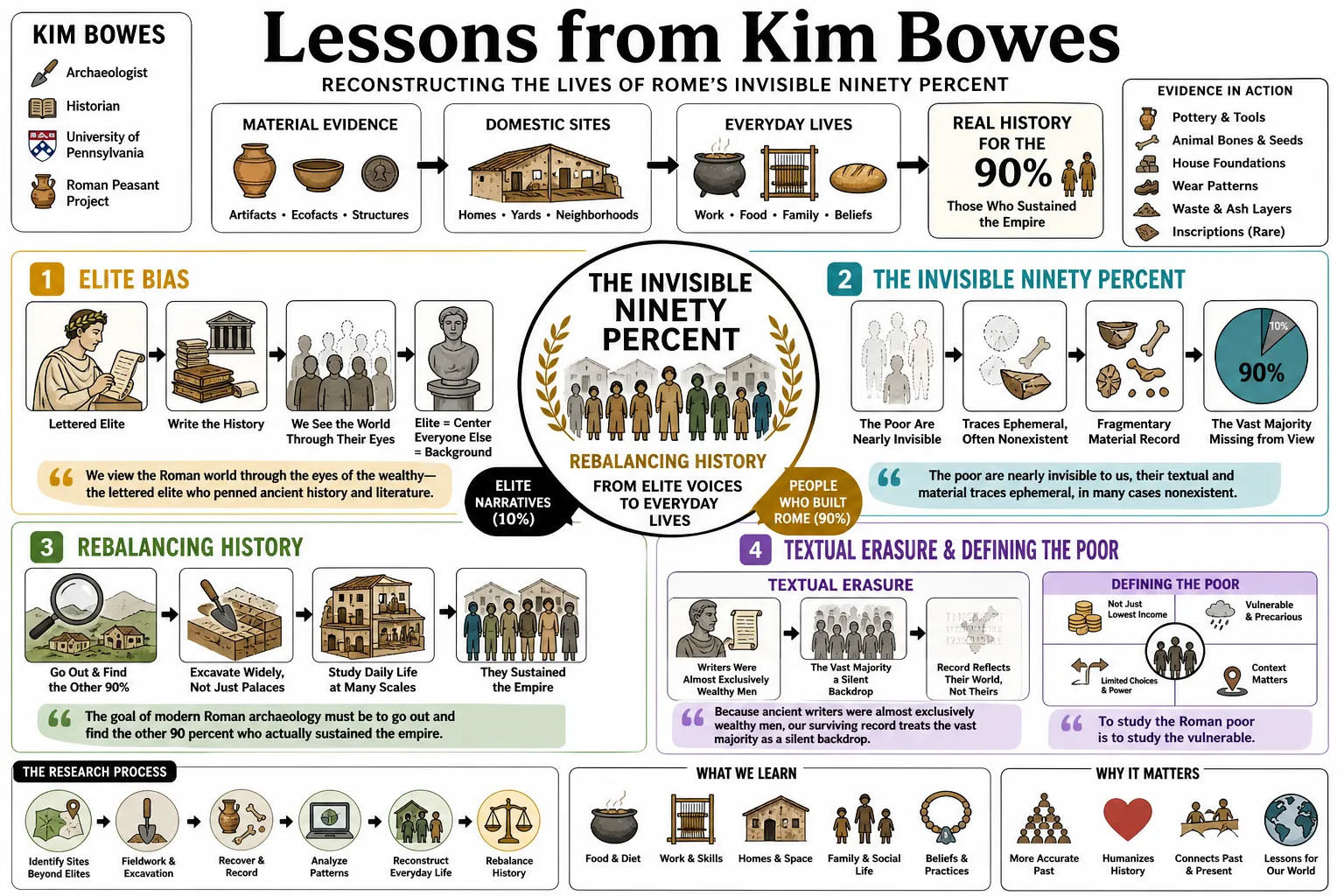
Kim Bowes is a University of Pennsylvania archaeologist and historian who studies the everyday lives of the Roman poor. Using material evidence from the Roman Peasant Project and domestic sites, she reconstructs the history of the 90 percent of Romans ignored by ancient literature. This profile collects her findings on how these ordinary people actually lived.
Part 1: The Invisible Ninety Percent
- On Elite Bias: "We view the Roman world through the eyes of the wealthy—the lettered elite who penned ancient history and literature." — Source: Penn Museum
- On the Missing Majority: "The poor are nearly invisible to us, their textual and material traces ephemeral, in many cases nonexistent." — Source: Penn Museum
- On Rebalancing History: "The goal of modern Roman archaeology must be to go out and find the other 90 percent who actually sustained the empire." — Source: University of Pennsylvania
- On Textual Erasure: "Because ancient writers were almost exclusively wealthy men, our surviving historical record treats the vast majority of the population as a silent backdrop." — Source: Conversations with Tyler
- On Defining the Poor: "To study the Roman poor is to study the vast spectrum of working people, from farmers to laborers, rather than a single destitute class." — Source: New Books Network
- On Survival: "The daily life of most Romans was defined by the physical labor and grit required simply to survive." — Source: New Books Network
- On the Lived Experience: "Understanding the Roman world requires shifting focus from emperors and conquests to the lived experience of ordinary people working with their hands." — Source: University of Pennsylvania
- On Historical Agency: "The non-elite majority were active participants; their labor, consumption, and daily choices were the actual engine of the Roman state." — Source: The Inequality Podcast
- On Locating the Poor: "Finding the Roman poor requires looking past monumental architecture to the ephemeral structures and scattered artifacts they left behind." — Source: The Past
- On the Silence of Ruins: "When we walk through Roman ruins today, we are almost entirely walking through the spaces built for and by the top ten percent of ancient society." — Source: Conversations with Tyler
Part 2: Rethinking the Roman Peasant
- On Subsistence Farming: "The traditional model of the Roman peasant barely scraping by on subsistence farming does not match the material evidence we find in the dirt." — Source: Harvard University
- On Economic Participation: "Far from being isolated, Roman peasants were deeply integrated into the empire's economy and dependent on its cycles of boom and bust." — Source: Harvard University
- On Distributed Habitation: "Rural dwellers practiced 'distributed habitation,' moving between different locations based on seasonal labor needs." — Source: The Past
- On Peasant Wealth: "Excavations reveal that the rural poor often possessed a wider range of manufactured goods, including glass and metal objects, than previously assumed." — Source: The Roman Peasant Project
- On Market Engagement: "The material affluence found in peasant dwellings indicates they had disposable income and regularly engaged with local markets." — Source: University of Pennsylvania
- On Dietary Stereotypes: "Evidence from peasant sites shows they consumed significant amounts of meat—including pork and beef—challenging the idea that they survived solely on grain." — Source: University of Pennsylvania
- On Market Drivers: "Peasants played an active role in the rise of cities and the development of markets, rather than being detached from these economic shifts." — Source: University of Pennsylvania
- On Rural Categories: "Traditional archaeological classifications like 'farm' or 'village' fail to capture the fluid reality of how rural Romans actually lived and worked." — Source: The Past
- On the End of Empire: "The collapse of the Roman Empire brought massive changes to rural life that resist simple narratives of mass impoverishment or sudden liberty." — Source: Harvard University
Part 3: Private Worship and Domestic Religion
- On the Christian Private: "The spread of Christianity in late antiquity was driven heavily by private, domestic rituals acting alongside the public institution of the Church." — Source: Cambridge University Press
- On Elite Landowners: "Wealthy landowners funded and facilitated religious practices on their rural estates, acting as powerful agents of religious change." — Source: Oxford University Press
- On Architectural Counterpoints: "Private manorial churches and domestic altars functioned as an architectural counterpoint to the official, bishop-led ecclesiastical buildings." — Source: Cambridge University Press
- On Episcopal Authority: "Domestic religious habits often occurred outside the supervision of bishops, creating significant tension and challenging the authority of the official Church." — Source: Cambridge University Press
- On Overwritten Histories: "The localized disputes between private worshippers and Church officials were erased by the later, triumphant narrative of institutional Christianity." — Source: Oxford University Press
- On Public vs. Private: "The fluidity between public and private spaces in late antiquity dictates how religious transformation actually occurred on the ground." — Source: Cambridge University Press
- On Household Rituals: "Religion was deeply embedded in the daily routines of the home, meaning Christianization operated as a domestic habit before it functioned as a civic identity." — Source: Bryn Mawr Classical Review
- On Independent Worship: "Many late antique Christians preferred to practice their faith within the familiar structures of patronage and household rather than submit to new clerical hierarchies." — Source: Cambridge University Press
- On Material Religion: "The textual commands of bishops often give a false impression of uniformity; the archaeological evidence of domestic spaces reveals a much messier religious reality." — Source: Bryn Mawr Classical Review
Part 4: The Reality of Roman Poverty
- On Working with Hands: "Surviving in the Roman world for the majority meant a lifetime of manual labor, a reality often romanticized or ignored by elite Roman authors." — Source: New Books Network
- On Financial Precarity: "The average Roman lived constantly on the edge of financial ruin, vulnerable to bad harvests and the whims of landlords." — Source: The Inequality Podcast
- On Measuring Inequality: "While the Roman Empire produced immense wealth, structural barriers ensured that almost none of this prosperity reached the lower classes." — Source: The Inequality Podcast
- On the Economics of Slavery: "Slavery functioned as the brutal, foundational economic logic that underpinned Roman prosperity at the expense of human lives." — Source: Conversations with Tyler
- On Physical Toll: "Skeletal evidence from Roman sites reveals the severe physical stress and occupational diseases that defined the lives of the working poor." — Source: Byzantium & Friends
- On Urban Slums: "The celebrated cities of the Roman Empire were largely composed of crowded, unsanitary insulae where the poor lived in constant danger of fire and collapse." — Source: Conversations with Tyler
- On Coping Mechanisms: "To survive, poor Romans relied heavily on informal credit networks, borrowing small amounts of money or food from neighbors and patrons." — Source: The Inequality Podcast
- On Taxation: "The Roman tax system was deeply regressive, placing the heaviest burden of supporting the state apparatus on those least able to afford it." — Source: Byzantium & Friends
- On the Illusion of Welfare: "The famous grain dole in Rome served only a privileged fraction of the urban population; the vast majority of the empire's poor received no state assistance." — Source: The Inequality Podcast
- On the Concept of Poverty: "Ancient Romans did not have a concept of structural poverty to be solved; they viewed being poor as a permanent, natural state for the masses." — Source: New Books Network
Part 5: Material Culture and Consumption
- On Plebeian Consumerism: "Average Romans were active consumers who bought cheap manufactured goods, challenging the idea that they produced only what they needed to survive." — Source: The Inequality Podcast
- On Coinage: "The presence of small-denomination coins in rural and domestic sites shows that ordinary people were highly engaged in a monetized, cash-based economy." — Source: The Economic and Political History Podcast
- On Quality Ceramics: "Even poor rural households had access to imported pottery and quality ceramics, indicating dense regional trade networks that reached beyond the elite." — Source: The Roman Peasant Project
- On Material Belonging: "For the Roman poor, acquiring small items of jewelry or imported glass was a way of participating in the broader cultural identity of the empire." — Source: University of Pennsylvania
- On Diet and Status: "The food ordinary people ate was far more varied than textual sources suggest, reflecting active choices rather than mere desperation." — Source: University of Pennsylvania
- On Gold Coins: "While elites hoarded gold, the everyday economy of the ninety percent operated entirely on base metal coins, creating a distinct financial reality for the working class." — Source: Conversations with Tyler
- On Disposable Income: "The fact that peasants bought non-essential goods proves they generated surplus wealth, completely contradicting the model of the closed, self-sufficient Roman farm." — Source: The Roman Peasant Project
- On Trash as Evidence: "What the Romans threw away—broken pots and butchered bones—tells a more honest story about their economy than the pristine statues in museums." — Source: Byzantium & Friends
- On Local Markets: "The Roman economy was driven by countless localized, periodic markets where peasants traded small surpluses, forming the true backbone of imperial commerce." — Source: Harvard University
Part 6: Architecture and the Labor of Building
- On the Brick Industry: "The monumental buildings of Rome were the product of a massive, heavily organized brick industry reliant on grueling manual labor." — Source: University of Pennsylvania
- On Invisible Builders: "When we look at the Colosseum or the Pantheon, we are looking at the frozen labor of thousands of unnamed slaves and artisans." — Source: University of Pennsylvania
- On Environmental Impact: "The Roman construction boom required staggering amounts of timber for scaffolding and fuel for kilns, drastically altering the local environment around the city." — Source: University of Pennsylvania
- On Supplying Rome: "The logistics of moving millions of bricks, stone blocks, and timber into the capital dictated the daily lives and livelihoods of entire communities in central Italy." — Source: University of Pennsylvania
- On Domestic Architecture: "The physical layout of late antique homes, from small rural dwellings to grand villas, dictated how religious and social hierarchies were enforced daily." — Source: Bryn Mawr Classical Review
- On Ephemeral Structures: "The vast majority of Romans lived in buildings made of mudbrick, timber, and thatch—materials that leave faint traces, artificially skewing our view toward stone monuments." — Source: The Past
- On Estate Management: "Roman villas functioned as working agricultural centers built on the relentless extraction of local labor, rather than merely serving as luxurious retreats." — Source: The Roman Peasant Project
- On Spatial Control: "Wealthy landowners used the architecture of their rural estates to project authority over the religious and economic lives of their tenants." — Source: Oxford University Press
- On the Cost of Grandeur: "The architectural achievements of the Roman Empire were subsidized by a system that kept the actual builders at the bottom of the social hierarchy." — Source: New Books Network
Part 7: Historical Methodology and Evidence
- On Interdisciplinary Methods: "Understanding the ancient world requires combining dirt archaeology and historical economics with anthropological theory." — Source: University of Pennsylvania
- On Textual Limitations: "Relying solely on the writings of elite Roman men is like trying to understand a modern economy by only reading the diaries of billionaires." — Source: Conversations with Tyler
- On Scientific Archaeology: "Integrating scientific data, such as isotopic analysis of bones and seeds, provides a hard check against the biases of ancient literature." — Source: Byzantium & Friends
- On Surveying the Landscape: "Systematic field surveys—walking the fields to collect surface artifacts—are required to find the ephemeral traces of the rural poor." — Source: The Past
- On Asking New Questions: "Archaeology is only as good as the questions it asks; if you only look for elite villas, you will only find elite villas." — Source: The Roman Peasant Project
- On Papyri Evidence: "Surviving Egyptian papyri provide a rare, unfiltered glimpse into the actual financial transactions, leases, and daily anxieties of ordinary working people." — Source: The Economic and Political History Podcast
- On Data Collection: "The greatest challenge in ancient economic history is assembling reliable data from highly fragmented, disparate archaeological findings." — Source: The Inequality Podcast
- On Pompeii's Value: "The sudden burial of Pompeii offers an invaluable cross-section of daily life, particularly regarding how money and everyday objects were actually used in a living city." — Source: The Economic and Political History Podcast
- On Challenging Orthodoxy: "Moving the focus from elite institutions to marginalized people forces us to throw out long-held assumptions about how the Roman world functioned." — Source: Harvard University
Part 8: The Roman Economy Reconsidered
- On Imperial GDP: "Traditional models of Roman economic growth overestimate the wealth of the empire because they focus exclusively on the top tier of society." — Source: Conversations with Tyler
- On Economic Unraveling: "The decline of the Roman economy occurred through the gradual unraveling of complex, interdependent trade networks that had sustained urban populations." — Source: Conversations with Tyler
- On the Role of the State: "The Roman state was less interested in managing a coherent imperial economy than it was in extracting resources to feed the city of Rome and supply the army." — Source: The Economic and Political History Podcast
- On Labor Markets: "There was no unified labor market in the Roman Empire; work was hyper-local, heavily reliant on coerced labor, and organized by patronage rather than wages." — Source: New Books Network
- On Wealth Concentration: "The Roman Empire achieved a level of wealth concentration at the very top that rivals or exceeds the most unequal societies in the modern world." — Source: The Inequality Podcast
- On Rural Productivity: "The true engine of Roman economic growth was the relentless, incremental productivity of millions of rural farmers working marginal lands." — Source: Harvard University
- On Monetization: "The spread of Roman coinage into the countryside fundamentally altered social relations, forcing peasants to engage with cash markets to pay taxes." — Source: The Economic and Political History Podcast
- On Trade Integration: "Long-distance trade in the Roman period was remarkable, but its actual impact on the daily lives of the rural ninety percent is frequently overstated by historians." — Source: Byzantium & Friends
- On Economic Risk: "For the Roman working class, economic strategy was entirely about risk mitigation—diversifying crops and labor to survive inevitable crises." — Source: Byzantium & Friends
- On the Legacy of Rome: "The ultimate economic legacy of the Roman Empire is a stark reminder of how vast political structures can thrive while systematically failing the majority of their inhabitants." — Source: Conversations with Tyler