Kim Shannon founded Sionna Investment Managers in 2002 and built her career on the principles of value investing. She is known for her book The Value Proposition and for applying an anthropological lens to the irrational behavior of financial markets. This profile collects her insights on market psychology, navigating crises, and surviving as a woman in a male-dominated industry.
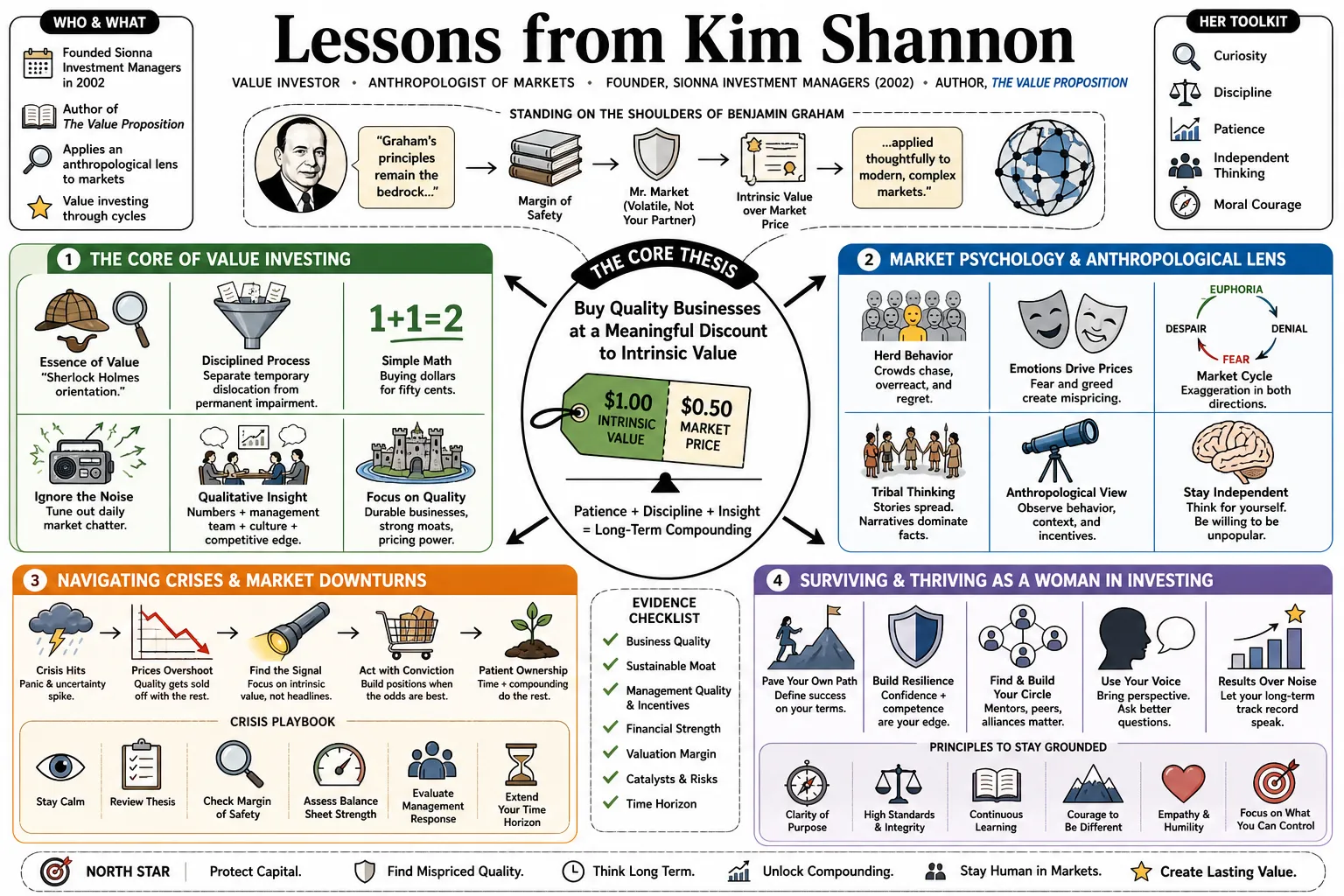
Part 1: The Core of Value Investing
- On the essence of value: "Finding quality businesses trading below their intrinsic value requires a Sherlock Holmes orientation." — Source: [Sionna Investment Managers]
- On process: "A disciplined, quantitative and qualitative process is necessary to separate temporary price dislocation from permanent capital impairment." — Source: [Sionna Investment Managers]
- On Benjamin Graham: "Graham’s principles remain the bedrock, but they must be applied thoughtfully to modern, complex markets." — Source: [The Meb Faber Show]
- On simple math: "Value investing is ultimately about the simple arithmetic of buying dollars for fifty cents." — Source: [CFA Institute]
- On ignoring noise: "Focusing on intrinsic value allows you to tune out the daily chatter of the market." — Source: [Sionna Investment Managers]
- On qualitative analysis: "Numbers only tell part of the story; you have to understand the management team and the business model." — Source: [Sionna Investment Managers]
- On margins of safety: "A margin of safety acts as a buffer against being wrong and serves as the primary driver of outsized returns." — Source: [CFA Institute]
- On independent thinking: "Value investors must be comfortable standing apart from the crowd, especially when the crowd is euphoric." — Source: [CFA Institute]
- On the nature of risk: "Risk is not volatility; risk is the permanent loss of capital." — Source: [Sionna Investment Managers]
- On common sense: "The path to investment success is built on common sense and discipline rather than complex algorithms." — Source: [CFA Institute]
Part 2: Behavioral Finance and Market Psychology
- On human nature: "I've long believed that the market reflects human nature as much as it does underlying fundamental value." — Source: [The Meb Faber Show]
- On emotional reactions: "Rational, incremental, proactive execution beats emotional, reactive trading." — Source: [Sionna Investment Managers]
- On the herd mentality: "People are wired to follow the herd, which is exactly why value investing works, as it exploits those psychological biases." — Source: [The Meb Faber Show]
- On market panics: "Panics are driven by fear rather than facts, and they create the best opportunities for those who can keep their heads." — Source: [CFA Institute]
- On euphoria: "When everyone is making easy money, that is precisely when you should be the most cautious." — Source: [CFA Institute]
- On psychological advantage: "The hardest part of investing is the waiting rather than the math." — Source: [Sionna Investment Managers]
- On self-awareness: "You have to know your own psychological triggers before you can hope to navigate the market's triggers." — Source: [The Meb Faber Show]
- On the illusion of control: "Investors often mistake a rising market for their own genius, which is a dangerous psychological trap." — Source: [The Meb Faber Show]
- On contrarianism: "Being a true contrarian means feeling uncomfortable most of the time." — Source: [CFA Institute]
Part 3: Women and Diversity in the Financial Industry
- On family planning: "Women in finance often feel intense pressure to delay having children until they have firmly established their careers." — Source: [RBC Global Asset Management]
- On structural barriers: "The industry was originally built without women in mind, which means we have to work harder to carve out our spaces." — Source: [Barbara Stewart's Rich Thinking]
- On diverse perspectives: "Diversity in an investment team serves as an active barrier against groupthink and improves returns." — Source: [C.D. Howe Institute]
- On being the only woman in the room: "Early in my career, being the only woman at the table was the norm, which forced me to ensure my voice was always backed by undeniable research." — Source: [Barbara Stewart's Rich Thinking]
- On industry evolution: "We are seeing progress for women in finance, but it is incremental rather than revolutionary." — Source: [RBC Global Asset Management]
- On female investors: "Women often make excellent value investors because they tend to be patient and less prone to ego-driven trading." — Source: [Barbara Stewart's Rich Thinking]
- On advocacy: "Those of us who have succeeded have a responsibility to pull up the next generation of women behind us." — Source: [C.D. Howe Institute]
- On the maternal wall: "The maternal wall is a real phenomenon, and the industry needs better structures to support women who choose to have children." — Source: [RBC Global Asset Management]
- On the confidence gap: "Women often feel they need to meet every single criteria before speaking up, whereas men will speak up at sixty percent. We need to bridge that gap." — Source: [Barbara Stewart's Rich Thinking]
- On male allies: "Progress requires men in leadership positions who are willing to sponsor and actively advocate for talented women." — Source: [C.D. Howe Institute]
Part 4: The Long Game: Patience and Persistence
- On time horizons: "We believe that the tortoise beats the hare. A focus on the long run leads to better investment decisions than a reaction to short-term movements." — Source: [Sionna Investment Managers]
- On compounding: "The most powerful force in investing is time, allowing compound interest to do the heavy lifting." — Source: [CFA Institute]
- On surviving bear markets: "You win by surviving the bear markets with your capital intact, rather than making the most in a bull market." — Source: [CFA Institute]
- On short-term thinking: "The financial industry is overly obsessed with quarterly earnings, which creates mispricing opportunities for those looking years ahead." — Source: [Sionna Investment Managers]
- On conviction: "If you truly believe in your thesis, a short-term drop in price should be viewed as a buying opportunity instead of a reason to panic." — Source: [The Meb Faber Show]
- On staying the course: "The hardest thing to do in investing is to sit on your hands and do nothing while everyone else is trading frantically." — Source: [Sionna Investment Managers]
- On incremental growth: "Wealth is built quietly and incrementally rather than through flashy, overnight successes." — Source: [CFA Institute]
- On defining success: "Investment success is measured in decades rather than months." — Source: [Sionna Investment Managers]
- On endurance: "Endurance is an underappreciated asset class in the investment world." — Source: [CFA Institute]
Part 5: Ethical Business and Client Relationships
- On firing clients: "Sometimes you have to fire a major client if their demands compromise your firm's standards and principles." — Source: [University of Toronto]
- On alignment of interests: "A successful firm is built on a strict alignment of interests between the managers and the clients." — Source: [Sionna Investment Managers]
- On transparency: "Clients deserve absolute transparency, especially when a portfolio is underperforming." — Source: [Sionna Investment Managers]
- On saying no: "The strength of a business is defined as much by what you say no to as what you agree to do." — Source: [University of Toronto]
- On fiduciary duty: "Fiduciary duty goes beyond a legal checklist; it is the moral obligation to put the client's money before your own ego." — Source: [C.D. Howe Institute]
- On fee structures: "Fees must be fair and transparent, or the relationship is fundamentally flawed from the start." — Source: [Sionna Investment Managers]
- On building trust: "Trust is built in drops and lost in buckets. You cannot afford to compromise your integrity even once." — Source: [University of Toronto]
- On independence: "Being an independent firm allows us to prioritize long-term client outcomes over short-term corporate pressures." — Source: [Sionna Investment Managers]
- On managing expectations: "It is better to lose a prospect by setting realistic expectations than to win a client by promising the impossible." — Source: [University of Toronto]
Part 6: Mentorship and Career Development
- On early career struggles: "The hard knocks of the investment world early in your career build the resilience needed to survive later." — Source: [Barbara Stewart's Rich Thinking]
- On the necessity of mentors: "Nobody succeeds in this industry alone; finding mentors who will tell you the hard truths is necessary." — Source: [Barbara Stewart's Rich Thinking]
- On unconventional backgrounds: "My background in zoology and anthropology provided a unique lens for observing human behavior in the markets." — Source: [Western University]
- On continuous learning: "The market is a harsh teacher, and if you stop learning, you will quickly become obsolete." — Source: [The Meb Faber Show]
- On taking risks: "Career growth often requires stepping off the traditional path and taking a risk on your own vision, as I did when founding Sionna." — Source: [Western University]
- On sponsorship: "A mentor advises you, but a sponsor advocates for you when you aren't in the room. Both are necessary." — Source: [Barbara Stewart's Rich Thinking]
- On building a team: "Hire people who are smarter than you and who possess the discipline to stick to the process during tough times." — Source: [Sionna Investment Managers]
- On handling mistakes: "You will make mistakes. The key is to analyze them ruthlessly and never make the same one twice." — Source: [Western University]
- On defining your own success: "Do not let the industry's default metrics define your success; build a career that aligns with your own values." — Source: [Barbara Stewart's Rich Thinking]
Part 7: Navigating Crises and Market Cycles
- On the Nortel collapse: "The Nortel bubble was a stark lesson in what happens when the market completely abandons fundamental valuation." — Source: [Canadian Couch Potato]
- On speculative bubbles: "Every generation believes their bubble is a new paradigm, but the laws of financial gravity always return." — Source: [CFA Institute]
- On market cycles: "Understanding that markets are cyclical rather than linear is the first step to avoiding panic at the bottom." — Source: [The Meb Faber Show]
- On cash as a position: "Holding cash during a speculative frenzy is a strategic decision to wait for a better pitch." — Source: [Starvine Capital]
- On historical perspective: "Financial history is the best antidote to market hysteria." — Source: [CFA Institute]
- On borrowing heavily: "Borrowing heavily during a downturn is what turns a temporary decline into a permanent disaster." — Source: [The Meb Faber Show]
- On identifying bottoms: "You will rarely buy exactly at the bottom. The goal is to buy when the margin of safety is overwhelmingly in your favor." — Source: [Sionna Investment Managers]
- On macroeconomic shifts: "We do not try to predict macroeconomic shifts; we focus on whether the individual business can survive them." — Source: [Sionna Investment Managers]
- On resilience: "A portfolio built on value principles is designed to grow while weathering inevitable market storms." — Source: [Starvine Capital]
Part 8: Active Management and Industry Evolution
- On passive investing: "The rise of passive investing creates inefficiencies that active value managers can exploit." — Source: [The Meb Faber Show]
- On index hugging: "If you are charging active fees for a portfolio that mirrors the index, you are doing a disservice to your clients." — Source: [Sionna Investment Managers]
- On true active management: "True active management requires the willingness to look very wrong in the short term." — Source: [Sionna Investment Managers]
- On the democratization of data: "Information is no longer an edge; the edge is in how you interpret the data and how disciplined you remain." — Source: [The Meb Faber Show]
- On industry timelines: "The asset management industry has become increasingly focused on quarterly performance, which hurts long-term outcomes." — Source: [CFA Institute]
- On the value of independence: "Independent firms are often better positioned to maintain a strict investment discipline without corporate interference." — Source: [Sionna Investment Managers]
- On algorithmic trading: "Machines can process data faster than humans, but they still struggle to accurately price human irrationality." — Source: [The Meb Faber Show]
- On ethical standards: "Organizations like the CFA Institute are vital for maintaining ethical standards in an industry prone to excesses." — Source: [C.D. Howe Institute]
- On standing out: "To outperform the average, you must build a portfolio that looks very different from the average." — Source: [Sionna Investment Managers]
- On the future of value: "Value investing is not dead; it simply requires patience during periods when growth and speculation dominate the headlines." — Source: [Starvine Capital]