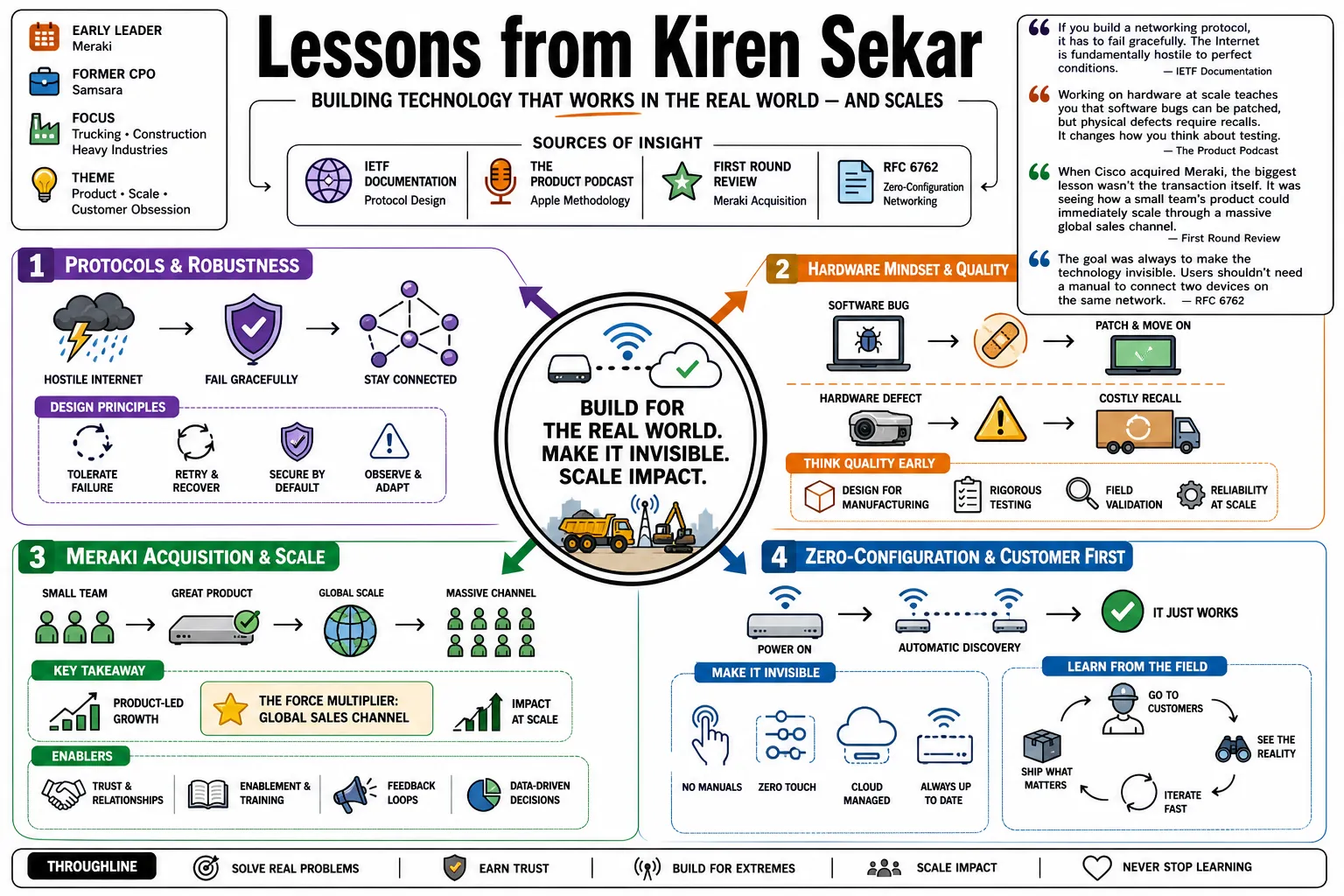
Lessons from Kiren Sekar
As an early leader at Meraki and former Chief Product Officer at Samsara, Kiren Sekar built hardware and software to digitize heavy industries like trucking and construction. This profile outlines his principles for product management, scaling technology, and learning directly from customers in the field.
Part 1: Early Career and Foundation
- On protocol design: "If you build a networking protocol, it has to fail gracefully. The Internet is fundamentally hostile to perfect conditions." — Source: IETF Documentation
- On the Apple methodology: "Working on hardware at scale teaches you that software bugs can be patched, but physical defects require recalls. It changes how you think about testing." — Source: The Product Podcast
- On the Meraki acquisition: Sekar says Meraki grew to about $100 million in revenue before Cisco acquired it for a little over $1.2 billion, then the team worked to make the product thrive inside Cisco. — Reference: First Round episode on Meraki and Cisco
- On zero-configuration networking: "The goal was always to make the technology invisible. Users shouldn't need a manual to connect two devices on the same network." — Source: RFC 6762
- On transitioning from engineer to product: "You stop measuring success by the elegance of the code and start measuring it by whether the customer actually solved their problem." — Source: The Product Podcast
- On hardware constraints: "Software engineers are used to infinite compute. Hardware engineers measure everything in millimeters and milliamps." — Source: Samsara Engineering Blog
- On the value of patents: "Patents are a byproduct of solving hard problems, rather than the goal itself. We filed them because we were hitting walls that standard technology couldn't bypass." — Source: Apple Patents Database
- On early startup days: Sekar describes Samsara's earliest phase as a mix of market exploration, technology tinkering, and prototype hacking around cheap connected sensors. — Reference: First Round episode on Samsara's origin story
- On learning from failures: "A failed deployment teaches you more about your system's architecture than a hundred successful lab tests." — Source: Tech Talks Network
Part 2: The Origin and Vision of Samsara
- On identifying the market: "We looked at industries that represented massive chunks of global GDP like trucking, logistics, and construction and realized they were running on clipboards and whiteboards." — Source: The Product Podcast
- On the initial thesis: The founding insight was that physical-operations companies ran on pen, paper, mainframes, and fragmented systems while sensors, cloud, and networks were becoming cheap enough to change that. — Reference: First Round episode on IoT market gaps
- On the first prototypes: "Our first hardware units were rough. We strapped them into vehicles to see if we could get reliable GPS and engine data back to the cloud." — Source: Samsara Engineering Blog
- On selling to operations managers: "You can't sell a shiny app to a fleet manager. You have to sell them a way to save fuel or keep their drivers out of accidents." — Source: The Product Podcast
- On the name Samsara: Sekar frames Samsara as a long-term physical-operations platform rather than a point solution, built around continuous customer data and feedback loops. — Reference: First Round episode on building broad from day one
- On defying Silicon Valley trends: "When everyone else was building photo sharing apps, we were figuring out how to monitor refrigerated trailers." — Source: Tech Talks Network
- On hardware as a wedge: "We didn't want to be a hardware company. However, to get the data for the software, we had to build the sensors ourselves." — Source: The Product Podcast
- On early customer meetings: Samsara's early research came from watching real operations and learning from customers such as Cowgirl Creamery before deciding what the first product should be. — Reference: First Round episode on early customer research
- On the scope of physical operations: "These are the people who keep the world running. If their operations are inefficient, everything costs more." — Source: Samsara Blog
Part 3: Customer-Centric Product Development
- On building empathy: Sekar says Samsara had to learn operations it did not run itself, from fleets to food production, by being customer-led and customer-first. — Reference: First Round episode on customer-centric roadmaps
- On customer feedback: "Customers are great at telling you what is broken. They are terrible at telling you what to build next. That is your job." — Source: The Product Podcast
- On ride-alongs: "We made it mandatory for product managers to spend time in the field. It completely changes your perspective on the product." — Source: Tech Talks Network
- On the voice of the customer: "It is easy to listen to the loudest customer. The challenge is aggregating feedback across thousands of fleets to find the structural problems." — Source: The Product Podcast
- On beta testing: "Hardware betas are brutal. You send a device out, and if it fails, you can't push a hotfix over the air. You have to drive out and replace it." — Source: Samsara Engineering Blog
- On solving the right problem: Early customer feedback helped Samsara move from broad experimentation to the use cases that customers actually valued enough to buy. — Reference: First Round episode on customer feedback loops
- On feature requests: "If a customer asks for a button, ask them what they are trying to achieve when they click it." — Source: The Product Podcast
- On continuous iteration: "We ship software updates constantly, but we have to be careful to avoid disrupting workflows that frontline workers have memorized." — Source: Tech Talks Network
- On prioritizing issues: "A bug that stops a truck from moving is prioritized over everything else. Physical downtime costs money by the minute." — Source: Samsara Blog
- On measuring success: "We look at how much time a safety manager saves reviewing footage, rather than how many clicks they make." — Source: The Product Podcast
Part 4: Leading Product and Engineering Teams
- On hiring engineers: "We look for people who are comfortable with ambiguity. The real world doesn't have clean APIs." — Source: Samsara Engineering Blog
- On cross-functional teams: Product School describes Sekar leading a large R&D organization that integrates hardware sensors, cameras, software, data, and AI into one platform. — Reference: Product School episode on hardware and software development
- On product management: "A good PM is a translator. They translate physical operational pain into technical requirements." — Source: The Product Podcast
- On speed of execution: "You have to accept some technical debt early on to validate the market. The trick is knowing when to pay it down." — Source: Tech Talks Network
- On engineering culture: "We celebrate the unglamorous work. Making a database query ten percent faster matters when you have millions of sensors pinging it." — Source: Samsara Engineering Blog
- On managing growth: The First Round conversation covers how Samsara kept a startup mindset while scaling from an early hardware prototype into a cross-industry IoT platform. — Reference: First Round episode on scaling Samsara
- On balancing priorities: "Half the roadmap is what customers are asking for today. The other half is what they will need three years from now." — Source: The Product Podcast
- On technical trade-offs: "Sometimes the best solution is a simple heuristic, rather than a massive machine learning model." — Source: Tech Talks Network
- On leadership: "Your job as a leader is to remove blockers. If an engineer is stuck on a bureaucratic process, I have failed." — Source: Samsara Blog
Part 5: Scaling from Startup to Enterprise
- On hitting one billion dollars ARR: "The numbers get larger, but the fundamental job doesn't change. You still have to deliver value every single day." — Source: The Product Podcast
- On organizational design: Sekar's product organization balances core products, growth initiatives, and innovation through a 70/20/10 roadmap framework. — Reference: Product School episode on product roadmap prioritization
- On expanding the product line: "We started with fleet tracking, but once we had the data pipeline, we realized we could track equipment, monitor safety, and manage dispatch." — Source: Tech Talks Network
- On enterprise sales: "Selling to a small fleet is a transactional process. Selling to a top 100 logistics company is a partnership that takes years." — Source: Samsara Blog
- On maintaining speed: "The biggest risk of scaling is becoming slow. We fight bureaucracy relentlessly to keep our shipping cadence." — Source: The Product Podcast
- On global expansion: Samsara chose to build broad rather than narrow, serving multiple operations-heavy industries instead of confining the platform to one vertical. — Reference: First Round episode on broad versus niche customers
- On data infrastructure: "When you go from thousands of sensors to millions, your entire backend has to be rewritten. It is an engineering nightmare but a business necessity." — Source: Samsara Engineering Blog
- On going public: "An IPO is a funding event, not the finish line. The next day, you still have to ship code." — Source: Tech Talks Network
- On long-term focus: "We don't build features for the next quarter. We build platforms for the next decade." — Source: The Product Podcast
Part 6: Designing for Physical Operations
- On user interfaces: Sekar emphasizes that frontline AI and software need to turn real-world data into decisions people can actually act on, not just dashboards. — Reference: Tech Talks Daily episode on frontline operations
- On connectivity issues: "You have to design for offline first. Trucks drive through dead zones all the time. The software must queue data and sync when it gets a signal." — Source: Samsara Engineering Blog
- On hardware durability: "Our devices have to survive extreme heat, cold, vibration, and sometimes getting hit by a forklift." — Source: Tech Talks Network
- On alert fatigue: "If you send a dispatcher fifty alerts a day, they will ignore all of them. You have to filter out the noise and flag the items requiring action." — Source: The Product Podcast
- On installation: Samsara's product challenge is full-stack: hardware sensors and cameras have to work with software and AI in the messy environments where physical operations happen. — Reference: Product School episode on hardware-software balance
- On power management: "A sensor on an unpowered trailer might need to last for years on a single battery. Every byte of data transmitted has to be justified." — Source: Samsara Engineering Blog
- On standardizing data: "Engine diagnostics differ by manufacturer. Our platform normalizes that data so a mixed fleet looks uniform on the dashboard." — Source: Tech Talks Network
- On safety culture: "Technology doesn't create a culture of safety. It gives managers the tools to coach drivers and enforce the culture they want." — Source: The Product Podcast
- On edge computing: "We do a lot of processing on the device itself. You can't wait for a cloud round-trip to detect a collision." — Source: Samsara Blog
- On respecting the user: Sekar says AI adoption in physical operations depends on care, transparency, and a clear focus on protecting workers rather than simply monitoring them. — Reference: Tech Talks Daily episode on trust and worker protection
Part 7: AI and the Future of Work
- On the purpose of AI: "We don't use AI to replace drivers. We use it to give them a co-pilot that watches the road and warns them of risks." — Source: Tech Talks Network
- On computer vision: "A dashcam that only records video is a liability. A dashcam that understands context like tailgating or running a red light is an asset." — Source: The Product Podcast
- On model accuracy: "If the AI flags a false positive for distracted driving, the driver loses trust in the system immediately. Precision is non-negotiable." — Source: Samsara Engineering Blog
- On data moats: Product School notes that Samsara collects more than 10 trillion data points annually to improve safety, efficiency, and sustainability for customers. — Reference: Product School episode on Samsara data scale
- On driver coaching: "AI can identify a bad habit, but it takes human empathy to coach a driver out of it." — Source: Tech Talks Network
- On predictive maintenance: "Machine learning allows us to see patterns in engine temperature and vibration. We can predict a breakdown before the truck leaves the yard." — Source: The Product Podcast
- On edge AI: "Running neural networks on a device the size of a deck of cards inside a hot vehicle is a massive hardware engineering challenge." — Source: Samsara Engineering Blog
- On privacy: Sekar treats trust and change management as central when AI systems influence real-world safety, monitoring, and productivity. — Reference: Tech Talks Daily episode on responsible AI deployment
- On automating workflows: "AI is best used for the repetitive tasks. Let the computer review hours of video so the safety manager only reviews the incidents." — Source: Samsara Blog
- On the limitations of AI: "AI is a tool, not a strategy. You still have to figure out how it integrates into the daily routine of a logistics company." — Source: Tech Talks Network
Part 8: Business Strategy and Growth
- On the platform approach: "Customers don't want ten different vendors for tracking, routing, and safety. They want a single pane of glass." — Source: The Product Podcast
- On pricing strategy: The First Round episode explicitly covers Samsara's pricing strategy and market positioning as part of its shift from early product to scalable company. — Reference: First Round episode on pricing and positioning
- On market expansion: "Every physical industry has the same fundamental problems with inefficiency, safety risks, and a lack of visibility. The core technology translates across sectors." — Source: Tech Talks Network
- On building an ecosystem: "We opened our API early on. We knew we couldn't build every integration, so we let our partners build on top of our data." — Source: Samsara Engineering Blog
- On customer retention: "Churn is a product problem. If a customer leaves, it means we stopped delivering value." — Source: The Product Podcast
- On capital efficiency: Sekar's Meraki and Samsara stories both stress long-term orientation: making decisions as if the company has to live with them for years. — Reference: First Round episode on long-term company building
- On the industrial economy: "Tech has spent decades optimizing the digital world. The next massive opportunity is optimizing the physical world." — Source: Tech Talks Network
- On organizational focus: "It is very easy to get distracted by shiny new verticals. You have to win the core market before you earn the right to expand." — Source: Samsara Blog
- On legacy: "I want to look back and say we made physical operations safer and more efficient, and that we built a company that outlasts its founders." — Source: The Product Podcast