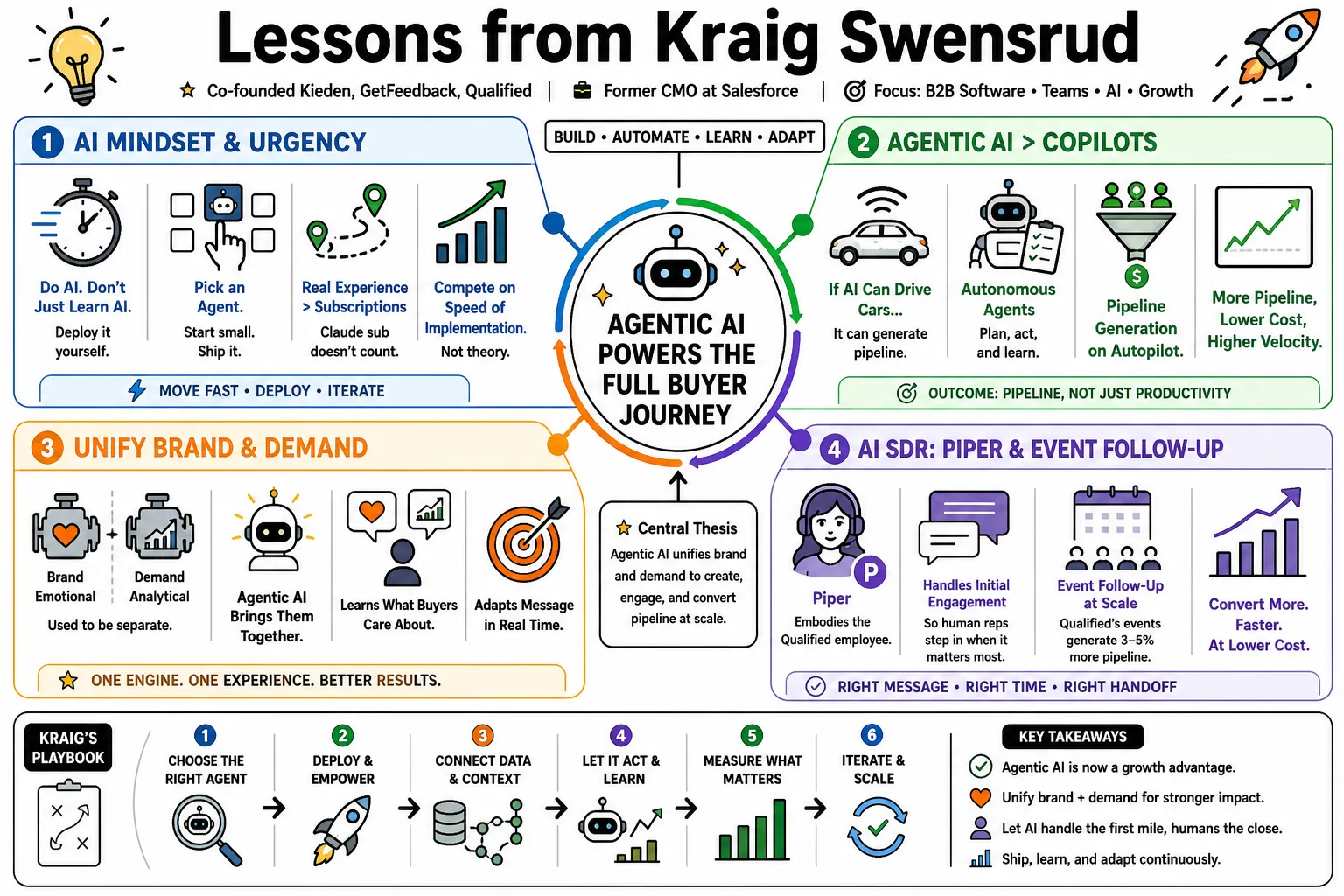
Lessons from Kraig Swensrud
Kraig Swensrud co-founded Kieden, GetFeedback, and Qualified, and previously served as CMO at Salesforce. This profile gathers his practical advice on building B2B software companies, managing technical teams, and replacing static lead forms with agentic AI.
Part 1: Artificial Intelligence & AI Agents
- On the urgency of AI implementation: "No, you need to do AI. Don't learn it. Buying a subscription to Claude does not count as learning AI. The way you're going to do it is pick an agent... Deploy it yourself." — Source: SaaStr
- On autonomous agents vs. copilots: "If AI can drive cars autonomously, why can't it autonomously generate pipeline?" — Source: Qualified
- On unifying brand and demand: "Brand and demand used to be two separate engines: one emotional, one analytical. Agentic AI brings them together. It executes campaigns, learns what your buyers care about, and adapts your message in real time." — Source: Substack
- On the AI SDR persona: "She's everything that embodies the Qualified employee. Piper handles the initial engagement so our human reps can step in when it matters most." — Source: Qualified
- On event follow-up scaling: "Qualified's own events pipeline is up 352% YoY using Piper AI SDR for post-event follow-up; the agent handles outreach at scale, and the team shows up live." — Source: J. Kuzel Blog
- On implementation bottlenecks: "The primary barrier to AI adoption in marketing is rarely the technology itself; it is the lack of a clear deployment strategy within the organization." — Source: SaaStr
- On the shift to doing AI: "Moving beyond theoretical applications of artificial intelligence requires buying a tool, setting it up, and trusting it to handle a specific, measurable workflow." — Source: SaaStr
- On relevance at scale: "AI allows companies to achieve what was previously impossible: personalizing the exact messaging a buyer sees without requiring manual human intervention for every interaction." — Source: Substack
- On the AI revolution parallel: "The current shift toward AI-driven software mirrors the disruption caused by the initial transition to cloud-based SaaS, forcing companies to adapt or face obsolescence." — Source: GTMnow
- On replacing static workflows: "AI agents replace the legacy rules-based automation that defined the previous decade of B2B marketing, rather than simply adding to the existing tech stack." — Source: Salesforce Ben
Part 2: B2B Pipeline & Marketing Strategy
- On moving past MQLs: "Marketers must pivot away from traditional metrics like Marketing Qualified Leads (MQLs) and instead focus entirely on outcomes that drive actual revenue and pipeline." — Source: Qualified
- On the purpose of marketing: "The ultimate job of the marketing department is to generate pipeline. Everything else is secondary to filling the sales team's calendar." — Source: Qualified
- On competing for attention: "When facing aggressive competition, resist the temptation to compete solely on discounts or ad spend. Lean into brand awareness and unique storytelling to differentiate your company." — Source: Qualified
- On modernizing the funnel: "The traditional B2B marketing funnel is broken because it forces buyers to wait. Modern strategy requires engaging them exactly when their intent is highest." — Source: Qualified
- On video storytelling: "Utilizing video formats and narrative-driven content is one of the most effective ways to stand out in a crowded, noisy software market." — Source: Qualified
- On SaaS pricing models: "Artificial intelligence is fundamentally changing software pricing strategies, forcing companies to reconsider seat-based licenses in favor of outcome-based value." — Source: GTMnow
- On earning renewals: "SaaS companies can no longer rely on inertia. In a market saturated with options, you have to actively earn your renewals every single year." — Source: GTMnow
- On aligning sales and marketing: "True alignment happens only when both departments are measured by the exact same metric: closed-won revenue generated from the pipeline." — Source: Qualified
- On speed to lead: "The probability of qualifying a lead drops significantly if you do not respond within the first few minutes of their inquiry." — Source: Qualified
- On the evolution of demand generation: "Demand generation has shifted from casting a wide net to using intent data to identify exactly which accounts are in-market at this exact moment." — Source: Qualified
Part 3: The Website & Inbound Conversion
- On website importance: "The corporate website is simultaneously a brand's biggest marketing asset and its biggest blindspot." — Source: PR Newswire
- On capitalizing on intent: "You must convert high-intent buyers the moment they arrive on your site, rather than letting them fall into a slow, multi-day lead-nurture queue." — Source: Spara
- On the contact us form: "Forcing interested buyers to fill out a static form and wait for an SDR to email them back is an archaic experience that kills momentum." — Source: Qualified
- On VIP experiences: "High-value target accounts visiting your website should receive a fundamentally different, white-glove experience compared to anonymous traffic." — Source: Qualified
- On real-time engagement: "If you know a target account is on your pricing page, the sales team should be able to instantly start a conversation right there on the screen." — Source: Qualified
- On website deanonymization: "The first step to a better website strategy is using data to reveal the companies behind the anonymous IP addresses visiting your pages." — Source: Qualified
- On conversational marketing: "Chat isn't about support anymore; it's a primary conversion mechanism for inbound B2B sales." — Source: Qualified
- On routing rules: "Immediate routing logic that connects a website visitor directly to their assigned account executive is critical for maximizing close rates." — Source: Qualified
- On maximizing ad spend: "Driving expensive paid traffic to a website is wasted money if the site is not optimized to instantly capture and engage that intent." — Source: Qualified
Part 4: Entrepreneurship & Company Building
- On serial co-founding: "Building multiple companies with the same co-founder relies on pattern recognition, scar tissue, and earned conviction." — Source: GTMnow
- On sustained effort: On the Truth Be Known episode page, Swensrud says that even in the lows of the lows, you have to be super excited about what you're working on, which supports the broader lesson that passion is what sustains entrepreneurial effort when data and logic alone stop being enough. — Reference: Truth Be Known episode page with Kraig Swensrud
- On sustainable growth: "The hyper-growth Silicon Valley model is evolving. Founders should focus on long-term profitability and sustainable, smart growth over burning capital." — Source: Cub Club
- On taking leaps: "Recognize when you have a burning entrepreneurial passion that pulls you away from a comfortable dream job, and trust that instinct to make a change." — Source: Talend
- On building in a known ecosystem: "Starting companies within an ecosystem you deeply understand provides an immediate advantage in product-market fit and customer acquisition." — Source: Salesforce Ben
- On the zero-to-one phase: "The earliest days of a startup require discarding large-company playbooks and doing whatever manual, unscalable work is necessary to win initial customers." — Source: GTMnow
- On market timing: "A great product will still fail if the market isn't ready. Success often comes from identifying a technological shift, like AI, right before it becomes mainstream." — Source: GTMnow
- On knowing your product: "Regardless of your role, whether CEO, CMO, or intern, you must deeply understand the product to ensure accountability and alignment with customer needs." — Source: Entrepreneur
- On continuous iteration: "Company building is never a finished process. You must be willing to tear down your own successful models when the technology market shifts." — Source: GTMnow
Part 5: Leadership & Talent Management
- On the hire fast myth: In the GTMnow episode transcript and highlights, Swensrud explicitly says the old 'hire fast, fire fast' adage is bs, which supports the broader lesson that startup hiring should be more deliberate and fit-driven than the slogan suggests. — Reference: GTMnow transcript with Kraig Swensrud
- On identifying potential: "Leadership involves spotting future superstars early and betting on high-potential employees even when more experienced options exist." — Source: Who Got Me Here
- On managing performance: The Truth Be Known episode page lists as a key takeaway that great performance requires aggressive performance management and moving people out of positions where they can't perform well is ultimately good for everyone involved. That supports the broader lesson that strong leaders address role mismatch directly instead of letting poor fit linger. — Reference: Truth Be Known episode page with Kraig Swensrud
- On mentorship obligations: "Leaders have a responsibility to 'pay it forward' by actively mentoring those who show drive, just as previous executives invested in them." — Source: Who Got Me Here
- On team alignment: "A leader's primary job is to ensure everyone understands the core objective clearly enough to make the right decisions independently, rather than making every decision themselves." — Source: Medium
- On promoting from within: "Investing in the growth of your existing team members builds a culture of loyalty and institutional knowledge that external hires cannot replicate." — Source: Medium
- On demanding excellence: "Holding a team to incredibly high standards is not micromanagement; it is the prerequisite for achieving category-defining success." — Source: Medium
- On structural clarity: "Organizations fail when accountability is blurred. Every key metric must have a single owner whose success depends entirely on that number." — Source: Forbes
- On adapting leadership styles: "The leadership approach required to manage a five-person startup is entirely different from what is required as a CMO managing a massive global team." — Source: Talend
Part 6: Data-Driven Decision Making
- On avoiding the HIPPO: "Replace the 'HIPPO' (Highest Paid Person's Opinion) approach with hard facts. Strategy should be dictated by data, rather than executive intuition." — Source: Forbes
- On foundational metrics: "Modern marketing executives must deeply understand their data foundation to make informed decisions rather than relying on surface-level vanity metrics." — Source: Forbes
- On measuring what matters: "If a metric does not have a direct, logical path to revenue generation, it is likely a distraction from the company's core goals." — Source: Talend
- On operational rhythm: "Establishing a strict cadence for reviewing performance data ensures that minor issues are identified and corrected before they become quarterly misses." — Source: Talend
- On predictive analytics: "The best use of data is to predict exactly what the pipeline will look like next quarter, rather than simply reporting on what happened last month." — Source: Forbes
- On data silos: "Customer data that lives in isolated systems is useless. Information must flow seamlessly between the website, the CRM, and the marketing automation platform." — Source: Qualified
- On testing assumptions: "Every major go-to-market initiative should be treated as a hypothesis to be tested and validated with data before committing the full budget." — Source: Forbes
- On qualitative data: "While quantitative metrics are important, directly listening to sales calls and customer feedback provides the context needed to interpret the numbers correctly." — Source: Forbes
- On accountability through data: "Transparent dashboards that are visible to the entire company foster a culture where poor performance cannot hide and success is easily replicated." — Source: Forbes
Part 7: Strategic Ecosystems & Partnerships
- On native integration: "As Salesforce alumni, my co-founders and I have always built our products to deeply integrate with Salesforce." — Source: SaaStr
- On platform loyalty: "Building a business on top of a massive, established platform provides built-in distribution and a pre-qualified customer base." — Source: Wikipedia
- On mutual benefit: "The best technology partnerships occur when your product solves a critical gap in the platform's native capabilities, making both products stickier." — Source: Salesforce Ben
- On strategic investment: "Securing investment from the venture arm of your ecosystem partner validates your technology to the broader customer base." — Source: Salesforce Ventures
- On ecosystem alignment: "Aligning your company's messaging and product releases with the major events and narratives of your platform partner amplifies your reach." — Source: Qualified
- On shared architecture: "Utilizing the same data models and architectural principles as your platform partner drastically reduces the friction of enterprise deployment." — Source: Qualified
- On the AppExchange model: "The enterprise software market has fundamentally shifted to a marketplace model where customers prefer integrated solutions over disparate point products." — Source: Salesforce Ben
- On long-term relationships: "The acquisition of a company by its primary platform partner highlights the value of maintaining deep, multi-decade relationships within a specific corporate ecosystem." — Source: GTMnow
- On focused markets: "Dominating a specific ecosystem is often a faster path to enterprise scale than trying to be all things to all companies." — Source: Qualified
Part 8: Career Trajectory & Mentorship
- On career risk: "Take more risks than you feel comfortable with, lean into emerging technology, never burn bridges, and remember that today's peers will be tomorrow's industry leaders." — Source: Who Got Me Here
- On the cold outreach: "A single, thoughtful cold email to a CEO can completely alter the trajectory of your professional life if executed correctly." — Source: Podchaser
- On redefining success: "Success is often found through clarity of purpose, generosity toward others, and the courage to ask for help when navigating unknown territory." — Source: Who Got Me Here
- On connecting the dots: "The true value of the relationships you build and the risks you take are often things you can't see looking forward, but only connect looking back." — Source: Who Got Me Here
- On learning from giants: "Working directly under proven leaders provides a masterclass in scale, vision, and executing against massive corporate goals." — Source: GTMnow
- On foundational roles: "Starting a career in a deeply technical, customer-facing role provides an irreplaceable understanding of how software actually delivers value." — Source: Who Got Me Here
- On maintaining connections: "Building lifelong professional bonds requires continuous, small efforts and a willingness to offer help without expecting an immediate return." — Source: Who Got Me Here
- On the value of alumni networks: "The relationships formed during hyper-growth phases at major tech companies become a powerful, lifelong professional network for future ventures." — Source: SaaStr
- On leaving gracefully: "When transitioning from a role to start a new venture, managing the exit with transparency and respect ensures those bridges remain intact for future partnerships." — Source: Talend
- On owning your path: "Ultimately, no mentor or manager cares as much about your career progression as you do. You must actively steer your own professional development." — Source: Who Got Me Here