Diagnosed with Type 1 diabetes and epilepsy, Krishna Kaliannan left finance to bake his own keto-friendly cereal. That home-kitchen project grew into Catalina Crunch, a low-sugar snack brand that has reached a $200 million retail run rate. The lessons below trace his path to national retail, detailing his daily health routines, goal-setting methods, and approach to building a consumer brand.
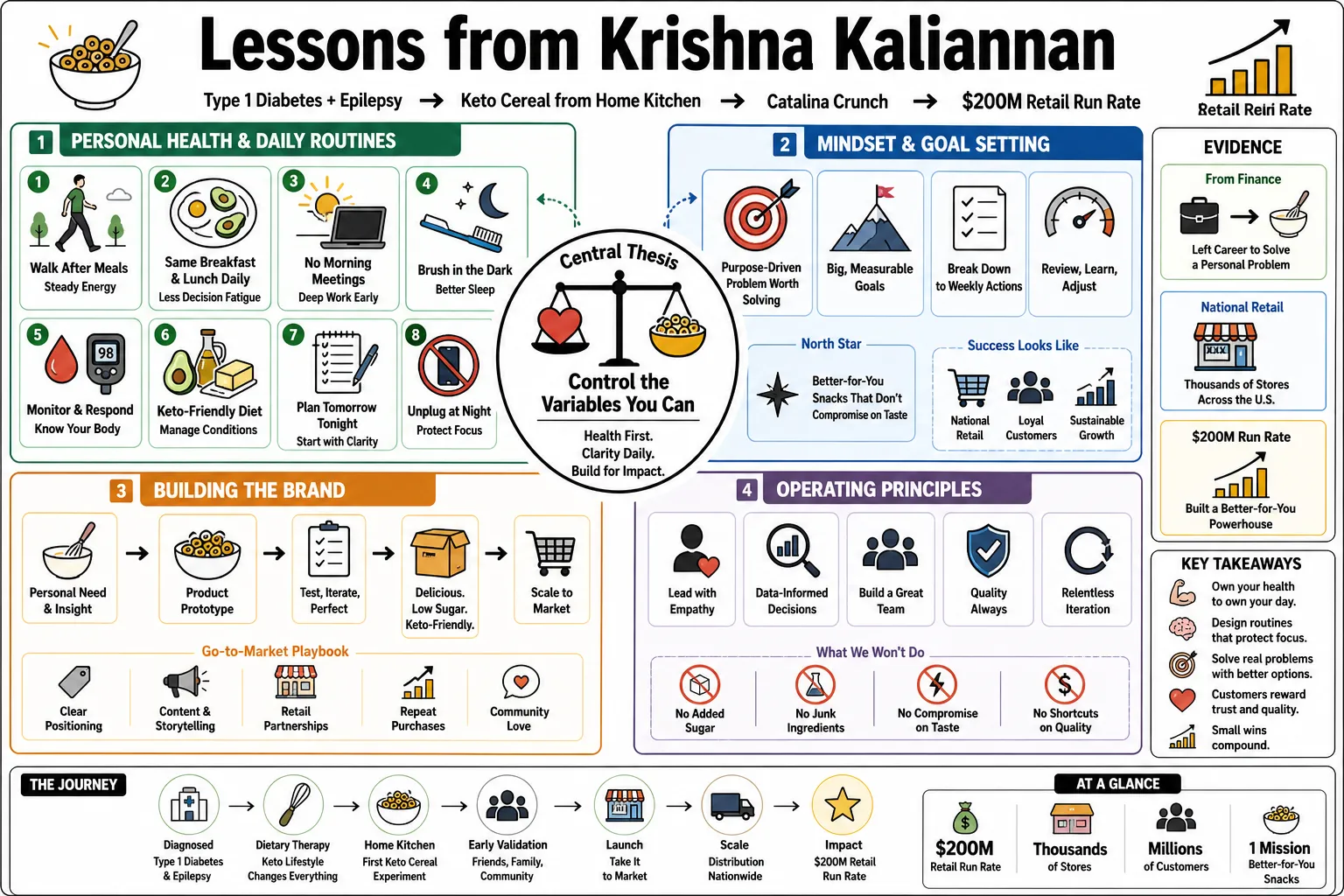
Part 1: Personal Health and Daily Routines
- On blood sugar management: Walking after meals helps limit blood sugar spikes and maintains steady energy levels throughout the day. — Reference: Business Insider
- On decision fatigue: Eating the exact same breakfast and lunch every day minimizes the number of decisions required for routine tasks, preserving mental energy for the workday. — Reference: Business Insider
- On scheduling deep work: Avoiding morning meetings leaves more open time for deep, focused work before the brain gets foggy later in the day. — Reference: Business Insider
- On sleep hygiene: Brushing your teeth in the dark can help prepare the body for a better night's sleep. — Reference: Business Insider
- On dietary therapy: Adopting a keto-friendly diet can be a powerful tool for managing health conditions, which for him meant controlling Type 1 diabetes and eliminating epileptic seizures. — Reference: PeasOnMoss
- On workday preparation: Writing a to-do list the day before ensures you can start the next morning knowing exactly what to focus on and accomplish. — Reference: Business Insider
- On unplugging: Setting an alarm and physically separating from your phone for the rest of the night prevents workaholics from getting sucked back into incoming emails. — Reference: Business Insider
- On recognizing bodily responses: Paying close attention to how specific foods impact your body teaches you that protein, fiber, and healthy fats stabilize energy, while empty carbs and sugar cause a rollercoaster effect. — Reference: Nasdaq Center
Part 2: Navigating the Workplace and Career Transitions
- On toxic work cultures: A work environment that demands long hours merely for the sake of face time does not serve the company or its employees well. — Reference: Business Insider
- On purpose over profit: A career solely focused on financial gains can feel empty if you cannot see how your work tangibly helps people. — Reference: Business Insider
- On self-awareness: Recognizing that your personality is not suited for having a boss can be a powerful catalyst to pursue entrepreneurship. — Reference: Business Insider
- On human elements in business: A demanding corporate finance career can inadvertently teach you that there is more value in finding and collaborating with the right people than just grinding behind a computer screen all day. — Reference: Business Insider
- On founder stamina: The motivation of building your own product from scratch can provide the adrenaline rush needed to sustain 18-hour workdays during the early stages of a business. — Reference: Business Insider
Part 3: Goal Setting and Relationship Building
- On process goals: Do not rely solely on outcome goals that only focus on a desired result; you must combine them with process goals that outline the specific, actionable steps required to achieve that outcome. — Reference: Medium
- On the relationship dimension: When planning your process goals, always add a second dimension by asking who in your network can help you accomplish each step. — Reference: Medium
- On categorizing contacts: When seeking help for your goals, sort potential contacts into four groups: core contacts, extended contacts, introductions, and cold contacts. — Reference: Medium
- On timeline mapping: To identify the right process goals, work backward from your ultimate outcome and ask yourself what needs to be done in the next month, three months, and year. — Reference: Medium
- On the self-made myth: Western media promotes the superhero-like ideal of the self-made person, but true success relies heavily on asking for help, building trust, and engaging your relationships. — Reference: Medium
- On iterative planning: The process of reaching out to your network for advice will often yield feedback that causes you to revise and improve your other process goals. — Reference: Medium
Part 4: Finding the Idea and Early Validation
- On entrepreneurship: "To me, entrepreneurship is a playbook for improving a small part of the world through business." — Source: Nasdaq Center
- On early failures: Even if your first venture fails—like an early college business that filtered laptops by practical use instead of technical specs—it can permanently change how you see the world and get you addicted to entrepreneurship. — Reference: Nasdaq Center
- On solving personal problems: The most authentic businesses often start when a founder gets fed up with the lack of viable solutions for their own needs, like finding a low-carb cereal that doesn't taste like cardboard. — Reference: LCG Foods
- On accidental market testing: Giving a homemade product to a friend to solve their dietary fatigue can lead to unexpected business validation when they insist on paying grocery store prices for it via Venmo. — Reference: Apple Podcasts
- On bootstrapping production: Early stage scaling might require grueling overnight shifts in rented commercial kitchens when your apartment's oven racks can no longer meet customer demand. — Reference: Business Insider
- On industry education: When entering a new category without experience, immerse yourself in specialized training—such as a university short course on commercial manufacturing—to learn how major incumbents operate. — Reference: Business Insider
Part 5: Product Formulation and Innovation
- On taste vs. macros: A product concept will not survive if it doesn't deliver on taste; even if the nutritional profile is perfect, people will not eat something that doesn't taste incredible. — Reference: Snack Food & Wholesale Bakery
- On multidisciplinary creation: Creating a successful health food brand requires merging nutritional science with the culinary arts to make foods that are both healthy and genuinely delicious. — Reference: LCG Foods
- On consumer obsession: If you obsess over your consumers, you might do things that other companies won't, like opening a dedicated manufacturing plant just to deliver cereal in a resealable pouch instead of a standard bag-in-box. — Reference: Nasdaq Center
- On consumption occasions: You can dramatically increase your buy rate by designing packaging—like stand-up pouches with large cereal squares—that encourages consumers to eat the product as an afternoon or evening snack, rather than just for breakfast. — Reference: Snack Food & Wholesale Bakery
- On enduring trends: While dietary fads constantly shift, focusing on the fundamental consumer desire for great taste combined with functional benefits creates lasting demand. — Reference: The Consumer VC
- On industry transitions: Founders coming from tech or finance backgrounds must rapidly embrace the food innovation learning curve and master industry-specific terms to become subject matter experts. — Reference: PeasOnMoss
Part 6: Scaling and Retail Strategy
- On finding the right channel: Direct-to-consumer models are difficult for food brands to sustain long-term; shifting to national retail distribution can be the true driver for scale. — Reference: The Consumer VC
- On retail velocity: When attempting to drive product velocity on grocery store shelves, word of mouth matters far more than most founders realize. — Reference: The Consumer VC
- On buyer pitches: Sharing a deeply personal origin story and guiding a buyer through a product tasting can be enough to secure national distribution from a major retailer. — Reference: Business Insider
- On influencer luck: An unexpected, unpaid organic endorsement from a major celebrity eating your product can provide a surreal and massive boost to brand visibility. — Reference: Business Insider
Part 7: Supply Chain and Operations Management
- On mitigating supply chain shocks: If tariffs threaten the cost of imported ingredients, buy enough inventory to give your culinary team time to formulate recipe changes without compromising the product's nutrition or taste. — Reference: Fox Business
- On pricing strategies: When faced with supply chain cost increases, lean companies should do everything possible to adapt their operations before passing those price hikes onto consumers. — Reference: Fox Business
- On internal check-ins: Setting aside time every Friday afternoon to meet virtually with an employee you haven't spoken with recently is an excellent way to uncover great ideas, identify operational struggles, and spot hidden risks. — Reference: Business Insider
- On sourcing limitations: Developing products that rely on specific, geographically bound crops—like monk fruit requiring a subtropical climate and high altitude—demands proactive planning when international trade disputes escalate. — Reference: Fox Business
Part 8: Executive Leadership and Vision
- On executive delegation: Finding great business executives and industry titans, like bringing on a veteran president or CEO, can make a game-changing impact on a growing business. — Reference: Nasdaq Center
- On knowing when to step back: When leading a rapidly scaling company begins to feel like running on a treadmill—working harder but getting less done—it may be time for a founder to hand over day-to-day operations to an experienced CEO. — Reference: Business Insider
- On focusing on the future: Once the right executive team is in place, a founder can dedicate their time to long-term strategies that will ensure the company's success years into the future. — Reference: Business Insider
- On defining success: For a health food company, true success isn't just revenue; it's seeing a measurable decline in national obesity rates back to historical single-digit levels. — Reference: Nasdaq Center
- On shareholder capital: Running a business on behalf of shareholders is a privilege, and management must remember they are not owed capital. — Reference: Nasdaq Center