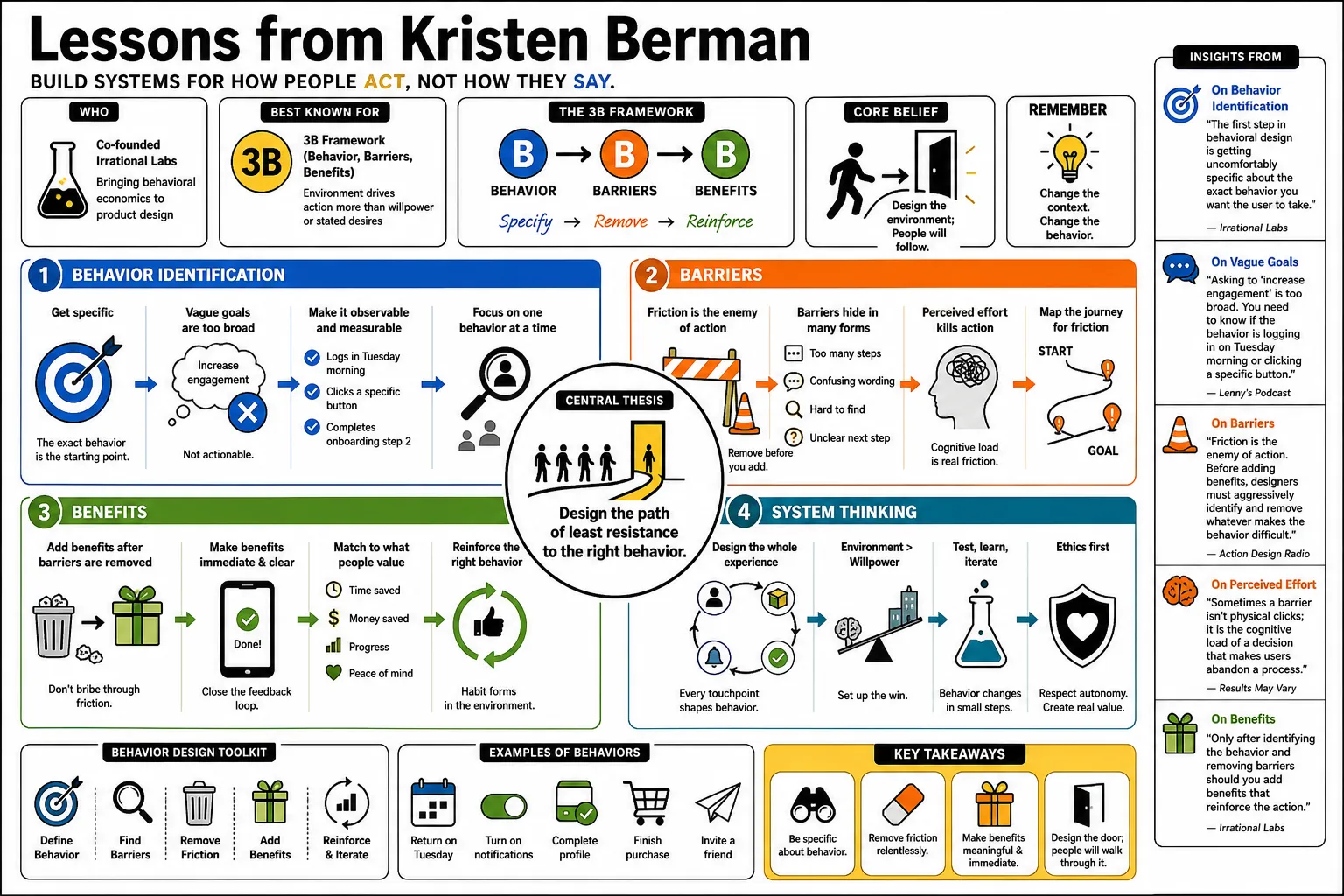
Lessons from Kristen Berman
Kristen Berman co-founded Irrational Labs to apply behavioral economics directly to product design. She is best known for the 3B Framework (Behavior, Barriers, Benefits) and the argument that environment drives action far more than willpower or stated desires. This profile catalogs her insights on building systems that reflect how people actually make decisions.
Part 1: The 3B Framework
- On Behavior Identification: "The first step in behavioral design is getting uncomfortably specific about the exact behavior you want the user to take." — Source: Irrational Labs
- On Vague Goals: "Asking to 'increase engagement' is too broad. You need to know if the behavior is logging in on Tuesday morning or clicking a specific button." — Source: Lenny's Podcast
- On Barriers: "Friction is the enemy of action. Before adding benefits, designers must aggressively identify and remove whatever makes the behavior difficult." — Source: Action Design Radio
- On Perceived Effort: "Sometimes a barrier isn't physical clicks; it is the cognitive load of a decision that makes users abandon a process." — Source: Results May Vary
- On Benefits: "Only after identifying the behavior and removing the barriers should you design the benefits to motivate the user." — Source: Afford Anything
- On Immediate Rewards: "Human beings dramatically overvalue immediate rewards and discount future benefits. Behavioral design must reflect this reality." — Source: Lenny's Podcast
- On the Order of Operations: "Most companies start by asking how to motivate users. They should start by asking why the behavior is hard in the first place." — Source: Irrational Labs
- On Logistical Friction: "We often blame a lack of motivation when the real culprit is poor logistics." — Source: Design Better Podcast
- On Measuring Behaviors: "If you cannot measure the behavior directly, you cannot optimize for it using the 3B framework." — Source: Lenny's Podcast
- On the Baseline: "Before running an experiment, you must establish the baseline rate of the specific behavior you are trying to change." — Source: Irrational Labs
Part 2: Customer Research
- On Focus Groups: "Do not ask customers what they want in a focus group. Their self-reported desires rarely match their actual behavior." — Source: TEDxBerlin
- On Good Intentions: "People honestly believe they will go to the gym next week or save money next month, but their current actions prove otherwise." — Source: Afford Anything
- On Observational Data: "You learn more by watching what a user clicks than by asking them what they value." — Source: Churn FM
- On Product Feedback: "When a customer says they want more features, they usually just want the core problem solved with less effort." — Source: Action Design Radio
- On Surveys: "Surveys measure intent, not action. If you rely on them for product strategy, you will build for a user that does not exist." — Source: TEDxBerlin
- On A/B Testing: "The most reliable way to know if a design works is to test it in a live environment, not in a user research lab." — Source: Lenny's Podcast
- On Rationality: "We design products as if users will carefully weigh the costs and benefits, but humans simply do not operate that way." — Source: Results May Vary
- On Self-Awareness: "Humans are remarkably bad at predicting their own future behavior." — Source: Irrational Labs
- On Behavioral Mapping: "Map the exact steps a user takes rather than the steps they tell you they take." — Source: Design Better Podcast
Part 3: Willpower vs. Environment
- On Willpower: "Willpower is a losing strategy. Small environmental changes beat motivation every time." — Source: Kristen Berman Substack
- On the Environment: In an Enrich Q&A, Berman uses an apple example to make the same behavioral point: stated attitudes are weak predictors, while the surrounding choice environment often determines what people actually do. — Reference: Enrich Q&A with Kristen Berman on environment mattering more than attitudes
- On Education: "Teaching people what they should do is notoriously ineffective for changing behavior. Changing their context works." — Source: Irrational Labs
- On Defaults: "The default option is the most powerful tool in behavioral design because it requires zero willpower to accept." — Source: Lenny's Podcast
- On Designing for Autonomy: On Lenny's Podcast, Berman presents behavioral design as specifying the target behavior, diagnosing barriers, and designing benefits around that action, so product work changes the action environment rather than relying on persuasion alone. — Reference: Lenny podcast page on Berman's 3B Framework for behavior, barriers, and benefits
- On Habit Failure: "When we fail to meet our goals, we blame our discipline instead of our poorly designed environment." — Source: Afford Anything
- On Opt-Outs: "Making a desired behavior the automatic choice drastically increases participation rates compared to opt-in systems." — Source: Irrational Labs
- On Visual Cues: "What is visible in your immediate environment will dictate what you consume and how you spend your time." — Source: Burning Man Live
- On Motivation: "Motivation fluctuates daily. An effective product does not require users to be highly motivated to succeed." — Source: Results May Vary
- On Structural Support: "True change happens when the structure of your life makes the bad habit harder and the good habit easier." — Source: Design Better Podcast
Part 4: Financial Psychology
- On Saving Money: "Telling someone to save for retirement requires them to fight their present bias. Automating their savings removes the fight." — Source: Pay Pod
- On One-Time Decisions: "Make a single, high-impact financial decision—like setting up an automatic transfer—rather than trying to rely on daily discipline." — Source: Afford Anything
- On Mental Accounting: "People treat money differently depending on how they earned it and how they categorize it in their heads." — Source: Impact Pricing
- On Friction in Spending: "Adding simple friction, like a waiting period before a large purchase, can drastically reduce impulsive spending." — Source: Pay Pod
- On Goal Proximity: "People save more when the goal feels immediate and tangible rather than abstract and distant." — Source: Irrational Labs
- On Peer Comparison: "Showing people how their savings rate compares to their peers is a stronger motivator than financial literacy training." — Source: Afford Anything
- On Windfalls: "People are much more likely to save a future bonus or tax refund if they commit to it before the money arrives." — Source: Impact Pricing
- On Financial Literacy: "Financial education often fails because knowing what to do is fundamentally different from doing it in the moment." — Source: Pay Pod
- On Credit Cards: "The abstraction of digital payments removes the pain of paying, which inevitably leads to higher spending." — Source: Afford Anything
Part 5: Friction and Flow
- On Adding Friction: "We usually want to remove friction, but adding intentional friction can force users to stop and make a deliberate choice." — Source: Churn FM
- On Onboarding: "The best onboarding experiences ask the user to do the core action immediately, rather than explaining it first." — Source: Lenny's Podcast
- On Simplification: "If you want someone to do something, make it the easiest possible thing they can do." — Source: Irrational Labs
- On Cognitive Load: "Every field in a sign-up form cuts conversion. You are spending your user's limited cognitive budget with every question." — Source: Design Better Podcast
- On Decision Fatigue: "Presenting too many choices paralyzes users. Curate the options to increase the likelihood they make a selection." — Source: Lenny's Podcast
- On Good Friction: "Adding friction before a destructive action, like deleting an account, protects the user from accidental errors." — Source: Churn FM
- On Default States: "Users rarely change settings. The default state of your product is the only state most users will ever experience." — Source: Action Design Radio
- On Information Diet: "Providing all the information at once overwhelms users. Reveal information only when it is needed for the next step." — Source: Irrational Labs
- On Habituation: "If a process is too smooth, users stop paying attention. Sometimes you need a bump in the road to ensure they read the terms." — Source: Results May Vary
Part 6: Habits and Decision Making
- On Habit Formation: "Habits are often overrated. Focus instead on one-time environmental changes that yield permanent results." — Source: Afford Anything
- On Commitment Contracts: The New Yorker's overview of the Ulysses strategy describes precommitment contracts as voluntary constraints or penalties people choose in advance; the article cites higher success rates for commitment contracts with stakes than for contracts without stakes. — Reference: New Yorker article on Ulysses strategy, precommitment, and commitment contracts with stakes
- On Timing: "Intervening at the exact moment a decision is being made is far more effective than reminding the user beforehand." — Source: Irrational Labs
- On Context Shifts: "The easiest time to change a habit is during a major life transition, like moving or starting a new job, when the old context is broken." — Source: Burning Man Live
- On Implementation Intentions: "Asking someone when, where, and how they will perform an action dramatically increases the odds they will do it." — Source: Results May Vary
- On Anchoring: "The first piece of information a user sees anchors their expectations for every decision that follows." — Source: Impact Pricing
- On Status Quo Bias: "People prefer things to stay the same. Overcoming this bias requires a benefit that is overwhelmingly obvious." — Source: Action Design Radio
- On Identity: "When a behavior is linked to a person's identity, they are much more likely to maintain it." — Source: Afford Anything
- On Loss Aversion: "Framing a choice in terms of what the user will lose is generally more motivating than framing it as a gain." — Source: Lenny's Podcast
Part 7: Product Design and Engagement
- On User Retention: "Retention is not driven by marketing emails; it is driven by users repeatedly finding core value with minimal friction." — Source: Churn FM
- On Rewards: "Unpredictable rewards keep users engaged much longer than predictable, scheduled rewards." — Source: Design Better Podcast
- On Social Proof: "Telling a user that 'most people' do something is a highly effective way to influence them to do the same." — Source: Irrational Labs
- On Gamification: "Adding points and badges only works if the underlying behavior is already somewhat meaningful to the user." — Source: Lenny's Podcast
- On Feedback Loops: "Immediate, clear feedback after an action reinforces the behavior and guides the user forward." — Source: Action Design Radio
- On Choice Architecture: "Every design choice influences behavior. There is no such thing as a neutral interface." — Source: TEDxBerlin
- On Goal Gradients: "Users speed up their actions as they get closer to completing a goal. Show them their progress." — Source: Irrational Labs
- On Product Ethics: "If you understand behavioral science, you have a responsibility to design products that align with the user's long-term well-being." — Source: Design Better Podcast
- On Novelty: "The human brain is wired to pay attention to new things. Product updates must balance familiarity with novelty to maintain attention." — Source: Churn FM
- On Deadlines: "Without a clear deadline or sense of urgency, users will defer action indefinitely." — Source: Lenny's Podcast
Part 8: Behavioral Science in Organizations
- On the Behavioral Product Manager: "We need a new role—the Behavioral Product Manager—who focuses entirely on the psychology of user actions rather than just feature delivery." — Source: Action Design Radio
- On Experimentation: "Do not assume you know how users will react. Build a culture where every significant change is tested as a behavioral experiment." — Source: Irrational Labs
- On Cross-Functional Teams: "Behavioral insights must be shared across design, product, and engineering, or the implementation will fail at the handoff." — Source: Lenny's Podcast
- On Metric Obsession: "Optimizing for short-term clicks often destroys long-term trust. Measure the behavior that indicates real value." — Source: Churn FM
- On Institutional Bias: "Companies suffer from the same biases as individuals, often clinging to failed projects due to sunk cost fallacy." — Source: Impact Pricing
- On Incentives: "If your team is incentivized to launch features rather than change user behavior, they will build bloatware." — Source: Results May Vary
- On Executive Buy-In: "To implement behavioral science effectively, leaders must accept that traditional customer research is inherently flawed." — Source: TEDxBerlin
- On Failures: "A failed experiment is a success if it accurately disproves an incorrect assumption about your users." — Source: Irrational Labs
- On the Future of Tech: "The next wave of innovation will not come from new technology, but from a better understanding of human psychology." — Source: Design Better Podcast