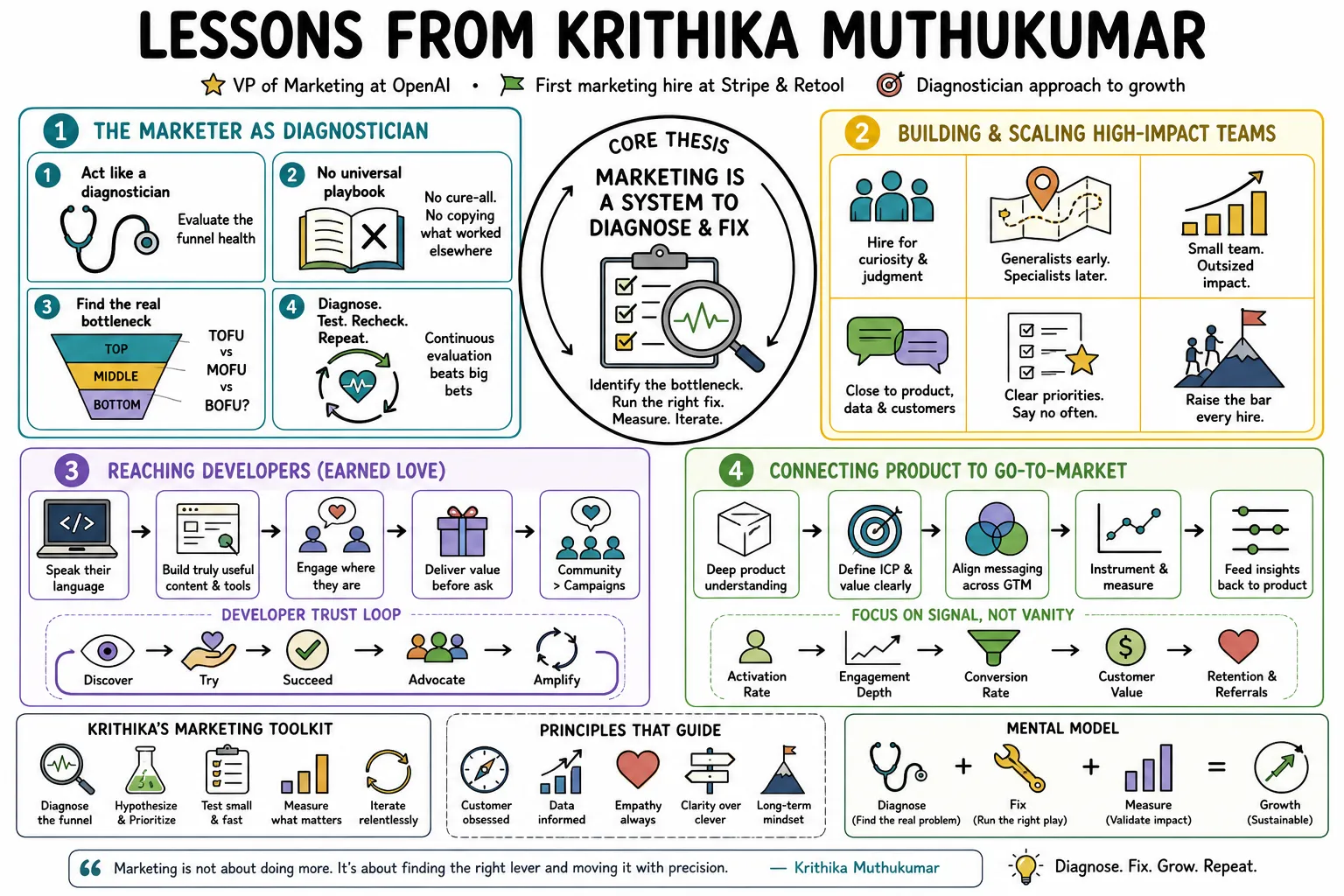
Lessons from Krithika Muthukumar
Krithika Muthukumar is the VP of Marketing at OpenAI and was the first marketing hire at both Stripe and Retool. She takes a "diagnostician" approach to marketing, treating company growth as a system that needs specific fixes rather than generic playbooks. This profile gathers her practical advice on scaling teams, reaching developers, and connecting product to go-to-market strategy.
Part 1: The Marketer as Diagnostician
- On the primary role of a marketer: "A startup marketer's job is to act like a diagnostician, evaluating the health of the company's funnel to figure out where the actual bottleneck is." — Source: First Round Review
- On rejecting universal playbooks: "There is no single cure-all for a startup's marketing challenges. You cannot copy what worked at another company and expect it to fix your specific growth problem." — Source: In Depth Podcast
- On identifying the real problem: "Before you decide to launch a massive brand campaign or overhaul your SEO, you need to diagnose whether your problem is actually top-of-funnel awareness or if it is middle-of-funnel conversion." — Source: First Round Review
- On continuous evaluation: "The diagnostic process isn't something you do once during onboarding. In a fast-growing company, the constraints change constantly, so you have to re-evaluate the business's health every few months." — Source: Retool Blog
- On prescribing the right medicine: "Once you have diagnosed the issue, the treatment varies wildly. A retention problem requires entirely different work streams, tools, and hires than an acquisition problem." — Source: In Depth Podcast
- On avoiding shiny object syndrome: "Marketers often want to do the fun, highly visible work. But if your diagnostic work shows that users are dropping off during onboarding, fixing the documentation is more important than a new billboard." — Source: Sharebird Interview
- On the 'House M.D.' analogy: "Think of the marketing function like the diagnostic team on House. You have to look at the symptoms, test hypotheses, and sometimes rule out the obvious answers to find the underlying issue." — Source: First Round Review
- On data as a diagnostic tool: Muthukumar frames early marketing as diagnostic work: understand the sales or buying motion deeply, then judge marketing by downstream signals such as revenue influence, engagement, and product usage rather than by surface activity. — Reference: First Round article on Muthukumar's diagnostician model for startup marketing
- On prioritizing interventions: "You will always have ten different things you could be doing to improve growth. Being a diagnostician means knowing which single intervention will have the highest impact right now." — Source: In Depth Podcast
- On adapting the marketing team: "As the diagnosis changes over time, so should the composition of your team. The generalist you hired for early awareness might be the wrong person to build out lifecycle marketing later." — Source: First Round Review
Part 2: Early-Stage Startup Marketing
- On being the first marketing hire: "When you join as the first marketer, you are building the fundamental systems that will allow the company to communicate with the outside world." — Source: Retool Blog
- On initial infrastructure: "In the early days, you don't need a complex martech stack. You need a single source of truth for your customer data, even if that means writing SQL queries yourself to pull lists." — Source: Retool Blog
- On founder alignment: "The most important relationship for an early marketer is with the founders. You have to deeply understand their ideas before you can translate them into external messaging." — Source: First Round Review
- On wearing multiple hats: "As the first marketer, you are doing positioning one hour and setting up DNS records for an email tool after lunch. You have to be comfortable in the weeds." — Source: In Depth Podcast
- On avoiding premature scaling: "Do not build marketing processes for a 500-person company when you only have 50 employees. Build the lightweight version that solves today's problem." — Source: Sharebird Interview
- On speed of execution: "In an early-stage startup, shipping fast is a feature. It is better to get a good enough campaign out the door and learn from it than to wait weeks for perfection." — Source: Retool Blog
- On establishing metrics: At Stripe, Muthukumar says the team measured marketing much deeper into the funnel: acquisition work was tracked toward sales-qualified opportunities, while product-side work looked at whether the right users engaged, used the product, and came back. — Reference: Retool interview on Stripe metrics, product engagement, and deep-funnel measurement
- On early positioning: "Your early positioning does not have to be permanent. It just has to be clear enough to attract your initial core audience and differentiate you from the immediate alternatives." — Source: Intercom Podcast
- On manual workarounds: "Do not be afraid of doing things that do not scale initially. I spent a lot of time manually segmenting lists and checking data in the early days of Stripe because the automated tools were not set up yet." — Source: Retool Blog
Part 3: Marketing to Developers
- On developer skepticism: Her developer-marketing standard at Stripe was to remove fluff, avoid alienating technical users, use plain-spoken language, keep useful content ungated, and earn trust through knowledge sharing rather than heavy-handed promotion. — Reference: First Round podcast transcript on Stripe developer marketing and ungated content
- On educational content: "The best way to market to developers is to educate them. Teach them how to solve a hard technical problem, and they will trust you when they need a tool in your space." — Source: Sharebird Interview
- On documentation as marketing: When Muthukumar joined Stripe, the public surface was mostly the website and documentation; support rotation exposed missing product explanations, so she built and burned down a stack-ranked list of public content gaps. — Reference: Retool interview on Stripe documentation, website surface area, and filling content gaps
- On authentic voice: "Your content needs to sound like it was written by an engineer, for an engineer. This means getting technical details right and avoiding hyperbolic claims." — Source: Retool Blog
- On community building: "You cannot manufacture a developer community; you have to earn it by consistently providing value, answering questions, and being transparent about your product's limitations." — Source: In Depth Podcast
- On showing the code: For Stripe Sigma, Muthukumar says the team studied how a new programming language used examples and code snippets to show how to build, then applied that inspiration to explain a data-analysis product for technical users. — Reference: First Round podcast transcript on Stripe Sigma examples and code snippets
- On open source contributions: "Contributing to open source or building free tools for developers builds immense goodwill that eventually translates into brand loyalty and paid usage." — Source: Sharebird Interview
- On developer events: "When hosting events for developers, focus on technical deep dives and architecture discussions rather than high-level product pitches." — Source: Intercom Podcast
- On respecting their inbox: Muthukumar describes expanding Stripe launches beyond occasional engineer-written posts into a fuller launch discipline, adding channels such as email, blog, social, events, landing pages, and dashboard communication to connect users with new products. — Reference: Intercom interview on Stripe launch discipline and customer communication channels
- On product-led growth: "For a developer audience, the product has to do the heavy lifting. Marketing's job is to get them to the aha moment in the product as quickly as possible." — Source: Retool Blog
Part 4: Scaling Operations at Stripe
- On transitioning from solo to team: "The shift from being the only marketer to managing a team requires a complete rewiring of how you work. You have to move from executing everything to setting context and editing." — Source: In Depth Podcast
- On building a launch culture: "At Stripe, we focused heavily on building a launch muscle. We wanted the entire company, especially engineering, to understand how to bring a product to market effectively." — Source: Retool Blog
- On cross-functional collaboration: "Scaling marketing means building repeatable processes with product and engineering. It cannot be marketing operating in a silo." — Source: First Round Review
- On expanding the audience: "As Stripe grew, we had to learn how to market to the CFO approving the purchase in addition to the developer integrating the API, without alienating our original base." — Source: Intercom Podcast
- On global expansion: "Taking a product global requires understanding local payment methods and regulatory environments." — Source: Intercom Podcast
- On maintaining quality at scale: "The hardest part of scaling is maintaining the high bar for quality that you had when the company was small. You have to codify what good looks like for the brand." — Source: In Depth Podcast
- On data infrastructure: "You eventually hit a breaking point where manual SQL queries fail to scale. Investing in marketing operations and data infrastructure is necessary for the next stage of growth." — Source: Retool Blog
- On managing complexity: "As the product portfolio expands, marketing has to manage the complexity of positioning multiple products that serve different needs while ensuring they still feel like one cohesive platform." — Source: Sharebird Interview
- On internal communication: "When a company grows quickly, internal marketing becomes as important as external marketing. The whole team needs to understand what we are launching and why." — Source: First Round Review
- On preserving agility: "Even as you add layers of process to handle scale, you have to find ways to preserve the agility that allowed you to move fast in the early days." — Source: In Depth Podcast
Part 5: Integrating Marketing with Product
- On breaking the silo: "Marketing should never be tacked on at the end of the product development cycle. If you wait until the product is finished to think about how to sell it, you are too late." — Source: Intercom Podcast
- On co-developing messaging: "The product team and the marketing team need to develop the messaging in tandem. The way a feature works should directly inform how it is described to the user." — Source: Intercom Podcast
- On user-facing release plans: "We found a lot of value in creating user-facing release plans early in the development process. This forces everyone to articulate exactly what benefit the product brings to the customer." — Source: Intercom Podcast
- On engineering involvement: "You want engineers to think beyond the code. Get them involved in writing the blog posts or thinking about the distribution strategy for the features they build." — Source: Retool Blog
- On feedback loops: "Product marketing is a two-way street. It involves taking customer feedback and market insights back to the product team to influence the roadmap." — Source: Sharebird Interview
- On alignment on utility: "Especially when marketing new ideas, the product messaging has to be tightly aligned with the actual, practical utility of the technology rather than the abstract concept." — Source: Intercom Podcast
- On shared goals: "Marketing and product should avoid competing metrics. They should share goals around product adoption or active usage to ensure they are pulling in the same direction." — Source: First Round Review
- On the value of a technical background: "Having a foundation in engineering makes it much easier to interface with product teams. You can understand the technical trade-offs and translate them accurately to the market." — Source: Retool Blog
- On launch readiness: "A product is not truly ready to launch until the go-to-market motion is as polished as the codebase." — Source: In Depth Podcast
Part 6: Storytelling and Brand Building
- On the core of a brand: "A brand is the consistent promise you make to your users and how reliably you deliver on it across every touchpoint." — Source: In Depth Podcast
- On educating the market: "When you are introducing a category-defining product, your primary job in marketing is education rather than persuasion. You have to teach the market why this new way of doing things is necessary." — Source: Intercom Podcast
- On clarity over cleverness: "In B2B and developer marketing, clarity always beats cleverness. If a user does not understand exactly what your product does within five seconds of landing on your site, you have lost them." — Source: Sharebird Interview
- On the pillars of brand: "Building a lasting brand requires a distinct visual identity and an uncompromising commitment to the user experience." — Source: In Depth Podcast
- On customer-centric storytelling: "The best product stories focus on what the product enables the customer to achieve. Make the customer the hero." — Source: Retool Blog
- On consistency: "Brand trust is built through repetition. It is about ensuring that the experience a user has reading your blog matches the experience they have using your API or talking to your support team." — Source: First Round Review
- On visual communication: "Design is an important part of marketing. High-quality design signals to users that you care about the details, which builds confidence in the reliability of your underlying product." — Source: In Depth Podcast
- On owning the narrative: "If you do not define your own story, the market or your competitors will do it for you. You have to proactively shape how people talk about your company." — Source: Intercom Podcast
- On enduring brands: "Enduring brands are built by being deeply observant of your audience. The more accurately you can reflect their daily realities and frustrations, the more resonant your brand will be." — Source: First Round Review
Part 7: Team Building and Hiring
- On the first marketing hire: "The ideal first marketer is a generalist who can execute across multiple channels but has a spike in one specific area, like product marketing or content." — Source: First Round Review
- On hiring for autonomy: "In a fast-growing startup, you need to hire marketers who do not need a playbook handed to them. You need people who can look at the data, figure out what needs to be done, and execute." — Source: Retool Blog
- On interviewing marketers: "When interviewing, ask candidates to walk you through a campaign they ran from end to end. You want to see if they understand the strategic why alongside the tactical how." — Source: Sharebird Interview
- On balancing specialists and generalists: "As the team grows, you transition from generalists to specialists. The challenge is knowing exactly when a channel has enough volume to justify hiring a dedicated expert." — Source: In Depth Podcast
- On cultural fit: "A marketer's success is heavily dependent on how well they mesh with the company's culture. A great marketer at a sales-led company might struggle in an engineering-driven environment." — Source: First Round Review
- On onboarding: "Effective onboarding for marketers must include deep product training. They need to understand the tool as well as a solutions engineer does to market it effectively." — Source: Sharebird Interview
- On setting expectations: "Be transparent with new hires about the level of chaos. If they expect perfectly clean data and established processes in a fast-growing environment, they will be frustrated." — Source: In Depth Podcast
- On diversity of thought: "The best marketing teams are composed of people with diverse backgrounds. Bringing together people from traditional tech and former engineering roles creates better ideas." — Source: First Round Review
- On scaling leadership: "Leading a team of five is completely different from leading a team of fifty. You have to learn to manage through other leaders and let go of the day-to-day execution." — Source: In Depth Podcast
Part 8: Resource Allocation and Leadership
- On managing resources: "Marketing always has infinite ideas and finite resources. The hardest part of leadership is saying no to good ideas so you can focus on the great ones." — Source: In Depth Podcast
- On focusing efforts: "Identify the small percentage of your marketing activities that are driving the majority of your results, and double down on them. Ruthlessly cut the programs that are just creating noise." — Source: First Round Review
- On budgeting for experiments: "Always carve out a portion of your budget and team bandwidth for wild experiments. If you only invest in proven channels, you will eventually tap them out and stall growth." — Source: Sharebird Interview
- On adapting to new environments: "Moving between different tech companies taught me that while the core principles of marketing remain the same, the specific application must adapt to the unique market dynamics of each company." — Source: In Depth Podcast
- On marketing AI products: "Marketing generative AI requires a delicate balance of explaining the transformative potential of the technology while remaining grounded in practical, immediate use cases." — Source: First Round Review
- On leading through ambiguity: "In high-growth companies, the strategy will change every six months. As a leader, your job is to absorb that ambiguity and provide clear, actionable goals for your team." — Source: In Depth Podcast
- On cross-functional trust: "You cannot mandate cross-functional alignment. You build trust with product and sales leaders by consistently delivering on your promises and showing that marketing is a revenue driver." — Source: Retool Blog
- On the value of constraint: "Tight budgets and limited headcounts often produce the most creative marketing. Constraints force you to focus on the highest-impact activities instead of throwing money at a problem." — Source: First Round Review
- On the long game: "Great marketing is rarely built in a single quarter. It requires patience to invest in foundational elements like brand and community that compound in value over years." — Source: In Depth Podcast