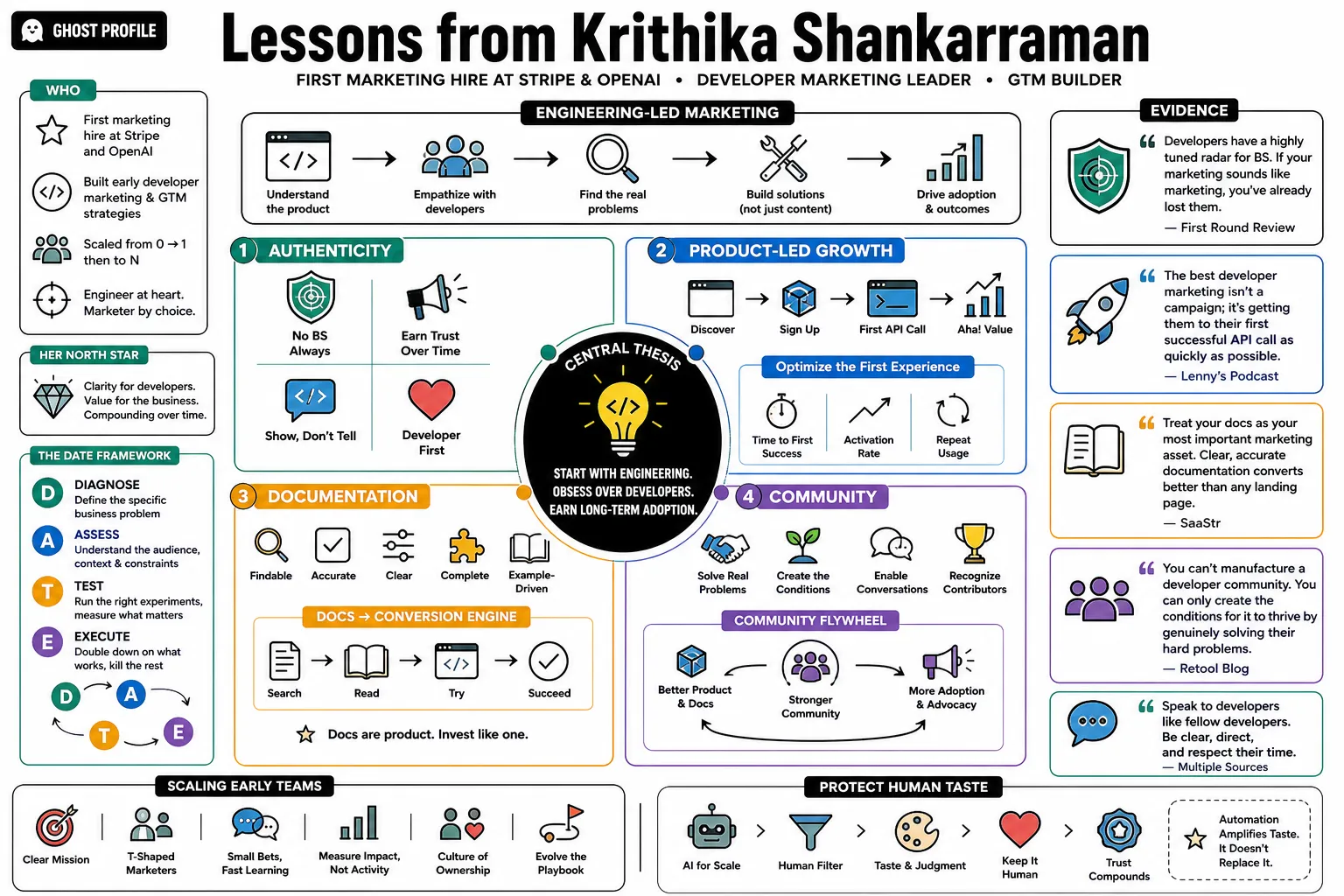
Lessons from Krithika Shankarraman
Krithika Shankarraman (Muthukumar) was the first marketing hire at Stripe and OpenAI, building their early developer marketing and go-to-market strategies. She favors an engineering-led approach to marketing, using the DATE framework to diagnose specific business needs instead of running standard playbooks. This profile covers how she positions technical products, scales early teams, and protects human taste against automated content.
Part 1: Marketing to Developers
- On authenticity: Shankarraman argues that developer audiences have a high bar for substance, so marketing needs to be technically precise and as carefully crafted as the product experience. — Reference: Lenny's Podcast episode with Krithika Shankarraman
- On product-led growth: Her marketing lesson is to move users toward the moment where they understand the product's value, not just toward another campaign impression. — Reference: Lenny's Podcast episode with Krithika Shankarraman
- On documentation: For technical products, useful educational surfaces -- docs, examples, launch copy, and onboarding -- function as part of the product, not decoration around it. — Reference: TLDL summary and transcript notes for Shankarraman on Lenny's Podcast
- On community: Shankarraman's approach starts with diagnosing what users need and what makes the product different, rather than trying to manufacture attention with generic playbooks. — Reference: Lenny's Podcast episode with Krithika Shankarraman
- On tone: Developer marketing has to respect the audience's technical judgment, with clear substance and precise claims instead of vague superlatives. — Reference: Lenny's Podcast episode with Krithika Shankarraman
- On education over promotion: Shankarraman emphasizes helping customers understand real use cases and constraints before defaulting to top-of-funnel marketing tactics. — Reference: Lenny's Podcast episode with Krithika Shankarraman
- On friction: In her OpenAI example, awareness was not enough; marketing had to help people understand what to use the product for and reach a clear moment of value. — Reference: Lenny's Podcast episode with Krithika Shankarraman
- On feedback loops: Shankarraman argues that marketing and product should stay tightly connected so messaging reflects real customer needs, product constraints, and adoption signals. — Reference: Lenny's Podcast episode with Krithika Shankarraman
- On useful case studies: Shankarraman's developer-marketing standard favors specific, technically useful examples over vague success stories, because technical audiences evaluate whether the product can solve their actual use case. — Reference: Lenny's Podcast episode with Krithika Shankarraman
- On respecting technical buyers: Her advice is to reduce vague marketing and give users concrete information about what the product does, where it fits, and what it helps them accomplish. — Reference: Lenny's Podcast episode with Krithika Shankarraman
Part 2: The First Marketing Hire
- On first-marketer priorities: Shankarraman's early-stage marketing work starts with understanding the product, the customer, and the use case clearly enough to make the company's story sharper. — Reference: Lenny's Podcast episode with Krithika Shankarraman
- On founder alignment: For a first marketing leader, Shankarraman emphasizes staying close enough to product and founder intent that external messaging reflects the actual strategy rather than a bolted-on campaign. — Reference: Lenny's Podcast episode with Krithika Shankarraman
- On marketing generalism: Shankarraman's first-marketer model is broad and hands-on: strategy, messaging, launches, customer understanding, and product feedback all sit close together early on. — Reference: Lenny's Podcast episode with Krithika Shankarraman
- On speed and learning: Shankarraman treats early marketing as an iterative learning loop: ship clear positioning, watch how users respond, and adjust the narrative as the product and market become clearer. — Reference: Lenny's Podcast episode with Krithika Shankarraman
- On communication culture: Her work at technical companies shows marketing setting more than campaign copy; it helps define how the company explains its product, its users, and its standards to the market. — Reference: TLDL summary and transcript notes for Shankarraman on Lenny's Podcast
- On early marketing signals: Before complex attribution work matters, Shankarraman focuses on whether customers understand the use case, see the product's value, and repeat the story back in useful language. — Reference: Lenny's Podcast episode with Krithika Shankarraman
- On hiring the next marketer: Shankarraman's first-marketer view implies that the next hire should add missing capability, not simply mirror what the first marketer already does well. — Reference: Lenny's Podcast episode with Krithika Shankarraman
- On resourcefulness: Her early marketing approach depends less on large budgets than on deep product understanding, fast execution, and a clear read on what customers need to understand. — Reference: Lenny's Podcast episode with Krithika Shankarraman
- On internal alignment: Shankarraman's product-adjacent marketing model requires internal alignment with engineering and product, so the external story reflects what the product actually does and where it is going. — Reference: TLDL summary and transcript notes for Shankarraman on Lenny's Podcast
- On patient brand-building: Shankarraman's work suggests that durable technical-brand equity compounds through repeated useful interactions, not one launch or campaign. — Reference: Lenny's Podcast episode with Krithika Shankarraman
Part 3: Building from the Ground Up
- On stage-appropriate playbooks: Her advice favors matching marketing systems to company stage; early teams need clarity and learning before they import the operating rituals of much larger companies. — Reference: Lenny's Podcast episode with Krithika Shankarraman
- On scaling operations: Shankarraman's early-stage marketing posture is to add process when it solves a visible bottleneck, not because a mature-company playbook says the tool should exist. — Reference: Lenny's Podcast episode with Krithika Shankarraman
- On category education: For technical products, Shankarraman emphasizes helping users understand the problem and use case before expecting them to respond to conventional solution marketing. — Reference: Lenny's Podcast episode with Krithika Shankarraman
- On marketing agility: Her first-marketer model keeps the marketing structure flexible as the company learns, because the needs of a tiny team and a scaling go-to-market motion are different. — Reference: TLDL summary and transcript notes for Shankarraman on Lenny's Podcast
- On customer intimacy: Shankarraman's first-marketer approach starts with close customer understanding, because technical messaging only improves when it reflects real use cases and adoption friction. — Reference: Lenny's Podcast episode with Krithika Shankarraman
- On prioritization: Shankarraman's early marketing lesson is to choose the few product stories and use cases that clarify the market, rather than scattering effort across every possible tactic. — Reference: Lenny's Podcast episode with Krithika Shankarraman
- On Experimentation: "Treat marketing initiatives like product features. Have a hypothesis, test it quickly, and measure the outcome." — Source: SaaStr
- On brand consistency: For technical products, Shankarraman's standard is a clear, repeated product narrative that helps users understand what the product is for and why it matters. — Reference: Lenny's Podcast episode with Krithika Shankarraman
- On Tooling: "Keep your marketing stack as simple as possible for as long as possible. Complex tools create busywork." — Source: Retool Blog
- On momentum: Shankarraman treats early marketing as an iterative learning loop: ship clear messaging, watch how users respond, and refine the story as the product and market become clearer. — Reference: Lenny's Podcast episode with Krithika Shankarraman
Part 4: Storytelling and Positioning
- On core narrative: Shankarraman's positioning work asks which customer problem, product use case, and category context make the product easiest for users to understand. — Reference: Lenny's Podcast episode with Krithika Shankarraman
- On simplicity: Her developer-marketing lesson is to make the use case easy to grasp quickly, because technical audiences will not reward clever copy that obscures what the product actually does. — Reference: Lenny's Podcast episode with Krithika Shankarraman
- On The Enemy: "Great stories need conflict. Identify the old way of doing things—the 'enemy'—and position your product as the inevitable future." — Source: SaaStr
- On showing product value: Shankarraman's marketing standard favors concrete demonstrations of what the product enables over vague adjectives about how impressive the product is. — Reference: Lenny's Podcast episode with Krithika Shankarraman
- On customer language: Shankarraman's approach makes customer understanding part of positioning: the best messaging reflects how users describe the problem, the workflow, and the moment of value. — Reference: Lenny's Podcast episode with Krithika Shankarraman
- On Differentiation: "Being slightly better is hard to market. Being fundamentally different is a story you can tell." — Source: Retool Blog
- On positioning evolution: Shankarraman's marketing framework treats positioning as context-dependent: diagnose the product, customer, and growth constraint first, then keep adjusting the story as the market changes. — Reference: Lenny's Podcast episode with Krithika Shankarraman
- On Empathy: "True product marketing requires deep empathy for the user's daily frustrations. If you don't feel their pain, you can't write to it." — Source: SaaStr
- On clarity: Shankarraman's messaging lesson is to make the use case obvious enough that customers can quickly understand the product's role, rather than rewarding clever language that slows comprehension. — Reference: Lenny's Podcast episode with Krithika Shankarraman
Part 5: The Engineering-Led Marketer
- On systems thinking: Shankarraman approaches marketing as an operating system: diagnose the constraint, choose the right lever, and make many small product, brand, and messaging decisions cohere. — Reference: First Round podcast with Krithika Muthukumar on marketing at Stripe, OpenAI, and Retool
- On analytical marketing: Shankarraman's edge is combining technical fluency, analytics, and storytelling so marketing choices are grounded in how users actually discover and adopt the product. — Reference: Lenny's Podcast episode with Krithika Shankarraman
- On Technical Competence: "To market a technical product, you have to understand the underlying architecture. You don't need to write production code, but you must grasp the concepts." — Source: Retool Blog
- On Iteration: "Marketing shouldn't be a waterfall process. Apply agile methodologies to your campaigns—launch, measure, adjust, repeat." — Source: SaaStr
- On technical credibility: Shankarraman's developer-marketing view is that brand comes from credible product decisions and technical substance, not from emotional claims that the product experience cannot support. — Reference: First Round podcast with Krithika Muthukumar on developer-facing marketing
- On AI leverage: Shankarraman's AI-era marketing lesson is to use tools to extend the team's creativity and judgment, while keeping strategy and customer understanding in human hands. — Reference: Lenny's Podcast episode with Krithika Shankarraman
- On Root Cause Analysis: "When a campaign fails, run a post-mortem like an engineering team would. Dig into the 'why' without assigning personal blame." — Source: SaaStr
- On precision: For technical audiences, Shankarraman's standard is specificity: product claims should be concrete enough that developers can connect the message to real capabilities and constraints. — Reference: First Round podcast with Krithika Muthukumar on high-tech marketing
- On product collaboration: Shankarraman's marketing work stays close to product and engineering because strong technical messaging depends on understanding what is shipping, what customers ask for, and how the experience actually works. — Reference: First Round podcast with Krithika Muthukumar on product marketing
Part 6: Human Taste in an AI Era
- On The True Differentiator: "As AI lowers the cost of content creation to zero, human taste and craft become the only sustainable moats." — Source: Business Insider
- On curation: Shankarraman's AI-era marketing view is that tools can expand output, but marketers still have to choose the right ideas, edit the work, and protect the quality bar. — Reference: Lenny's Podcast episode with Krithika Shankarraman
- On authenticity: Shankarraman's brand lesson is that messaging works best when it reflects real product substance and customer experience, not a generic voice pasted on top of the company. — Reference: First Round podcast with Krithika Muthukumar on brand and product marketing
- On Quality Over Quantity: "Don't use AI to spam the internet with mediocre blog posts. Use it to help you write one exceptional, highly researched piece." — Source: Business Insider
- On judgment: Shankarraman's framework uses data and diagnosis, but the marketer still has to decide which constraint matters most and which lever fits the product's actual market context. — Reference: Lenny's Podcast episode with Krithika Shankarraman
- On brand voice: Shankarraman treats brand voice as the product's operating truth made visible: distinctive messaging has to come from what the company actually builds, believes, and proves to customers. — Reference: First Round podcast with Krithika Muthukumar on brand-building decisions
- On Leverage: "Use AI to scale your operations and handle the busywork, but protect the creative core of your marketing strategy fiercely." — Source: Business Insider
- On customer empathy: Shankarraman's growth advice starts with the customer's situation: messaging should speak to the real workflow and adoption barrier instead of treating AI output as a substitute for customer understanding. — Reference: Lenny's Podcast episode with Krithika Shankarraman
- On the future marketer: Shankarraman's AI-era marketer is less a button-pusher than a strategist and editor: someone who knows the customer, chooses the right lever, and judges quality rigorously. — Reference: Lenny's Podcast episode with Krithika Shankarraman
Part 7: The DATE Framework and Growth Levers
- On Diagnostic Mindset: "The DATE framework is about diagnosing the true constraints of your business before throwing marketing tactics at the wall." — Source: TeardownX
- On custom strategy: Shankarraman argues against universal growth recipes; the right marketing move depends on diagnosing the product, audience, and market constraint in front of the team. — Reference: Lenny's Podcast episode with Krithika Shankarraman
- On identifying levers: Shankarraman's DATE framework pushes teams to identify the actual growth constraint first, then focus marketing energy on the few levers most likely to move that constraint. — Reference: Lenny's Podcast episode with Krithika Shankarraman
- On Avoiding Dogma: "Just because a tactic worked brilliantly at your last company doesn't mean it will work here. Context is everything." — Source: SaaStr
- On Data Integrity: "Any framework is only as good as the data feeding it. If your foundational metrics are broken, your strategic decisions will be flawed." — Source: TeardownX
- On alignment: Shankarraman's DATE framework helps teams argue less about departmental tactics and focus more on the product, audience, and growth constraint that actually needs attention. — Reference: Lenny's Podcast episode with Krithika Shankarraman
- On iterative growth: Shankarraman treats growth work as diagnosis followed by focused testing: understand the constraint, try the most relevant levers, and update the plan as evidence comes in. — Reference: Lenny's Podcast episode with Krithika Shankarraman
- On Market Dynamics: "You have to adjust your levers based on whether you are in a highly competitive existing market or defining a completely new one." — Source: SaaStr
- On Focus: "The hardest part of growth is ignoring the noise of what everyone else is doing and focusing solely on your primary constraints." — Source: TeardownX
Part 8: Lessons from OpenAI and Stripe
- On high-stakes launches: Shankarraman's OpenAI-era launch lesson is that new categories need clear framing: marketing has to help users understand what the product is, where it fits, and how to adopt it responsibly. — Reference: Lenny's Podcast episode with Krithika Shankarraman
- On scaling complexity: Shankarraman's Stripe experience shows the marketer's job in technical infrastructure: make complex capabilities understandable without flattening the product's substance or developer credibility. — Reference: First Round podcast with Krithika Muthukumar on Stripe and technical marketing
- On audience context: Shankarraman's growth framework starts by matching the tactic to the audience and product context; consumer excitement and enterprise trust require different messages and proof points. — Reference: Lenny's Podcast episode with Krithika Shankarraman
- On The Power of Design: "Stripe proved that design isn't just a wrapper; it's a core marketing asset. Beautiful APIs and beautiful docs signal quality." — Source: SaaStr
- On managing hype: Shankarraman's AI marketing approach is to pair excitement with education, so customers understand the use case and adoption path instead of reacting only to category noise. — Reference: Lenny's Podcast episode with Krithika Shankarraman
- On developer trust: Shankarraman's developer-marketing standard is credibility first: the story should respect technical buyers, show real product value, and avoid replacing substance with aggressive promotion. — Reference: First Round podcast with Krithika Muthukumar on developer-facing marketing
- On frontier products: Shankarraman's work on frontier products treats marketing as translation: help the market understand a new capability while staying grounded in the adoption barrier users face today. — Reference: Lenny's Podcast episode with Krithika Shankarraman
- On infrastructure marketing: Shankarraman's infrastructure-marketing lesson is to connect the technical platform to what builders can accomplish with it, while preserving the precision developers need to trust the claim. — Reference: First Round podcast with Krithika Muthukumar on Stripe and OpenAI marketing
- On The Ultimate Metric: "The most profound marketing metric isn't leads or traffic; it's the number of people building their life's work on top of your platform." — Source: SaaStr