Kyle Bass, the founder and Chief Investment Officer of Hayman Capital Management, is a prominent figure in the investment world, known for his bold, often contrarian, macroeconomic bets. His fame skyrocketed after he correctly predicted and profited from the subprime mortgage crisis of 2008. Bass's investment philosophy is a blend of deep macroeconomic research, geopolitical analysis, and a willingness to take on concentrated, high-conviction positions.
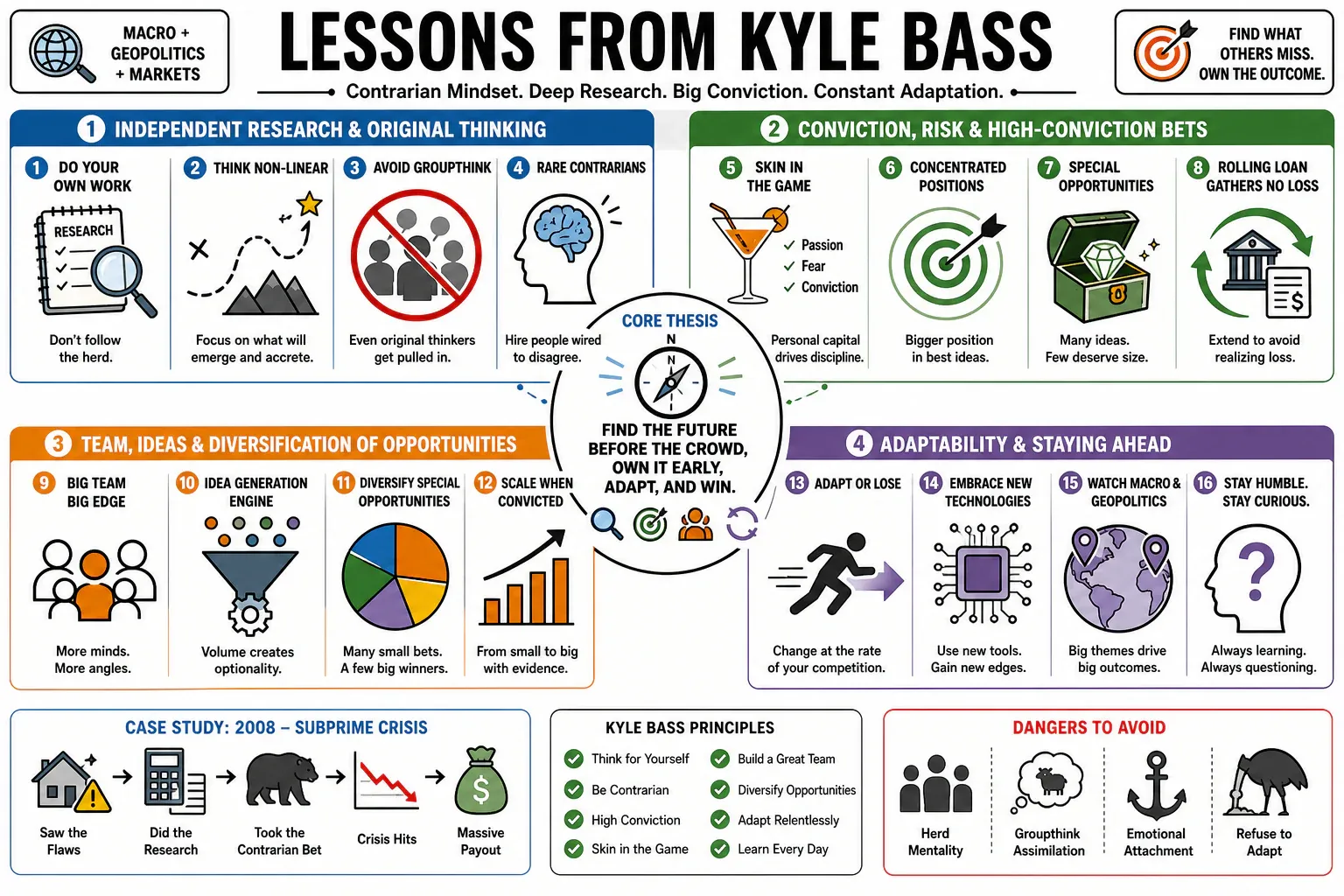
On Investment Philosophy and Strategy
- On doing your own work: Bass built his edge from original research rather than borrowed conviction; his subprime thesis rested on detailed due diligence, trade structuring, and willingness to stay with a view others rejected. — Reference: Business Insider on Bass doing due diligence before the subprime trade
- On fear as fuel: Bass frames pressure as part of the job: insecurity, fiduciary duty, and fear can be useful only when they push the investor toward better work and clearer communication. — Reference: Business Insider on Bass using pressure, communication, and fiduciary responsibility
- On non-linear thinking: Bass looks for situations where the past is a poor guide to the future; macro investing requires asking when correlations break and events change the payoff map. — Reference: Business Insider on Bass warning against treating past correlations as destiny
- On resisting consensus: Bass treats contrarian work as more than having a different opinion; the hard part is holding a researched thesis when smart people around you think it is wrong. — Reference: Business Insider on Bass staying with the subprime thesis despite skeptics
- On contrarian wiring: Bass values investors who are comfortable looking where others are not; the point is not reflexive disagreement, but the ability to find hidden opportunities before they become consensus. — Reference: Real Vision on Bass finding hidden opportunities by thinking outside the box
- On opportunity breadth: Hayman is built around global macro and event-driven opportunities, which lets Bass range across currencies, sovereign debt, equities, and special situations without being boxed into one asset class. — Reference: Economic Club of Dallas bio on Hayman global macro and event-driven investing
- On adapting to change: Bass treats macro views as living judgments: tariffs, currency pressure, trade relationships, and China risk all have to be updated as policy and market structure move. — Reference: Bloomberg Talks interview on trade, China, and currency risk
- "A rolling loan gathers no loss." [2] This adage points to the practice of extending or refinancing loans to avoid realizing losses, a key theme he identified in the lead-up to the subprime crisis. [2]
- "Don't (habitually) bet on Armageddon – it only happens once." [3] While known for his bearish calls, Bass cautions against constantly predicting doomsday scenarios, suggesting that such events are rare. [3]
- "To throw caution to the wind, and hope the central banks get it right from here is an out-sized risky proposition. It would be a breach of anyone's fiduciary duty to do so." [3] A critique of blind faith in central bank policies, this quote highlights his belief in prudent risk management and not abdicating investment decisions to monetary authorities. [3]
- "I have decided to take the big bet(s) and hedge the portfolio." [3] This summarizes his strategy of making significant, well-researched bets while using hedges to manage overall portfolio risk. [3]
- "The nature of investing is that you don't need a lot of good ideas throughout your career to be very successful. You need a couple of ideas that you have a high conviction in that you can execute on." [4] This reflects his belief in the power of concentrated, high-conviction investing.
On Macroeconomics and Geopolitics
- On geopolitical escalation: Bass connects markets to state conflict: his China analysis watches trade, Taiwan, the Philippines, rare earths, and pharmaceutical supply chains as part of one geopolitical risk system. — Reference: Bloomberg Talks interview on U.S.-China escalation risks
- On policy risk hedges: Bass thinks in terms of policy error and political cycles; when governments reset trade, deficits, and currency relationships, the investor has to price the instability, not just the headline asset move. — Reference: Bloomberg Talks interview on tariffs, deficits, and policy risk
- On real returns: Bass separates nominal gains from purchasing power: currency weakness, reserve pressure, and dollar-priced essentials can make an apparent asset return far less valuable in real terms. — Reference: Bloomberg Talks interview on currency weakness and dollar-priced essentials
- On China fiduciary risk: Bass argues that Chinese equities carry governance and fiduciary-duty problems investors should not wave away; the concern is investor protection, not just valuation. — Reference: CNBC interview on Bass avoiding Chinese stocks and fiduciary-duty concerns
- "We might have to go to a brief recession in order to rebuild our foundation." [6][7] Bass has argued that a short-term economic contraction may be necessary for the U.S. to address structural issues like trade imbalances and fiscal deficits, ultimately leading to a stronger long-term foundation. [6][7]
- "If we're doing tit-for-tat on tariffs, China loses, because there is no functional equivalency in the amount of goods and services moving back and forth." [6] In the context of the U.S.-China trade war, Bass believes the U.S. has the upper hand due to the significant trade imbalance. [3][6]
- "Bond markets don't lie Andrew, Chinese leadership lies but the bond markets don't lie." [3] He trusts the signals from the bond market over official government pronouncements, particularly when assessing the health of an economy like China's. [3]
- "We are a massive deficit running trade deficit running country where we have the global store value and the hegemonic currency." [8] This quote describes the unique position of the U.S. in the global financial system, which allows it to run deficits in a way other countries cannot. [8]
- "I think the world's going to just be a different place just imagine if Xi Jinping were to leave Taiwan alone how much better the world would be." [9] Bass highlights the geopolitical risk surrounding Taiwan as a major threat to global stability and prosperity. [9]
- "There's nothing that's going to bail China out of their economic spiral. They're having a real estate crisis, a banking crisis, a youth unemployment crisis, and now they need to be worried about their current account." [9] A summary of his deeply bearish thesis on the Chinese economy, pointing to a confluence of structural problems. [9]
- "You don't need to diversify into communism... you lose every time." [5] A blunt assessment of the risks of investing in state-controlled economies, arguing that the lack of rule of law and property rights will ultimately harm investors. [5]
- "The most leverage China has is now and it's every day that goes by they have less and less leverage." [10] Bass argues that time is on the side of the U.S. in its strategic competition with China, as China's relative power will diminish. [10]
- "I think that you need to let this play out I'm I don't know how much lower the market's going to go but my own inkling is that our belief is that you're not gonna the fed's not gonna be able to pull one trillion dollars out of risk assets." [10] A warning against buying dips during periods of monetary tightening, suggesting that the Federal Reserve's actions will continue to put downward pressure on asset prices. [10]
Learnings from Kyle Bass's Career and Approach
- Focus on "Tail Risks": Bass believes investors should pay more attention to "tail risks"—the possibility of rare but significant losses or gains. His famous subprime mortgage trade was a bet on a low-probability, high-impact event. [11]
- Global Macro is Key: His investment strategy has evolved from event-driven to a global macro focus. He believes that since the 2008 crisis, the "events" have become macroeconomic in nature as private debt was transferred to public balance sheets. [9][11]
- Understand Policymaker Motivations: A crucial part of his analysis involves understanding the motivations and constraints of policymakers and central bankers around the world. [11]
- Contrarianism as a Core Tenet: Bass actively seeks out investments that go against the prevailing market consensus. His bet against subprime mortgages when the housing market appeared strong is a prime example of his contrarian approach. [12]
- The Power of Asymmetric Bets: He looks for investment opportunities where the potential upside is significantly greater than the potential downside. The credit default swaps on subprime mortgages offered this type of asymmetric payoff profile.
- Geopolitical Analysis is Non-Negotiable: Bass integrates geopolitical analysis into his investment framework, believing that global power dynamics, conflicts, and political decisions are major drivers of market outcomes. [12]
- Short Selling as a Tool: He is a skilled short-seller, using it not just to profit from declining asset prices but also as a way to express a bearish view on a company or market. He has famously shorted biotech stocks and a Real Estate Investment Trust (REIT). [12]
- The Importance of a Network: Bass relies on a vast network of experts, academics, and other CIOs to share ideas, concerns, and gain different perspectives. [9]
- On humility from losses: Bass credits a painful early short sale with teaching him respect for position sizing, stop-losses, and the limits of being right too early. — Reference: Business Insider excerpt on Bass learning from his worst trade
- Look for "Signal Events": He focuses on identifying "signal events"—things that have never happened before—as these are the moments that can lead to significant market dislocations and opportunities. [4]
- Be Wary of Leverage: His analysis of the Chinese economy is heavily focused on its massive leverage, which he sees as a critical vulnerability. He notes their banking system is 3.5 times the size of its GDP, a much higher ratio than the U.S. had before the 2008 crisis. [5]
- Invest in Jurisdictions with the Rule of Law: A recurring theme is his preference for investing in countries with strong legal frameworks, property rights, and fiduciary duties to investors. [5]
- The US as a Hub of Innovation: Despite its challenges, Bass remains bullish on the United States as the world's primary engine of innovation and a top destination for investment. [13][14]
- Real Assets as a Hedge: In an environment of stagflation, he has advocated for owning real, hard assets as a way to defend wealth against the loss of purchasing power. [7]
- Cash Has Option Value: During times of market turmoil and uncertainty, Bass sees value in holding cash, not as a long-term investment, but for the optionality it provides to buy assets at lower prices later. [7]
- The "Controlled Burn" Analogy: He has described necessary but painful economic adjustments, like those from tariffs or spending cuts, as a "controlled burn" – a difficult but necessary process to create a healthier foundation for future growth. [15]
- Decoupling from China is a Long-Term Trend: He believes the economic and strategic decoupling between the U.S. and China is an ongoing process that will reshape global supply chains for years to come. [6]
- Challenge the Narrative: Bass's career is a testament to the value of questioning official narratives, whether from corporate executives or government officials. [3]
- Position Sizing Matters: He thinks deeply about how to size positions, sometimes allocating up to 30% of a fund to a single "best idea," demonstrating the courage of his convictions. [4]
- Being Early Can Mean Being Wrong for a While: A key challenge of his contrarian, trend-spotting approach is that he can be ahead of the market, which means his positions may underperform in the short term. [4]
- The US Dollar's "Exorbitant Privilege": He frequently discusses the unique role of the U.S. dollar as the world's reserve currency, which gives the United States significant economic and financial power. [8]
- Think in Cycles: Bass's macroeconomic approach is inherently cyclical. He analyzes where economies are in their respective credit and business cycles to inform his investment decisions. [4]
- National Security is Economic Security: He views issues like domestic manufacturing capacity and supply chain resilience through a national security lens, arguing that a strong economy is vital for a strong nation. [7][16]
- Adaptability in Strategy: While his core principles remain, his strategic focus shifts based on the global landscape. He moved from micro event-driven trades to macro bets as government and central bank actions became the primary drivers of the market. [9][11]
- On conviction after research: Bass earns conviction through detailed work: the subprime trade came from tracing mortgage-pool mechanics until a seemingly small assumption revealed a large asymmetric payoff. — Reference: Max Raskin interview on the subprime research process
Learn more:
- Kyle Bass Talks Tariffs and US Recession Odds - Bloomberg Talks | iHeart
- Kyle Bass on U.S.-China trade war: The pain is much greater on their side than our side
- Kyle Bass Interviews Contrarian John Burbank On His Investment Strategy - YouTube
- Uncovering the Truth: Is China's Economy Collapsing? w/ Kyle Bass (TIP611) - YouTube
- Watch CNBC's full interview with Steve Bannon and Kyle Bass on 'phase one' trade deal
- US May Need a Recession to Rebuild Foundation, Bass Says - YouTube
- The Interview - The Premier Finance & Business Interview Series in the Word | Real Vision
- Kyle Bass: China's Economic Spiral and the Coming Taiwan War - YouTube
- A Global Rethink: Kyle Bass at CNBC Financial Advisor Summit - YouTube
- Kyle Bass: Why the Chinese Economy is Going to Collapse - YouTube
- The Kyle Bass Interviews | Real Vision
- Global Macro Investing And Geoeconomics With Hedge Fund Investor Kyle Bass
- Global Macro Investing And Geoeconomics With Hedge Fund Investor Kyle Bass - YouTube
- Hayman Capital Kyle Bass: Tariffs will work in long-term - YouTube
- A Global Rethink with Kyle Bas… - The Keynote by CNBC Events - Apple Podcasts