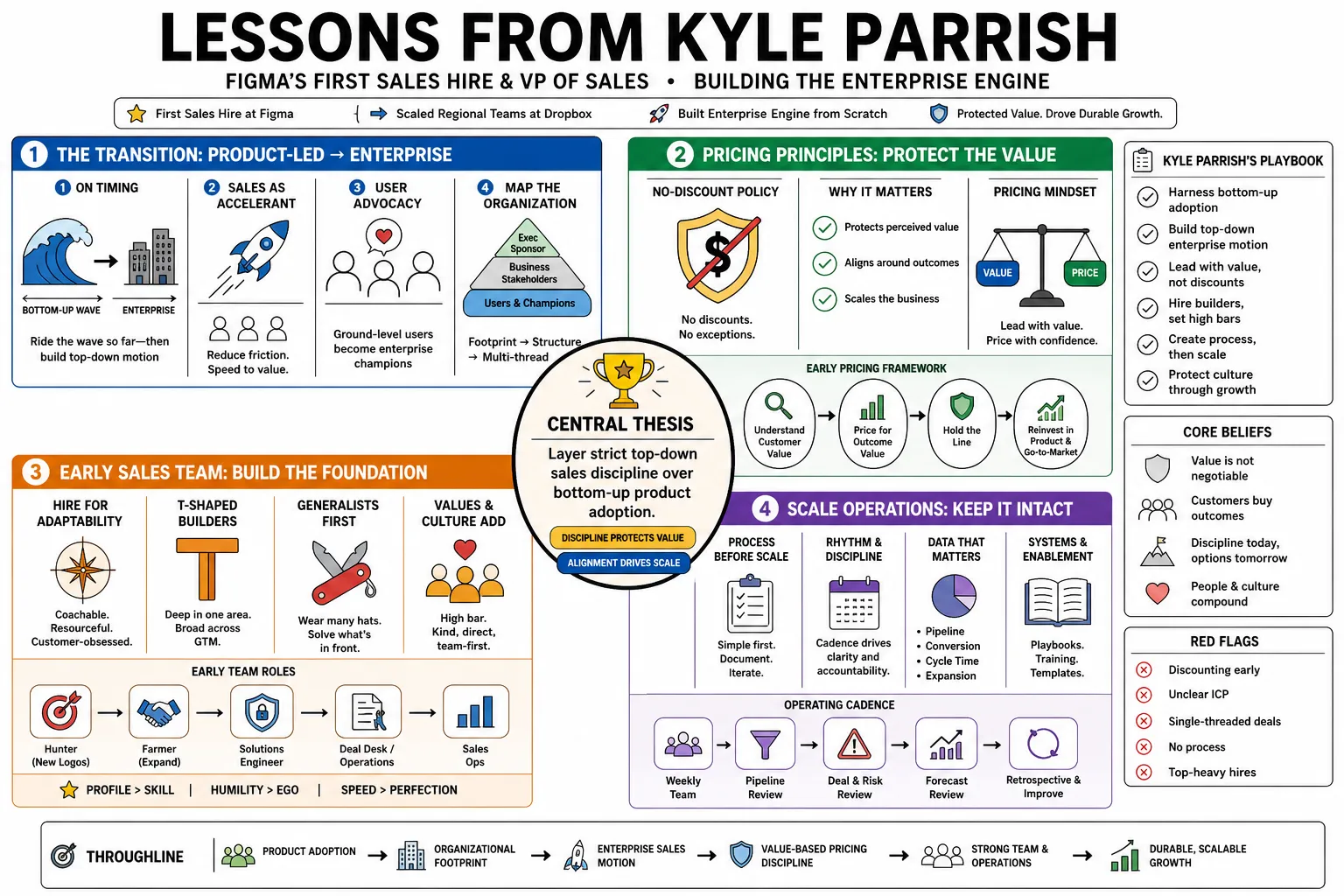
Lessons from Kyle Parrish
Kyle Parrish was Figma's first sales hire and VP of Sales, building the company's enterprise engine from scratch after years scaling regional teams at Dropbox. He figured out how to layer strict top-down sales discipline over bottom-up product adoption, notably enforcing a hard no-discount policy to protect the software's value. This collection organizes his specific frameworks for early-stage hiring, pricing strategy, and keeping operations intact during fast growth.
Part 1: The Transition from Product-Led to Enterprise
- On timing the transition: "You can only ride the wave of bottom-up adoption so far before you must build a structured top-down motion to capture true enterprise value." — Source: First Round Review
- On sales as an accelerant: "In a product-led environment, a sales team shouldn't introduce friction; they should act as an accelerant to help users navigate procurement and security." — Source: GTMnow
- On user advocacy: "Your best champions in an enterprise deal are the ground-level users who already love the product from the self-serve tier." — Source: SaaStr
- On mapping the organization: "Bottom-up growth gives you a footprint, but enterprise sales requires mapping that footprint against the organization's actual decision-makers." — Source: The Crew Podcast
- On retaining self-serve velocity: "The biggest risk in adding enterprise sales is slowing down the self-serve flywheel that got you there in the first place." — Source: First Round Review
- On enterprise readiness: "You know you're ready for an enterprise motion when your self-serve customers start asking for centralized billing, security reviews, and SSO." — Source: Mixmax
- On aligning with product: "The transition to enterprise fails if the sales team and the product team have fundamentally different views of who the customer is." — Source: GTMnow
- On bridging the gap: "Sales in a PLG motion is often just bridging the gap between a passionate individual user and a skeptical IT department." — Source: First Round Review
- On early sales motions: "The zero-to-one sales motion at a PLG company is less about outbound cold calling and more about intelligent, data-driven expansion." — Source: The Crew Podcast
- On customer expansion: "The goal isn't just to land a massive deal; it's to take a cluster of active users and formally organize them into a company-wide deployment." — Source: SaaStr
Part 2: Early Sales Hiring and "Scar Tissue"
- On hiring for resilience: "When building an early sales team, you want operators with 'scar tissue'—people who have survived the messy, chaotic phases of a startup before." — Source: GTMnow
- On the first sales hire: "The first sales hire shouldn't be a pure playbook executor; they need to be someone who can write the playbook while simultaneously closing deals." — Source: First Round Review
- On adaptability: "Early-stage sales is inherently unpredictable. You need reps who don't freeze when the product breaks or the messaging changes." — Source: Top1.fm
- On evaluating talent: "Look for candidates who ask hard, structural questions about the business during the interview, rather than just asking about quota and territory." — Source: First Round Review
- On avoiding big-company habits: "Sometimes hiring successful reps from massive tech giants backfires early on because they expect infrastructure that simply doesn't exist yet." — Source: GTMnow
- On founder alignment: "The initial sales hires must have an incredibly tight feedback loop with the founders, acting as the translator between market reality and product vision." — Source: First Round Review
- On the ideal profile: "You want a hybrid: someone analytical enough to understand usage data, but empathetic enough to build genuine relationships with users." — Source: The Crew Podcast
- On testing for grit: "I always look for evidence that a rep can handle the emotional roller coaster of early-stage growth without burning out." — Source: GTMnow
- On scaling the team: "Once you have two or three AEs consistently hitting quota with a repeatable motion, then you have permission to pour gas on the fire." — Source: SaaStr
- On leading by example: "As a sales leader in the early days, you cannot lead from a dashboard. You have to be on the calls, taking the rejections, and feeling the market." — Source: First Round Review
Part 3: The Philosophy of Pricing and No-Discounts
- On protecting value: "A strict no-discount policy forces your sales team to sell the actual value of the product rather than relying on price levers to close deals." — Source: First Round Review
- On procurement friction: "Procurement teams will always push for a discount out of habit, but holding firm signals that your product's pricing is transparent and fair." — Source: GTMnow
- On long-term trust: "When customers know you never discount, they stop waiting until the last day of the quarter to sign the contract." — Source: Mixmax
- On sales confidence: "Taking the discount lever away makes your sales reps better. It removes their crutch and forces them into deeper discovery." — Source: The Crew Podcast
- On early pricing strategy: "It's better to get your list price right and stick to it than to artificially inflate it just so you can offer the illusion of a deal." — Source: First Round Review
- On setting boundaries: "Saying no to a discount request is often the first real test of the partnership between a software vendor and an enterprise client." — Source: GTMnow
- On revenue predictability: "A no-discount culture makes forecasting drastically more accurate because deals aren't artificially held up by pricing games." — Source: SaaStr
- On internal alignment: "If the leadership team caves on pricing at the end of the quarter, the sales floor learns immediately that the rules are negotiable." — Source: First Round Review
- On customer respect: "Customers ultimately respect companies that stand behind the value of what they've built." — Source: Top1.fm
Part 4: Evolving from Founder-Led Sales
- On founder bottlenecks: "There comes a point where a founder's time becomes the primary bottleneck for revenue growth, and that is exactly when you must transition." — Source: First Round Review
- On the founder advantage: "Founders close early deals based on vision and sheer force of will. Sales teams must close them based on process and proven ROI." — Source: GTMnow
- On establishing repeatability: "Do not hire a sales team until the founders have personally sold enough deals to prove that the market actually wants the product." — Source: First Round Review
- On transferring knowledge: "The hardest part of moving away from founder-led sales is extracting the founder's intuition and turning it into a replicable playbook." — Source: The Crew Podcast
- On founder involvement: "Even after you build a sales org, founders should never fully step away from the customer. They just shift from closing to acting as executive sponsors." — Source: SaaStr
- On letting go: "Founders often struggle to let reps make mistakes, but a sales team cannot learn if the founder swoops in to save every deal." — Source: First Round Review
- On validating the process: "When your first non-founder rep hits quota using the established playbook, you have officially transitioned out of the founder-led phase." — Source: GTMnow
- On building the engine: "The goal is to move from an artisanal, hand-crafted sales process to a manufacturing engine that predictably yields revenue." — Source: Top1.fm
- On trusting the team: "The founders have to visibly trust the sales leader, or the rest of the company will continuously bypass sales to get to the founders." — Source: First Round Review
Part 5: Navigating Categories and Market Trends
- On picking winners: "I think you're looking for something where you see some big trends—like the rise of design in technology—that are disrupting major markets." — Source: Top1.fm
- On established categories: "If the category already exists and is understood, but it just hasn't been PLG'd, it is much easier to sell. People already understand the baseline." — Source: Top1.fm
- On behavioral shifts: "The best companies capitalize on a fundamental shift in how people want to work, rather than just building a marginally better feature." — Source: First Round Review
- On the power of defaults: "When your tool becomes the default language of a specific discipline, enterprise sales shifts from evangelism to simple facilitation." — Source: GTMnow
- On market timing: "You can have the best sales motion in the world, but if you are five years too early to a category, you will constantly be pushing a boulder uphill." — Source: The Crew Podcast
- On horizontal vs. vertical: "Selling a horizontal tool requires extreme discipline to not get distracted by every shiny new use case that a random customer suggests." — Source: SaaStr
- On changing mindsets: "We weren't just selling a new tool; we were selling a completely new, collaborative way of thinking about design." — Source: First Round Review
- On competitive moats: "Your strongest competitive moat is usually the community of passionate users who refuse to work in anything else." — Source: GTMnow
- On evaluating opportunities: "When looking at a startup, ask yourself if their approach removes a massive point of friction that users have simply accepted as normal." — Source: Mixmax
Part 6: Building Sales Culture and Resilience
- On defining culture: "Sales culture isn't about ping-pong tables; it's about how the team behaves on the last day of the month when things aren't going well." — Source: GTMnow
- On transparency: "In early-stage sales, you have to be completely transparent with your team about what is broken, or they will lose trust in leadership." — Source: First Round Review
- On celebrating losses: "You have to dissect the deals you lose with the same rigor and lack of ego as the deals you win." — Source: The Crew Podcast
- On peer learning: "The fastest way to scale institutional knowledge is to create an environment where top performers actively want to coach the newer reps." — Source: SaaStr
- On handling rejection: "Resilience is the quietest but most important trait in a salesperson. The ability to take a punch and dial the next number is everything." — Source: Top1.fm
- On setting the tone: "The sales leader's reaction to missing a target dictates the culture. If you panic, the team panics. If you analyze, the team analyzes." — Source: First Round Review
- On internal reputation: "A sales team must fiercely protect its reputation within the company by acting as collaborative partners, not just demanding revenue cowboys." — Source: GTMnow
- On avoiding burnout: "You manage the emotional roller coaster by focusing the team on the inputs they can control, rather than obsessing over the final outcome." — Source: Mixmax
- On continuous iteration: "A healthy sales culture treats the go-to-market playbook as a living document that is never truly finished." — Source: First Round Review
Part 7: Scaling Regional Teams and Go-To-Market Hubs
- On launching new offices: "When scaling a hub like we did in Austin, you are essentially launching a startup within a startup. It requires dedicated, cultural anchors." — Source: SaaStr
- On preserving DNA: "The hardest part of opening a second office is ensuring the original company DNA transfers over without feeling forced or artificial." — Source: First Round Review
- On local autonomy: "You have to give regional offices the autonomy to build their own sub-culture, as long as it aligns with the broader company values." — Source: GTMnow
- On over-communication: "When you operate across multiple hubs, you cannot rely on osmosis. You have to aggressively over-communicate every strategy shift." — Source: The Crew Podcast
- On leadership presence: "Headquarters leadership must physically spend time in the new hubs to prove that the remote office is not a second-class citizen." — Source: SaaStr
- On hiring local leaders: "Don't just transplant a mid-level manager from HQ; find a local leader who understands the regional talent market and commands respect." — Source: First Round Review
- On cross-pollination: "We constantly rotated successful reps between offices to ensure best practices were shared organically rather than mandated from above." — Source: GTMnow
- On standardizing operations: "While culture can be localized, your sales operations, metrics, and technical tooling must remain universally standardized." — Source: Mixmax
- On scaling fast: "Growing an office from 3 to 100 people quickly requires you to accept that processes will break, and you must patch them on the fly." — Source: First Round Review
Part 8: Integrating Sales with Design and Product
- On product empathy: "A salesperson selling a design tool must fundamentally respect the craft of design, or the end-user will see right through them." — Source: First Round Review
- On the feedback loop: "Sales is the sensory organ of the company. It is our job to capture market friction and deliver it cleanly to the product team." — Source: GTMnow
- On resisting custom features: "You have to rigorously protect the product roadmap from the sales team's desire to promise custom features just to close a single deal." — Source: Top1.fm
- On selling collaboration: "We weren't selling pixels or vectors; we were selling the ability for product, design, and engineering to finally speak the same language." — Source: The Crew Podcast
- On cross-functional trust: "The relationship between the VP of Sales and the VP of Product is the most critical alliance in a product-led growth company." — Source: SaaStr
- On product limitations: "A great sales rep doesn't hide the product's limitations; they confidently navigate around them while highlighting the core strengths." — Source: First Round Review
- On user experience as a metric: "In a PLG motion, the user experience of the actual software is your strongest piece of sales collateral." — Source: GTMnow
- On avoiding silos: "If sales and product sit in entirely different worlds, you end up selling a vision that the product can't deliver." — Source: Mixmax
- On speaking the language: "We trained our sales reps not just on negotiation, but on the core principles of design thinking, so they could have credible conversations." — Source: First Round Review
- On shared success: "When a massive enterprise deal closes, it isn't just a sales victory. It is validation that the product team built something fundamentally necessary." — Source: OpenView Partners