Lessons from Lane Shackleton
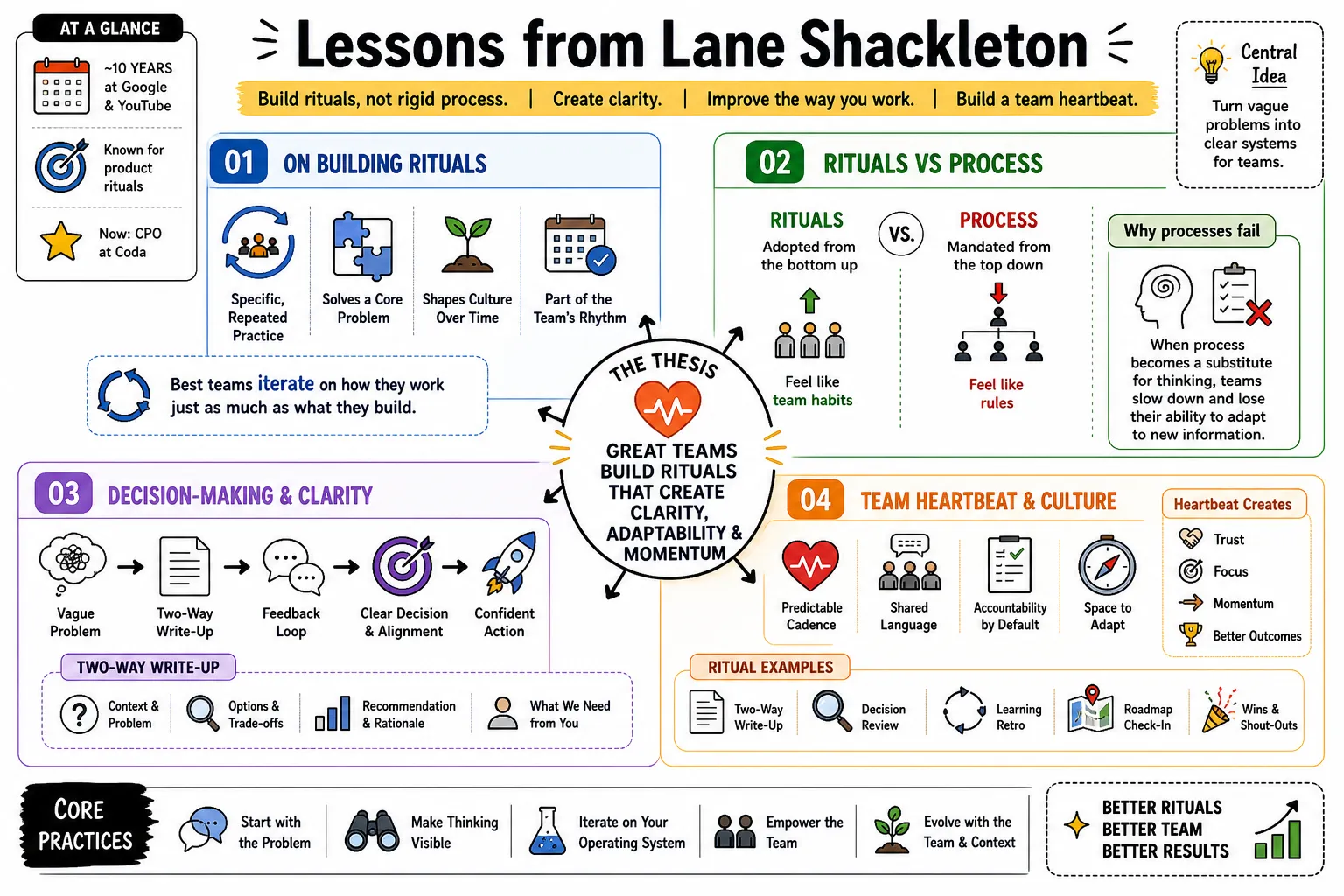
Lane Shackleton spent nearly a decade leading product at Google and YouTube before becoming Coda's Chief Product Officer. He is best known for formalizing product rituals like the two-way write-up and turning vague problems into clear systems for teams. This profile gathers his observations on decision-making, team culture, and how to run a more effective product organization.
Part 1: On Building Rituals
- On Rituals vs Process: "Processes are mandated from the top down and feel like rules, whereas rituals are adopted from the bottom up and feel like team habits." — Source: Lenny's Podcast
- On the definition of a ritual: "A ritual is a specific, repeated practice that solves a core problem for a team and shapes its culture over time." — Source: Coda Blog
- On continuous improvement: "The best teams treat their operating rhythm as a product itself, iterating on how they work just as much as what they build." — Source: Creator Economy
- On why standard processes fail: "When process becomes a substitute for thinking, teams slow down and lose their ability to adapt to new information." — Source: Medium
- On the heartbeat of a team: "Good rituals create a predictable cadence that reduces anxiety and allows people to focus their energy on solving hard problems." — Source: Product School
- On starting small: "You don't need a massive overhaul to change team culture; you just need one highly effective meeting format that people actually want to attend." — Source: Coda Blog
- On adopting vs inventing: "Don't try to invent every practice from scratch. Look at what successful teams are doing and adapt their templates to fit your context." — Source: Lenny's Podcast
- On documenting rituals: "If a team's operating principles only live in the manager's head, they aren't real. They have to be written down and accessible." — Source: Medium
- On naming rituals: "Giving a specific name to a team practice helps it stick and gives the team a shared vocabulary to discuss how they work." — Source: Creator Economy
- On assessing team health: "You can tell a lot about a team's health by looking at whether they blindly follow old routines or actively refine how they collaborate." — Source: Product School
Part 2: On Vision and "Cathedrals"
- On the cathedral fable: "When you ask a bricklayer what they are doing, they can say they are laying bricks, or they can say they are building a cathedral. Great teams do the latter." — Source: Coda Blog
- On laying bricks: "Focusing solely on the immediate task creates a feature factory where people lose sight of the actual customer problem." — Source: Lenny's Podcast
- On connecting daily work to purpose: "A product leader's primary job is to ensure every engineer and designer understands how their current sprint connects to the long-term vision." — Source: Medium
- On avoiding feature factories: "Shipping features is not success. Changing user behavior and solving real pain points is the only metric that matters." — Source: Product School
- On shared context: "Without a shared understanding of the end goal, highly talented individuals will inevitably pull the product in competing directions." — Source: Creator Economy
- On storytelling in product: "A strategy only works if it is a story that the entire team can repeat accurately when you are not in the room." — Source: Coda Blog
- On motivating engineers: "Engineers do not want to be handed a list of requirements; they want to be handed a compelling problem and the autonomy to solve it." — Source: Lenny's Podcast
- On the limits of goal-setting: "OKRs are useful for measurement, but they are terrible for inspiration. You need a narrative alongside the numbers." — Source: Medium
- On measuring impact: "Celebrate the outcome, not the launch. A launch just means you have started the experiment." — Source: Creator Economy
Part 3: On The "Two-Way Write-Up"
- On broadcasting vs conversation: "Traditional slide decks are a broadcast medium. They optimize for the presenter's comfort rather than the audience's understanding." — Source: Coda Blog
- On why presentations fail: "When you present slides, the audience is mostly trying to guess what is on the next slide instead of engaging deeply with the current point." — Source: Lenny's Podcast
- On silent reading periods: "Starting a meeting with ten minutes of silent reading levels the playing field and ensures everyone is operating from the same baseline of facts." — Source: Medium
- On collecting dissenting opinions: "A proper write-up forces people to put their questions and disagreements in text before the discussion begins, preventing groupthink." — Source: Creator Economy
- On the HIPPO effect: "Text-based feedback neutralizes the 'highest-paid person's opinion' because good ideas have to stand on their own merit, regardless of title." — Source: Coda Blog
- On forcing clarity: "Writing in complete sentences exposes sloppy thinking in a way that bullet points on a slide never will." — Source: Product School
- On equalizing participation: "Introverts often get talked over in live brainstorming. Collaborative documents allow them to formulate thorough, highly valuable feedback." — Source: Lenny's Podcast
- On the anatomy of a good write-up: "State the problem clearly, outline the explored options, detail the proposed solution, and list the explicit trade-offs." — Source: Medium
- On keeping discussions focused: "When comments are logged in a document, the meeting moderator can sort them by priority and systematically resolve the most contentious issues first." — Source: Coda Blog
- On ending with a decision: "The goal of the write-up is not to create a permanent artifact; it is to drive the team to a clear, actionable decision by the end of the hour." — Source: Creator Economy
Part 4: On AI and the Future of Product
- On AI as a thought partner: "Treat language models less like search engines and more like junior colleagues who can help you pressure-test your logic." — Source: Product School
- On automating busywork: "Product managers spend too much time formatting updates. AI should handle the synthesis so humans can focus on strategy." — Source: Coda Blog
- On multi-agent teams: "The future of product development involves humans orchestrating multiple specialized AI agents to accelerate research and code generation." — Source: Medium
- On changing the PM role: "As AI handles the execution details, product managers will need to become much better at framing problems and defining taste." — Source: Lenny's Podcast
- On prompt engineering for PMs: "Learning to instruct AI effectively is quickly becoming as fundamental as understanding agile methodology was a decade ago." — Source: Creator Economy
- On maintaining human elements: "No algorithm can replace the empathy required to sit across from a frustrated user and truly understand their emotional state." — Source: Product School
- On synthesizing user feedback: "We can now feed thousands of unstructured support tickets into a model and get a prioritized list of user pain points in seconds." — Source: Coda Blog
- On fast prototyping: "AI allows product teams to build functional prototypes in an afternoon, drastically reducing the cost of testing new ideas." — Source: Medium
- On AI-assisted drafting: "Staring at a blank page is the biggest bottleneck in documentation. Use AI to generate the first draft, then edit heavily." — Source: Lenny's Podcast
Part 5: On Decision Making and Ambiguity
- On turning ambiguity into clarity: "The best product managers act as a filter, taking chaotic, conflicting inputs and turning them into an ordered set of priorities." — Source: Lenny's Podcast
- On one-way vs two-way doors: "Most decisions in software are reversible. Spend your time debating the permanent choices and move quickly on everything else." — Source: Medium
- On decision logs: "Writing down why a decision was made prevents teams from endlessly revisiting the same arguments three months later." — Source: Coda Blog
- On disagree and commit: "Healthy teams argue passionately behind closed doors but present a completely unified front once a direction is chosen." — Source: Creator Economy
- On avoiding consensus traps: "Seeking total agreement leads to watered-down products. Someone needs to be explicitly accountable for making the final call." — Source: Product School
- On empowering teams: "Push decision-making authority as close to the actual work as possible. The people building the feature usually have the best context." — Source: Forbes
- On data vs intuition: "Data tells you what is happening, but intuition and qualitative research tell you why it is happening. You need both to decide." — Source: Coda Blog
- On framing the problem: "If a team is struggling to agree on a solution, they almost certainly have not agreed on the definition of the problem." — Source: Lenny's Podcast
- On timing of decisions: "Making a good decision too late is often worse than making a mediocre decision immediately." — Source: Medium
- On reversible choices: "When a choice is easily reversible, optimize for speed of execution and learn from the subsequent user behavior." — Source: Creator Economy
Part 6: On Team Alignment and Culture
- On breaking silos: "Great products are not built by isolated departments handing off specs. They are built by cross-functional pods sharing the same metrics." — Source: Coda Blog
- On product and design overlap: "The line between product management and product design should be blurry. Both roles are ultimately responsible for the user experience." — Source: Medium
- On the clean slate culture: "Early-stage companies have the advantage of inventing their culture from scratch, without the drag of legacy bureaucracy." — Source: Product School
- On managing stakeholders: "Stakeholder management is not about pleasing everyone; it is about ensuring everyone feels heard while you execute on the core strategy." — Source: Lenny's Podcast
- On celebrating failures: "If your team never ships a feature that fails, you are playing it too safe and leaving innovation on the table." — Source: Creator Economy
- On building trust: "Trust within a team is built through consistent, reliable follow-through on small commitments over time." — Source: Coda Blog
- On transparent communication: "Default to transparency. Information hoarding is a sign of a dysfunctional, highly political organization." — Source: Medium
- On cross-functional collaboration: "A product manager's authority is entirely informal. You have to lead by influence and logic, not by title." — Source: Forbes
- On resolving conflict: "Address interpersonal friction immediately. Unresolved conflict compounds and eventually destroys a team's ability to ship." — Source: Lenny's Podcast
Part 7: On Career Growth and Empathy
- On lessons from guiding climbs: "Being an Alaskan climbing guide taught me that leadership is about keeping people calm and focused when the environment becomes unpredictable." — Source: Lenny's Podcast
- On serving the team: "The best leaders view their role as a support function, actively removing roadblocks so their team can do their best work." — Source: Medium
- On active listening: "Most people listen just enough to formulate their counterargument. Real empathy requires listening to understand the underlying concern." — Source: Creator Economy
- On user empathy: "You cannot build a great product if you view users as data points. You have to genuinely care about solving their daily frustrations." — Source: Product School
- On the thankless nature of PM work: "Product management is a job where you take the blame for failures and give the credit for successes to the engineers and designers." — Source: Coda Blog
- On protecting team time: "A good manager acts as a shield, deflecting unnecessary meetings and organizational chaos away from the makers." — Source: Forbes
- On balancing family and high-stakes work: After missing some early family hours during a long commute, Shackleton says he now leaves work at 5 PM every day, helped by working in a mature startup culture where colleagues understand what it is like to have kids. — Reference: Startup Dad quote page from Lane Shackleton on leaving work at 5 PM and family-aware startup culture
- On giving feedback: "Criticize the work, not the person. Keep feedback highly specific, actionable, and grounded in user impact." — Source: Medium
- On personal growth: "Your career trajectory is determined by your willingness to volunteer for the messy, ambiguous projects that no one else wants to touch." — Source: Lenny's Podcast
Part 8: On Product Strategy and Design
- On the transition from YouTube: "Leaving a scaled giant like YouTube to join a startup requires unlearning the habits of optimization and relearning the habits of zero-to-one creation." — Source: Coda Blog
- On flexible software: "Modern software should adapt to how the team works, rather than forcing the team to adapt to how the software was designed." — Source: Medium
- On solving core problems: "Do not fall in love with your solution. Fall in love with the problem, and be willing to throw away your code if a better approach emerges." — Source: Creator Economy
- On monetization strategies: "Pricing and packaging are not afterthoughts; they are core product features that dictate how users perceive the value of what you have built." — Source: Lenny's Podcast
- On builder mentalities: "The most successful products empower users to feel like creators, giving them building blocks rather than rigid, predefined workflows." — Source: Product School
- On the Coda ecosystem: "Building a platform means your success is entirely dependent on the creativity of the community building on top of your primitives." — Source: Coda Blog
- On scaling product orgs: "As the team grows, the communication overhead scales exponentially. You have to aggressively simplify your organizational structure to maintain speed." — Source: Medium
- On simplicity in design: "A complex interface is usually a symptom of an unresolved argument among the product team. Simplicity requires making hard choices." — Source: Forbes
- On long-term bets: "You have to balance short-term metric optimization with long-term strategic bets that might take years to fully materialize." — Source: Lenny's Podcast