Key Learnings from Larry Ellison
Larry Ellison co-founded Oracle. His interviews and speeches explore competition, product development, independent judgment, and satisfying work. These selections distinguish his own observations from borrowed lines and historical ambitions. — Smithsonian — Larry Ellison Oral History.
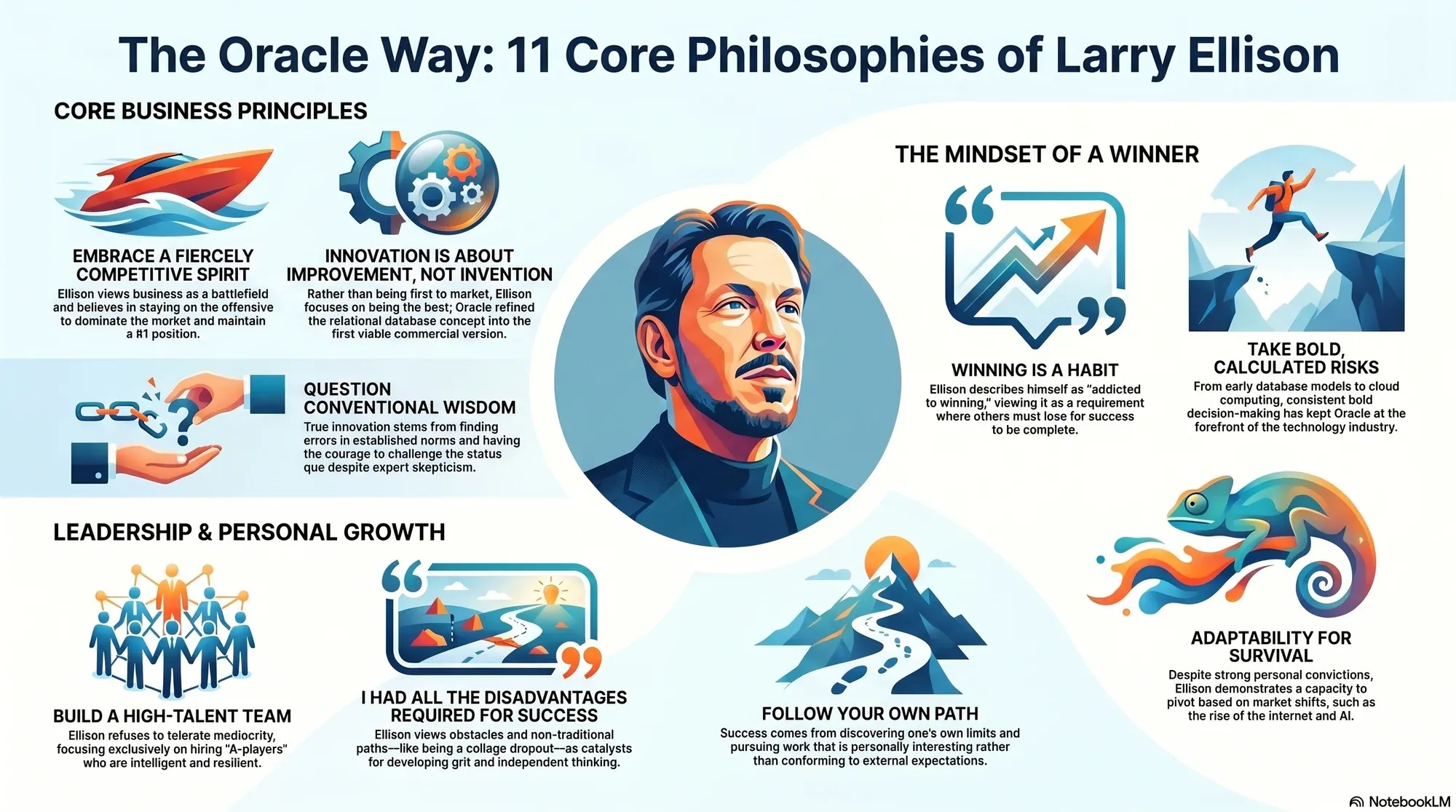
- Embrace a Fiercely Competitive Spirit: In his 1997 interview, Ellison frames his job as winning customers through better products and factual comparisons. — Academy of Achievement — Larry Ellison Interview.
- Innovation is About Improvement, Not Invention: Oracle sought to commercialize IBM’s published relational-database research rather than inventing the underlying theory. — Smithsonian — Larry Ellison Oral History.
- Question Conventional Wisdom: He credits questioning experts and authority with helping him think independently. — Academy of Achievement — Larry Ellison Interview.
- Take Calculated Risks and Be Bold: He argues for occasional major technical bets when emerging technology changes what can be built—not difference for its own sake. — Smithsonian — Larry Ellison Oral History.
- Focus on Building a Great Product: He links repeat business to product quality, while acknowledging that a better product does not always win. — David Sheff — Larry Ellison Interview.
- Adaptability is Crucial for Survival: In 2006, he advocated adapting to software-as-a-service rather than resisting a new delivery model. — Financial Times — Larry Ellison Interview.
- Build a Strong, Talented Team: He values talented colleagues who exercise independent judgment and challenge his thinking. — Academy of Achievement — Larry Ellison Interview.
- Follow Your Own Path: In his commencement address, he distinguishes his own interests from other people’s expectations of a medical career. — USC — 2016 Commencement Address.
On Winning and Competition:
- Keep Testing Yourself Through Competition: He describes finding it hard to stop competing, whether he has just won or lost. — Charlie Rose — Larry Ellison, 2013.
- Put Competitive Quotations in Context: Ellison says the everyone-else-must-fail line came from a story about another executive and was reported out of context. — Smithsonian — Larry Ellison Oral History.
- Learn Through Competition: He describes competition as a way to discover what he and his team can achieve. — David Sheff — Larry Ellison Interview.
- Distinguish Company Goals from Personal Wealth: In 2002, he valued Oracle overtaking Microsoft more than his personal ranking among wealthy people. — David Sheff — Larry Ellison Interview.
- Accept the Discomfort of a Different View: He recalls internal opposition when Oracle moved toward internet-based software despite prevailing customer preferences. — David Sheff — Larry Ellison Interview.
- Keep Competition’s Stakes in Perspective: He distinguishes the stakes: business matters more than sport but less than war; sailing is also fun. — David Sheff — Larry Ellison Interview.
- Build Better Products to Compete: In 1997, he described overtaking Microsoft as his competitive goal, not an accomplished result. — Academy of Achievement — Larry Ellison Interview.
On Innovation and Strategy:
- Expect Skepticism About Innovation: He cautions that being called crazy can accompany innovation—but can also mean an idea is wrong. — USC — 2016 Commencement Address.
- Differentiate Through a Real Technical Opportunity: He seeks emerging technologies that change what can be built, not novelty merely for its own sake. — Smithsonian — Larry Ellison Oral History.
- Find Errors in Conventional Wisdom: He connects major opportunities with identifying where accepted business assumptions are wrong. — David Sheff — Larry Ellison Interview.
- Do Not Copy a Role Model’s Surface Traits: He warns against copying Jobs’s surface traits instead of his product focus. — TechCrunch — Ellison at D10.
- Understand Software’s Scaling Economics: He explains that selling more software need not increase development costs proportionately, creating potential scale advantages. — The Chronicle — On the Record.
- Add Value Around Open Source: In 2006, he argued for adopting useful open-source software and selling added value such as support. — Financial Times — Larry Ellison Interview.
- Treat Generative AI as a Major Possibility: At CloudWorld 2023, he called generative AI potentially the most important new computing technology, while leaving the outcome open. — Oracle CloudWorld — Generative AI Strategy.
- Solve Problems and Build Things: He describes being driven to learn when knowledge helps him solve an engineering problem. — Smithsonian — Larry Ellison Oral History.
On Leadership and Management:
- Use Profit as an Operating Discipline: He views profit as pressure to operate efficiently, while acknowledging that public provision can also work. — Smithsonian — Larry Ellison Oral History.
- Create a Place You Enjoy Working: He wanted a workplace with competent colleagues he liked and trusted, rather than destructive internal competition. — Smithsonian — Larry Ellison Oral History.
- Make Necessary Decisions: He describes replacing managers as painful but necessary when the company’s survival and employees’ interests were at stake. — Academy of Achievement — Larry Ellison Interview.
- Build a Job You Love: His initial aim was a personally rewarding programming workplace; he did not originally expect a large company. — USC — 2016 Commencement Address.
- Keep Learning on the Job: As Oracle grew, he describes learning new things daily while adapting to an increasingly demanding role. — USC — 2016 Commencement Address.
- Think Before You Believe: He puts reasoning and evidence ahead of accepting a claim merely because someone in authority asserts it. — Charlie Rose — Larry Ellison, 2013.
- Give the Team Your Full Effort: He says he owes his sailing team full effort after its years of design and preparation. — Charlie Rose — Larry Ellison, 2013.
- Grades Do Not Guarantee Business Success: He calls academic success an advantage, but not a guarantee of business achievement. — Academy of Achievement — Larry Ellison Interview.
- Accept Discomfort with Difference: He says unconventional choices can unsettle others; criticism alone is not a reason to conform. — Academy of Achievement — Larry Ellison Interview.
On Life and Personal Philosophy:
- Do Not Romanticize Disadvantage: He invokes a theatrical line about disadvantage, but immediately acknowledges that adversity can destroy people as well as strengthen them. — David Sheff — Larry Ellison Interview.
- Recognize the Fear of Failure: He describes fear of failure as a personal driver of hard work and preparation. — Academy of Achievement — Larry Ellison Interview.
- Reconsider Risk After Experience: He says surviving the Sydney–Hobart storm made him more cautious about repeating the race. — David Sheff — Larry Ellison Interview.
- Discover Your Own Limits: He treats work and sport as forms of self-discovery, alongside relationships with other people. — Academy of Achievement — Larry Ellison Interview.
- Separate Your Dreams from Others’ Expectations: He recalls deciding not to confuse his family’s and wife’s expectations with his own dreams. — USC — 2016 Commencement Address.
- Notice What Interests You: He describes struggling to study premedical subjects that did not interest him. — USC — 2016 Commencement Address.
- Experiment to Discover Your Interests: He recalls trying different activities and jobs during his twenties as he searched for satisfying work. — USC — 2016 Commencement Address.
- Look Across Computing and Biology: He saw possibilities where computing met biotechnology and encouraged young scientists and engineers to build useful things. — Smithsonian — Larry Ellison Oral History.
- Reason from First Principles: He urges people to reason through scientific, moral, and business questions themselves. — Academy of Achievement — Larry Ellison Interview.
- Make a Deliberate Giving Commitment: His 2010 pledge letter states an intention to give away most of his wealth, while explaining his preference for private giving. — Giving Pledge — Larry Ellison’s Letter.
- Recognize a Borrowed Literary Voice: Describing life aboard his sailboat, Ellison explicitly borrows James Joyce’s words; the literary line is not his own aphorism. — USC — 2016 Commencement Address.
- Stay for the Unfinished Challenge: In 2002, he described reluctance to leave Oracle while its competitive story was still unfolding. — David Sheff — Larry Ellison Interview.
- Compete to Test the Team: He describes pursuing the America’s Cup to find out whether his team could engineer and sail the better boat. — David Sheff — Larry Ellison Interview.
- Consider What Money Is For: He recounts Jobs reminding him that their Apple plans need not be driven by making more money. — Charlie Rose — Larry Ellison, 2013.
- Separate Technology from Fashionable Labels: He describes cloud computing as promising while questioning claims that a new label represented an entirely new idea. — AllThingsD — Larry Ellison at D10.
- Distinguish Invention from Competitive Execution: Discussing Gates, Ellison repeats someone else’s Edison–Rockefeller comparison while emphasizing Gates’s focus and endurance. — Charlie Rose — Ellison on Gates.
- Revisit What Is Technically Feasible: He describes revisiting apparently impractical ideas when new technology changes the available engineering solutions. — Smithsonian — Larry Ellison Oral History.
Learn more:
- Academy of Achievement — Larry J. Ellison: 1997 Interview
- Smithsonian Oral and Video Histories — Lawrence Ellison Interview
- The Giving Pledge — Larry Ellison’s 2010 Pledge Letter
- David Sheff — Larry Ellison: September 2002 Playboy Interview
- Financial Times — Transcript: FT Interview with Larry Ellison
- Oracle — Larry Ellison Outlines Oracle’s Generative AI Strategy
- Charlie Rose — Larry Ellison Interview, August 15, 2013
- TechCrunch — Want to Be Like Steve Jobs? Ellison’s D10 Remarks
- The San Francisco Chronicle — On the Record: Larry Ellison (2005)
- AllThingsD — Oracle CEO Larry Ellison: Dog Fight in the Cloud (D10)
- Charlie Rose — Bill Gates Program: Ellison Interview Excerpt at 44:01
- USC — Lawrence J. Ellison’s 2016 Commencement Address