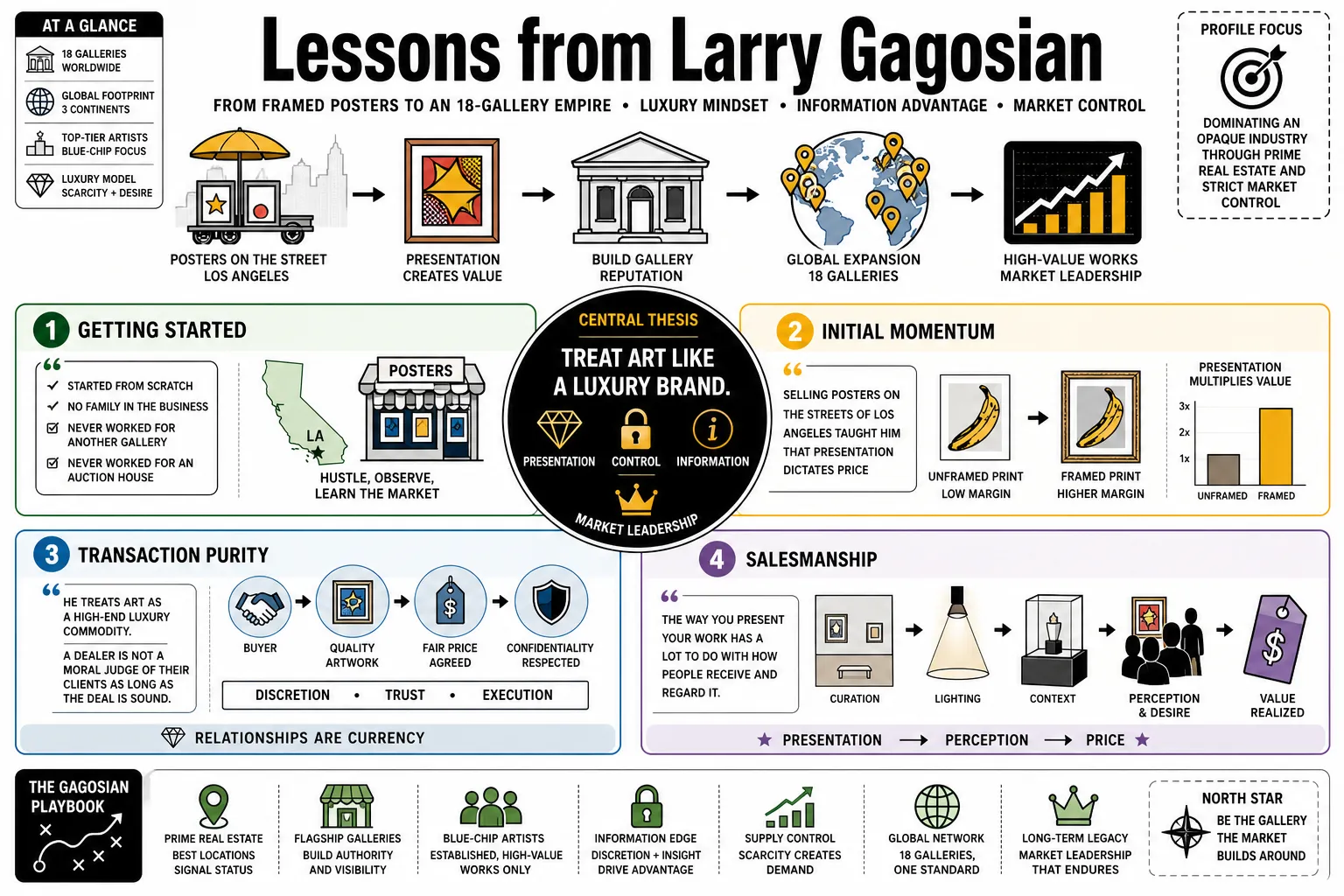
Lessons from Larry Gagosian
Larry Gagosian went from selling framed posters in Los Angeles to building an 18-gallery network that changed how contemporary art is bought and sold. He deals almost exclusively in established, high-value works, applying the mechanics of luxury brand expansion and information trading to the art market. This profile breaks down his unsentimental approach to dominating an opaque industry through prime real estate and strict market control.
Part 1: The Art of the Deal
- On Getting Started: "My journey is different from some other major galleries because I started from scratch. I didn't have family in the business. I never worked for another gallery. I never worked for an auction house." — Source: [Alain Elkann Interviews]
- On Initial Momentum: "Selling posters on the streets of Los Angeles taught him that presentation dictates price; framing a cheap print immediately increased its margin." — Source: [Interview Magazine]
- On Transaction Purity: "He treats art as a high-end luxury commodity, maintaining that a dealer is not a moral judge of their clients as long as the deal is sound." — Source: [The Art Newspaper]
- On Salesmanship: "The way you present your work has a lot to do with how people receive and regard it." — Source: [Numéro]
- On Cold Calling: "In his early days, he built his network through hundreds of cold calls, hunting down specific artworks that he knew a wealthy buyer might want." — Source: [Puck News]
- On Maintaining Momentum: "What keeps me going is the way it all plays off itself: the shows, the deals, the relationships." — Source: [Numéro]
- On Secondary Markets: "He often reverses traditional gallery logic by letting the secondary market signal demand, which then reinforces the value of the primary work he represents." — Source: [Wall Street Journal]
- On Precision Over Volume: "During market downturns, he advocates for tailoring sales tactics to specific works and specific collectors rather than blasting out broad inventory lists." — Source: [The Art Newspaper]
- On Playing Hard: "I play hard. So the critical stuff doesn't surprise me or bother me." — Source: [Numéro]
- On Strategic Focus: "He discovered early on that controlling the flow of a few high-value, blue-chip pieces provides far more power than representing dozens of untested names." — Source: [Wall Street Journal]
Part 2: Working With Artists
- On Primary Loyalty: "Professionally, what comes first is representing the artist. Whether they're alive or dead." — Source: [Numéro]
- On Personal Alignment: "If you don't want to collect the artist, then you probably shouldn't be representing them." — Source: [Milken Institute]
- On Dealer Responsibility: "My job as a dealer representing these incredible artists is ensuring they have income. I take it as a very serious responsibility to keep the ball rolling." — Source: [Milken Institute]
- On Representation vs. Friendship: "He emphasizes the necessity of genuinely liking the artists he works with, while maintaining the clear boundary that his primary job is to generate wealth and stability for them." — Source: [Alain Elkann Interviews]
- On Career Choreography: "He manages an artist's career from their primary debut to their later circulation at auction, ensuring their value remains stable across decades." — Source: [Puck News]
- On Estates: "He actively represents artist estates, treating the management of deceased artists' work with the exact same aggression and market strategy as living ones." — Source: [Interview Magazine]
- On Borrowed Trust: "Leo Castelli gave him early credibility by allowing him to show Castelli's artists in Los Angeles, teaching him that borrowing credibility from established names is the fastest way to build your own." — Source: [Puck News]
- On Departures: "When artists leave the gallery, he treats it as a structural reality of the business rather than an emotional defeat, focusing immediately on the next available asset." — Source: [Wall Street Journal]
- On Market Shielding: "By dealing heavily in established names, he shields his artists from the volatility of being newly discovered, providing them with institutional-level financial backing." — Source: [The Art Newspaper]
- On Exhibition Scale: "He funds elaborate, costly exhibitions that rival public museums, knowing that elevating the physical context of the work directly elevates its price ceiling." — Source: [Wall Street Journal]
Part 3: Scale and Architecture
- On Overhead as an Asset: "He uses the staggering cost of his lavish galleries as a marketing tool, as the massive expense signals stability and permanence to elite buyers." — Source: [Wall Street Journal]
- On Reinventing the Gallery: "I take a lot of pride in the fact that we created a new model of what a gallery could be. And other galleries have followed that." — Source: [Numéro]
- On Space and Perception: "He hires world-class architects like Jean Nouvel to design his spaces because he understands that the physical environment dictates the perceived value of the objects inside it." — Source: [Interview Magazine]
- On Following Capital: "He establishes physical footprints in major financial hubs like New York, London, Paris, and Hong Kong, ensuring he is exactly where the wealthiest collectors live and trade." — Source: [Puck News]
- On Opportunistic Growth: "His global expansion was rarely the result of a master plan; moving into London was driven by the practical need to accommodate a talented employee who was relocating." — Source: [Puck News]
- On Museum-Quality Branding: "By hosting historical, scholarly exhibitions curated by experts, the gallery elevates its brand to the level of a major public institution." — Source: [The Art Newspaper]
- On Real Estate: "The galleries are not merely retail spaces; they are exclusive environments designed specifically to host high-stakes events and close major deals in private." — Source: [Wall Street Journal]
- On Inventory Scale: "Operating eighteen locations worldwide requires holding massive amounts of high-quality inventory, effectively turning his operation into a decentralized museum that functions for profit." — Source: [Alain Elkann Interviews]
- On Digital Adaptation: "He uses Online Viewing Rooms not as a replacement for physical spaces, but as a way to bypass geographical limits and move inventory between major exhibitions." — Source: [The Art Newspaper]
Part 4: Competition and Ambition
- On Defining Ambition: "To me, ambition is energy with a purpose. There was always the energy, but there was no purpose." — Source: [Alain Elkann Interviews]
- On Industry Mechanics: "He considers the high-end art market to be a blood sport and freely admits that he loves the sheer challenge and the thrill of winning." — Source: [CBS News]
- On Auctions: "Bidding at high levels is thrilling for him; he uses auction houses both as a place to acquire inventory and a highly public stage to set market benchmarks." — Source: [CBS News]
- On Competitor Dynamics: "As a dealer gains experience and knows exactly where to find specific works, the competition with other elite dealers to secure those pieces only increases." — Source: [Alain Elkann Interviews]
- On Market Dominance: "Observers note that his genius lies in simplicity, avoiding overly corporate introspection to focus entirely on the aggressive pursuit of market opportunities." — Source: [Puck News]
- On Internal Motivation: "Unusually for the art world, he utilizes significant commission-based incentives for his gallery directors, demanding they be as aggressive and results-oriented as he is." — Source: [Wall Street Journal]
- On Being Default Aggressive: "His approach relies on showing up uninvited, creating demand through scarcity, and being entirely comfortable with high-profile conflicts when necessary." — Source: [Puck News]
- On Ignoring Critics: "The frequent criticism regarding his outsized influence over the market does not deter him; he views it as a natural byproduct of operating at the absolute top of a competitive field." — Source: [Numéro]
- On Finding Focus: "Ambition really didn't kick in until later in his life, but once he found his lane in art dealing, he eliminated distractions and focused entirely on compounding his advantage." — Source: [Alain Elkann Interviews]
Part 5: The Collector's Mind
- On Taking the First Step: "Well, you start by buying. Buy what you like, buy what you can afford—and I'm not just saying that because I'm a dealer." — Source: [Milken Institute]
- On the Danger of Over-Researching: "You can't be so paralyzed to where you keep saying, 'I've got to learn more.' The best way to learn is to go home and actually put something on the wall." — Source: [Milken Institute]
- On Skin in the Game: "He believes that buying an artwork fundamentally changes your relationship to it, immediately turning an intellectual interest into an active investment." — Source: [Milken Institute]
- On Collector Psychology: "He observes that much of the market's intensity is driven by wealthy collectors who are motivated to outdo one another in an endless cycle of one-upmanship." — Source: [CBS News]
- On Taste: "I don't think you can tell somebody how they should collect. I think it's just about being turned on by art. At the end of the day, some people just kind of get it." — Source: [Numéro]
- On Global Consensus: "The art market is global now, and there's becoming more of an international consensus about what constitutes good art." — Source: [Numéro]
- On Long-Term Partnerships: "He prioritizes long-term, high-stakes relationship management with elite collectors over closing fast, one-off transactional sales." — Source: [Wall Street Journal]
- On Access: "He controls who gets to buy what, using the deliberate withholding of premium works to train collectors to rely on his gallery for access to the highest tier of culture." — Source: [The Art Newspaper]
- On Building Confidence: "By operating museum-quality spaces, he gives collectors the psychological safety to spend tens of millions of dollars, ensuring they feel they are buying history rather than decoration." — Source: [Puck News]
Part 6: Risk, Instinct, and Markets
- On His Core Strategy: "He avoids the speculative risk of breaking new, unknown artists; instead, he deals in proven, blue-chip assets where a baseline of market demand already exists." — Source: [Wall Street Journal]
- On Gut Feelings: "Despite running a massive global operation, he claims to work largely on instinct, preferring immediate, intuitive decisions over layered corporate strategy." — Source: [Puck News]
- On Grand Plans: "He often dismisses the idea that he built his empire with a mapped-out business plan, attributing his massive growth to recognizing and seizing right-in-front-of-you opportunities." — Source: [Puck News]
- On Setting the Market: "When he bids aggressively at auction, he isn't just trying to win a piece; he is consciously setting the price floor for every other piece by that artist currently in his inventory." — Source: [CBS News]
- On Structural Control: "He realized early that to command value, one must control the circulation of art, dictating not just who buys it, but when and where it is allowed to be resold." — Source: [The Art Newspaper]
- On Downturns: "During economic contractions, he relies on his international network to swiftly shift inventory to regions with more liquid capital, avoiding local market traps." — Source: [Wall Street Journal]
- On the Luxury Logic: "He successfully applied the logic of luxury conglomerates to the art world: offering the most expensive items in the most exclusive rooms to the wealthiest subset of the population." — Source: [The Art Newspaper]
- On Calculated Aggression: "What outsiders view as unnecessarily risky behavior, such as entering high-profile litigation over a painting, is usually a highly calculated move to protect his access to top-tier inventory." — Source: [Wall Street Journal]
- On Keeping It Simple: "He maintains a remarkably flat organizational structure, ensuring he remains directly involved in major deals rather than being sidelined by administrative duties." — Source: [Alain Elkann Interviews]
Part 7: Information and Control
- On Information Asymmetry: "He built his empire by becoming the primary hub of data in the art world, knowing who wants what and who needs to sell before anyone else does." — Source: [Puck News]
- On the Value of Secrets: "In a completely unregulated market, proprietary knowledge, such as knowing a collector is quietly divorcing and needs to liquidate assets, is the most valuable currency." — Source: [Wall Street Journal]
- On Deal Flow: "He uses his lavish dinners and gallery openings as reconnaissance missions to gather intelligence on exactly what his clients are looking for next." — Source: [The Art Newspaper]
- On Outworking the Room: "In his early Los Angeles days, he would aggressively track down specific prints just because he heard a passing rumor that a local movie producer wanted one." — Source: [Interview Magazine]
- On Maintaining the Hub: "By employing directors with their own deep Rolodexes, he ensures that all high-level market information globally filters back directly to him." — Source: [Puck News]
- On the Primary and Secondary Loop: "Controlling primary sales gives him the ability to control secondary sales, effectively allowing him to capture profit on both ends of an artist's career." — Source: [The Art Newspaper]
- On Institutional Overlap: "He frequently hires former museum curators, essentially buying their academic credibility and inside knowledge of institutional acquisition plans." — Source: [Wall Street Journal]
- On Controlling the Narrative: "The gallery's in-house publications and scholarly catalogs are designed to write the history of the art as it is being sold, cementing its cultural importance." — Source: [The Art Newspaper]
- On Pricing Visibility: "He keeps prices largely opaque to the general public, ensuring that only qualified buyers know the true cost, which preserves the strict aura of exclusivity." — Source: [CBS News]
- On the Limits of Transparency: "He thrives in the gray areas of the market, where extreme discretion and private handshakes move nine-figure assets without any public scrutiny." — Source: [Puck News]
Part 8: The Brand and the Future
- On the Definition of a Gallery: "He transformed the concept of an art dealer from a person standing in a room with paintings into an international luxury lifestyle brand." — Source: [The Art Newspaper]
- On Personal Branding: "He recognizes that his own name and reputation for ruthlessness are features of the business, assuring wealthy sellers that he will extract the absolute highest price." — Source: [CBS News]
- On Publishing: "By launching his own quarterly magazine, he bypassed traditional art critics to create a direct-to-consumer editorial channel that controls the conversation around his artists." — Source: [The Art Newspaper]
- On Succession: "While he runs a tightly controlled operation, the lack of a clear, public succession plan is viewed as a testament to how entirely the brand relies on his specific personal relationships." — Source: [Puck News]
- On the Evolution of Buyers: "He adapts quickly to new money, shifting focus effortlessly from old European wealth to Wall Street hedge funds, and more recently, to Asian technology billionaires." — Source: [Wall Street Journal]
- On the Limits of the Model: "He understands that the model he built requires constant, aggressive expansion to maintain its market momentum and cover its massive physical overhead." — Source: [Alain Elkann Interviews]
- On the Ultimate Goal: "He is not interested in being a traditional gallerist; his objective has always been to be the central, unavoidable hub of the entire global art trade." — Source: [The Art Newspaper]
- On His Legacy: "He wants to be remembered as the dealer who built the definitive, most expansive platform for the absolute best artists of his era." — Source: [Numéro]
- On Never Stopping: "Despite his wealth and age, he refuses to step back, driven by the simple fact that he still loves the game of selling more than anything else." — Source: [CBS News]