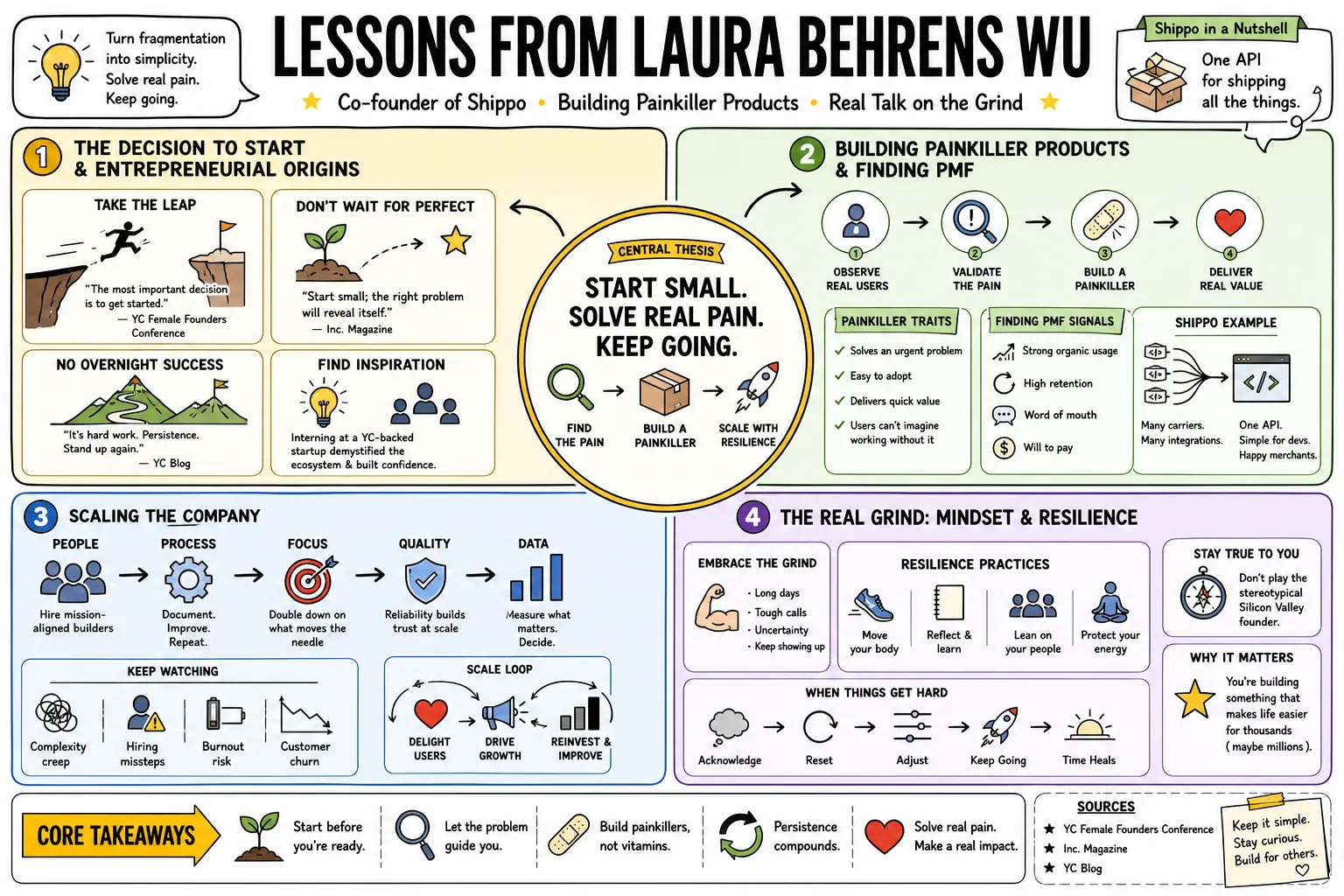
Lessons from Laura Behrens Wu
Laura Behrens Wu co-founded Shippo, turning fragmented shipping logistics into a simple API for e-commerce. She built her reputation on practical "painkiller" products and a refusal to play the stereotypical Silicon Valley founder. This profile gathers her advice on finding product-market fit and managing the actual grind of scaling a company.
Part 1: The Decision to Start & Entrepreneurial Origins
- On taking the leap: "I think that's the most important decision that a founder can make: the decision to get started." — Source: Y Combinator Female Founders Conference
- On waiting for the perfect idea: "You don't need to come up with a grand, world-changing idea on day one; just start working on something small, and the right problem will eventually reveal itself." — Source: Inc. Magazine
- On the myth of the overnight success: "There is no overnight success. It's a lot about hard work. It's about being persistent. It's about standing up again after you fall." — Source: Y Combinator Blog
- On finding inspiration: "Working as an intern at a YC-backed startup demystified the Silicon Valley ecosystem and provided the confidence needed to transition from employee to founder." — Source: Bessemer Venture Partners
- On the accidental origins of Shippo: "The company didn't start with a master plan to disrupt logistics; it was born out of the sheer frustration of trying to ship handbags for an early e-commerce side project." — Source: Entrepreneur
- On building what you know: "When you experience a muddled, fragmented process firsthand, you are uniquely positioned to understand exactly what the end-user needs to solve it." — Source: First Round Review
- On continuous iteration: "The first version of your company is rarely the final one; the key is to stay in motion so you can pivot when the real opportunity appears." — Source: Founders Field Guide Podcast
- On initial traction: "Gaining those first few users often requires doing things that don't scale, like manually fulfilling orders or handling every support ticket yourself." — Source: Quora Sessions
- On the value of naivete: "Sometimes, not knowing how entrenched and difficult an industry is can be an advantage; if you knew all the hurdles in advance, you might never start." — Source: First Round Review
- On shifting focus: "Shelving our initial e-commerce store to focus entirely on the shipping API was a difficult but necessary decision to address a much larger, universal pain point." — Source: FundersClub
Part 2: Product-Market Fit & The Pivot to Shippo
- On identifying the real problem: "While setting up an online store was easy with modern tools, the realization that shipping remained opaque and inefficient became the catalyst for everything we built." — Source: Entrepreneur
- On democratizing access: "Small and medium-sized businesses deserve the same logistical power, efficiency, and carrier discounts previously reserved only for giants like Amazon." — Source: Medium
- On aggregating complexity: "The goal was to take a highly fragmented industry requiring multiple accounts and contracts, and distill it into a single, easy-to-integrate API." — Source: First Round Review
- On recognizing product-market fit: "True product-market fit is often found when you pivot away from your original idea to solve the biggest bottleneck your own business is facing." — Source: Zendesk Sit Down Startup
- On listening to the market: "When customers start asking to use the internal tool you built for yourself rather than the actual product you are selling, it is time to pivot." — Source: First Round In Depth Podcast
- On the 3 Horizons Framework: "Prioritizing resources effectively means balancing immediate core product needs with medium-term expansions and long-term bets." — Source: First Round Review
- On the turning point: "There is a distinct, memorable moment when a startup transitions from feeling like an experiment to feeling like a real, scalable business driven by organic demand." — Source: First Round Review
- On infrastructure over storefronts: "Building the picks and shovels of e-commerce proved to be a far more scalable opportunity than running a single consumer-facing store." — Source: Shopify Beyond the Build Podcast
- On removing friction: "The core thesis of a great API product is to take a process that requires waiting in line at the post office and turn it into a few lines of code." — Source: Bessemer Venture Partners
Part 3: Building "Painkillers" vs. "Vitamins"
- On the best advice received: "A former CEO once told me to build something that resembles painkillers, not vitamins." — Source: Inc. Magazine
- On product necessity: "If you build something that’s ‘nice to have,’ it won’t be around for very long." — Source: Inc. Magazine
- On survival during downturns: "Products that act as painkillers are immune to budget cuts, whereas vitamin products are the first to be discarded when a business tries to save money." — Source: Good Work Podcast
- On shaping the roadmap: "Every new feature should be evaluated on whether it actively removes a critical operational blocker for the customer." — Source: Forbes
- On the shipping mandate: "E-commerce businesses cannot survive without shipping packages; therefore, a platform that makes this cheaper and faster is inherently a painkiller." — Source: Y Combinator Podcast
- On framing the value proposition: "When pitching your product, focus entirely on the immediate, bleeding-neck problem you are solving right now, not just the theoretical future benefits." — Source: Founders Field Guide Podcast
- On customer urgency: "A clear sign you have built a painkiller is when customers are actively frustrated if they cannot get access to your platform immediately." — Source: Zendesk Sit Down Startup
- On maintaining focus: "It is easy to get distracted by building adjacent, shiny tools, but a startup must ruthlessly focus on its core utility until it dominates that space." — Source: TechCrunch
- On product messaging: "Your marketing should not sell a vision of the future; it should sell the immediate relief of a specific, painful operational headache." — Source: First Round Review
Part 4: Being an Outsider & Defying Archetypes
- On rejecting the standard mold: "To be an effective leader, I've learned to be unapologetic about who I am. There are so many expectations about what the perfect founder should look like." — Source: Quora Sessions
- On giving up imitation: "I used to try to be like Steve Jobs or Mark Zuckerberg but that’s impossible because I’m Laura, and I’m proud of that." — Source: Quora Sessions
- On the immigrant advantage: "Growing up globally and moving between countries instilled an adaptability that proved invaluable when navigating the unpredictable terrain of Silicon Valley." — Source: Gotham Gal
- On industry outsiders: "Coming into the entrenched logistics space without preconceived notions allowed us to question outdated standards and build a modern, software-first solution." — Source: First Round Review
- On overcoming imposter syndrome: "Acknowledging that there is no single way how a great founder should look like is the first step to leading with genuine confidence." — Source: Y Combinator Blog
- On self-education: "As an outsider, reading industry publications extensively was a crucial early strategy for understanding the unwritten rules of the startup ecosystem." — Source: Bessemer Venture Partners
- On diverse perspectives: "Bringing a fresh, external perspective to an old industry often yields solutions that veterans, constrained by legacy thinking, would never attempt." — Source: Founders Field Guide Podcast
- On redefining leadership: "Authentic leadership requires discarding the aggressive tech persona in favor of a style that aligns with your actual personality and values." — Source: Reboot Podcast
- On the power of the underdog: "Being continually underestimated in the early days can be a strategic advantage, allowing you to build quietly and gain traction before incumbents notice." — Source: First Round Review
Part 5: Resilience, Optimism, & Surviving the Lows
- On the founder mindset: "I for sure think that optimism, or the ability to stand back up when you're falling, is one of the most important skills that a founder and entrepreneur needs to have." — Source: Good Work Podcast
- On facing rejection: "Hearing 'no' from investors or customers is not a reflection of personal worth; it is simply data that must be used to refine the pitch and the product." — Source: Y Combinator Female Founders Conference
- On practical optimism: "True optimism is not delusion; it is the practical ability to acknowledge severe challenges while maintaining the conviction that you will figure out a way through them." — Source: Good Work Podcast
- On the grit required: "Building a massive company is rarely a straight line; it requires an extraordinary tolerance for pain and the resilience to weather near-death company experiences." — Source: Forbes
- On maintaining momentum: "When things look bleak, the most effective strategy is to focus entirely on the next tangible task, refusing to be paralyzed by the macro picture." — Source: Bessemer Venture Partners
- On early-stage survival: "Gaining initial traction often means going against the flow and fighting through agonizingly long sales cycles without losing faith in the product." — Source: Shippo Blog
- On defining failure: "Failure only truly occurs when a founder completely stops trying; everything else is just an expensive, painful lesson on the path to finding what works." — Source: Inc. Magazine
- On emotional regulation: In a HuffPost Q&A, Behrens Wu says founder life is a continuing rollercoaster, the emotional ups and downs are normal, and trusted founders, mentors, board members, and coaches help her lower the guard and keep learning. — Reference: HuffPost Q&A on startup emotional ups and downs, trusted peers, mentors, board members, and coaching
- On continuous effort: "There is no finish line where a startup suddenly becomes easy to run; the challenges simply change scale, requiring a permanent commitment to problem-solving." — Source: First Round Review
- On internal validation: "Startups must derive their confidence from user engagement and product utility, rather than relying on external press or investor praise to validate their existence." — Source: TechCrunch
Part 6: Fundraising & Managing Investors
- On the reality of capital: "Raising money is not a milestone of success; it is simply the beginning of the real work and the start of a much higher set of expectations." — Source: Quora Sessions
- On choosing partners: "Founders must be uncomfortably selective about who they take money from, ensuring that investors share their core values and long-term vision." — Source: Quora Sessions
- On the illusion of cash: "Money alone cannot solve fundamental business challenges like a lack of product-market fit or a toxic company culture." — Source: Medium
- On confidence in pitching: "Confidence was cash. You have to have some to get some. And people were loath to give it to you." — Source: Y Combinator Female Founders Conference
- On board dynamics: "The best investors are those who provide unwavering support during the inevitable bad times, not just those who celebrate the easy victories." — Source: Bessemer Venture Partners
- On fundraising as a tool: "Never raise capital just for the sake of raising; capital is a strategic tool meant to accelerate a working engine, not to figure out what the engine should be." — Source: Forbes
- On maintaining leverage: "The strongest position to fundraise from is one where you don't actually need the money to survive, giving you the power to walk away from misaligned term sheets." — Source: TechCrunch
- On investor transparency: "Be radically honest with your investors about the challenges you are facing; hiding bad news only erodes the trust required to navigate crises together." — Source: First Round Review
- On the pitch narrative: "Investors fund lines, not dots; you must demonstrate a consistent trajectory of execution and learning over time, rather than just a single impressive snapshot." — Source: Y Combinator Blog
Part 7: Customer Centricity & Sales Hustle
- On the CEO as support: "In the early days, handling customer support personally is the most direct way to understand exactly where your product is failing and how to fix it." — Source: Quora Sessions
- On the pain of churn: "Losing early customers is a brutal but necessary lesson in the importance of proactive account management and anticipating the needs of scaling businesses." — Source: Zendesk Sit Down Startup
- On customer retention: "It is infinitely more valuable to keep your current users incredibly happy than to endlessly burn resources acquiring new users who will quickly churn." — Source: Zendesk Sit Down Startup
- On aligning with user success: "The beauty of a transaction-based API is that your revenue scales directly with your customers' success; if they ship more, you make more." — Source: Shopify Beyond the Build Podcast
- On the feedback loop: "A product roadmap should not be dictated by internal assumptions; it must be a direct reflection of the most frequent requests and pain points voiced by your actual users." — Source: First Round In Depth Podcast
- On enterprise sales: "Selling to large, entrenched businesses requires immense patience and the willingness to push through sales cycles that can last many months." — Source: Shippo Blog
- On assessing candidates: "When interviewing, ask questions that reveal a candidate's intrinsic motivation to serve the customer, rather than just their technical ability to write code." — Source: First Round Review
- On solving the unglamorous: "The most loyal customers are those for whom you have solved a deeply unglamorous, tedious backend problem that they dread dealing with." — Source: Founders Field Guide Podcast
- On talking to users: "Never assume you know what the customer wants; pick up the phone, ask them directly, and be prepared to have your core assumptions challenged." — Source: Y Combinator Podcast
Part 8: Scaling, Culture, & Authentic Leadership
- On living core values: "Company core values must go beyond public statements on a wall; they must be tangibly lived and integrated into the daily operations and hiring practices of the company." — Source: Inc. Magazine
- On building a team: "As a founder transitions from an operator to a CEO, the primary job shifts from building the product to building the team that builds the product." — Source: First Round Review
- On intentional diversity: "True diversity and inclusion require moving beyond just recruitment metrics; it means actively supporting existing employees and ensuring diverse perspectives in every assessment." — Source: Founders For Change
- On the definition of culture: The Good Work interview notes describe Shippo culture through values such as Path to Green: when the team faces a difficult situation, the habit is to move quickly from identifying the problem toward a solution-oriented response. — Reference: Good Work interview notes on Shippo culture, Path to Green, and solution-oriented values
- On the pressure of scaling: "Managing a growing organization requires learning to delegate trust and resisting the urge to micromanage every function you used to run yourself." — Source: Forbes
- On authentic values: "The most effective company values are those that genuinely reflect the founder's personal principles, ensuring that the culture feels organic rather than manufactured." — Source: Inc. Magazine
- On remote management: "Leading distributed teams successfully requires over-communication, a high degree of empathy, and an intentional effort to foster human connection across screens." — Source: Good Work Podcast
- On evolving as a leader: "The skills that get a company from zero to one are fundamentally different from the skills required to manage a multi-layered organization." — Source: First Round In Depth Podcast
- On continuous learning: "A successful CEO must be fiercely committed to their own personal growth, constantly seeking out mentors and adapting their leadership style to the company's current stage." — Source: Bessemer Venture Partners
- On maintaining the mission: "As a company scales rapidly, the leader's most critical role is to continually remind the organization of its original purpose and the core problem it set out to solve." — Source: First Round Review