Laura Modi is the co-founder and CEO of Bobbie, an organic infant formula company she launched after struggling to find options that met her standards as a new mother. Drawing from her earlier career in operations at Airbnb and Google, she challenged established monopolies to bring a European-style formula to the U.S. market. The insights below detail her decisions during the 2022 national formula shortage and her ongoing efforts to remove the cultural stigma attached to formula feeding.
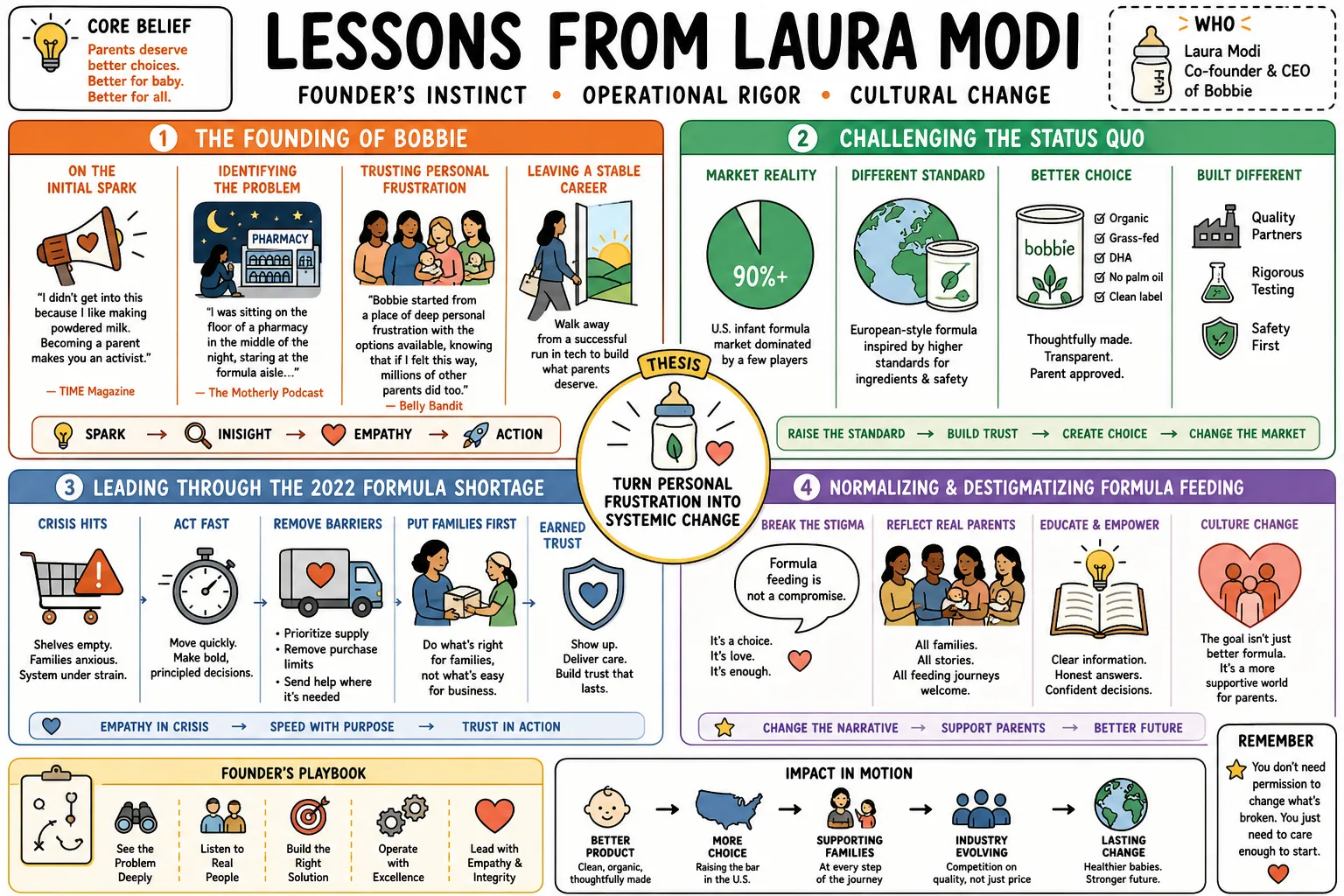
Part 1: The Founding of Bobbie
- On the initial spark: "I didn't get into this because I like making powdered milk. Becoming a parent makes you an activist." — Source: TIME Magazine
- On identifying the problem: "I was sitting on the floor of a pharmacy in the middle of the night, staring at the formula aisle, and realized that nothing on the shelves spoke to me as a modern mother." — Source: The Motherly Podcast
- On trusting personal frustration: "Bobbie started from a place of deep personal frustration with the options available, knowing that if I felt this way, millions of other parents did too." — Source: Belly Bandit
- On leaving a stable career: "Walking away from a successful run in tech at Airbnb to start a formula company was terrifying, but the problem I wanted to solve felt far more urgent than staying comfortable." — Source: Second Life Podcast
- On the lack of innovation: "The infant formula industry in the U.S. had been stagnant for decades, dominated by a few massive players who hadn't updated their recipes or their messaging." — Source: Forbes
- On setting product standards: In Forbes, Modi says she and Sarah Hardy had both resorted to the black market for European formula and started Bobbie to bring a better formula to U.S. parents through a product they would feel good feeding their own babies. — Reference: Forbes interview with Laura Modi and Sarah Hardy, part 1
- On the early days of development: "Creating a USDA-certified organic formula meant navigating an incredibly complex regulatory landscape. We had to be relentlessly patient." — Source: Behind Her Empire
- On identifying the target audience: Bobbie's story page makes clear that the company was built around the parent's experience of feeding, not just the baby's nutrition, after Modi and Hardy could not find a trusted organic option that supported their choices without judgment.— Reference: Bobbie Our Story page
- On naming the company: "The name comes from my daughter's pronunciation of 'bottle'—it is a constant reminder of exactly why and for whom we started this company." — Source: Belly Bandit
- On solving your own problem: "When you build a company to solve a problem you experienced firsthand, you have an innate understanding of the customer that no focus group can give you." — Source: Lenny's Podcast
Part 2: Destigmatizing Infant Feeding
- On the feeding binary: "We have to break the breast versus formula war. Most parents are combo feeding, and we need to reflect that reality without judgment." — Source: The Dr. Hyman Show
- On the pressure on mothers: "The medical community often pushes breastfeeding so hard that mothers feel like they have failed before they have even started if they cannot produce milk." — Source: Kelly Corrigan Wonders
- On shifting the narrative: "We exist to bring peace of mind to parenting by shifting the scrutiny of how we feed to what we feed." — Source: The Returnity Project
- On unapologetic choices: "Simply put, if you choose to feed your little one formula, it should be undeniably good, and we will be here to support you whatever your decision." — Source: The Returnity Project
- On the guilt of supplementing: "Experiencing mastitis and realizing I couldn't exclusively breastfeed was a breaking point that taught me how much unnecessary guilt is tied to infant feeding." — Source: The Motherly Podcast
- On validating the parent's journey: "Our marketing is about telling parents that however they choose to feed their baby is exactly the right way." — Source: She Pivots
- On removing the stigma: "There shouldn't be back-alley conversations about formula. It needs to be brought into the light and celebrated as a valid, healthy choice." — Source: TIME Magazine
- On mental health and feeding: "A mother's mental health is just as critical to a baby's well-being as the source of their nutrition. Sometimes formula is the best choice for the whole family." — Source: The Dr. Hyman Show
- On normalizing combo feeding: "The reality is that combination feeding is the norm, not the exception. It is time our cultural conversation caught up with what parents are actually doing." — Source: Forbes
- On supporting choices: In Forbes, Modi explicitly frames the company around meeting families where they are, arguing that there is no single correct way to feed a baby and that the right answer depends on what works for the family.— Reference: Forbes interview with Laura Modi and Sarah Hardy, part 2
Part 3: Motherhood and Leadership
- On prioritizing roles: "I cannot show up as a good professional... without also being a great mother and recognizing that that is the number one job." — Source: theSkimm
- On the reality of balance: "The moment I ignore that my role as a mother is front and center, I guarantee you I will not be doing a better job at work." — Source: theSkimm
- On motherhood as training: "Being a mother makes you incredibly decisive. You learn how to operate on limited sleep, prioritize ruthlessly, and handle chaos." — Source: Behind Her Empire
- On vulnerability at work: "I want my team to see me balancing motherhood and leadership. If I hide the struggles of parenting, I am doing a disservice to the parents who work for me." — Source: Leadership Matters
- On leading with empathy: "The empathy required to raise children translates directly into how you manage a team and understand your customers." — Source: The Motherly Podcast
- On building while pregnant: "I was raising capital while heavily pregnant. It forces you to pitch a vision of a world where women do not have to choose between a family and a company." — Source: She Pivots
- On boundary setting: "You have to draw strict lines. There are hours of the day that belong entirely to my children, and no email or meeting is going to infringe on that." — Source: Second Life Podcast
- On redefining the CEO role: "We need to normalize the image of a CEO who might have a toddler interrupting a Zoom call. That is real life." — Source: Forbes
- On maternal ambition: "Becoming a mother didn't diminish my ambition; it gave it an entirely new direction and purpose." — Source: TIME Magazine
- On shared responsibilities: "Building a company requires a support system at home. It is a partnership in every sense of the word." — Source: Kelly Corrigan Wonders
Part 4: Lessons from Airbnb and Tech
- On applying hospitality to retail: "My time as Director of Hospitality at Airbnb taught me that every customer touchpoint is an opportunity to make someone feel seen and cared for." — Source: Lenny's Podcast
- On hyper-growth: "At Airbnb, I saw what it takes to scale a company rapidly while trying to maintain the core magic of the brand." — Source: Behind Her Empire
- On community building: Lenny's transcript says Bobbie thinks about growth through content, community, and commerce, reflecting Modi's view that infant formula is not just a transaction but a relationship with parents who need education and support.— Reference: Lenny's Podcast transcript with Laura Modi
- On operational rigor: "Working at Google gave me a foundation in operations and data that is absolutely essential when you are managing physical supply chains." — Source: Lenny's Podcast
- On disrupting legacy spaces: "Airbnb didn't invent the vacation rental; they reimagined the experience. At Bobbie, we completely reimagined the parent's experience of buying and using formula." — Source: Second Life Podcast
- On moving fast: "In tech, you are taught to move fast and iterate. In the food and infant nutrition space, you have to balance that speed with uncompromising safety and compliance." — Source: She Pivots
- On the importance of design: Reuters describes Bobbie using endcap displays and clear visual cues to educate shoppers in a formula aisle Modi calls miserable, underscoring her belief that presentation and retail design help exhausted parents feel oriented instead of intimidated.— Reference: Reuters article on Bobbie expanding into Target during the formula shortage
- On learning from founders: "Working closely with Brian Chesky taught me the importance of being a founder who stays intimately connected to the product details." — Source: Lenny's Podcast
- On transitioning industries: "The skills required to build a marketplace in tech are surprisingly similar to those needed to build a direct-to-consumer brand: you obsess over the customer." — Source: Behind Her Empire
Part 5: Building a Community-Driven Brand
- On direct-to-consumer relationships: Forbes says Bobbie launched as the first direct-to-consumer, subscription-based infant formula in the U.S., which fits Modi's operating logic that formula is a recurring need best served through an ongoing relationship rather than one-off retail luck.— Reference: Forbes interview with Laura Modi and Sarah Hardy, part 2
- On authentic marketing: "Parents can spot a gimmick from a mile away. Our marketing works because it is rooted in the actual, unfiltered experiences of real mothers." — Source: The Motherly Podcast
- On building a loyal following: "You build a cult-like brand not by shouting the loudest, but by listening the closest and reflecting your customers' values back to them." — Source: Lenny's Podcast
- On customer support: "Our customer support team is there to offer a digital shoulder to cry on for a stressed-out parent at 3 AM." — Source: Lenny's Podcast
- On user feedback: "The parents who use Bobbie are our best product developers. We listen to their feedback on everything from the scoop design to the packaging." — Source: Belly Bandit
- On creating brand advocates: "When you validate a parent's choices and provide a product they love, they become advocates who will defend your brand." — Source: She Pivots
- On shared values: "People buy Bobbie because of the ingredients, but they subscribe and stay because they believe in the mission behind the company." — Source: Forbes
- On the tone of voice: "We wanted the brand to sound like your smartest, most supportive mom friend—knowledgeable, reassuring, and never judgmental." — Source: The Returnity Project
- On packaging and experience: Reuters notes that Bobbie used retail displays to explain grass-fed sourcing and make the shelf experience less bleak, showing Modi's preference for turning even a routine formula purchase into something clearer, more confident, and less clinical for parents.— Reference: Reuters article on Bobbie expanding into Target during the formula shortage
Part 6: Crisis Management and the Formula Shortage
- On the 2022 shortage: "The infant formula shortage woke us up to a lack of redundancy and resiliency that this essential good deserves to have." — Source: CNBC Events
- On domestic manufacturing: "The shortage underscored the fact that we really had zero time to waste to invest in domestic manufacturing, with 'domestic' being the operative word." — Source: CNBC Events
- On pausing growth: "During the height of the shortage, we had to shut off our storefront to new customers to guarantee supply for our existing subscribers. It was a terrifying business decision, but the only moral one." — Source: theSkimm
- On industry vulnerability: "When an entire country relies on three facilities to feed its most vulnerable population, you don't just have a supply chain problem; you have a national security issue." — Source: Kelly Corrigan Wonders
- On communicating in a crisis: "Transparency is the only currency that matters in a crisis. We told parents exactly what we had in the warehouse and exactly what our limits were." — Source: Leadership Matters
- On government intervention: CNBC's profile says Modi treats formula access as an industry-capacity problem exposed by the 2022 duopoly shock, which is why her public stance centers on practical fixes for families rather than turning feeding policy into another partisan fight.— Reference: CNBC Changemakers profile of Laura Modi
- On the emotional toll: "Fielding calls from parents who were literally driving across state lines to find food for their babies was the most heartbreaking experience of my career." — Source: She Pivots
- On long-term solutions: "Importing formula is a temporary band-aid. The only way to prevent another shortage is to heavily invest in building a resilient, diversified manufacturing base here in the U.S." — Source: TIME Magazine
- On the responsibility of brands: Bobbie's formula-safety page argues that an industry responsible for feeding babies has to be unusually transparent and heavily tested, capturing Modi's broader belief that formula brands owe families more than basic compliance.— Reference: Bobbie Formula Safety page
Part 7: Parent-First Company Culture
- On defining culture: "Culture is core to everything we do. I believe that without having a strong culture, there is no way you can build a legacy." — Source: Leadership Matters
- On hiring parents: "We actively recruit mothers and parents because they intuitively understand our customer. Their lived experience is a professional asset." — Source: Forbes
- On paid leave: "Advocating for paid family leave isn't a political stance for us; it is a fundamental business necessity for supporting a modern workforce." — Source: theSkimm
- On returning to work: "The transition back to work after having a baby is incredibly fragile. Companies must build specific support systems to help mothers navigate this return." — Source: The Returnity Project
- On flexible environments: "A parent-first workplace means judging employees on their output and impact, not on the hours they sit visibly at a desk." — Source: Behind Her Empire
- On internal policies: "We structured our benefits to reflect what parents need—from comprehensive healthcare to stipends that help offset the immense cost of child-rearing." — Source: Forbes
- On leading by example: "I take my leave and I set my boundaries publicly because if the CEO doesn't do it, no one else in the company will feel safe doing it." — Source: Leadership Matters
- On burnout prevention: "Parents are already running a marathon at home. As an employer, my job is to ensure work doesn't become a second exhausting marathon that burns them out." — Source: The Motherly Podcast
- On cultural alignment: "When your internal team culture matches your external brand mission, you don't have to force authenticity—it just happens naturally." — Source: Lenny's Podcast
Part 8: Reforming the Industry
- On challenging monopolies: "The formula industry has been controlled by monopolies for too long. Competition is the only way to force innovation and improve quality." — Source: TIME Magazine
- On regulatory hurdles: The Behind Her Empire episode notes that Modi had to launch in a highly regulated category, work through major FDA roadblocks, and keep rebuilding after an early shutdown, which helps explain why she treats regulatory difficulty as part of earning trust in formula.— Reference: Behind Her Empire episode page with Laura Modi
- On ingredient transparency: "Parents deserve to know exactly what is in the formula they buy, where it was sourced, and why it was chosen. Transparency shouldn't be a premium feature." — Source: Belly Bandit
- On the future of nutrition: "The future of infant nutrition is about closing the gap between breast milk and formula through rigorous scientific research and better sourcing." — Source: The Dr. Hyman Show
- On systemic change: "We are trying to force a systemic change in how the U.S. regulates, manufactures, and talks about infant nutrition." — Source: Forbes
- On corporate responsibility: "Companies making infant formula bear a unique moral responsibility. We are literally producing the sole source of nutrition for a human being's first year of life." — Source: She Pivots
- On continuous improvement: "We don't believe in a static recipe. As pediatric nutritional science evolves, our formula will evolve with it." — Source: Behind Her Empire
- On policy advocacy: "Founders in the nutrition space have to be advocates. You have to be willing to sit down with lawmakers and explain why the current system is failing families." — Source: CNBC Events
- On a new industry standard: CNBC frames Modi's ambition as breaking a stagnant duopoly and forcing overdue innovation in infant formula, matching her goal of raising the baseline so parents are no longer stuck with decades-old assumptions about what formula has to be.— Reference: CNBC Changemakers profile of Laura Modi