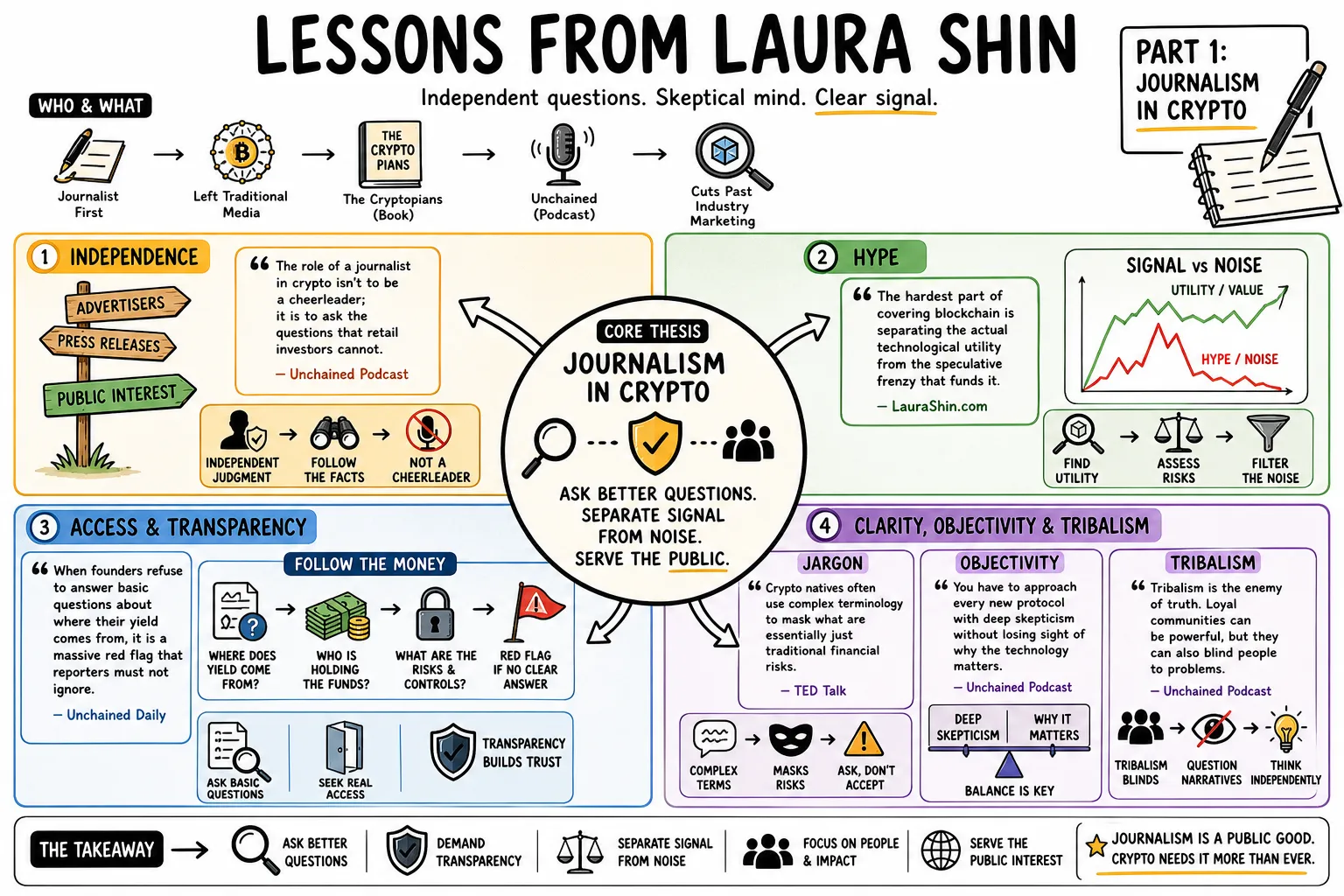
Lessons from Laura Shin
Laura Shin left traditional media to become one of the first mainstream journalists to cover cryptocurrency full-time. Through her book The Cryptopians and podcast Unchained, she cuts past industry marketing to document the people behind blockchain and explain how decentralization actually affects finance and governance.
Part 1: Journalism in Crypto
- On Independence: "The role of a journalist in crypto isn't to be a cheerleader; it is to ask the questions that retail investors cannot." — Source: Unchained Podcast
- On Hype: "The hardest part of covering blockchain is separating the actual technological utility from the speculative frenzy that funds it." — Source: LauraShin.com
- On Access: "When founders refuse to answer basic questions about where their yield comes from, it is a massive red flag that reporters must not ignore." — Source: Unchained Daily
- On Jargon: "Crypto natives often use complex terminology to mask what are essentially just traditional financial risks." — Source: TED Talk
- On Objectivity: "You have to approach every new protocol with deep skepticism without losing sight of why the technology matters." — Source: Unchained Podcast
- On Tribalism: "The factionalism between different blockchain communities makes it difficult to have honest conversations about any network's flaws." — Source: LauraShin.com
- On Accountability: "The transparency of public blockchains makes it possible for journalists to track exactly where the money went, removing the corporate veil." — Source: Unchained Daily
- On Mainstream Media: "Traditional finance reporters initially dismissed crypto entirely, missing the structural shift happening underneath the price volatility." — Source: Forbes
- On Retractions: "In a space moving this fast, correcting the record quickly when new on-chain data emerges is essential for credibility." — Source: Unchained Podcast
- On Historical Record: "This is a really important moment in history, and I want people to know one hundred years from now what actually happened without sugarcoating things." — Source: Time Interview
Part 2: Ethereum's Origins
- On Vitalik Buterin: "He was a teenager with a brilliant idea, but he was completely unprepared for the vicious corporate infighting that would follow." — Source: The Cryptopians
- On Charles Hoskinson: "The clash over whether Ethereum should be a for-profit corporation or a non-profit foundation defined the network's early culture." — Source: The Cryptopians
- On The Crowdsale: "Ethereum's initial coin offering created a template for funding that completely bypassed traditional venture capital, for better and worse." — Source: The Cryptopians
- On Early Leadership: "The original founders of Ethereum were a chaotic mix of idealists, capitalists, and opportunists who could barely agree on a shared vision." — Source: The Cryptopians
- On Joe Lubin: "ConsenSys was built on the premise that Ethereum would need a massive, well-funded corporate entity to build its infrastructure." — Source: The Cryptopians
- On Gavin Wood: "The technical architecture of Ethereum was as much a product of Wood's pragmatism as it was of Buterin's vision." — Source: The Cryptopians
- On Launch Delays: "The tension between releasing a secure network and appeasing angry investors who had funded the project was nearly catastrophic." — Source: The Cryptopians
- On Initial Distribution: "The way the initial Ether supply was allocated created whales whose influence over the network persists today." — Source: The Cryptopians
- On Early Culture: "The early days of Ethereum resembled a dysfunctional family drama more than a professional tech startup." — Source: Unchained Podcast
- On the Whitepaper: "The Ethereum whitepaper promised a world computer, but it left the social consensus required to maintain it completely undefined." — Source: The Cryptopians
Part 3: Decentralization & Governance
- On Immutable Ledgers: "People assume blockchains are immutable, but in reality, they operate on social consensus. If everyone agrees to upgrade the protocol, the rules can change." — Source: TechFlow Post
- On Social Consensus: "The hardest forks are not the technological ones; they are the ideological fractures within the community." — Source: Unchained Podcast
- On Network Upgrades: "Every major protocol upgrade is a political negotiation disguised as a software update." — Source: Unchained Daily
- On Decentralized Power: "True decentralization is incredibly difficult to maintain because human nature gravitates toward hierarchy." — Source: LauraShin.com
- On DAO Voting: "Token-weighted voting often replicates the exact plutocracies that crypto was supposed to disrupt." — Source: Unchained Podcast
- On Community Governance: "Discord and Twitter have become the messy, unofficial town halls where billion-dollar protocol decisions are effectively made." — Source: Unchained Podcast
- On Node Operators: "The ultimate power in a blockchain network belongs not to the founders, but to the thousands of anonymous node runners enforcing the rules." — Source: The Cryptopians
- On Core Developers: "Core developers wield outsized influence because they alone understand the technical risks of implementing community demands." — Source: Unchained Daily
- On Hard Forks: "A network split forces users to decide what they value more: the original rules or the recovery of lost funds." — Source: The Cryptopians
Part 4: Greed vs. Idealism
- On The Core Conflict: "The main power struggle was basically between the business guys and the developers over profits for themselves versus tools to help others, greed versus altruism." — Source: Goodreads
- On ICOs: "The initial coin offering boom was driven by a belief in decentralized networks, but it was corrupted by the easy money of speculative retail investors." — Source: The Cryptopians
- On Wealth Creation: "Overnight wealth in crypto changes people, testing whether their commitment to decentralization can survive a nine-figure net worth." — Source: Unchained Podcast
- On Financial Motives: "You cannot separate the technological innovation in crypto from the financial incentives that pay developers to build it." — Source: LauraShin.com
- On Scams: "The transparency of blockchain technology is often weaponized by scammers using complex smart contracts to confuse victims." — Source: Unchained Daily
- On Founders: "Many crypto founders start as idealists wanting to change the world and end up as hedge fund managers trying to prop up their token price." — Source: The Cryptopians
- On VCs in Crypto: "Venture capitalists entering crypto fundamentally altered the ethos, shifting the focus from open-source public goods to capturing token value." — Source: Unchained Podcast
- On Cults of Personality: "The industry frequently abandons its ethos of verifiable trust the moment a charismatic leader promises massive returns." — Source: Unchained Daily
- On Altruism: "Building decentralized tools requires capital, which means pure altruism in crypto is often dependent on periodic bull markets." — Source: The Cryptopians
Part 5: Power Dynamics & Regulation
- On Global Shift: "The crypto world is, at its core, a deeply personal struggle to influence the coming revolution in money, culture, and power." — Source: LauraShin.com
- On New Elites: "Power has moved from Wall Street to a global class of coders who don't need traditional corporate structures to build financial networks." — Source: Next Big Idea Club
- On Regulators: "Regulators are trying to apply aging securities laws to borderless software networks, which often harms the retail investors they aim to protect." — Source: Unchained Podcast
- On Enforcement by Design: "When the code is law, the people who write the smart contracts hold more regulatory power than government agencies." — Source: TED Talk
- On the SEC: "The lack of clear guidelines from regulators forces companies to either move offshore or operate under the constant threat of retroactive enforcement." — Source: Unchained Daily
- On Financial Inclusion: "Bitcoin's ability to act as censorship-resistant money is more urgent for activists in authoritarian regimes than for investors in the West." — Source: Unchained Podcast
- On Institutions: "Traditional banks initially fought crypto, then ignored it, and are now desperately trying to co-opt the underlying technology." — Source: Forbes
- On Geopolitics: "Digital assets are becoming a macroeconomic tool, with nations quietly considering how Bitcoin affects the dominance of the US dollar." — Source: Unchained Podcast
- On Decentralized Finance: "DeFi removes the middlemen from lending and trading, but it transfers the risk directly to the end user who must audit the code." — Source: Unchained Daily
Part 6: The DAO and Existential Threats
- On the DAO Hack: "The theft of millions in ETH from The DAO was the first true existential crisis for a smart contract platform." — Source: The Cryptopians
- On Code as Law: "The DAO proved that trusting code only works until a massive exploit threatens the entire economic security of the ecosystem." — Source: The Cryptopians
- On the Ethereum Classic Split: "Rolling back the blockchain to refund DAO investors permanently split the Ethereum community into two competing philosophical camps." — Source: The Cryptopians
- On Investigation: "The trail of the DAO attacker demonstrated that while crypto can be pseudonymous, it is rarely entirely anonymous if you know how to trace the blockchain." — Source: Forbes
- On Chain Reorganizations: "Altering the blockchain's history to save user funds sets a dangerous precedent regarding who has the power to undo financial reality." — Source: The Cryptopians
- On Vulnerabilities: "Smart contracts hold millions of dollars in open-source honeypots, meaning security audits are the only defense against instant ruin." — Source: Unchained Podcast
- On Systemic Risk: "The interconnectedness of DeFi protocols means a flaw in one base-layer contract can trigger liquidations across the entire ecosystem." — Source: Unchained Daily
- On Bailouts: "Unlike traditional finance, when a decentralized protocol fails, there is no central bank to step in and make users whole." — Source: Unchained Podcast
- On Forensics: "On-chain analytics tools have evolved so quickly that the public ledger is now the worst place to commit financial fraud." — Source: Unchained Podcast
Part 7: Market Cycles & Speculation
- On Bear Markets: "Bear markets in crypto are historically when the most significant infrastructure is built, free from the distraction of retail exuberance." — Source: Unchained Podcast
- On Bull Runs: "During a bull market, the narrative inevitably shifts from technological utility to finding the next token that will yield massive returns." — Source: Unchained Daily
- On Utility vs. Price: "A protocol's token price is often completely divorced from its actual user adoption or technological progress." — Source: Unchained Podcast
- On Retail Investors: "Retail participants often arrive late to the cycle, providing exit liquidity for the venture funds that bought tokens at a fraction of a cent." — Source: LauraShin.com
- On Leverage: "The extreme volatility in crypto is repeatedly amplified by unregulated exchanges offering massive leverage to unsophisticated traders." — Source: Unchained Daily
- On Yield Farming: "When a protocol offers unsustainable double-digit yields, you have to ask yourself where that yield is coming from, or risk being the yield." — Source: Unchained Podcast
- On Narratives: "Crypto markets are uniquely narrative-driven; a compelling story about a new consensus mechanism can outcompete functional software." — Source: Unchained Podcast
- On Mania: "The NFT craze highlighted how humans will assign tremendous value to digital scarcity, even when the underlying asset is trivial." — Source: Unchained Daily
- On Market Corrections: "Wiping out billions in over-leveraged capital is painful, but it is the only mechanism the crypto market has to clear out bad actors." — Source: Unchained Podcast
Part 8: The Long-Term Promise of Blockchain
- On True Ownership: "Blockchain provides the first mechanism for digital property rights, allowing users to own their assets independent of a central platform." — Source: TED Talk
- On Web3: "The promise of Web3 is returning control of data and monetization from giant tech monopolies back to the individual creators." — Source: Unchained Podcast
- On Financial Access: "By lowering the barrier to entry, decentralized networks allow anyone with a smartphone to access yield, loans, and international remittance." — Source: Unchained Podcast
- On Trust: "We are moving from systems that require us to trust legacy institutions to systems where trust is mathematically guaranteed by the code." — Source: TED Talk
- On Future Infrastructure: "In ten years, blockchain will be a backend technology so seamlessly integrated into our lives that users won't even know they are interacting with it." — Source: Unchained Daily
- On Digital Identity: "Cryptographic wallets will eventually serve as our decentralized identities, proving who we are without requiring us to expose our private data." — Source: Unchained Podcast
- On Open Source: "The composability of crypto means developers can build on top of each other's work instantly, creating a compounding rate of financial innovation." — Source: Unchained Podcast
- On Micropayments: "Removing the friction of traditional payment processors allows for new economic models where users can be compensated in real-time for their attention." — Source: LauraShin.com
- On Creators: "Tokenization allows artists and musicians to capture the secondary value of their work, radically changing the economics of creativity." — Source: Unchained Podcast
- On the Internet of Value: "Blockchain is fundamentally upgrading the internet from a network for exchanging information to a network for exchanging value." — Source: TED Talk