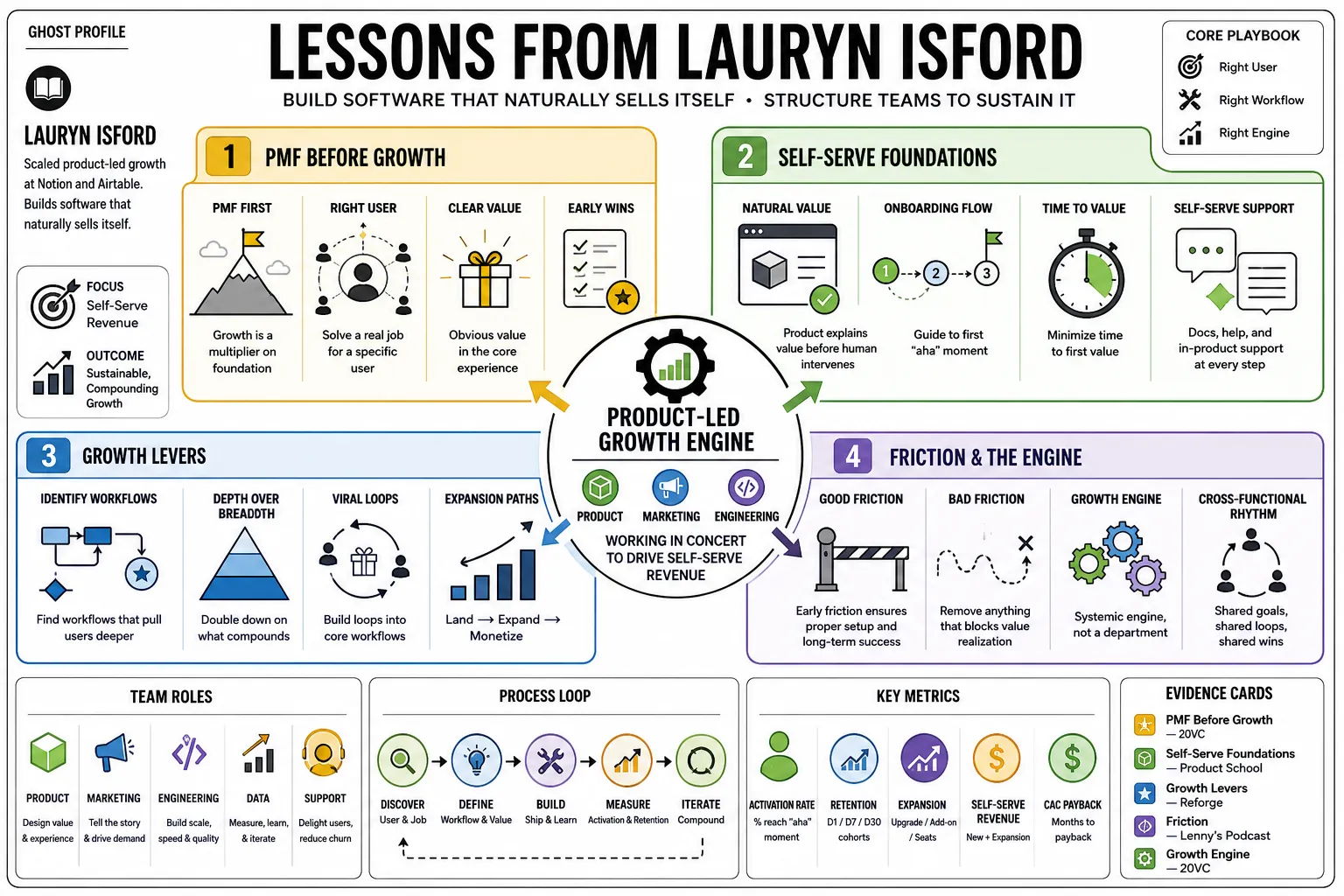
Lessons from Lauryn Isford
Lauryn Isford is a product leader who scaled product-led growth at Notion and Airtable. She drives self-serve revenue by redesigning user onboarding workflows and defining precise activation metrics. This profile compiles her methods for building software that naturally sells itself and structuring the teams required to sustain it.
Part 1: Product-Led Growth Strategy
- On PMF Before Growth: "You cannot growth-hack your way to product-market fit; growth is a multiplier on an existing foundation." — Source: 20VC
- On Self-Serve Foundations: "A strong self-serve motion requires the product to naturally explain its own value before a human ever intervenes." — Source: Product School
- On Growth Levers: "Not every feature is a growth lever; identify the specific workflows that pull users deeper into the product ecosystem." — Source: Reforge
- On Friction: "Friction isn’t always bad; sometimes introducing friction early ensures the user is properly configured for long-term success." — Source: Lenny's Podcast
- On The Growth Engine: "Growth isn't a department; it's a systemic engine that relies on product, marketing, and engineering working in concert." — Source: 20VC
- On Product as Sales: In a 20VC conversation, Isford says a product-led motion works best when users can experience the product's value from inside the product itself, which supports the narrower lesson that good self-serve onboarding does part of the educational work that sales teams would otherwise have to do from scratch. — Reference: 20VC conversation on product-led growth and learning value inside the product
- On User Psychology: "Understand the user's immediate problem. If you try to sell the grand vision before solving the task at hand, they will bounce." — Source: Reforge
- On Scaling Loops: "A growth loop is only valid if it compounds. If user acquisition scales linearly with marketing spend, it's a funnel, not a loop." — Source: 20VC
- On Tooling vs. Solutions: "Users don’t want to buy tools; they want to buy solutions to their specific, immediate workflows." — Source: Lenny's Newsletter
- On B2B vs B2C Growth: "The best B2B growth strategies borrow heavily from B2C by focusing obsessively on the end-user experience, not just the buyer." — Source: Product School
Part 2: Rethinking User Onboarding
- On Tooltips: "Tooltips are not true onboarding. They point at buttons, whereas real onboarding teaches value." — Source: Deepika Murthy Blog
- On Scaffolding: "Effective onboarding acts as scaffolding, guiding users toward their first real outcome rather than just showing them around." — Source: Lenny's Podcast
- On Personalization: "Generic demos fail. Onboarding must be customized to the user's specific context and intended use case." — Source: 20VC
- On the First 5 Minutes: "If a user hasn't experienced a micro-win within the first few minutes, the chance of long-term retention plummets." — Source: Reforge
- On Multi-Player Onboarding: "For collaboration tools, onboarding isn't complete until the user has successfully invited and interacted with a teammate." — Source: EarlyNode
- On Blank Slates: "Never drop a new user into a completely blank slate; provide templates or dummy data to illustrate what's possible." — Source: Reforge
- On Simplification: In Lenny's Newsletter, Isford explains that for products with high cognitive load, guided scaffolding can outperform a tooltip-heavy approach because it lowers the effort required to get to first value. That supports the more defensible lesson that simplification often means reducing setup burden, not just removing interface elements. — Reference: Lenny's Newsletter on guided onboarding for complex products
- On Goal-Oriented Setup: "Ask users what they want to achieve right away, and construct their entire initial environment around that specific answer." — Source: Lenny's Newsletter
- On Reverse Trials: "Starting users on a premium tier and falling back to freemium is a powerful way to demonstrate value early." — Source: Reforge
- On User Context: "A majority of current onboarding flows fail because they ignore the user's intent and force a rigid, one-size-fits-all path." — Source: 20VC
Part 3: Defining and Measuring Activation
- On Activation Metrics: "A lower activation rate, like 5-15%, is often better than a high one if the metric actually correlates to long-term retention." — Source: Growth Talent
- On Trivial Tasks: "If your activation metric is too easy to hit, it stops being a predictive measure of success and becomes a vanity metric." — Source: Lenny's Podcast
- On the 'Aha' Moment: "The 'aha' moment isn't when they understand the product; it's when they realize the product just saved them time." — Source: Reforge
- On Measuring Milestones: "Activation isn't a single point in time; it's a series of quantitative milestones that prove the user is extracting value." — Source: Lenny Rachitsky Wiki
- On Predictive Value: "A good activation metric should make you confident that the user will still be active three months from now." — Source: 20VC
- On Team Activation: "For enterprise software, individual activation is insufficient; you must measure when the team unit becomes activated." — Source: EarlyNode
- On Revising Metrics: "Activation metrics should evolve. What worked when you had ten thousand users won't work when you have ten million." — Source: Lenny's Newsletter
- On False Positives: "Beware of users who complete the onboarding checklist but never return; your activation definition might be tracking the wrong behaviors." — Source: Reforge
- On Time-to-Value: "Decreasing the time it takes to hit the activation milestone is often the highest-leverage growth project a team can tackle." — Source: Product School
Part 4: The Strategy of Experimentation
- On Over-Experimenting: "Teams can become too dependent on experimentation. Sometimes, when confidence is high, you should just build it." — Source: Medium
- On Experiment Purpose: "Experiments primarily serve two purposes: understanding the exact metric impact and mitigating risk during major changes." — Source: The Masterly
- On User Experience: In Lenny's Newsletter, Isford says teams can become overly dependent on experimentation when they already have strong conviction about the right experience, and that more time should often go to customer understanding, mocks, and shipping. That supports a narrower lesson that protecting the user experience sometimes means avoiding unnecessary test fragmentation. — Reference: Lenny's Newsletter on when not to over-index on experimentation
- On Strategic Filters: "Growth design should act as a strategic filter, ensuring we only test high-leverage hypotheses." — Source: Medium
- On Failed Tests: "A failed experiment is only a waste if you didn't design it well enough to learn why the user rejected the hypothesis." — Source: Reforge
- On Local Maxima: "A/B testing is great for optimizing a funnel, but it will rarely help you pivot to an entirely new, better direction." — Source: 20VC
- On Qualitative Data: "Quantitative experiments tell you what is happening, but you still need qualitative user research to tell you why." — Source: Lenny's Podcast
- On Big Swings: "Reserve a portion of your growth roadmap for big, un-testable swings that have the potential to step-change the business." — Source: Reforge
- On Rollouts: "Use experiments during rollouts not just to prove a thesis, but to ensure you aren't quietly breaking a secondary workflow." — Source: Lenny's Newsletter
Part 5: Building and Scaling Growth Teams
- On Timing: "Hiring a growth team before you have solid product-market fit is a waste of capital." — Source: Product Led Alliance
- On the First Hire: "Your first growth hire shouldn't be a specialist; they need to be a generalist who can bridge product, data, and engineering." — Source: 20VC
- On Team Structure: "Growth teams should be cross-functional pods with dedicated engineering and design resources, not siloed marketers." — Source: Reforge
- On Scaling PMF: "Growth teams exist to scale product-market fit, not to discover it from scratch." — Source: Lenny's Newsletter
- On Autonomy: In the 20VC discussion, Isford describes how growth work benefits from enough logging and data support to make experimentation on onboarding, pricing, and product flows actually possible. The safer takeaway is that autonomy for growth teams depends on having the instrumentation to test and learn, not on operating as a disconnected function. — Reference: 20VC conversation on experimentation infrastructure for growth teams
- On Growth Maturity: "A company needs to have naturally figured out a basic growth loop before bringing in a team to optimize it." — Source: Product Led Alliance
- On Resource Allocation: "Under-resourcing engineering on a growth team guarantees they will only ever build superficial, high-funnel hacks." — Source: 20VC
- On Mandates: "The growth team’s mandate must be perfectly clear to the rest of the company to avoid turf wars over product surface area." — Source: Reforge
- On Shared Goals: "Growth and core product teams must share underlying North Star metrics, even if they operate on different timelines." — Source: Product School
Part 6: Hiring for Growth and Impact
- On Intrinsic Motivation: "When hiring growth practitioners, I look for a deep, intrinsic motivation to have a measurable impact on the business." — Source: Lenny's Podcast
- On Founder Fit: In the 20VC conversation, Isford says the first hiring question is what the company actually wants the growth role to do, since a mandate focused on new signups requires a different profile than one centered on deeper product work. That supports the lesson that founder-role fit starts with clarity about the real growth problem being hired for. — Reference: 20VC conversation on scoping the growth hire before hiring
- On Problem Solving: In describing how she interviews growth candidates, Isford says she likes giving them the product, asking them to sign up and explore it, and then seeing whether they come back with multiple net-new ideas for growth. That supports the lesson that good product problem-solvers should generate concrete observations from direct product use, not just abstract frameworks. — Reference: 20VC conversation on evaluating growth candidates through product teardown work
- On Analytical Rigor: "A great growth PM doesn't need to write SQL, but they must possess the analytical rigor to know when the data is lying to them." — Source: Reforge
- On Assessing Talent: "The best interview questions force candidates to explain how they handle competing priorities when all options look mathematically viable." — Source: Coda
- On Curiosity: "The defining trait of a top-tier growth hire is relentless curiosity about why users behave the way they do." — Source: Lenny's Newsletter
- On Resilience: "Growth involves a lot of failure. I look for candidates who get energized by a failed experiment rather than defeated." — Source: 20VC
- On Cross-Functional Empathy: In the 20VC discussion, Isford argues that early and mid-stage growth teams often work best inside the broader product organization because one engineering system is still delivering all changes and the quality bar should stay high across both growth and core product. That supports the narrower lesson that cross-functional empathy comes from respecting shared constraints rather than treating growth as a separate island. — Reference: 20VC conversation on growth teams sitting with product teams
- On Specialized Roles: "Growth hiring is difficult because the discipline is young, and the definition of a 'Growth PM' varies wildly between companies." — Source: Product Led Alliance
Part 7: Monetization and the Self-Serve Engine
- On Paywalls: "A paywall should feel like a natural progression of value, not an arbitrary punishment for using the product well." — Source: Reforge
- On Freemium: "Freemium is an acquisition strategy, not a monetization strategy. It only works if the free tier creates urgency for the paid tier." — Source: Product School
- On Self-Serve Revenue: "The goal of self-serve is to allow the user to discover, adopt, and pay for the product entirely on their own schedule." — Source: 20VC
- On Pricing Transparency: "If users have to hunt for your pricing page or do complex math to understand what they owe, you are losing self-serve conversions." — Source: EarlyNode
- On Feature Packaging: "Don't just restrict features randomly; package them based on the distinct workflows of different buyer personas." — Source: Lenny's Podcast
- On Upgrade Paths: "The upgrade path should be embedded contextually within the workflow, exactly at the moment the user experiences the limitation." — Source: Reforge
- On Sales Hand-offs: In the 20VC conversation, Isford says that when product-led onboarding is working, sales can often engage users who already understand the product's value and build from existing usage rather than beginning with first-touch education. That supports the lesson that better hand-offs happen when the product has already done meaningful discovery and value communication. — Reference: 20VC conversation on sales building on existing product usage
- On Usage Limits: "Usage-based limits often convert better than feature gates because the user has already built a habit around the core workflow." — Source: Lenny's Newsletter
- On Value Realization: "Users will gladly pay when the cost of the software is visibly dwarfed by the time or money it saves them." — Source: 20VC
- On B2B Purchases: "In the modern enterprise, the end-user initiates the purchase; your self-serve engine must empower them to advocate to their boss." — Source: Product School
Part 8: Team Collaboration and Product Alignment
- On Core vs. Growth: "Core product builds the value; growth product ensures that value is discovered and adopted by the widest possible audience." — Source: Reforge
- On Communication: "If growth teams operate in a vacuum, they will inevitably build flows that conflict with the core product vision." — Source: 20VC
- On Metric Ownership: "Clear lines of metric ownership prevent turf wars. Core might own retention, while growth owns activation and conversion." — Source: Lenny's Podcast
- On Design Systems: "Growth experiments must adhere strictly to the company's design system to maintain trust and brand consistency." — Source: Medium
- On Shared Learnings: In the 20VC discussion, Isford says growth and core product teams learn more when they are close enough to share one another's experiments, quality standards, and user understanding. That supports a conservative lesson that organizational learning compounds when growth does not become an isolated function. — Reference: 20VC conversation on growth and core product learning together
- On Leadership Buy-in: "Growth initiatives fail when executive leadership views them as short-term marketing hacks rather than long-term product strategy." — Source: Product Led Alliance
- On Empathy in Product: "Building great products requires empathy not just for the user, but for the engineers and designers executing the vision." — Source: Stanford STVP
- On Managing Stakeholders: "When prioritizing growth initiatives, you have to be able to explain the mathematical 'why' to stakeholders who rely on intuition." — Source: Reforge
- On Continuous Alignment: "Alignment isn't a one-time meeting; it's a continuous process of checking the data against the overarching company strategy." — Source: Lenny's Newsletter