Leah Tharin is a product executive and growth advisor known for her practical, unvarnished approach to B2B SaaS scaling and Product-Led Growth (PLG). Through her newsletter, courses, and the ProducTea podcast, she dissects how to bridge the operational gap between product and sales teams to build functioning revenue engines. This profile gathers her core frameworks and perspectives on pricing, data, leadership, and modern market dynamics.
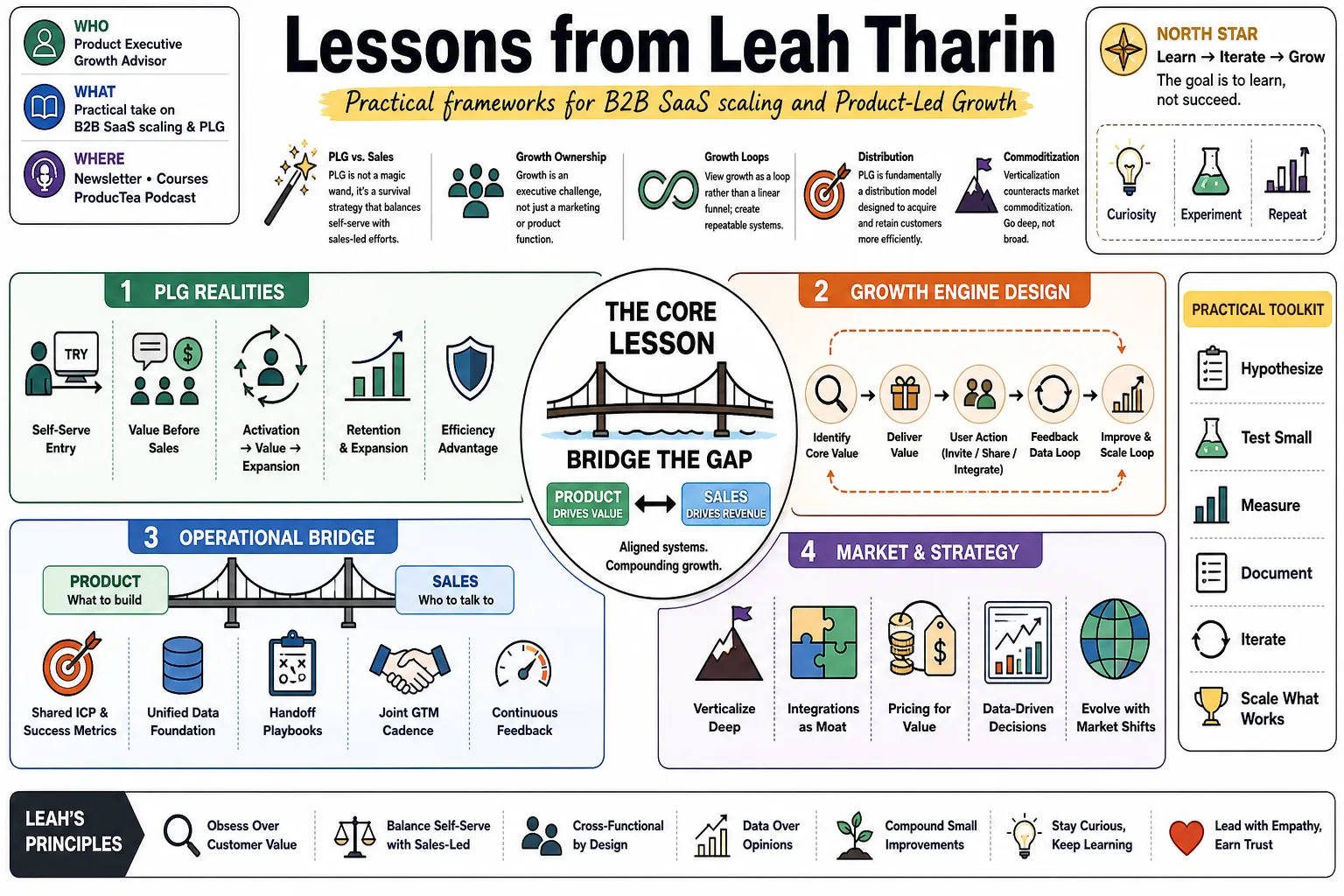
Part 1: Product-Led Growth Realities
- On Product-Led Growth vs. Sales: "PLG is not a magic wand, it’s a survival strategy that balances self-serve with sales-led efforts." — Source: [Maven]
- On B2B Growth Ownership: "Growth is an executive challenge, not just a marketing or product function." — Source: [Leah's ProducTea]
- On Growth Loops: "View growth as a loop rather than a linear funnel; identify what makes a business successful and create repeatable systems." — Source: [Leah Tharin]
- On Distribution: "PLG is fundamentally a distribution model designed to acquire and retain customers more efficiently." — Source: [Leah's ProducTea]
- On the Core Goal: "The goal is to learn, not succeed. It is very difficult to not succeed if you keep learning." — Source: [Product State]
- On Market Commoditization: "Verticalization counteracts market commoditization; focus on specific segments to improve value propositions." — Source: [Leah's ProducTea]
- On Cross-Functional Reality: "Marketing, Sales, and Product must align on common goals, shared scorecards, and clear SLAs to ensure a cohesive buyer journey." — Source: [LinkedIn]
- On Economic Storytelling: "Convert executive skepticism into advocacy by demonstrating the revenue risks of inaction and linking product value to economic outcomes." — Source: [Leah's ProducTea]
- On Outcomes Over Output: "Focusing on meaningful customer outcomes—instead of feature deliveries—lays the foundational work for aligned incentives." — Source: [Product State]
Part 2: Product-Led Sales and The Gary Problem
- On Product-Led Sales: "Product-Led Sales is the bridge that combines the strengths of PLG and Sales-Led Growth." — Source: [Leah Tharin]
- On Data-Driven Sales: "Use behavioral product data as a trigger for sales intervention, rather than relying on arbitrary timelines." — Source: [ProducTea Podcast]
- On The Gary Problem: "The Gary Problem happens when quota-driven sales teams force complex, high-touch processes on customers who could have self-served." — Source: [SaaSiest]
- On Sales Overpromising: "Sales teams often overpromise on features to close deals, hurting long-term retention and scalability." — Source: [Leah's ProducTea]
- On PLG Market Fit: "PLG is best for low-LTV, high-volume self-serve customers; SLG is best for high-LTV, low-volume customers." — Source: [Leah Tharin]
- On PLS Market Fit: "PLS acts as a sub-function of PLG, designed specifically for medium-LTV, medium-volume customers." — Source: [Leah Tharin]
- On Sales Timing: "Sales teams should only engage when a user has reached a specific 'aha' moment or demonstrated clear intent." — Source: [ProducTea Podcast]
- On the New Buyer Reality: "The product must be built for a reality where most buyers prefer to test-drive before speaking to a salesperson." — Source: [Leah's ProducTea]
- On Feature Requests: "Implement structured business case hygiene to evaluate feature requests rather than reacting to every demand from the sales team." — Source: [Leah Tharin]
Part 3: Strategy and Alignment
- On the Purpose of Strategy: "Any strategy, not only for product, is essentially a communication tool to align people." — Source: [Product State]
- On Strategic Simplicity: "Any strategy or vision has to be simple. It is a thing that is retold often." — Source: [Product State]
- On Alignment: "The purpose of strategy is to make sure that we're running in the same direction." — Source: [Product State]
- On Complexity: "The more complexity you introduce the less likely you will reach the same impact every time." — Source: [Product State]
- On Product Sense: "We are more often wrong than not. Let's not trust our product sense too much." — Source: [Leah's ProducTea]
- On the Knowledge Layer: "Maintain a simple, verified text file that records known truths to prevent organizational panic and repeated mistakes." — Source: [Leah Tharin]
- On Assumptions: "You must put a dimension on assumptions that create work to avoid building entire quarterly initiatives on unverified ideas." — Source: [Leah Tharin]
- On Documentation Overload: "Focus on updating existing documents rather than constantly creating new ones to prevent organizational chaos." — Source: [Leah Tharin]
- On Shared Revenue Plans: "Successful go-to-market requires a shared revenue plan across all departments." — Source: [Leah's ProducTea]
Part 4: Pricing and Packaging
- On Pricing Philosophy: "Pricing should not be an arbitrary number; it must align with what the target audience truly values." — Source: [ProductLed]
- On Packaging: "Packaging should be designed to showcase customer value, rather than just listing features." — Source: [ProducTea Podcast]
- On Pricing as a Growth Lever: "Pricing is one of the most direct and underutilized levers for influencing revenue." — Source: [Leah's ProducTea]
- On Experimentation: "While early-stage companies should avoid frequent price changes, mature companies must experiment with pricing often." — Source: [ProducTea Podcast]
- On Complex Packaging: "Avoid complex packaging that creates anxiety for customers by front-loading features they do not yet understand." — Source: [ProducTea Podcast]
- On Freemium Models: "Use free versions or usage-limited freemiums to build advocacy and help users experience the 'aha' moment." — Source: [ProducTea Podcast]
- On Paywalls: "Paywalls and upgrade prompts should be strategically associated with advanced features that provide clear, immediate value." — Source: [ProducTea Podcast]
- On Cross-Functional Pricing Ownership: "Product has quantitative data on usage, while Sales has qualitative data on prospect reactions; both must align on pricing." — Source: [Produx Labs]
- On Client Quality: "Low-paying clients often attract more low-paying clients; price yourself at the level you want to be at." — Source: [Leah Tharin]
Part 5: Data, Metrics, and Churn
- On Reframing Churn: "Reframe churn as 'Value Destruction' or 'Value Loss' rather than just a standard negative metric." — Source: [Leah Tharin]
- On the Depth Map: "Flip the traditional altitude map of growth metrics on its head to build a depth map of negative metrics." — Source: [Leah Tharin]
- On Actionable Churn: "Create a churn score for users that increases based on negative behaviors or friction points before they actually churn." — Source: [Leah Tharin]
- On Friction Points: "Events like visiting cancellation pages, failed uploads, or server errors should actively increase a user's churn score." — Source: [Leah Tharin]
- On Shared Churn Ownership: "No single team should own churn; a rising churn score should trigger specific actions across Product, CS, and Sales." — Source: [Leah Tharin]
- On Activation Churn: "When power users who intensely use a product suddenly stop without converting, they haven't classically churned because they were never customers." — Source: [Leah Tharin]
- On Learning from Drop-offs: "Activation churn represents a critical learning opportunity—reach out directly to understand the 'why' behind their departure." — Source: [Leah Tharin]
- On ICP Segmentation: "Segment metric data by Ideal Customer Profile to avoid drowning in noise and to identify actionable churn trends." — Source: [Amplitude]
- On Reporting Limitations: "Reporting is useful for keeping a pulse, but nobody ever found an insight from reporting that moved the needle." — Source: [Leah Tharin]
- On Technical Monitoring: "If you only learn about technical issues through churn surveys, the problem has likely been broken for too long." — Source: [Leah Tharin]
- On Industry Benchmarks: "Stop over-relying on industry benchmarks; focus instead on process-oriented questions like why teams aren't fixing identified issues." — Source: [Leah Tharin]
Part 6: Activation and Aha Moments
- On Time to Value: "Optimize products for self-onboarding and ease of use to ensure the shortest possible Time to Value." — Source: [Leah Tharin]
- On the PLG Necessity: "In PLG, where there is often no human touch, it is essential to connect users to the product's value immediately." — Source: [Boundaryless]
- On the Aha Moment: "The Aha moment is the precise instance a user realizes the core value of the product for the very first time." — Source: [Leah Tharin]
- On The Milestone Sequence: "The user journey moves through distinct, measurable stages: Setup, Aha Moment, Eureka Moment, and Habit Moment." — Source: [Produx Labs]
- On the Eureka Moment: "The Eureka moment—such as inviting collaborators—serves as a strong behavioral signal of intent to buy." — Source: [Leah Tharin]
- On Habit Formation: "The Habit moment occurs when the product becomes an integrated part of the user's regular routine." — Source: [Leah Tharin]
- On Acquisition vs. Activation: "Growth is not just about acquisition; it is about bringing the right people in and connecting them to value fast." — Source: [Maven]
- On Sales Signals: "Transitioning companies must look for customer success signals within product data to better align sales interventions." — Source: [ProducTea Podcast]
- On Intermediate Steps: "By measuring intermediate milestone steps, teams can better diagnose drop-offs and improve their onboarding strategies." — Source: [ProductLed]
- On the Egg Effect: "Don't eliminate user effort entirely; when users invest small effort, they invest in the outcome, driving better adoption." — Source: [Leah Tharin]
Part 7: Leadership and Culture
- On Servant Leadership: "Being a servant leader means enabling the team to succeed, not enabling everyone at any cost." — Source: [Leah Tharin]
- On Talent Development: "Double down on your strong performers and their strengths rather than trying to mold weak links into something they are not." — Source: [Leah Tharin]
- On Empathy vs. Accountability: "Don't be ruinously empathetic; failing to act on difficult topics to keep the peace ultimately costs the team." — Source: [Leah Tharin]
- On Handling Failure: "Never punish failure; use it as an opportunity to address issues directly and maintain organizational trust." — Source: [Leah Tharin]
- On Management Style: "Let's trust our stakeholders and become coaches instead of dictators that tell them to deliver." — Source: [Product State]
- On Executive Communication: "You should not be a senior leader if you cannot speak well." — Source: [ProducTea Podcast]
- On Company Culture: "I can tell immediately if a company has a good culture by looking at how they handle information internally." — Source: [Leah Tharin]
- On Incentivizing Learning: "Think about incentivizing learning rather than pure success, and success will follow inevitably." — Source: [Product State]
- On Business Language: "Product managers must learn to articulate the value of improvements in financial terms to communicate effectively with sales-led stakeholders." — Source: [Leah Tharin]
Part 8: The Impact of AI on GTM
- On the Future of PMs: "The PMs getting passed over aren't the ones who can't ship; they're the ones whose entire track record is shipping." — Source: [Leah Tharin]
- On Commoditization: "The underlying skill stack of purely shipping features is exactly what AI has commodified first." — Source: [Leah Tharin]
- On AI Literacy: "GTM leaders must understand how AI changes both internal team efficiency and the external market landscape." — Source: [Leah Tharin]
- On Uniqueness Erosion: "AI accelerates the erosion of your product’s uniqueness, requiring constant adjustment in your GTM strategy." — Source: [Leah Tharin]
- On AI and Culture: "A company's ability to effectively use AI to ship a good product is directly tied to their internal information handling culture." — Source: [Leah Tharin]
- On Manual Overrides: "Organizations need a context layer to serve as a manual override for AI, ensuring decisions aren't based on outdated assumptions." — Source: [Leah Tharin]
- On the Changing Landscape: "AI forces product teams to focus heavily on strategy and commercial viability, rather than just technical execution." — Source: [Leah's ProducTea]
- On Efficiency: "The real value of AI in product management is not replacing the PM, but automating the documentation and execution layers." — Source: [ProducTea Podcast]
- On Adaptation: "Those who adapt to AI will focus on customer outcomes and economic storytelling, leaving rote execution behind." — Source: [Leah Tharin]