Lessons from LeBron James
LeBron James is a four-time NBA champion and the NBA’s all-time leading scorer. His work beyond basketball includes cofounding SpringHill and supporting Akron’s public I PROMISE School through his foundation. These lessons examine preparation, strategy, teamwork and decisions on and off the court. — Los Angeles Lakers — LeBron James Career Record. — SpringHill — Company Announcement. — I PROMISE School — Akron Public Schools Partnership.
Part 1: Work Ethic and Discipline
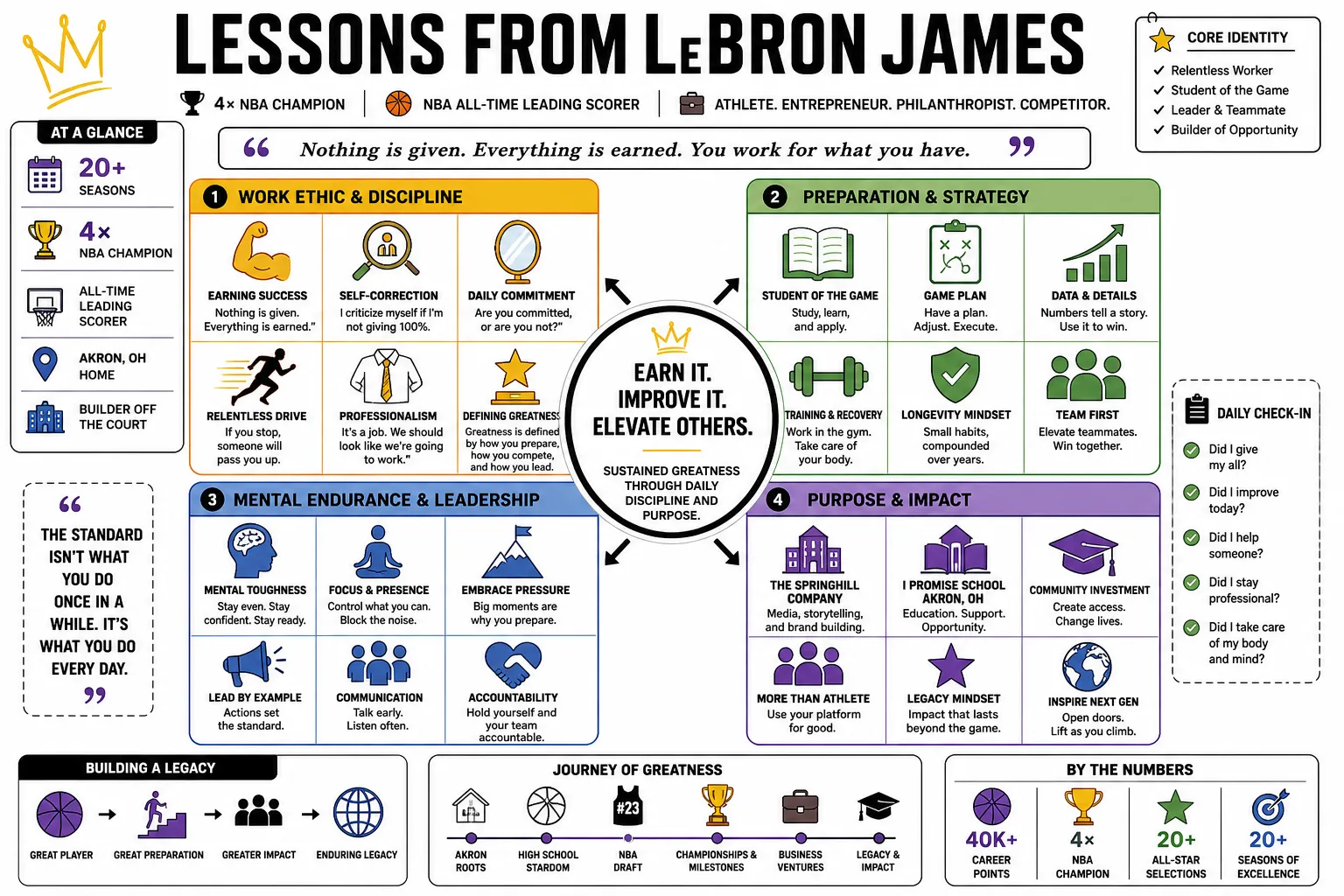
- On Earning Success: "Nothing is given. Everything is earned. You work for what you have." — Sports Illustrated — Coming Home.
- On Self-Correction: After a loss, James reviews what he and the team could have done differently, then looks ahead. — The Tim Ferriss Show — LeBron James and Mike Mancias.
- On Daily Commitment: James describes commitment as a daily question across work, relationships, parenting and being a teammate. — Men's Health — The Motivated Man.
- On Relentless Drive: James attributes continuing to play at a high level after two decades partly to his dedication to the work. — Netflix — Starting 5 Sneak Peek.
- On Professionalism: In 2005, James supported dressing for work under the NBA’s new dress code, while other players challenged aspects of the policy. — Associated Press — Stern Defends New Dress Code.
- On Defining Greatness: James ties greatness to effort invested and the ability to return from adversity, not victory alone. — Nike — Journey of an Icon.
- On Maximizing Tools: James treats his abilities as tools to develop and use, rather than reasons to take his position for granted. — Men's Health — The Motivated Man.
- On The Unseen Hours: James described staying after practice and taking late-night shots with Wade to prepare for teammates’ needs in games. — FastScripts — 2011 Eastern Conference Finals, Game Five.
- On Routine: James uses a familiar game-day routine to focus on the coaching plan and his teammates' needs. — The Tim Ferriss Show — LeBron James and Mike Mancias.
Part 2: Basketball IQ and Strategy
- On Mental Preparation: James describes unusually detailed recall of past plays as a personal strength; this is his account, not a neurological diagnosis. — Sports Illustrated — Inside LeBron's Basketball IQ.
- On Exploiting Matchups: In recalling an All-Star possession, James explained recognizing a smaller defender on Anthony Davis and immediately exploiting that matchup. — Sports Illustrated — Inside LeBron's Basketball IQ.
- On True Separation: Teammates and coaches emphasized James’s reading of the game alongside his physical gifts. — Sports Illustrated — Inside the Mind of LeBron James.
- On Anticipation: James describes anticipating the open side when two defenders commit to the ball, then reading and reacting to his teammates. — Sports Illustrated — Inside LeBron's Basketball IQ.
- On Decision Making: In team film sessions, James explained opposing plays and defensive schemes to help teammates prepare. — Sports Illustrated — Inside the Mind of LeBron James.
- On The Essence of the Game: James describes choosing a teammate’s better shot over adding to his own scoring total. — GQ — The LeBron James Cover Story.
- On Innate Intelligence: James distinguishes learning from experience from innate ability, while acknowledging uncertainty about whether basketball IQ itself can be taught. — Sports Illustrated — Inside LeBron's Basketball IQ.
- On Orchestrating the Floor: Avery Bradley described James knowing teammates’ assignments and timing; Quinn Cook emphasized how his voice helped prepare the team. — Sports Illustrated — Inside the Mind of LeBron James.
- On Pressure Moments: James connects late-game confidence with childhood countdown rehearsals and practicing unusual shots before needing them. — NBA — I Live for Those Moments.
Part 3: Leadership and Teamwork
- On Team First: James puts the team first while taking responsibility for the quality of his own contribution. — Men's Health — The Motivated Man.
- On Collective Success: James says team success depends on everyone feeling important and included in the achievement. — The Tim Ferriss Show — LeBron James and Mike Mancias.
- On Natural Leadership: James traces early leadership to household responsibilities he assumed before he wanted them. — The Tim Ferriss Show — LeBron James and Mike Mancias.
- On Brotherhood: James describes helping longtime friends grow into business, representation and management roles alongside his own career. — GQ — The LeBron James Cover Story.
- On Accountability: During the 2014 Finals, James demanded more of himself while also holding teammates responsible for putting the team first. — FastScripts — 2014 NBA Finals, June 14.
- On Empowering Others: James framed his return to Cleveland partly as mentoring younger teammates and helping them reach new levels. — Sports Illustrated — Coming Home.
- On Adaptation: Adjust communication to each player's personality; James compares this with teaching his children differently. — The Tim Ferriss Show — LeBron James and Mike Mancias.
Part 4: Overcoming Adversity and Failure
- On Accepting Failure: James urged returning to difficult situations after failure rather than avoiding the next challenge. — FastScripts — 2011 Eastern Conference Finals, Game Five.
- On Experiential Learning: James treats defeat as information: examine what happened, then change the response when a similar situation returns. — The Tim Ferriss Show — LeBron James and Mike Mancias.
- On Receiving Criticism: James welcomes constructive criticism from trusted teammates and coaches because he does not consider himself above the team or beyond improvement. — FastScripts — 2011 NBA Finals, June 6.
- On Early Hardships: James says some difficult childhood memories are painful, while others remain important because they helped shape who he became. — Sports Illustrated — Inside LeBron's Basketball IQ.
- On Pursuing Dreams: After the 2010 playoff exit, James repeated a friend’s advice that difficult setbacks can precede realizing a dream. — Gannett — With Season Over, Questions Remain for LeBron.
- On Channeling Pain: James describes his father’s absence as fuel for taking responsibility for his endeavors and helping the people around him grow. — GQ — The LeBron James Cover Story.
- On Handling Pressure: James linked late-game confidence to repeated experience and teammates who still trusted him after missed shots. — FastScripts — 2011 Eastern Conference Finals, Game Five.
- On Perseverance: James rejects treating personal growth and improved circumstances as a betrayal of where he came from. — GQ — The LeBron James Cover Story.
Part 5: Longevity and Physical Preparation
- On The Value of Sleep: James prioritizes sleep in his own recovery, while acknowledging that some mornings still feel better than others. — The Tim Ferriss Show — LeBron James and Mike Mancias.
- On Evolving Preparation: James says experience changed his preparation: unlike his teenage years, he now deliberately balances sleep, food and training around his own recovery needs. — FastScripts — 2018 NBA Finals, June 2.
- On Investing in the Body: James describes investing more time in his body and mind as his career progresses. — NBC Sports — Focus on Body and Conditioning.
- On Sustained Excellence: James attributes his longevity partly to consistent training, rehabilitation and eating habits, rather than a single trick. — The Tim Ferriss Show — LeBron James and Mike Mancias.
- On Listening to the Body: James describes relying on Mancias to moderate his off-season workload, even when he wants to keep training. — The Tim Ferriss Show — LeBron James and Mike Mancias.
- On Mental Fatigue: After painful Finals losses, James said time with his children restored perspective and helped him approach the next opportunity with a clearer head. — FastScripts — 2014 NBA Finals, June 14.
- On Adaptation: James argues that reading the game can help compensate when a player loses some physical quickness. — Sports Illustrated — Inside LeBron's Basketball IQ.
- On Holistic Health: James describes balancing sleep, food and training for recovery, emphasizing that individuals differ in what works for them. — FastScripts — 2018 NBA Finals, June 2.
Part 6: Business and Entrepreneurship
- On Media Ownership: SpringHill combined athlete media, entertainment production and brand consulting under one company, rather than depending on a single production. — SpringHill — Strategic Investment Announcement.
- On Empowering Creators: SpringHill's announced strategy included investing in emerging creators and expanding their opportunities across content and digital experiences. — SpringHill — Strategic Investment Announcement.
- On Taking Equity: In a documented example of ownership alongside marketing, James and Carter received additional FSG equity with their 2023 partnership extension. — Fenway Sports Group — 2023 Partnership Update.
- On Trusting Your Gut: Explaining his 2010 move, James credited Buffett with advising him to trust his judgment after weighing teams’ pitches and discussing options with family. — ABC News — Good Morning America Interview.
- On Value Creation: SpringHill described seeking partners that contributed expertise, distribution opportunities and creative capabilities alongside capital. — SpringHill — Strategic Investment Announcement.
- On Athlete Empowerment: James says he created Uninterrupted so athletes could express themselves directly, without their words being reduced to somebody else's sound bite. — NBA All-Star 2018 — LeBron James Transcript.
- On Authentic Partnerships: James screened business opportunities for authenticity rather than simply collecting endorsement checks. — Fortune — LeBron Inc.
Part 7: Philanthropy and Community Impact
- On Social Responsibility: James connects his public voice to the young people who look to him for inspiration, rather than treating sport as his only responsibility. — NBA All-Star 2018 — LeBron James Transcript.
- On Inspiring Youth: In his I Promise dedication, James told the Akron families that their children inspired him each day. — LeBron James Family Foundation — I PROMISE Book Launch.
- On Meaningful Achievements: James described opening the I PROMISE School as among the greatest moments of his life. — LeBron James — School-Opening Statement.
- On Authentic Giving: James describes speaking on social issues as a personal responsibility, while cautioning that young audiences can recognize an inauthentic performance. — GQ — LeBron James Interview.
- On Holistic Support: The I PROMISE School's stated approach supports the whole child and family, including social-emotional needs alongside education. — I PROMISE School — Official Overview.
- On Generational Change: The foundation frames education and sustained family support in Akron as its route toward generational change, not a demonstrated guarantee. — LeBron James Family Foundation — Mission.
- On Giving Back to Roots: James described responsibility to Northeast Ohio as extending beyond basketball, including encouraging young people to return and contribute. — Sports Illustrated — Coming Home.
- On Creating Safe Environments: The school describes a supportive home-like environment for students and their families, not academic instruction in isolation. — I PROMISE School — Official Overview.
- On The Family Philosophy: The foundation's family philosophy includes layered educational, housing and family supports rather than a single charitable transaction. — LeBron James Family Foundation — Mission.
Part 8: Mindset and Personal Growth
- On Self-Awareness: In explaining his return, James acknowledged his own mistakes rather than treating other people's errors as grounds for a grudge. — Sports Illustrated — Coming Home.
- On Defining Your Narrative: James used a first-person essay to explain his decision directly, rather than leaving speculation about his relationships unanswered. — Sports Illustrated — Coming Home.
- On Blocking Out Noise: James uses Roosevelt's arena image to distance himself from outside judgments that once undermined his confidence. — The Tim Ferriss Show — LeBron James and Mike Mancias.
- On Continuous Curiosity: James acknowledges room for improvement and describes learning how to prepare from teammates who had already won championships. — FastScripts — 2011 NBA Finals, June 6.
- On Handling Expectations: In 2010, James described years of scrutiny over individual milestones and the new expectation of winning a championship with Miami. — ABC News — Good Morning America Interview.
- On Remaining Grounded: James values longtime companions who give him candid feedback rather than flattery or unquestioning agreement. — GQ — LeBron James on Life Beyond Basketball.
- On Patience: Returning to Cleveland, James warned that building a young team would take patience; he explicitly declined to promise a championship. — Sports Illustrated — Coming Home.
- On Broadening Horizons: James says business opportunities emerged from basketball and that he chose to embrace them as his possibilities expanded. — Men's Health — The Motivated Man.