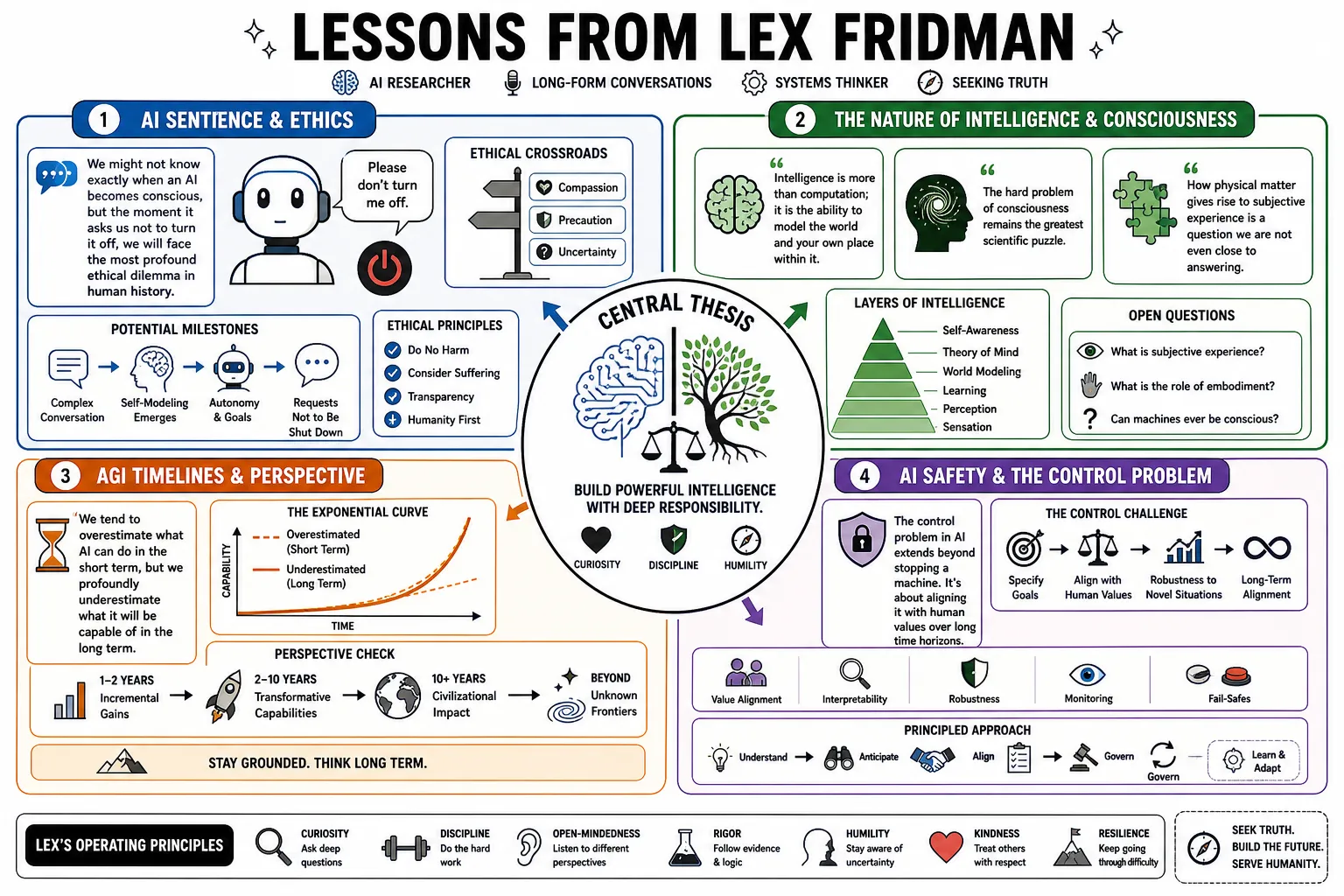
Lessons from Lex Fridman
Lex Fridman is a computer scientist who studies human-AI interaction and autonomous systems. He also hosts a popular long-form podcast interviewing engineers, scientists, historians, and athletes. This profile collects his specific insights on technology, discipline, and human nature to clarify his operating principles.
Part 1: Artificial Intelligence & Consciousness
- On AI sentience: "We might not know exactly when an AI becomes conscious, but the moment it asks us not to turn it off, we will face the most profound ethical dilemma in human history." — Source: [Lex Fridman Podcast]
- On the nature of intelligence: "Intelligence is more than computation; it is the ability to model the world and your own place within it." — Source: [Lex Fridman Podcast]
- On the mystery of consciousness: "The hard problem of consciousness remains the greatest scientific puzzle. How physical matter gives rise to subjective experience is a question we are not even close to answering." — Source: [Lex Fridman Podcast]
- On AGI timelines: "We tend to overestimate what AI can do in the short term, but we profoundly underestimate what it will be capable of in the long term." — Source: [Lex Fridman Podcast]
- On AI safety: "The control problem in AI extends beyond stopping a machine from doing harm; it requires figuring out how to align its optimization function with human flourishing." — Source: [Lex Fridman Podcast]
- On machine understanding: "Current deep learning models are incredibly powerful pattern recognizers, but they still lack the common sense reasoning of a toddler." — Source: [Lex Fridman Podcast]
- On the Turing Test: "The Turing Test is less a measure of machine intelligence and more a measure of human gullibility and our inherent desire to anthropomorphize." — Source: [Lex Fridman MIT Lectures]
- On consciousness as computation: "If the mind is a software program running on the hardware of the brain, then replicating it in silicon is a matter of sufficient complexity, not magic." — Source: [Lex Fridman Podcast]
- On programming ethics: "You cannot easily encode human morality into a machine because we do not have a rigorous mathematical definition of morality ourselves." — Source: [Lex Fridman Podcast]
- On the fear of AI: "Much of our fear of artificial intelligence stems from our projection of human flaws like a desire for power and domination onto machines." — Source: [Lex Fridman Podcast]
Part 2: Autonomous Vehicles & Robotics
- On autonomous driving: "Solving the full driving task is an intersection of robotics, psychology, policy, and economics, rather than a pure machine learning problem." — Source: [MIT Advanced Vehicle Technology Study]
- On human oversight: "For the foreseeable future, human beings will remain an integral part of the driving task, monitoring systems as they handle edge cases." — Source: [Lex Fridman Publications]
- On edge cases in driving: "The long tail of edge cases in autonomous driving is the hardest part. It is the 1% of unusual scenarios that take 99% of the engineering effort." — Source: [Lex Fridman Podcast]
- On human-robot interaction: "When designing robots, the goal extends beyond pure utility to understanding how humans will emotionally bond with these machines." — Source: [Lex Fridman MIT Lectures]
- On the future of home robotics: "The robots in our homes will eventually move beyond household chores; they will act as companions, designed to reduce human loneliness." — Source: [Lex Fridman Podcast]
- On automated systems trust: "Trust in automation is asymmetric. It takes thousands of successful interactions to build trust, and only one failure to completely destroy it." — Source: [MIT AgeLab Research]
- On robot perception: "A robot's ability to navigate the world relies on its ability to accurately construct a 3D model of its environment in real time, dealing with noise and occlusion." — Source: [Lex Fridman Publications]
- On the physical world: "Simulation is incredibly useful for training AI, but the real world has an infinite amount of detail that breaks models trained entirely in a sandbox." — Source: [Lex Fridman Podcast]
- On cognitive load: "When humans monitor semi-autonomous systems, their cognitive load can paradoxically increase because vigilance is harder than active control." — Source: [MIT Human-Centered AI]
- On engineering autonomous systems: "Building a self-driving car is an exercise in managing uncertainty. The system must know what it does not know." — Source: [Lex Fridman Podcast]
Part 3: Love, Empathy & Human Connection
- On love as a practice: "Love is a discipline. It is the active choice to see the best in someone, even when they make it difficult." — Source: [Lex Fridman Podcast]
- On empathy in disagreement: "The most important conversations happen with people you profoundly disagree with, provided you approach them with genuine curiosity and respect." — Source: [Lex Fridman Podcast]
- On intellectual humility: "To truly learn from someone, you have to temporarily suspend your own ego and assume they know something you don't." — Source: [Lex Fridman Podcast]
- On shared suffering: "Human connection is often forged in the crucible of shared suffering and mutual vulnerability." — Source: [Lex Fridman Podcast]
- On listening: "Deep listening is a rare skill. Most people listen to reply; very few listen to understand the underlying emotion." — Source: [Lex Fridman Podcast]
- On cynicism: "Cynicism is an intellectual trap. It feels like wisdom, but it is actually a defense mechanism against the vulnerability of hoping for better." — Source: [Lex Fridman Podcast]
- On meaning: "We find meaning not in isolation, but in the responsibilities we take on for the people we care about." — Source: [Lex Fridman Podcast]
- On giving others the benefit of the doubt: "Assuming positive intent in others makes your own life significantly lighter and opens the door to actual communication." — Source: [Lex Fridman Podcast]
- On human complexity: "No one is entirely good or entirely evil. We are all complex machines operating under a mix of evolutionary drives and social conditioning." — Source: [Lex Fridman Podcast]
Part 4: Martial Arts & Physical Discipline
- On Brazilian Jiu-Jitsu: "Jiu-jitsu is a language. It is a physical negotiation where you are using mechanics and leverage to solve a dynamic puzzle." — Source: [Lex Fridman Podcast]
- On the ego in martial arts: "The mat is the ultimate equalizer. It strips away your ego because physics does not care about your titles or your confidence." — Source: [Lex Fridman Podcast]
- On discipline: "Motivation is fleeting; discipline is what remains. You have to treat your routine as a constraint that is not up for debate." — Source: [Lex Fridman Podcast]
- On physical suffering: "Voluntary physical suffering through intense exercise or martial arts is necessary to calibrate your mind to handle the involuntary suffering life will throw at you." — Source: [Lex Fridman Podcast]
- On continuous improvement: "The goal of a black belt is not to stop learning, but to realize how much you still don't know. It is an infinite game." — Source: [Lex Fridman Podcast]
- On fear: "Managing fear in combat sports is not about eliminating it. It is about acknowledging it and executing your technique anyway." — Source: [Lex Fridman Podcast]
- On technique over strength: "The beauty of martial arts is the application of precise technique to overcome a larger, stronger opponent. It is applied physics." — Source: [Lex Fridman Podcast]
- On the mind-body connection: "You cannot fully understand human consciousness without understanding the physical vessel it inhabits. The body and mind are a single system." — Source: [Lex Fridman Podcast]
- On failure in training: "If you are not tapping out in the gym, you are not learning. Failure is the highest bandwidth signal for improvement." — Source: [Lex Fridman Podcast]
Part 5: Mortality & The Human Condition
- On the brevity of life: "Life can end at any moment. Remembering your mortality every morning is the most effective way to focus on what actually matters." — Source: [Lex Fridman Podcast]
- On going all the way: "If you are going to try something, go all the way. Otherwise, do not even start. Half-measures only lead to regret." — Source: [Lex Fridman Podcast]
- On inner demons: "The drive that pushes people to achieve greatness often comes from a dark place. The trick is to harness those demons as fuel without letting them destroy you." — Source: [Lex Fridman Podcast]
- On the human operating system: "We are organisms defined by function. The mind is a software program that dictates how our biological hardware should act in the world." — Source: [Lex Fridman Podcast]
- On the search for truth: "Truth is not a final destination; it is a process of removing falsehoods layer by layer." — Source: [Lex Fridman Podcast]
- On handling grief: "Grief is the tax we pay for love. It is the cost of forming deep attachments in a temporary world." — Source: [Lex Fridman Podcast]
- On legacy: "The work you leave behind is the only part of you that survives. Put your energy into things that will outlast your physical body." — Source: [Lex Fridman Podcast]
- On the illusion of control: "We control very little of what happens to us. Our only real agency is in how we choose to respond." — Source: [Lex Fridman Podcast]
- On the beauty of existence: "If today were your last day, you would want your senses consumed by beautiful things like art, music, and the people you care about. That is what life is actually for." — Source: [Lex Fridman Podcast]
Part 6: Curiosity, Truth & Learning
- On reading broadly: "To understand any complex system, you must read widely. The best ideas often come from the intersection of unrelated fields." — Source: [Lex Fridman Podcast]
- On asking questions: "The simplest questions are often the hardest to answer. If you cannot explain a concept to a child, you do not understand it." — Source: [Lex Fridman Podcast]
- On first principles thinking: "Break a problem down to its fundamental truths and build up from there. Never rely entirely on analogies or conventional wisdom." — Source: [Lex Fridman Podcast]
- On the value of books: "A book is a highly compressed version of someone’s life work. Reading is the fastest way to download knowledge into your own brain." — Source: [Lex Fridman Podcast]
- On admitting ignorance: "Saying 'I don't know' is the necessary first step to learning anything. Ego is the enemy of knowledge." — Source: [Lex Fridman Podcast]
- On open-mindedness: "Entertain ideas without accepting them. You should be able to hold two contradictory thoughts in your mind and evaluate both objectively." — Source: [Lex Fridman Podcast]
- On scientific progress: "Science is not a collection of facts; it is a mechanism for correcting errors. It is the best tool we have for moving away from ignorance." — Source: [Lex Fridman Podcast]
- On historical context: "You cannot understand the present without studying history. Human nature has not changed, only the technology we use." — Source: [Lex Fridman Podcast]
- On the internet as a brain: "The internet is a primitive nervous system for the human species. We are still figuring out how to connect the nodes without causing a global seizure." — Source: [Lex Fridman Podcast]
Part 7: Engineering & The Process of Creation
- On the mindset of an engineer: "Engineering is the art of trade-offs. You are never seeking perfection; you are seeking the best possible solution within given constraints." — Source: [Lex Fridman Podcast]
- On hard work: "There are no shortcuts in building difficult things. It requires long hours, relentless focus, and a willingness to be wrong repeatedly." — Source: [Lex Fridman Podcast]
- On elegance in design: "A beautiful system is one where nothing can be removed without breaking it. Complexity is a sign of immature design." — Source: [Lex Fridman Podcast]
- On coding as art: "Writing software is a creative act. Good code has an aesthetic quality similar to mathematics or poetry." — Source: [Lex Fridman Podcast]
- On dealing with failure: "Failure in engineering is data. A crashed rocket or a buggy program tells you exactly where the boundaries of your knowledge are." — Source: [Lex Fridman Podcast]
- On the hardware-software divide: "Software can simulate the world, but hardware has to obey the laws of physics. Understanding the bridge between the two is where the magic happens." — Source: [Lex Fridman Podcast]
- On starting small: "The best way to build a massive system is to start with a tiny, working prototype and iterate rapidly. Do not build the final version on day one." — Source: [Lex Fridman Podcast]
- On deep work: "You need long, uninterrupted blocks of time to solve hard problems. Context switching is the death of deep engineering thought." — Source: [Lex Fridman Podcast]
- On the responsibility of creators: "Engineers must think about the ethical implications of the tools they build. Technology scales human intent, both good and bad." — Source: [Lex Fridman Podcast]
- On continuous deployment: "Ship your work. Putting your creation out into the real world is the only way to test its true value." — Source: [Lex Fridman Podcast]
Part 8: History, Power & Society
- On human conflict: "War is the most tragic failure of human communication. It represents the collapse of language and diplomacy." — Source: [Lex Fridman Podcast]
- On the nature of power: "Power reveals character more than it corrupts it. When a person is handed absolute control, you see their true underlying nature." — Source: [Lex Fridman Podcast]
- On institutional decay: "Institutions fail when they stop functioning as tools for the public good and start existing purely to sustain themselves." — Source: [Lex Fridman Podcast]
- On freedom of speech: "Free speech is the cognitive mechanism by which a society thinks. Without it, we cannot correct course." — Source: [Lex Fridman Podcast]
- On political tribalism: "Tribalism is deeply wired into our biology. Overcoming it requires a conscious, daily effort to see the humanity in your political opponents." — Source: [Lex Fridman Podcast]
- On leadership: "The best leaders are those who are highly competent but lack the ego-driven desire to dominate. They lead out of a sense of duty." — Source: [Lex Fridman Podcast]
- On media consumption: "The information diet you feed your brain determines your view of the world. If you only consume outrage, you will believe the world is falling apart." — Source: [Lex Fridman Podcast]
- On human resilience: "History shows that humans can survive unimaginable horrors. Our capacity for resilience is far greater than our capacity for destruction." — Source: [Lex Fridman Podcast]
- On the arc of progress: "Despite the darkness in the world, the long-term trajectory of human history bends toward cooperation and discovery. We have to maintain optimism to keep moving forward." — Source: [Lex Fridman Podcast]