Li Ka-Shing is a Hong Kong entrepreneur and philanthropist whose business began in plastics and expanded into property and other industries. — Foundation Award Announcement.
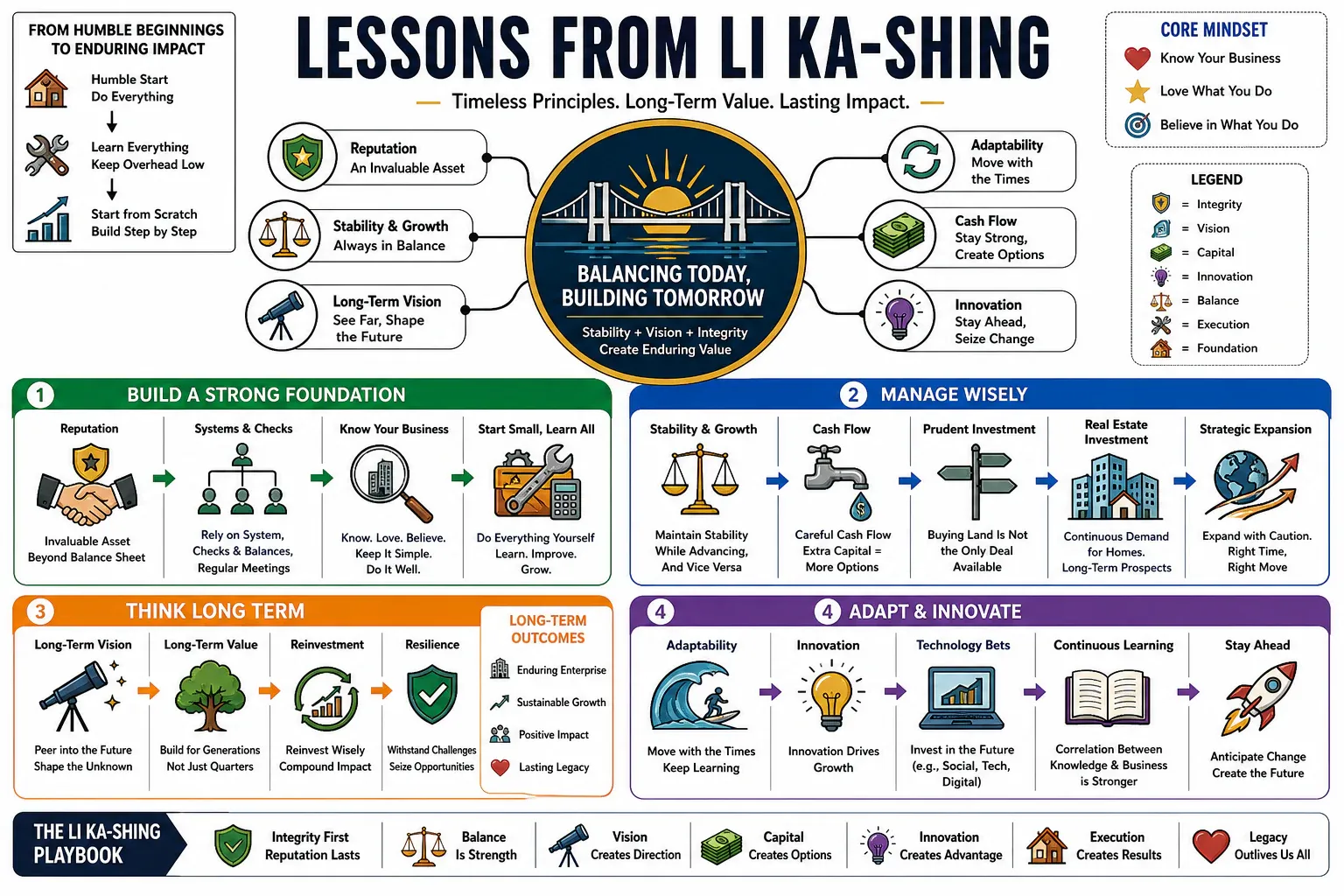
Business and Investment Philosophy
- On Reputation: Keep promises even when a better offer appears; he describes honoring an existing customer’s order despite a rival’s higher bid. — Thoughts of Li Ka-Shing.
- On Stability and Growth: Advance without abandoning stability. He describes reviewing investments and balancing exposures across industries and regions. — Caixin Interview.
- On Long-Term Vision: Use vision to give shape to uncertain possibilities rather than treating the future as already determined. — Technology as Our Enabler.
- On Adaptability: Re-examine established business models as technology changes costs, efficiency and what customers can afford. — Caixin Interview.
- On Cash Flow: Watch liquidity even when profits look healthy; a profitable company can still fail without cash. — Shantou Economic Forum.
- On Prudent Investment: Set an investment limit before bidding and walk away when the price exceeds it, even for an important opportunity. — Thoughts of Li Ka-Shing.
- On Real Estate Investment: In 2002 he saw continuing housing demand but still emphasized conservative investment. That dated outlook is not a guaranteed return. — Bloomberg Markets Interview.
- On Starting Small: With little capital, learn essential tasks yourself. He describes doing his own accounting to keep early overhead low. — Thoughts of Li Ka-Shing.
- On Systems and Checks: Combine trust with oversight that protects the company and the people entrusted with responsibility. — EMBA Q&A.
- On Innovation: Invest in innovation and human capability as industries change; he sees education and problem-solving skills as important complements to technology. — Caixin Interview.
- On Knowing Your Business: Develop a genuine interest in the business and learn through involvement rather than expecting speculation to substitute for understanding. — EMBA Q&A.
- On Strategic Expansion: Balance established operations with new ventures, while recognizing that their risks and management needs differ. — Straits Times Q&A.
On Success and Hard Work
- On Fate and Self-Improvement: He credits self-improvement and committed effort over a factory’s supposedly unlucky location. — Create a New Legend.
- On Luck: Do not rely on luck alone: acquire the knowledge needed to recognize and use an opportunity. — The Art of Management.
- On Preparation: Prepare before a downturn. He describes diversifying away from property after becoming concerned about a speculative boom. — Bloomberg Markets Interview.
- On Continuous Growth: He describes continuing to embrace new projects enthusiastically even without the financial pressure of his early working life. — Bloomberg Markets Interview.
- On Humility in Success: Listen even when confident: another person may know the missing detail that changes the decision. — Shantou Economic Forum.
- On Lifelong Learning: Keep learning as conditions change; he describes reading about new technologies and ideas to avoid falling behind. — Create a New Legend.
- On Overcoming Adversity: He describes answering poverty and uncertainty with determination rather than abandoning his ambitions. — The Future Matters to Me.
- On Hard Work Compensating for Weaknesses: He identifies learning, hard work and a sense of right and wrong as strengths that help him address personal weaknesses. — The Third Son Also Rises.
- On Doing Your Homework: His early plastics work involved long days before he started Cheung Kong; the published account credits hard work and prudence. — Foundation Award Announcement.
Advice for Youth
- On Investing in Yourself: Limited means need not end self-investment. He recalls buying secondhand books while supporting his family. — The Art of Management.
- On Gaining Sales Experience: He sought a harder wholesale-sales role because it offered better prospects; his account illustrates learning through greater responsibility, not a universal part-time-job prescription. — Thoughts of Li Ka-Shing.
- On Planning Your Life: Revisit what you want to achieve and whether your knowledge, judgment and courage match that ambition. — The Art of Management.
On Life and Character
- On Having a Big Heart: Ability needs character: he emphasizes sincerity, organization and capable colleagues rather than charisma alone. — Shantou Economic Forum.
- On Setting High Goals: Pursue high ideals with perseverance, while allowing conscience and reason to guide how you pursue them. — Could Your Life Be Better than Your Dreams?.
- On Humility and Frugality: Keep material needs modest. He describes preferring a simple lifestyle and valuing peace of mind over additional comfort. — Bloomberg Markets Interview.
- On Integrity: Do not treat unscrupulous gains as durable success; he stresses ethical conduct and its legal consequences. — EMBA Q&A.
- On Facing Life Early: He recalls feeling prematurely adult when family hardship required him to work as a child. — Thoughts of Li Ka-Shing.
- On Cherishing What You Have: Remember hardship when enjoying prosperity. He uses a memory of food during wartime to explain why he does not take comfort for granted. — Bloomberg Markets Interview.
- On Criticism: Consider criticism calmly, distinguish useful feedback from attacks, and examine whether your conscience is clear. — The Third Son Also Rises.
- On the Dynamic Nature of the World: Adapt organizational structure to a changing world and different viewpoints rather than assuming a single fixed way of managing. — Bloomberg Markets Interview.
- On Optimism and Hope: Let ambition outweigh fear without surrendering honesty or principle when circumstances become difficult. — The Future Matters to Me.
- On Knowledge and Vision: Develop critical thinking and a broad perspective alongside formal qualifications and specialized skills. — New Thinking.
Philanthropy and Legacy
- On the Future Being in People: He locates the future in people’s ideas and aspirations, not only in the technologies or circumstances around them. — Technology as Our Enabler.
- On Dedication to Humanity: Direct capability toward benefits beyond personal gain, including service to the wider community. — Technology as Our Enabler.
- On Giving Back: In the 2006 interview, he pledged one-third of his wealth to a foundation intended entirely for charity. — Thoughts of Li Ka-Shing.
- On Meaningful Deeds: He values meaningful contributions more than accumulating additional wealth for his own simple needs. — Create a New Legend.
- On Populism and Wealth Gap: He argues that emotionally satisfying policies may not improve livelihoods, and emphasizes education and opportunity in tackling persistent poverty. — Caixin Interview.
- On His Foundation's Focus: He links his foundation’s education and healthcare priorities to poverty and the experience of being unable to afford care for his father. — Bloomberg Markets Interview.
- On Technology Unlocking Time: Use communications technology to expand coordination and knowledge exchange, while remaining deliberate about how you use the time it creates. — Technology as Our Enabler.
- On His Legacy: Build philanthropy to benefit people beyond your family and to continue beyond your own lifetime. — The Third Son Also Rises.
Learn more:
- Caixin Interview with Mr Li Ka-shing
- Technology as Our Enabler
- Bloomberg Markets Interview
- New Thinking
- Shantou University Business School Economic Forum
- Cheung Kong Graduate School of Business, EMBA Q&A
- The Straits Times Q&A with Mr Li
- Create a New Legend (Yazhou Zhoukan)
- The Third Son Also Rises (Yazhou Zhoukan)
- The Future Matters to Me
- Li Ka Shing Foundation — First Malcolm S. Forbes Lifetime Achievement Award
- Thoughts of Li Ka-Shing
- The Art of Management
- Could Your Life Be Better than Your Dreams?