Lina Khan shifted the trajectory of modern antitrust law by arguing that monopolies harm more than just consumer prices. Through her academic work and her tenure as Chair of the Federal Trade Commission, she has targeted how structural market power chokes off competition, suppresses wages, and threatens democratic institutions. This profile collects her arguments on platforms, private equity, and the mechanics of corporate dominance.
Part 1: The Consumer Welfare Standard
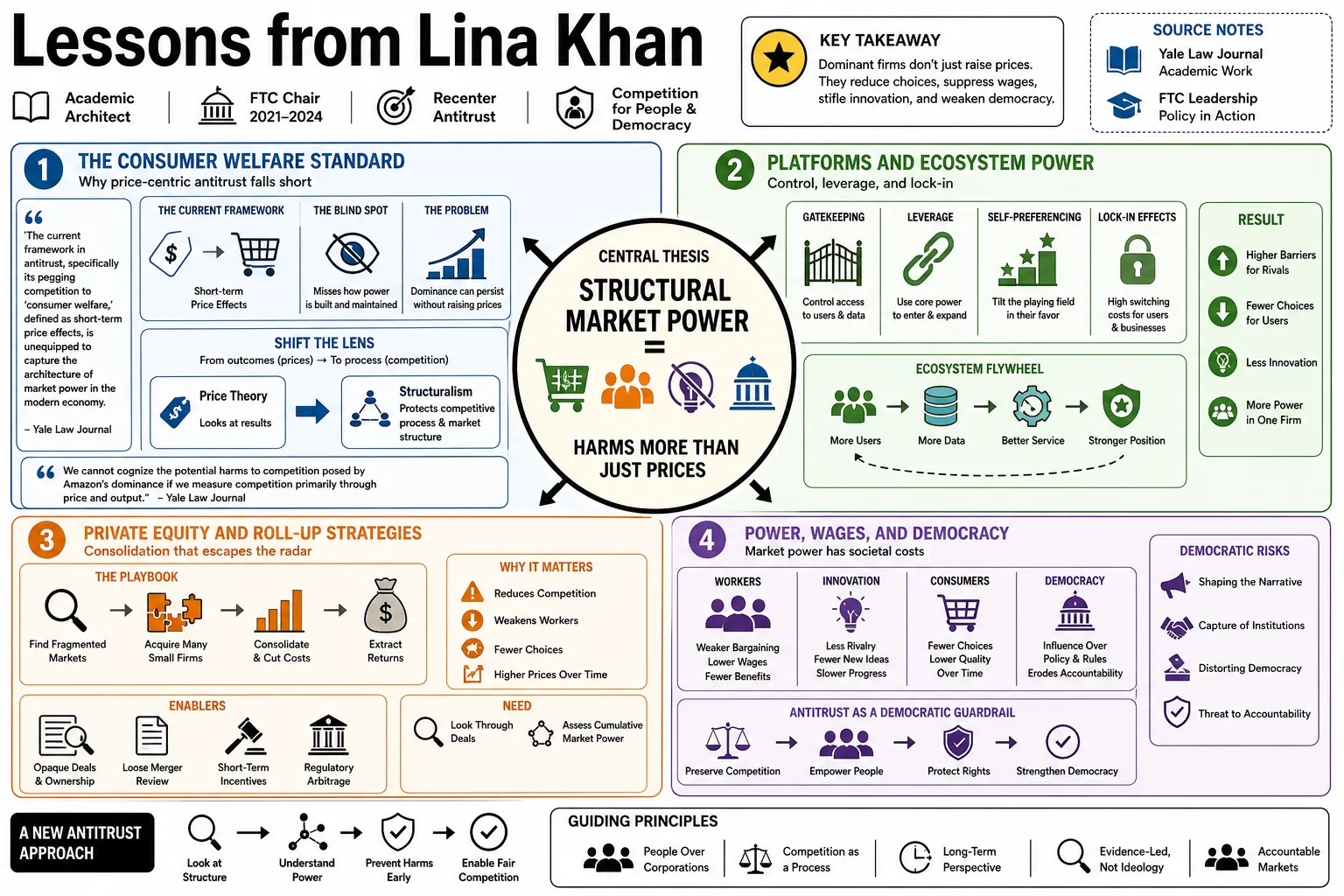
- On the inadequacy of price-centric antitrust: "The current framework in antitrust, specifically its pegging competition to 'consumer welfare,' defined as short-term price effects, is unequipped to capture the architecture of market power in the modern economy." — Source: Yale Law Journal
- On the Chicago School's blind spot: "We cannot cognize the potential harms to competition posed by Amazon’s dominance if we measure competition primarily through price and output." — Source: Yale Law Journal
- On structuralism versus price theory: "In order to capture these anticompetitive concerns, we should replace the consumer welfare framework with an approach oriented around preserving a competitive process and market structure." — Source: Yale Law Journal
- On how low prices mask dominance: "Antitrust doctrine views low consumer prices, alone, to be evidence of sound competition. By this measure, Amazon has excelled; it has evaded government scrutiny in part through fervently devoting its business strategy and rhetoric to reducing prices for consumers." — Source: Yale Law Journal
- On the original intent of antitrust laws: "Congress passed the antitrust laws to protect independent businesses and to prevent the concentration of economic power, recognizing that concentration threatens our democratic system." — Source: House Antitrust Subcommittee Report
- On the failure to predict harms: "The Chicago School assumed that markets self-correct and that predatory pricing is irrational, but in the digital economy, capturing market share through sustained losses is heavily rewarded by investors." — Source: The Atlantic
- On the limits of efficiency: "Efficiency is not the only value. A system that optimizes purely for efficiency often creates single points of failure and fragile supply chains." — Source: Financial Times
- On restoring the legislative framework: "We are simply returning to the text of the statutes that Congress wrote. The consumer welfare standard is a judicial creation, not a legislative mandate." — Source: University of Chicago Institute of Politics
- On the breadth of consumer identity: "People are not just consumers; they are workers, they are creators, they are small business owners. Antitrust must account for how market power affects people across all these dimensions." — Source: NPR
- On shifting the burden of proof: "When enforcers operate under a framework that views false positives as more dangerous than false negatives, we end up with decades of under-enforcement and runaway consolidation." — Source: Harvard Law Review
Part 2: Amazon and Platform Monopolies
- On the conflict of vertical integration: "Because online platforms serve as critical intermediaries, integrating across business lines positions these platforms to control the essential infrastructure on which their rivals depend." — Source: Yale Law Journal
- On the data advantage of platforms: "This dual role also enables a platform to exploit information collected on companies using its services to undermine them as competitors." — Source: Yale Law Journal
- On infrastructure capture: "Amazon is the titan of twenty-first century commerce. In addition to being a retailer, it is now a marketing platform, a delivery and logistics network, a payment service, a credit lender, an auction house, a major book publisher, a producer of television and films, a fashion designer, a hardware manufacturer, and a leading host of cloud server space." — Source: Yale Law Journal
- On predatory pricing in the internet era: "The economics of platform markets create incentives for a company to pursue growth over profits, a strategy that investors have rewarded. Under these conditions, predatory pricing becomes highly rational." — Source: Yale Law Journal
- On the common carrier solution: "If a platform provides essential infrastructure, applying common carrier obligations and duties could prevent it from discriminating against competitors that rely on its network." — Source: Yale Law Journal
- On Amazon's fulfillment coercion: "By tying prime eligibility to the use of its own fulfillment services, Amazon forces sellers to pay for its logistics network even if they could find cheaper alternatives elsewhere." — Source: FTC Press Release on Amazon Lawsuit
- On the illusion of choice: "While consumers see a vast marketplace, the underlying architecture is controlled by a single gatekeeper that dictates terms, fees, and visibility for millions of businesses." — Source: House Judiciary Committee Testimony
- On monopoly rent extraction: "As platforms lock in both buyers and sellers, they transition from offering subsidies to extracting steep tolls, essentially functioning as a private tax on the digital economy." — Source: Columbia Law Review
- On algorithmic suppression: "When a platform manipulates its search algorithms to bury rivals and heavily feature its own private-label products, it abandons fair competition for self-preferencing." — Source: FTC Amazon Complaint
- On structural separation: "The clearest way to eliminate the inherent conflict of interest in dominant platforms is structural separation, preventing the owner of the marketplace from competing in that same marketplace." — Source: Yale Law Journal
Part 3: The FTC and Regulatory Philosophy
- On the cost of inaction: "For too long, the FTC has been overly cautious, resulting in a crisis of consolidation. The cost of doing nothing is far higher than the cost of bringing difficult cases." — Source: The New York Times
- On taking tough cases: "If you never lose a case, you are not bringing enough cases. We must be willing to test the bounds of the law to fulfill our statutory mandate." — Source: Bloomberg
- On rewriting merger guidelines: "The revised merger guidelines reflect commercial realities. They acknowledge that markets can be harmed not just by horizontal monopolies, but by vertical integration and the entrenchment of dominant platforms." — Source: FTC Merger Guidelines
- On administrative rulemaking: "Case-by-case adjudication is slow and resource-intensive. To effectively police unfair methods of competition across the economy, the FTC must utilize its dormant rulemaking authority." — Source: FTC Policy Statement
- On reviving Section 5: "Section 5 of the FTC Act prohibits unfair methods of competition. This is explicitly broader than the Sherman Act, intended to stop incipient monopolies before they fully form." — Source: FTC Policy Statement
- On interagency cooperation: "Antitrust enforcement requires a whole-of-government approach. We are partnering with the DOJ, the NLRB, and sector-specific regulators to ensure markets work for everyone." — Source: White House Competition Council
- On deterrence: "The goal of enforcement is not just to win settlements, but to create a deterrent effect. Companies must know that illegal consolidation will be met with vigorous resistance, not a minor fine." — Source: Wall Street Journal
- On analyzing market realities: "We cannot look at markets in a vacuum or rely solely on abstract economic models. We have to look at how businesses actually operate, how they use data, and how they coerce trading partners." — Source: Stanford Law School Speech
- On the purpose of the agency: "The FTC was created to be an expert body that protects the public from predatory business practices. We serve the public, not the incumbent monopolies." — Source: FTC Commission Meeting
- On resource constraints: "We are facing companies with trillion-dollar market caps and bottomless legal budgets. To effectively police these markets, Congress must adequately fund the antitrust agencies." — Source: Senate Commerce Committee Testimony
Part 4: Big Tech and Algorithmic Pricing
- On surveillance pricing: "Firms that harvest Americans' personal data can put people's privacy at risk. Now, firms could be exploiting this vast trove of personal information to charge people higher prices." — Source: FTC Press Release
- On the opacity of algorithms: "Americans deserve to know whether businesses are using detailed consumer data to deploy surveillance pricing, and the FTC's inquiry will shed light on this shadowy ecosystem of pricing middlemen." — Source: FTC Press Release
- On AI and the law: "A violation of the law does not cease being a violation if committed with AI. There is no AI exemption to the antitrust laws." — Source: Carnegie Endowment for Peace
- On algorithmic collusion: "When competitors use the same third-party algorithmic pricing software to set rent or ticket prices, they are effectively fixing prices without ever meeting in a smoke-filled room." — Source: DOJ/FTC Statement of Interest on RealPage
- On digital lock-in: "Tech platforms design their ecosystems to trap users and businesses. High switching costs and lack of interoperability are deliberate strategies to maintain monopoly power." — Source: FTC Technology Blog
- On generative AI consolidation: "We must ensure the emerging market for generative AI does not become dominated by the same few tech giants that control cloud computing and digital markets." — Source: FTC Open Commission Meeting
- On exploiting vulnerabilities: "Algorithms can detect moments of consumer desperation like a canceled flight or an urgent medical need, and instantly adjust prices to extract maximum revenue from a vulnerable buyer." — Source: FTC Surveillance Pricing Probe
- On data as a barrier to entry: "Vast troves of proprietary data serve as an insurmountable moat for dominant tech firms, making it nearly impossible for new entrants to train competitive algorithms." — Source: House Judiciary Tech Investigation
- On behavioral tracking: "The underlying business model of the internet relies on relentless behavioral tracking, which strips individuals of privacy and feeds the very algorithms that manipulate their choices." — Source: FTC Commercial Surveillance Rulemaking
Part 5: Labor Markets and Non-Competes
- On the trap of non-competes: "Non-compete clauses keep wages low, suppress new ideas, and rob the American economy of dynamism, including from the more than 8,500 new startups that would be created a year once non-competes are banned." — Source: FTC Press Release
- On worker mobility: "The freedom to change jobs is core to economic liberty. When employers lock workers in, they strip them of their primary leverage to demand better pay and conditions." — Source: FTC Press Release
- On monopsony power: "Antitrust has historically focused on monopoly power over consumers, but monopsony power over workers, the ability of a dominant buyer of labor to suppress wages, is just as damaging and illegal." — Source: University of Chicago Law Review
- On non-competes in low-wage work: "It is particularly egregious when non-competes are forced on fast-food workers, security guards, and janitors, people who pose no risk of stealing trade secrets but are simply being denied the right to seek a better livelihood." — Source: FTC Open Meeting on Non-Competes
- On gig worker classification: "Misclassifying workers as independent contractors while maintaining algorithmic control over their every move is a method of evading labor protections and shifting business risks onto individuals." — Source: FTC Policy Statement on Gig Work
- On the chilling effect: "Even when non-competes are legally unenforceable in a particular state, employers still use them to intimidate workers who cannot afford the legal fees to fight back." — Source: FTC Non-Compete Rulemaking
- On labor market consolidation: "When hospitals merge in a local market, the immediate victims are often nurses and staff who suddenly have only one potential employer in town, leading to stagnant wages and worsening conditions." — Source: FTC Healthcare Guidelines
- On the false necessity of non-competes: "Employers argue they need non-competes to protect trade secrets, but they already have intellectual property laws and non-disclosure agreements for that. Non-competes are simply a tool of coercion." — Source: NPR Planet Money
- On restoring entrepreneurialism: "Banning non-competes is not just a worker protection issue; it is a competition issue. By freeing workers to start their own firms, we inject vital new competition into consolidated markets." — Source: FTC Press Release
Part 6: Private Equity and Roll-ups
- On stealth consolidation: "The FTC will continue to scrutinize and challenge serial acquisitions, roll-ups, and other stealth consolidation schemes that private equity firms use to quietly monopolize local markets." — Source: FTC Press Release
- On the strip-and-flip model: "Short-term, high-risk, and low-consequence ownership can encourage a flip and strip approach, where they load up companies with enormous amounts of debt, strip valuable assets and sell them off to enrich the private equity owners." — Source: FTC Private Capital Workshop
- On evading merger review: "By buying up dozens of small competitors one by one, private equity firms deliberately keep each transaction below the dollar threshold that requires reporting to antitrust authorities, flying under the radar until the market is cornered." — Source: FTC Merger Guidelines Update
- On the cost to healthcare: "ER doctors, for example, report having to take shortcuts to meet profit-driven metrics in understaffed emergency rooms, a trend they attribute to a slew of private equity buyouts." — Source: American Medical Association Speech
- On holding parent companies accountable: "We are not just looking at the portfolio companies; we are looking at the private equity sponsors themselves. If they direct the anticompetitive strategy, they will be named in the lawsuits." — Source: FTC Welsh Carson Complaint
- On quality degradation as a price increase: "When a private equity firm buys a nursing home, slashes staff, and reduces the quality of care to pay down debt, that is an antitrust injury. A severe drop in quality is economically identical to a price increase." — Source: FTC Private Capital Workshop
- On the financialization of the economy: "The increasing presence of private equity in sectors ranging from housing to veterinary care represents a shift toward financial engineering over actual productive growth." — Source: Financial Times
- On interlocking directorates: "Private equity firms frequently place their executives on the boards of multiple competing companies within the same industry, violating Section 8 of the Clayton Act and facilitating collusion." — Source: FTC Section 8 Enforcement
- On restoring long-term investment: "Antitrust enforcement against extractive roll-ups helps pivot capital back toward organic business creation and long-term investment rather than short-term rent extraction." — Source: Bloomberg Law
Part 7: Healthcare and Pharmacy Benefit Managers
- On the power of middlemen: "Pharmacy benefit managers are again these obscure players, but basically they're these middlemen so they determine who gets access to what medicines and at what price." — Source: Interview with Senator Bernie Sanders
- On PBM opacity: "I think we've seen time and time again where some businesses will use complexity to shroud what's really going on." — Source: NCPA Convention Speech
- On steering practices: "PBMs engage in tactics that hike the price of drugs, deprive patients of access to certain medicines, and drive community pharmacies out of business by steering patients to their own affiliated pharmacies." — Source: White House Roundtable on PBMs
- On rebate walls: "Through exclusionary rebate agreements, dominant PBMs demand massive kickbacks from drug manufacturers in exchange for formulary placement, which structurally blocks cheaper generic alternatives from ever reaching the patient." — Source: FTC PBM Report
- On insulin pricing: "The fact that patients are rationing life-saving insulin because of artificially inflated prices engineered by middlemen is a catastrophic failure of competition." — Source: FTC Action Against PBMs
- On vertical integration in healthcare: "The consolidation of insurers, PBMs, and pharmacies under massive corporate umbrellas creates overwhelming conflicts of interest that prioritize corporate margins over patient health." — Source: FTC Healthcare Competition Policy
- On phantom networks: "Health insurers and PBMs often advertise broad networks of providers that do not actually exist or are unavailable, misleading consumers and locking out independent practitioners." — Source: FTC Comments on Healthcare
- On the demise of independent pharmacies: "Local pharmacists are being forced to reimburse PBMs at rates lower than the cost to acquire the drugs, a predatory squeeze designed to eliminate independent competition." — Source: NCPA Convention Speech
- On enforcing the Robinson-Patman Act: "We are closely looking at reviving enforcement of the Robinson-Patman Act to stop dominant pharmaceutical middlemen from engaging in illegal price discrimination against smaller rivals." — Source: FTC Policy Updates
Part 8: Democracy, Power, and The Rule of Law
- On extreme concentration and democracy: "Concentrated economic power poses a threat not just to open markets, but to democratic institutions. When a few private actors control our essential communications and commerce infrastructures, they wield quasi-sovereign power." — Source: Yale Law Journal
- On the rule of law: "If companies are large enough to routinely violate the law as a cost of doing business, or dictate terms to their regulators, we have lost the rule of law." — Source: House Judiciary Subcommittee Testimony
- On shifting power dynamics: "Antitrust is fundamentally about the distribution of power. It dictates whether power rests with a diverse array of citizens and independent businesses or is consolidated in the hands of a few corporate executives." — Source: Open Markets Institute Forum
- On the failure of behavioral remedies: "Consent decrees that merely ask a monopolist to promise to behave better without altering their underlying structural incentives have repeatedly failed. We must prioritize structural remedies." — Source: Harvard Law Review
- On systemic fragility: "Decades of unchecked consolidation have left our economy brittle. When a single factory goes offline and creates a nationwide shortage of infant formula, that is a symptom of extreme market concentration." — Source: FTC Supply Chain Report
- On challenging corporate bullying: "We cannot let the threat of aggressive litigation by trillion-dollar companies intimidate the government into standing down. We are here to enforce the law without fear or favor." — Source: The New York Times
- On the public interest over private profits: "The purpose of a market is to serve the public, foster innovation, and distribute prosperity. When markets are structured purely to extract wealth for a handful of gatekeepers, they have failed their social purpose." — Source: Stanford Law School Speech
- On reclaiming economic liberty: "A free market is not a market without rules. A free market is one where the rules prevent monopolies from suffocating competition, allowing individuals the genuine liberty to compete and build." — Source: Columbia Law Review
- On the legacy of the New Brandeis movement: "We are recovering a lost tradition in American political economy, one that understands that antimonopoly law is essential to maintaining a republic where citizens, not corporate sovereigns, govern themselves." — Source: The Atlantic