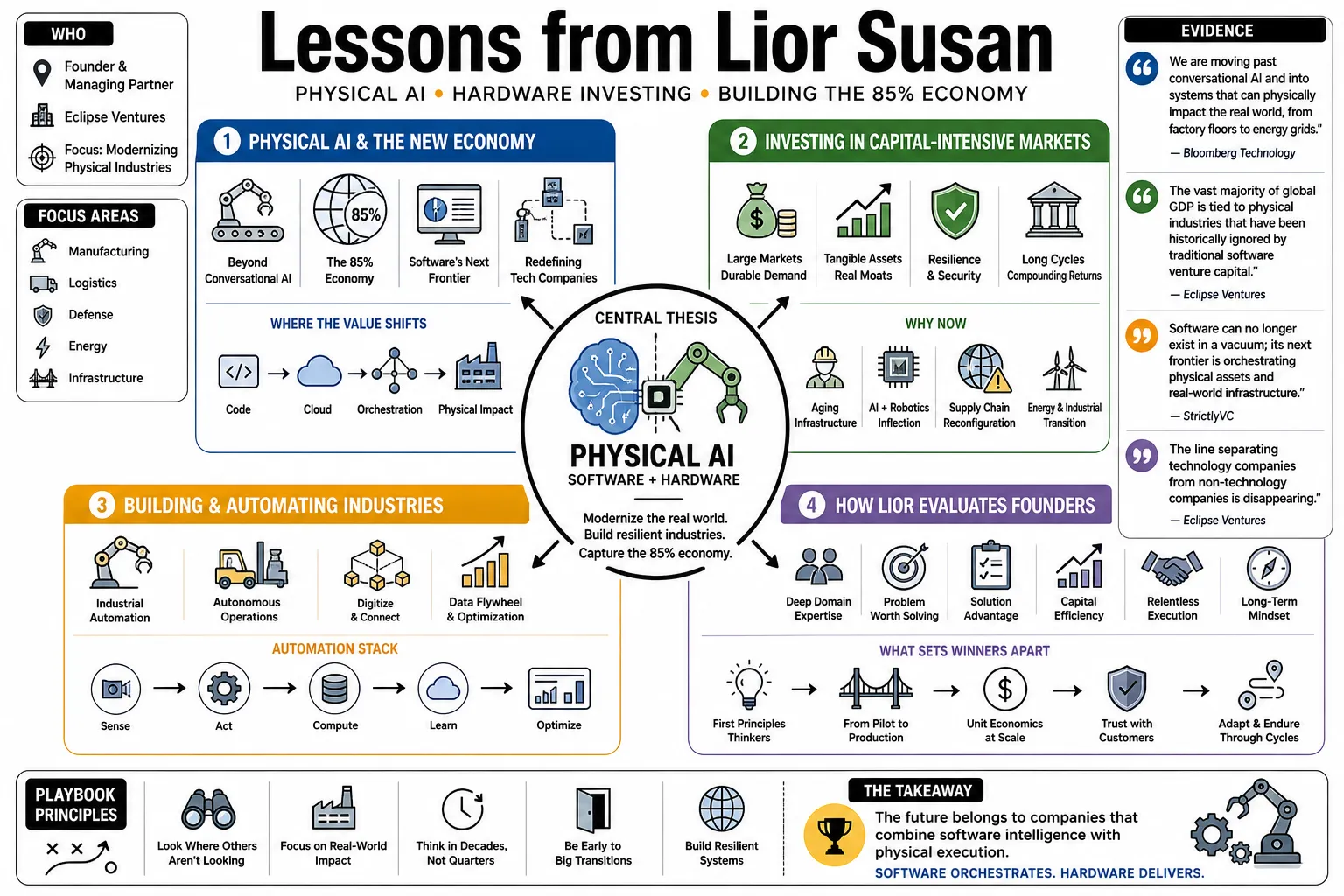
Lior Susan is the founder and managing partner of Eclipse Ventures, a venture capital firm that focuses on modernizing physical industries like manufacturing, logistics, and defense. He is known for championing the concept of "Physical AI," which argues for the integration of hardware and software to fix aging infrastructure and improve supply chain resilience. This profile outlines his approach to hardware investing, industrial automation, and evaluating founders in capital-intensive markets.
Part 1: Physical AI and the New Economy
- On the Physical AI transition: StrictlyVC framed Susan's 2026 appearance around Eclipse's big bet on what the firm calls physical AI, which is a safer way to say he sees the next AI wave as software moving into factories, infrastructure, and other real-world systems rather than staying in chat alone. — Reference: StrictlyVC episode on Eclipse's bet on Physical AI
- On the 85% economy: "The vast majority of global GDP is tied to physical industries that have been historically ignored by traditional software venture capital." — Source: Eclipse Ventures
- On software's new frontier: In Eclipse's Heavy Hitters recap, Susan says essential physical industries never received the same internet, mobile, and cloud transformation that software-centric sectors did. That supports the narrower lesson that software's next frontier is modernizing the physical economy, not just adding more standalone apps. — Reference: Eclipse Heavy Hitters recap on digitizing essential physical industries
- On redefining tech companies: "The line separating technology companies from non-technology companies is effectively over; every critical industry must become tech-enabled to survive." — Source: VulcanForms
- On bits versus atoms: "Generating revenue based on atoms rather than bits requires fundamentally different operational frameworks, but the digital tools to do so are finally mature." — Source: Medium
- On solving the hard problems: "We cannot afford to keep building apps when the foundational infrastructure of our daily lives remains analog and fragile." — Source: The Full Ratchet
- On the AI hype cycle: The 5-Year Frontier summary focuses less on generative-AI novelty and more on autonomous factories, digital twins, and manufacturing systems delivering higher precision and quality. That supports a safer lesson that Susan values AI most when it improves real industrial output. — Reference: 5-Year Frontier on AI, robotics, and the future of manufacturing
- On physical infrastructure fragility: "COVID exposed that the physical world was running on highly brittle, decades-old operating models that desperately need modernization." — Source: Tank Talks
- On the next wave of unicorns: "The next trillion dollars in market cap will be built by companies dragging old-line industries into the digital age, not by another SaaS application." — Source: Eclipse Ventures
- On long-term economic shifts: "We need a new economy that delivers tangible goods faster, cleaner, and closer to the end consumer." — Source: VulcanForms
Part 2: Revitalizing Manufacturing and Supply Chain
- On legacy manufacturing: "Aging, rigid systems and fragmented supply chains are the biggest bottlenecks in manufacturing today, requiring software-defined solutions to fix." — Source: PR Newswire
- On supply chain visibility: "You cannot optimize what you cannot see; digital tracking across the entire supply chain is the baseline for modern commerce." — Source: Eclipse Ventures
- On software-defined factories: "Adopting ecosystem-wide, software-defined processes is the only way to ease the burden of labor shortages and rigid production lines." — Source: PR Newswire
- On industrial scale: "The real test of industrial innovation isn't building a prototype; it's scaling manufacturing to deliver real capability at industrial volumes." — Source: 3DPrint.com
- On supply chain resilience: "Resilience doesn't mean holding infinite inventory; it means having the digital agility to reroute manufacturing and logistics in real time." — Source: Tank Talks
- On the reality of hardware execution: "Industries are huge and easy to research, but simulation is no substitute for deep market knowledge and surviving real-world manufacturing conditions." — Source: Scribd
- On modernizing the factory floor: "The factory floor has remained largely untouched by the digital revolution that transformed our offices; that asymmetry is no longer sustainable." — Source: Augmented Ops
- On distributed manufacturing: "The future of production is moving away from massive, centralized overseas hubs toward distributed, software-orchestrated local facilities." — Source: Eclipse Ventures
- On the true cost of offshore manufacturing: "We miscalculated the true cost of offshore manufacturing by ignoring the strategic vulnerabilities and supply chain fragility it created." — Source: Mission North
- On continuous industrial improvement: 5-Year Frontier says digital twins give AI a training ground for continuous testing and optimization across the manufacturing process. That supports the lesson that modern factories should improve through constant software feedback loops rather than fixed one-time process design. — Reference: 5-Year Frontier on digital twins and continuous optimization
Part 3: The Intersection of Atoms and Bits (Hardware + Software)
- On the full-stack approach: "Pushing software into hardware and pulling data from hardware is how you create superior, defensible business models." — Source: The Full Ratchet
- On defensive moats: "Hardware combined with intelligent software creates a moat that is significantly harder to copy than pure software solutions." — Source: Substack
- On digital bridges: "We need digital bridges to the physical world to extract the data necessary to run physical systems efficiently." — Source: Eclipse Ventures
- On the hardware stigma: "Technology investors historically saw hardware as a drag on margins, missing that hardware is the essential conduit to real-world data." — Source: Medium
- On multidisciplinary engineering: "Building at the intersection of atoms and bits requires teams that can speak mechanical engineering, embedded systems, and machine learning fluently." — Source: EVCA
- On iterative hardware: "Hardware development must adopt the iterative, agile methodologies of software, moving away from slow, monolithic design cycles." — Source: TechAviv
- On data extraction from physical assets: "If your physical asset isn't generating real-time operational data, it's a dead asset." — Source: Eclipse Ventures
- On the software wrapper: "You can't just slap a software wrapper on legacy hardware and call it innovation; the hardware itself must be designed to be software-defined." — Source: Tomorrow Access
- On capital intensity: "Atoms require more capital than bits initially, but the long-term enterprise value of owning the physical layer justifies the investment." — Source: Startup Intros
Part 4: Geopolitics, Reshoring, and National Security
- On domestic capability: "Strengthening the U.S. and allied industrial base with real manufacturing capability is an urgent mission, built here and now." — Source: 3DPrint.com
- On manufacturing as security: "Reclaiming domestic manufacturing capabilities is not just about economic health; it is fundamentally a matter of national security." — Source: Augmented Ops
- On the China dynamic: "If we can mimic human labor cost-effectively through robotics, we remove the demographic disadvantage we face against massive overseas labor forces." — Source: Mission North
- On strategic policy: "We need to think beyond shiny objects and coordinate trade policy, tax credits, and allied cooperation to rebuild the broader supply chain." — Source: Hudson Institute
- On defense tech execution: "Defense technology requires companies that can actually scale physical systems like propulsion, not just pitch concepts." — Source: 3DPrint.com
- On the U.S. industrial base: "The degradation of the American industrial base was a decades-long policy failure that venture capital must now help correct." — Source: Eclipse Ventures
- On geopolitical breaking points: "Trade wars and geopolitical tension forced legacy industries to finally take digital transformation seriously out of sheer survival instinct." — Source: Mission North
- On nearshoring: "Supply chains are moving closer to home not out of patriotism, but because the math of offshore risk no longer makes sense." — Source: Tank Talks
- On allied tech ecosystems: "Building resilient supply chains requires deep integration and shared technology standards among allied nations." — Source: Hudson Institute
Part 5: The Builder VC Model and Hands-On Incubation
- On incubating companies: "Sometimes the solutions for legacy industries are too complex for two people in a garage, so we act as co-founders to incubate them from scratch." — Source: Tomorrow Access
- On venture capital's role: "VC shouldn't just be about allocating capital; in hard industries, it must be about company building and operational heavy lifting." — Source: Teaser Club
- On the 'too hard' pile: "The most lucrative opportunities in venture right now are the ones sitting in the 'too hard' or 'too complicated' pile." — Source: Tomorrow Access
- On operational expertise: "We prefer to build a firm composed of operators who have actually run factories and supply chains, rather than career financiers." — Source: Eclipse Ventures
- On founding teams: "When we incubate, we actively recruit multidisciplinary executives who might not naturally meet each other in the standard startup ecosystem." — Source: TechAviv
- On the Flex experience: "My time at Flextronics showed me that leaders across vastly different sectors—from medical to energy—were struggling with the exact same technology integration issues." — Source: Eclipse Ventures
- On long-term conviction: The 5-Year Frontier write-up says hard-tech founders are drawn by the long-term struggle and ultimate reward of transforming industrial and physical landscapes. That supports the safer takeaway that this category requires longer-duration conviction than a standard quick-turn venture playbook. — Reference: 5-Year Frontier on the long-term nature of hard-tech building
- On thesis-driven investing: "We don't react to pitches; we identify structural flaws in physical industries and then find or build the companies to fix them." — Source: Eclipse Ventures
- On capital efficiency in hardware: "The myth is that hardware takes infinite capital; the reality is that disciplined incubation and modern software design drastically reduce hardware burn rates." — Source: The Full Ratchet
Part 6: Founder Traits and Leadership in Hard Tech
- On founder domain expertise: "We look for founders who understand incredibly well the specific, regulated market they are trying to transform." — Source: Scribd
- On navigating complexity: "Founders in physical industries must be able to navigate the beast of large-scale corporate procurement while maintaining startup agility." — Source: Eclipse Ventures
- On ambition: "We seek out leaders with the audacity to tackle massive, multidisciplinary problems rather than building incremental software features." — Source: EVCA
- On operational mindset: In Heidrick's conversation, Susan says leaders in physical-industry startups need commercial edge, market savviness, and customer centricity, not just technical depth. That supports the narrower lesson that hard-tech founders need an operating mindset that covers go-to-market and execution as well as engineering. — Reference: Heidrick on leadership traits for physical-industry founders
- On resilience: "Building in the physical world guarantees things will break; a founder's resilience is the only buffer against hardware reality." — Source: Heidrick & Struggles
- On respect for legacy industries: "You cannot walk into a century-old industry with arrogance; founders must respect the existing operational complexity before trying to disrupt it." — Source: Tank Talks
- On team building: "The best founders recognize they cannot be experts in both hardware and software, so they over-index on hiring complementary talent." — Source: Eclipse Ventures
- On managing capital: "Hardware founders must have an inherent respect for capital efficiency, because mistakes in atoms cost significantly more than mistakes in bits." — Source: Startup Intros
- On enterprise sales: "Selling physical infrastructure requires founders who understand the psychology of risk-averse enterprise buyers." — Source: Heidrick & Struggles
- On optimistic realism: "You have to be a relentless optimist to believe you can change old-line industries, but a harsh realist when executing the daily operations." — Source: VulcanForms
Part 7: Automation, Robotics, and Human Augmentation
- On robotic proliferation: "Once you can build a cost-effective robot, you can scale manufacturing capacity infinitely without being constrained by human demographics." — Source: Mission North
- On human augmentation: "Automation should not be about blind replacement; it is about augmenting humans so they can perform higher-level, more impactful work." — Source: Augmented Ops
- On the labor shortage: "We simply do not have enough skilled workers willing to do repetitive manual assembly; robotics is the mathematical solution to this gap." — Source: PR Newswire
- On flexible automation: 5-Year Frontier describes production changes designed in software and then consumed as instructions by robotic microfactories, replacing rigid line changes with more adaptable automation. That supports a safer lesson that the new factory model is more software-directed and flexible than older caged automation systems. — Reference: 5-Year Frontier on software-driven robotic microfactories
- On computer vision: "Vision systems act as the bridge between software intelligence and physical execution, allowing machines to perceive their environments." — Source: Eclipse Ventures
- On democratizing robotics: "Software-defined robotics is driving down the cost of deployment, making automation accessible to mid-sized manufacturers." — Source: Tomorrow Access
- On factory safety: "Removing humans from dangerous, heavy-lifting environments through automation is a fundamental improvement to workplace safety." — Source: Augmented Ops
- On precision and quality: The same 5-Year Frontier piece describes autonomous factories of high precision and quality, tying automation to better consistency rather than just lower labor input. That supports the lesson that robotics matters because it can improve repeatability and quality control at scale. — Reference: 5-Year Frontier on autonomous factories and quality
- On data generation: 5-Year Frontier says connected factories will leverage machine health, digital twins, software automation, and multiple sensors to create a more complete operating picture. That supports the lesson that industrial automation becomes more valuable when physical systems continuously generate usable data. — Reference: 5-Year Frontier on connected factories, sensors, and data
Part 8: Lessons from the Kibbutz and Military Service
- On resourcefulness: "Growing up on an agricultural kibbutz forces you to understand the absolute baseline of how food and physical goods are produced." — Source: Eclipse Ventures
- On collective effort: "The kibbutz structure ingrained in me that complex physical tasks require highly synchronized, collective human effort to succeed." — Source: Full Ratchet
- On first-principles thinking: "Military service in the Special Forces teaches you to strip a problem down to its bare, operational realities when under pressure." — Source: EVCA
- On leadership under stress: "Leading teams in high-stakes military environments translates directly to navigating the existential crises of early-stage hardware startups." — Source: Startup Intros
- On people and systems: "My background taught me that you can have the best technology in the world, but it will fail if the underlying human system isn't aligned." — Source: Eclipse Ventures
- On humility: "Serving in the IDF instills a level of humility and directness that is essential when dealing with the unforgiving nature of hardware." — Source: EVCA
- On decisive action: "In both the military and venture capital, waiting for perfect information before making a decision is a guaranteed way to fail." — Source: Me.sh
- On mission-driven work: "I approach venture capital with the same mission-driven mindset learned in the military—we are trying to build infrastructure that secures the future." — Source: VulcanForms
- On unconventional paths: "Silicon Valley historically favored software engineers from specific universities; my path proved that operational grit from the farm and military is just as valuable." — Source: Substack