Lessons from Liz Ann Sonders
As the Chief Investment Strategist at Charles Schwab, Liz Ann Sonders turns complex macroeconomic data into practical advice for everyday investors. For more than 20 years, she has used her analysis of market cycles and investor sentiment to guide portfolio management. This profile breaks down her approach to risk and market discipline.
Part 1: The Foundations of Market Discipline
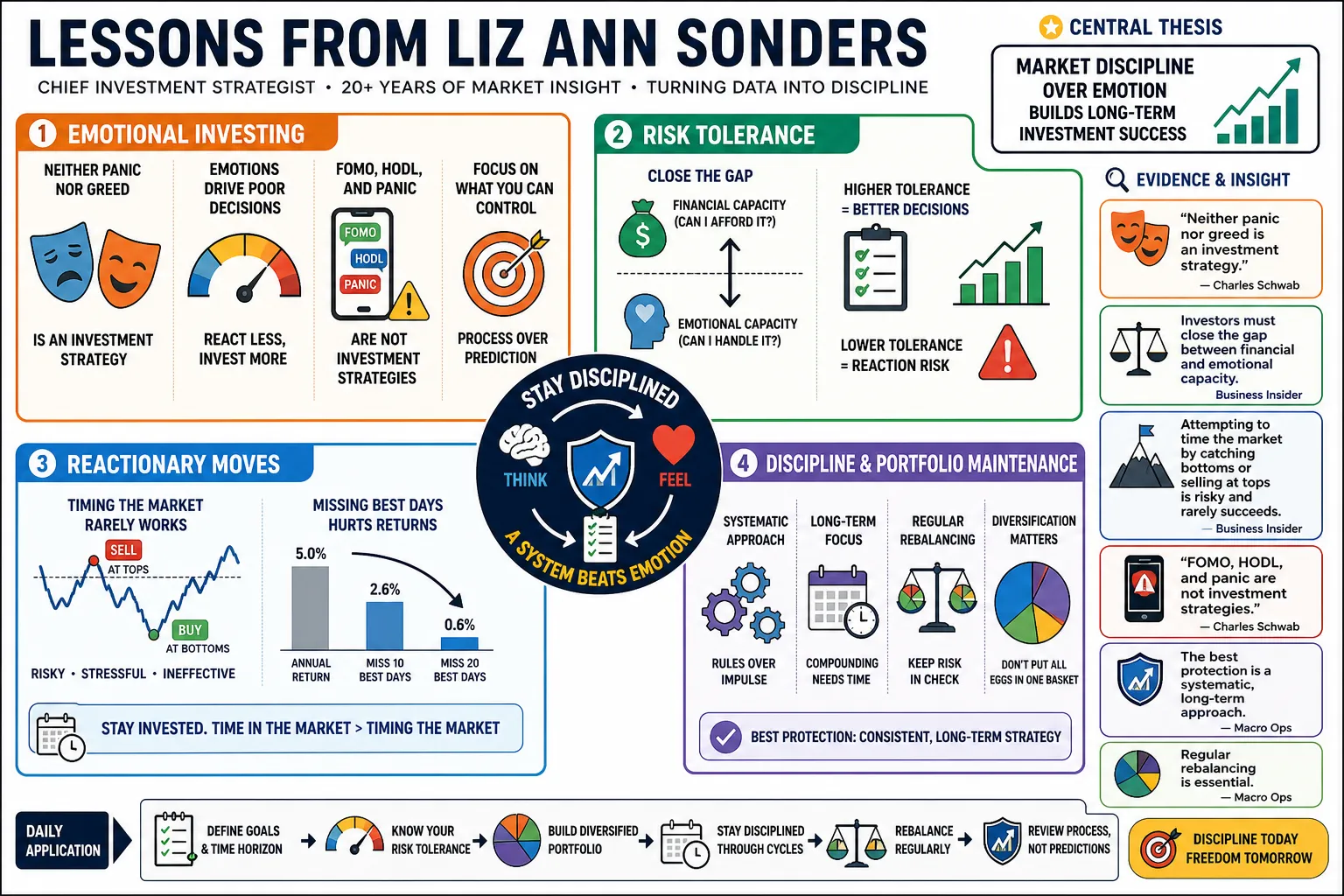
- On Emotional Investing: "Neither panic nor greed is an investment strategy." — Source: Charles Schwab
- On Risk Tolerance: Investors must close the gap between their financial capacity to absorb losses and their emotional ability to withstand market volatility. — Source: Business Insider
- On Reactionary Moves: Attempting to time the market by catching bottoms or selling at tops is inherently risky and rarely succeeds over the long term. — Source: Business Insider
- On Modern Trends: "FOMO, HODL, and panic are not investment strategies." — Source: Charles Schwab
- On Discipline: The best protection against unpredictable market behavior is a systematic approach that prioritizes a consistent, long-term strategy. — Source: Macro Ops
- On Portfolio Maintenance: Regular rebalancing is essential to avoid getting trapped by unintended concentration risk when certain sectors outperform. — Source: Business Insider
- On Simplistic Labels: Rigidly adhering to binary labels like "Growth vs. Value" often obscures the underlying fundamentals that drive returns. — Source: Charles Schwab
- On Taking Profits: Investors should remember the old adage that no one ever went broke taking profits, especially after periods of rapid appreciation. — Source: Barchart
- On Noise vs. Signal: Success requires looking beyond daily headline noise and focusing on actual corporate earnings and economic indicators. — Source: Advisor Perspectives
- On Enduring Principles: While market environments and trading technologies evolve, the fundamental human tendency to let emotions drive decisions at the worst moments remains unchanged. — Source: Advisor Perspectives
Part 2: Dissecting Market Cycles
- On the Anatomy of a Bull Market: "Bull markets are born on pessimism, grow on skepticism, mature on optimism, and die on euphoria." — Source: Charles Schwab
- On Emotional Drivers: The Templeton cycle of a bull market is brilliant because it focuses entirely on investor emotional states rather than traditional economic metrics. — Source: Ritholtz
- On Late-Stage Markets: In aging expansions, a bull market that was born on despair and grew on disbelief often faces its greatest threat when the public finally reaches broad acceptance. — Source: Hendershot Investments
- On Recession Bears: The most severe and long-lasting bear markets are typically tied directly to deep economic recessions. — Source: Validea
- On Echo Bears: Market corrections that occur in the absence of a recession often act as a "pause that refreshes" before growth resumes. — Source: Validea
- On Post-Recession Snapbacks: The initial phase following a bear market is typically characterized by a sharp one-to-two-year rally before transitioning to a more mature growth phase. — Source: Validea
- On Market Regimes: Investors should focus on understanding the specific structural regime the market is currently in, rather than relying on simplistic bull versus bear labels. — Source: Charles Schwab Asset Management
- On Instability: Modern markets are often characterized more by underlying instability—shifting rules and abrupt policy changes—than by simple uncertainty. — Source: Substack
- On Sector Rotations: Choppy market behavior and sharp internal sector rotations can mask the true health of the broader headline indexes. — Source: The Motley Fool
- On Complacency: Even when a bull market remains intact, investor complacency makes equities acutely vulnerable to unexpected exogenous shocks. — Source: ThinkAdvisor
Part 3: The Jigsaw Puzzle of the Economy
- On Analytical Frameworks: Analyzing the financial markets is like putting together a jigsaw puzzle; you must synthesize individual data points into a broader picture. — Source: Aspire Planning Associates
- On Incomplete Information: Investors must accept that the market is a complex puzzle where they will never find every single piece needed to complete the perfect picture. — Source: Substack
- On Economic Indicators: Economic data points and sentiment surveys should be viewed merely as individual pieces of the puzzle, not as isolated signals to trade on. — Source: Charles Schwab
- On Probabilistic Thinking: Because the economic puzzle is never entirely complete, investing requires a disciplined, probabilities-based approach rather than seeking absolute certainty. — Source: Charles Schwab
- On Headline Resilience: Strong headline GDP growth often obscures underlying fault lines within the economy that investors must actively monitor. — Source: Charles Schwab
- On the Labor Market: While immediate recession signals may be absent, survey-based employment data often reveals early warning signs that warrant careful attention. — Source: Charles Schwab Asset Management
- On Capital Expenditures: Sustained business investments, particularly in emerging technologies and infrastructure, act as critical structural support for economic growth. — Source: Advisor Perspectives
- On Supply Shocks: Geopolitical disruptions that drive up energy prices function as supply shocks, introducing significant friction into economic expansions. — Source: Charles Schwab
- On the Big Picture: To solve the economic jigsaw puzzle, investors must zoom out and rely on the "picture on the box"—their overarching financial plan. — Source: Aspire Planning Associates
Part 4: Consumer Realities and Inflation
- On Personal Inflation: Inflation is not just a broad monetary phenomenon; it is a highly personal experience determined by individual circumstances and commuting costs. — Source: Hedgeye
- On Sentiment vs. Confidence: Consumer sentiment is heavily influenced by the daily reality of inflation, whereas consumer confidence is more closely tied to the state of the labor market. — Source: Charles Schwab Asset Management
- On Diverging Data: There is often a stark divergence between robust headline economic data and the lived, day-to-day reality reported in consumer sentiment surveys. — Source: Charles Schwab Asset Management
- On the Misery Index: The disconnect between strong economic growth and poor public sentiment is frequently reflected in an elevated Misery Index, highlighting the corrosive strain of inflation. — Source: Charles Schwab Asset Management
- On Household Strain: Even during economic expansions, households can face severe pressure from negative real wage growth and depleted savings rates. — Source: Advisor Perspectives
- On Headline CPI: The aggregate Consumer Price Index numbers rarely capture the true financial strain felt by average consumers facing rising non-discretionary costs. — Source: The Motley Fool
- On Sticky Prices: Inflation can remain persistently sticky due to structural factors like energy costs and massive capital expenditures in technology. — Source: Charles Schwab
- On Corporate Cost-Passing: A primary risk of reigniting inflation lies in the ability and pressure of businesses to pass rising labor and tariff costs directly onto consumers. — Source: Seeking Alpha
- On Affordability: Prolonged affordability pressures can act as a quiet drag on the economy, eventually undermining the strength of consumer spending. — Source: Charles Schwab
Part 5: Navigating Market Froth and Speculation
- On Casino Culture: "I have been very focused on the blurring of the lines between gambling and investing and some of the casino-like behavior that we're seeing in markets." — Source: Business Insider
- On Speculation vs. Investing: When you are merely gambling on short-term price movements, you are essentially acting as a spectator rather than an investor. — Source: Benzinga
- On Retail Risks: The proliferation of complex derivatives, such as zero-day options and leveraged funds, creates an environment where retail traders risk being entirely wiped out. — Source: Benzinga
- On the AI Trade: Investors must evaluate whether the extreme valuations of technology companies have fully priced in a monetization trajectory that may take years to materialize. — Source: Charles Schwab
- On Speculative Juices: There is no question that speculative juices flow heavily in late-stage markets, often completely detaching prices from underlying fundamentals. — Source: Barchart
- On Concentration Risk: A bull market driven by highly concentrated strength in a few mega-cap sectors is structurally vulnerable to sudden shifts in sentiment. — Source: Charles Schwab
- On Equity Risk Premiums: A historically thin equity risk premium leaves the market highly exposed to disappointment if earnings growth fails to meet elevated expectations. — Source: Charles Schwab
- On Fundamentals: True equity accumulation requires stepping away from speculative trading trends and returning to disciplined fundamental analysis. — Source: Benzinga
- On Market Froth: While underlying economic resilience exists, the "froth" surrounding specific trending themes requires a cautious and defensive posture. — Source: ThinkAdvisor
Part 6: Planning Over Prediction
- On the Box Cover: Sonders uses the picture on a jigsaw-puzzle box as a reminder that investors need a plan before markets test their risk tolerance. — Source: Aspire Planning Associates
- On Forecasting: A robust financial plan is designed to survive varied environments; focusing solely on predicting the next macroeconomic move is often a fool's errand. — Source: Advisor Perspectives
- On Being All-In: Taking an "all-in" or "all-out" approach to the market removes flexibility and forces an investor to be right twice: when selling and when buying back in. — Source: The Motley Fool
- On Preparation: The goal of an investor is not to predict the future with certainty, but to prepare their portfolio to weather a range of probable outcomes. — Source: Advisor Perspectives
- On Strategic Allocation: Maintaining a clearly defined strategic asset allocation serves as an anchor during periods of intense market volatility. — Source: Macro Ops
- On the Fallacy of Certainty: Investors often demand absolute certainty in an environment governed by probabilities, leading to delayed and reactionary decision-making. — Source: Charles Schwab
- On Course Correction: Establishing a long-term plan allows investors to make methodical course corrections rather than panicking at the first sign of a downturn. — Source: Business Insider
- On Financial Education: Understanding the mechanics of the market is less important than understanding one's own behavioral biases and time horizon. — Source: Charles Schwab
- On Tuning Out the Noise: The financial media cycle is designed to provoke action, but successful planning requires the discipline to stand still when nothing fundamental has changed. — Source: Charles Schwab Asset Management
Part 7: The Interplay of Stocks, Bonds, and the Fed
- On Market Leadership: "The bond market is in the driver's seat for the equity market." — Source: Fox Business
- On Correlation Shifts: The traditional assumption that bonds will always act as a buffer against falling equities has been structurally challenged in an era of persistent inflation. — Source: Charles Schwab Asset Management
- On the 60/40 Portfolio: The classic 60/40 portfolio is not dead, but the "beneficial diversification" it once offered automatically requires far more nuance today. — Source: Charles Schwab
- On the Great Moderation: We have exited the "Great Moderation"—a long era of low volatility and disinflation—and entered a secular regime requiring dynamic risk management. — Source: AdvisorAnalyst
- On Fed Independence: "Any serious threat to the independence of the Fed" would act as an unquestionable negative for the stability of financial markets. — Source: ThinkAdvisor
- On Policy Reliance: Modern markets find themselves at the mercy of rapid-fire monetary policy decisions, creating a tricky environment for long-term capital allocation. — Source: ThinkAdvisor
- On Active vs. Passive: The return of a meaningful risk-free rate and higher market volatility has leveled the playing field, creating an environment where active management can truly complement passive indexing. — Source: Ritholtz
- On Yield Dynamics: Fluctuations in bond yields directly dictate equity market sentiment, heavily influencing valuations and the willingness to take on risk. — Source: Charles Schwab
- On Expanding Horizons: In a fragmented macroeconomic environment, true diversification requires looking beyond simplistic stock-and-bond binary allocations. — Source: Charles Schwab
Part 8: Timeless Wisdom and Mentorship
- On Acknowledging Mistakes: "It's okay to be wrong; it's unforgivable to stay wrong." — Source: Masters in Business
- On Following the Tape: To succeed, you must have discipline and patience; you have to wait for the market to give its message before imposing your will on it. — Source: Masters in Business
- On Fighting the Fed: The old adage "Don't fight the Fed" remains one of the most reliable truisms for understanding the primary driver of market liquidity. — Source: Masters in Business
- On Market Momentum: "The trend is your friend." Staying in gear with the tape is generally a safer strategy than constantly trying to fight established momentum. — Source: Masters in Business
- On Measuring Sentiment: Studying extreme investor sentiment—through tools like the put/call ratio pioneered by Marty Zweig—is essential for identifying turning points. — Source: Masters in Business
- On the Dual Mindset: A successful investor must be both a "worrier" who obsessively analyzes data and a "warrior" who acts decisively when execution is required. — Source: Masters in Business
- On Foundational Reading: Edwin Lefèvre’s Reminiscences of a Stock Operator remains one of the most vital texts for understanding the immutable psychology of trading. — Source: Masters in Business
- On Ego and Humility: The market ultimately humbles those who prioritize their ego and rigid forecasts over what the data and price action are actively demonstrating. — Source: Masters in Business
- On Absorbing Wisdom: The greatest asset for a young professional is proximity to seasoned mentors who have navigated multiple severe economic cycles. — Source: Masters in Business
- On Legacy: The truest test of investment philosophy is not how it performs during a roaring bull market, but how it preserves capital when the crowd descends into panic. — Source: Masters in Business