Lessons from Logan Kilpatrick
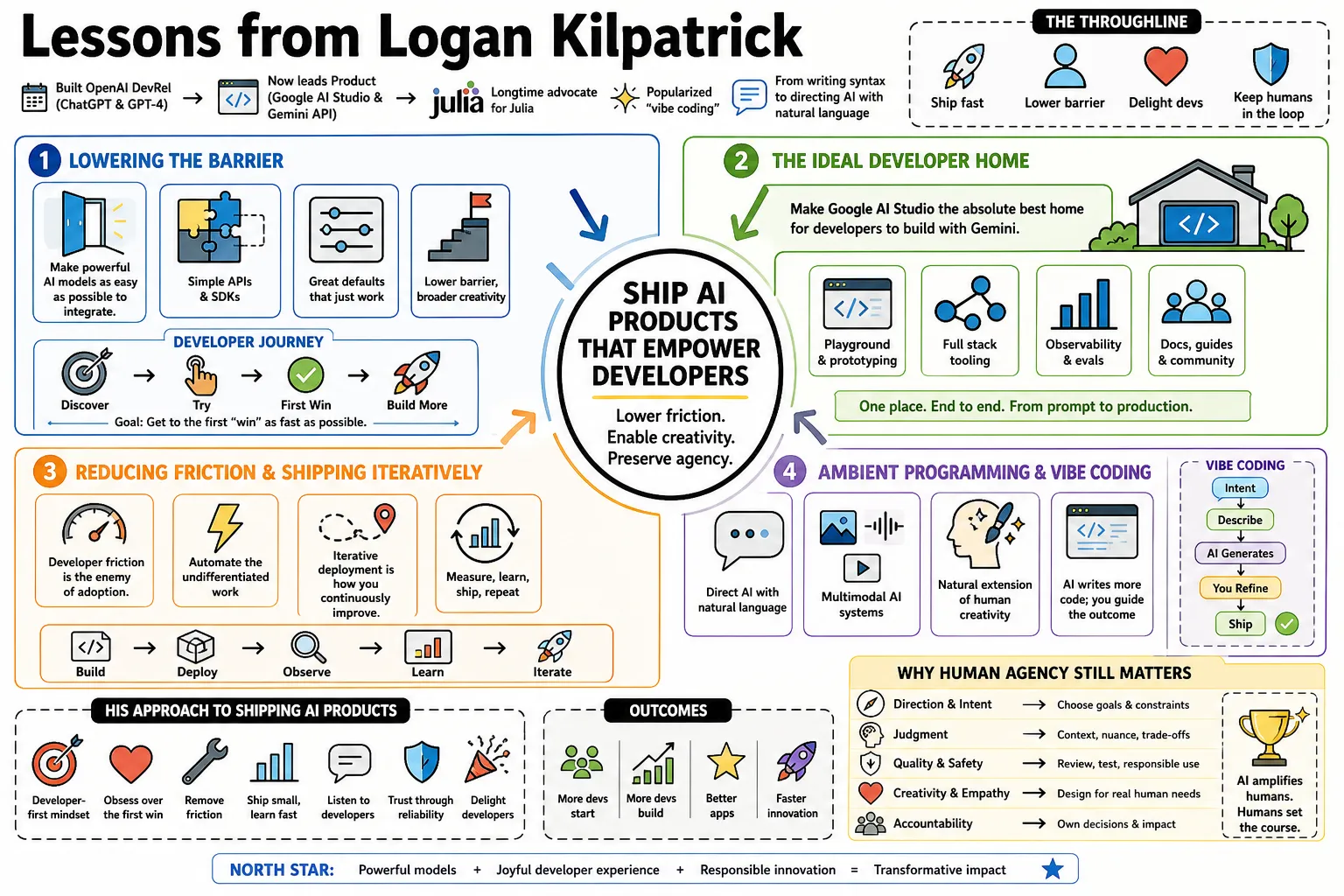
Logan Kilpatrick built OpenAI's developer relations program during the ChatGPT and GPT-4 launches and now leads product for Google AI Studio and the Gemini API. A longtime advocate for the Julia language, he recently popularized "vibe coding" to describe the shift from writing manual syntax to directing AI with natural language. This piece covers his approach to shipping AI products and his argument for why human agency still matters as models write more of the code.
Part 1: The AI Developer Experience & Tooling
- On lowering the barrier: "The primary goal is making powerful AI models as easy as possible for developers to integrate into their own applications." — Source: [Google Blog]
- On the ideal developer home: "We want to make Google AI Studio the absolute best home for developers to build with Gemini." — Source: [The Neuron Daily]
- On reducing friction: "Developer friction is the enemy of adoption; the goal is to get developers to their first 'win' as fast as possible." — Source: [The Stack Overflow Podcast]
- On ambient programming: "Multimodal AI systems are transforming software creation into a natural extension of human creativity." — Source: [Google Blog]
- On iterative integration: "Iterative deployment is how you continuously get signal into the world of the progress that the models are making." — Source: [Release Notes]
- On massive context windows: "Integrating research breakthroughs like long context windows directly into practical tools changes how engineers think about memory." — Source: [Feedforward]
- On rapid prototyping: "AI Studio is designed to let builders prototype ideas quickly before getting bogged down in heavy implementation details." — Source: [The Neuron Daily]
- On the new abstraction layer: "We are building tools that allow you to focus on the creative vision rather than manual boilerplate syntax." — Source: [Google Blog]
Part 2: The Shift to "Vibe Coding"
- On natural syntax: "Natural language is the only syntax you need." — Source: [Google Blog]
- On empowering non-technical users: "Vibe coding is making development exciting and approachable for non-technical workers like HR professionals and accountants." — Source: [Release Notes]
- On the joy of creation: "So many people get excited by creating games only to be hit with C/C#/C++ and realize it’s not fun." — Source: [X/Twitter]
- On immediate visualization: "Instead of describing an idea to a developer, people are now vibe coding it a little bit and showing it to people directly." — Source: [Release Notes]
- On the timeline for gaming: "Everyone is going to be able to vibe code video games by the end of 2025." — Source: [X/Twitter]
- On the blank canvas problem: "Vibe coding is not intended to replace professional developers, but rather to eliminate the fear of facing a blank editor." — Source: [Business Insider]
- On the new artist-engineer: "Engineers are artists now thanks to AI, and artists are becoming engineers, all in a positive sense." — Source: [X/Twitter]
- On shifting focus: "Gemini unlocks the true potential of vibe coding, allowing you to focus on the creative vision rather than the plumbing." — Source: [Google Blog]
- On massive scale: "This is going to successfully usher in the next 100M 'developers' with ease." — Source: [X/Twitter]
Part 3: Product Building, Agency & Execution Speed
- On agency as a differentiator: "Agency is a superpower. Most of the things I am most proud of have come from just doing the thing." — Source: [LoganK.ai]
- On bias for action: "Most people spend too much time asking questions, debating, or waiting for permission instead of acting." — Source: [LoganK.ai]
- On reversible decisions: "Most decisions are 'two-way doors'—the risk of taking action is often lower than the reward of moving quickly." — Source: [LoganK.ai]
- On iteration over perfection: "Move faster; iteration speed often makes up for mistakes made during rapid execution." — Source: [LoganK.ai]
- On the necessity of speed: "Shipping fast is required." — Source: [LoganK.ai]
- On staying outside the lane: "To accelerate innovation, staying in your lane can be a hindrance. If a problem exists, solve it, even if it falls outside your traditional job description." — Source: [LoganK.ai]
- On timeless product truths: "The fundamentals of what it means to build a great product actually haven't changed in the last two or three years; technology changes, but fundamentals don't." — Source: [Around the Prompt]
- On measuring impact: "Focus on actions that can reach or help hundreds of developers at once rather than one-off tasks." — Source: [Lenny's Newsletter]
- On blurring roles: "Officially giving up my 'PM' title, we are all members of the technical staff now, time to embrace it." — Source: [X/Twitter]
Part 4: The Future of AGI & Engineering Work
- On the shift to robotics: "2026 is going to be a huge year for embodied AI, moving from software into physical robots." — Source: [X/Twitter]
- On the ultimate mission: "I think the North Star for us is we want to provide AI to the world. The goal is to make AGI and provide that to the world." — Source: [The Cognitive Revolution]
- On scaling laws: "Reaching artificial superintelligence directly through scaling test-time compute is becoming increasingly probable." — Source: [Around the Prompt]
- On rapid acceleration: "The next 6 months of AI are likely to be the most wild we will have seen so far." — Source: [X/Twitter]
- On the changing developer role: "AI will not replace developers but will instead empower a new generation of creators to build complex software more easily." — Source: [freeCodeCamp]
- On model scale: "We are operating at a massive scale of usage, approaching hundreds of trillions of tokens per month." — Source: [The Cognitive Revolution]
Part 5: Human Authenticity & The Value of Expertise
- On the human premium: "In a world of AI, the value of being human is increasing quickly." — Source: [LoganK.ai]
- On biological programming: "Humans want what other humans create, it is biologically programmed into us." — Source: [LoganK.ai]
- On the exponential value of authenticity: "In turn, the value of authenticity by humans is on an exponential curve." — Source: [LoganK.ai]
- On the irreplaceable touch: "The human touch in software development remains irreplaceable, even with AI advancements." — Source: [freeCodeCamp]
- On the premium of understanding: "The more you increase software in the world, actually the premium of people who understand what's really happening with that software continues to go up." — Source: [Around the Prompt]
- On breaking the ceiling: "While AI helps beginners, the value of true experts will only increase, as they are the ones who will help vibe coders break through the ceiling of what AI can do alone." — Source: [freeCodeCamp]
- On putting your name out there: "As AI becomes more prevalent, putting your name out there and standing behind your work matters more than ever." — Source: [LoganK.ai]
- On human agency: "As AI makes technical tasks easier, human agency—the drive to identify problems and autonomously solve them—becomes an even more critical differentiator." — Source: [LoganK.ai]
- On the personal touch: "DevRel should feel personal and human, not like a corporate marketing function." — Source: [Lenny's Newsletter]
Part 6: The Julia Language & Solving the "Two-Language Problem"
- On the 1-based indexing debate: "Having a first-time computer science student show up on day 3 and telling them that in certain contexts you have to start counting at zero instead of 1 does not make sense to me." — Source: [JuliaZoid]
- On the core solution: "Julia solves the two-language problem by combining the ease of use of Python and R with the speed of C++." — Source: [Towards Data Science]
- On beginner friendliness: "Julia is an ideal language for those early in their programming journey." — Source: [Julia Crash Course]
- On the power of the REPL: "The Julia REPL is very powerful and can be helpful for quick prototyping and testing code." — Source: [DevGenius]
- On the future of scientific computing: "I think right now the best-in-class scientific machine learning software is being written in Julia." — Source: [Towards Data Science]
- On community warmth: "The Julia community itself... is extremely welcoming and helpful for those joining the language ecosystem." — Source: [JuliaZoid]
- On language stability: "The stability of Julia is something users and developers have grown to love over the years... Why Julia 2.0 isn't coming anytime soon is a good thing." — Source: [JuliaZoid]
- On industry impact: "Julia is powering the next wave of biomedical, machine learning, and climate startups." — Source: [NumFOCUS]
- On bringing a fresh perspective: "Companies are often interested in hiring folks who can bring a fresh perspective. Julia can be that fresh perspective!" — Source: [DevGenius]
Part 7: Developer Relations, Documentation & Community
- On the core mission of DevRel: "My job is to make developers successful at whatever the cost." — Source: [freeCodeCamp]
- On the supreme importance of docs: "If I could only focus on one thing, it would be documentation. Docs are the most impactful tool for developer success and scaling support." — Source: [The Stack Overflow Podcast]
- On extreme empathy: "My approach is rooted in overwhelming empathy for developers in stuck moments." — Source: [freeCodeCamp]
- On answering the call: "DevRel should be about genuinely helping people overcome technical hurdles, shaped by years of answering Stack Overflow questions." — Source: [Stack Overflow]
- On the death of traditional onboarding: "The old ways of onboarding developers are becoming obsolete; the focus must be getting them to their first win immediately." — Source: [The Neuron Daily]
- On hiring DevRel too early: "Founders of developer-tooling companies should engage with the community directly for as long as possible before hiring a DevRel team." — Source: [Lenny's Newsletter]
- On founder-led engagement: "The most successful developer tools let the builders do the talking; developers trust other developers and founders more than polished marketing messages." — Source: [Lenny's Newsletter]
- On hiring for urgency: "When building a team, high agency and urgency are the two most important traits to look for." — Source: [Lenny's Newsletter]
- On avoiding the feedback loop trap: "I prefer people who see a problem and tackle it immediately without waiting for a flywheel of feedback." — Source: [Lenny's Newsletter]
- On building bridges: "The primary role of developer advocacy is serving as the real-time bridge between the lab's research and the global builder community." — Source: [freeCodeCamp]
Part 8: Paradigm Shifts: From Prompt Engineering to Context
- On manual workarounds: "Prompt engineering emerged because early models were unable to retrieve or manage context on their own, forcing humans to manually gather information." — Source: [Tessl.io]
- On handling detail: "Users should ask for dozens of things at once because modern models are now fully capable of handling that level of detail." — Source: [Tessl.io]
- On the end of the transitional phase: "The era of prompt engineering is a transitional phase where humans had to compensate for model weaknesses." — Source: [Tessl.io]
- On expanding the window: "With massive context windows like in Gemini 1.5 Pro, the bug of needing to precisely guide the model through small prompts is being fixed." — Source: [Feedforward]
- On shifting focus: "When you don't have to meticulously engineer the prompt, you can focus entirely on the architectural vision of what you're trying to build." — Source: [Around the Prompt]