Louis-Vincent Gave is the co-founder and CEO of Gavekal Research, a macro-economic research firm that analyzes global market trends. He is known for identifying structural economic shifts, including the failure of the traditional 60/40 portfolio and China's transition to high-value manufacturing. This profile gathers his core frameworks for understanding inflation, geopolitics, and asset allocation in a fragmented global economy.
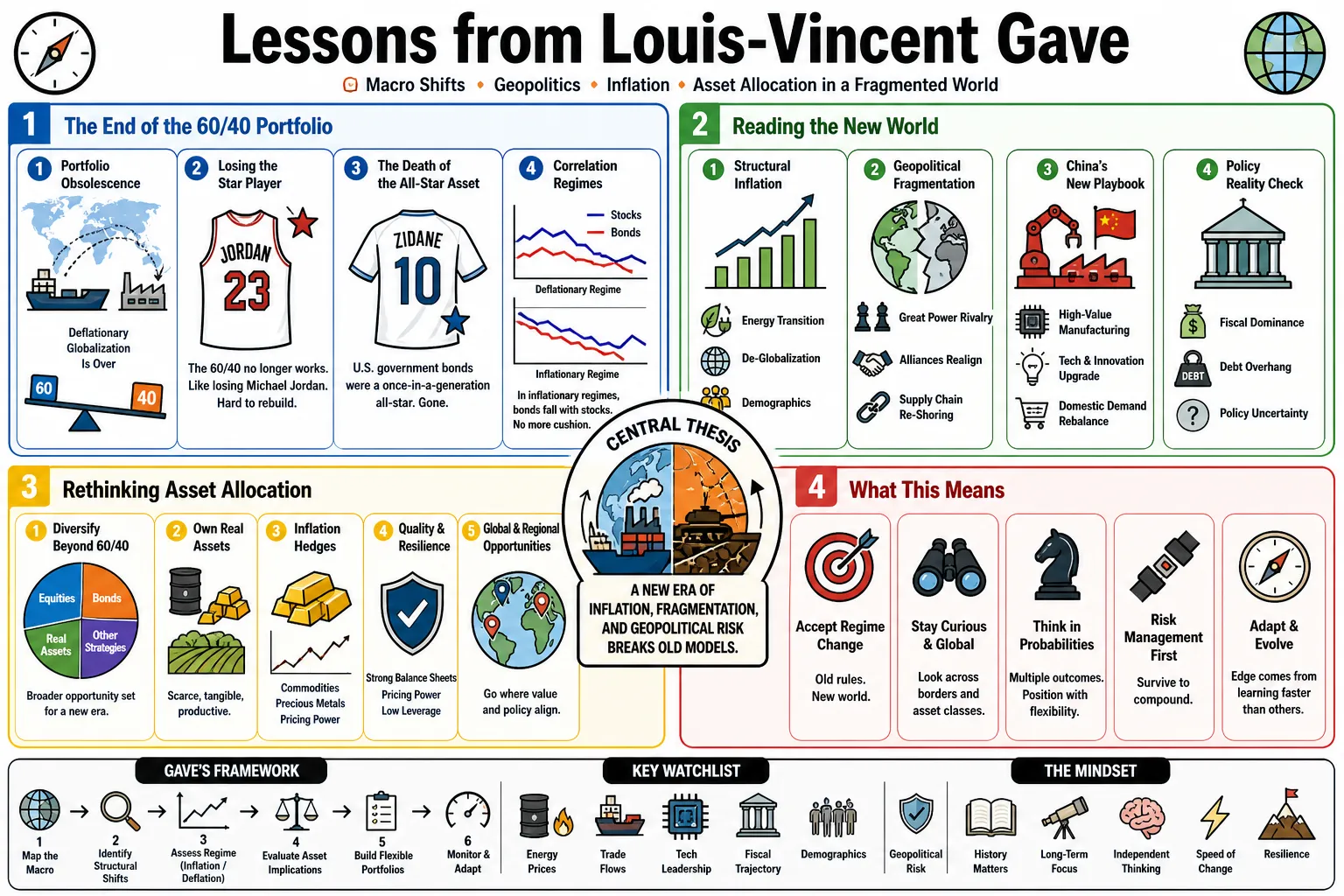
Part 1: The End of the 60/40 Portfolio
- On Portfolio Obsolescence: "The traditional 60/40 portfolio was built for a world of deflationary globalization that simply no longer exists." — Source: [InvestorPlace]
- On Losing the Star Player: "Nobody wants to confront the reality that the 60/40 no longer works. It was like having Michael Jordan on your team, and then he leaves. It's pretty hard to rebuild." — Source: [Macro Voices]
- On the Death of the All-Star Asset: "U.S. government bonds were an incredible asset class for a generation. Losing them as a reliable cushion is like the French soccer team losing Zinedine Zidane." — Source: [In Gold We Trust Report]
- On Correlation Regimes: "In an inflationary regime, bonds stop acting as a shock absorber for equity market volatility and instead start falling at the exact same time." — Source: [MooMoo]
- On the New Allocation: "Investors should consider moving toward a 60/20/20 allocation: 60% equities, 20% precious metals, and 20% energy." — Source: [Wealthion]
- On Hegemonic Shifts: "The core assumption of the 60/40 was a stable world overseen by a benevolent U.S. hegemon, a reality that has now structurally fractured." — Source: [Gavekal Research]
- On Passive Indexing: "Relying on passive index funds becomes deeply dangerous when the foundational diversifier in those models fails to provide positive real returns." — Source: [The Investors Podcast]
- On Inflationary Fragmentation: "We have transitioned from an era of capital abundance and cheap goods to one of capital scarcity and inflationary fragmentation." — Source: [Capital Allocators]
- On Structural Realities: "The inability to hedge equity risk with sovereign debt is the new reality staring investors right in the eye." — Source: [Macro Voices]
Part 2: The Energy Transition and Inflation
- On Economic Activity: "Economic activity, at its most fundamental level, is simply energy transformed." — Source: [Evergreen Gavekal]
- On Sustained Price Increases: "It is historically nearly impossible to maintain sustained inflation without a corresponding, structural rise in energy prices." — Source: [Macro Voices]
- On the Inflation Camp: "Yeah, sorry, Erik. No, I'm as big as an inflationista as you're going to have on this show, I'm afraid." — Source: [Macro Voices]
- On Energy Policy: "Policies that explicitly discourage domestic energy production in favor of lower consumption ultimately guarantee a reduction in baseline prosperity." — Source: [Evergreen Gavekal]
- On the Structural Bull Market: "The energy sector has entered a structural, multi-year bull market driven directly by political under-investment." — Source: [The Investors Podcast]
- On Capex Shortfalls: "The physical realities of global energy demand are colliding with a decade of severe capital expenditure shortfalls in fossil fuels." — Source: [Wealthion]
- On the Disruption Threshold: "There are specific price thresholds, such as oil remaining above $120, that act as a dark force capable of severely disrupting global financial stability." — Source: [Gavekal Research]
- On the Energy Anchor: "Energy prices are the central anchor; if they remain elevated, they drag the entire cost structure of the global economy up with them." — Source: [Capital Allocators]
- On Transition Limits: "The market frequently ignores the hard, physical limitations of transitioning a global grid while maintaining economic growth." — Source: [Macro Voices]
Part 3: The Weaponization of Finance and De-Dollarization
- On Trust in Fiat: "The weaponization of the U.S. dollar and the Western financial system has fundamentally and permanently damaged global trust in fiat monetary networks." — Source: [The Idea Farm]
- On Sanction Repercussions: "Using SWIFT as an economic weapon forces non-aligned nations to aggressively build and adopt alternative payment architectures." — Source: [Gavekal Research]
- On Politicized Trade: "We are moving away from seamless globalization into a world where every major trade route and currency reserve is highly politicized." — Source: [Kitco]
- On Physical Resources: "The weaponization of finance naturally triggers a global race for physical, tangible resources over abstract financial claims." — Source: [Blind Squirrel Macro]
- On Gold's Utility: "Gold is returning to its historical role as the ultimate neutral reserve asset for central banks seeking outside money." — Source: [In Gold We Trust Report]
- On Sovereign Hoarding: "Sovereign nations are actively shifting their reserves from sovereign debt to strategic commodities and precious metals." — Source: [Macro Voices]
- On Offshore Centers: "The modern weaponization of everything frequently involves targeting the regulatory systems and offshore financial centers that once facilitated frictionless capital flow." — Source: [My Worst Investment Ever]
- On Regional Blocs: "The post-WWII dollar-centric system is visibly fracturing into regional, resource-backed trading blocs." — Source: [Wealthion]
- On Confiscation Risk: "When central bank reserves can be frozen overnight, the risk premium on holding Western fiat assets fundamentally changes for emerging markets." — Source: [Gavekal Research]
- On Safe Havens: "Western financial hubs are steadily losing their undisputed status as safe havens for global capital." — Source: [Capital Allocators]
Part 4: China's Industrial Leapfrogging
- On the Automotive Leap: "Western observers completely missed how rapidly China leapfrogged the global automotive industry, particularly in electric vehicles." — Source: [Financial Sense]
- On Strategic Dominance: "China has systematically established dominance in the most essential industries of the next decade, including solar, batteries, and nuclear power." — Source: [Marcellus]
- On the Covid Hiatus: "A 'Covid-induced hiatus' meant Western executives stopped visiting China, blinding them to five years of aggressive industrial progress." — Source: [Macro Voices]
- On Executing to Standard: "The realization from auto executives that executing to a Chinese standard is now the global priority proves how the competitive market has flipped." — Source: [Marcellus]
- On the Economic Pivot: "China has actively engineered a painful transition away from a real estate-driven growth model toward raw industrial independence." — Source: [KraneShares]
- On High-Value Manufacturing: "The Chinese economy is no longer about cheap labor; it is about moving rapidly up the value chain into high-tech manufacturing." — Source: [The Core]
- On Exporting Deflation: "Through sheer scale and efficiency, China is now exporting technological deflation in green energy components to the rest of the world." — Source: [Hidden Forces]
- On Structural Rebalancing: "We are witnessing a deliberate, top-down structural rebalancing of the Chinese economy to prioritize engineering prowess over property speculation." — Source: [Gavekal Research]
- On the Futility of Tariffs: "Western tariffs are a reactive measure that largely fail to halt the underlying momentum of Asian industrial dominance." — Source: [Wealthion]
Part 5: Western Misperceptions and Cultural Prejudice
- On Cultural Blindness: "There is an ingrained cultural prejudice in the West that consistently leads leaders to underestimate the capabilities of Asian competitors." — Source: [Marcellus]
- On CEO Ignorance: "Western CEOs have suffered from a massive blind spot regarding the speed and scale of Chinese domestic innovation." — Source: [Macro Voices]
- On Explaining China: "Explaining what investors get wrong about China takes so long that you practically need to share a taxi ride with them to cover it all." — Source: [Macro Voices]
- On Outdated Narratives: "Investors remain stubbornly stuck in perceptions of Chinese development that are a decade out of date." — Source: [The Investors Podcast]
- On Engineering Speed: "The West fundamentally misunderstands the speed of Asian engineering cycles and product iteration." — Source: [Gavekal Research]
- On Technological Superiority: "Assuming that Western technological superiority is a permanent, unbreakable reality is a dangerous geopolitical calculation." — Source: [Capital Allocators]
- On Financial Echo Chambers: "Western financial media operates in a localized echo chamber that filters out the realities of emerging market advancements." — Source: [Hidden Forces]
- On Misinterpreting Policy: "Western analysts frequently mistake deliberate Chinese policy shifts—like popping the property bubble—for uncontrolled economic weakness." — Source: [KraneShares]
- On Ground Truth: "You cannot understand the current Asian economic reality without traveling there and observing the ground truth firsthand." — Source: [Macro Voices]
Part 6: The Deflationary Boom and Hunger Games Capitalism
- On the Natural State of Capitalism: "A deflationary boom—where growth happens alongside falling prices—is the natural, desired state of free-market capitalism." — Source: [The Investors Podcast]
- On Producing More With Less: "The core engine of a deflationary boom is the ability of entrepreneurs and businesses to consistently produce more with fewer inputs." — Source: [Gavekal Research]
- On Creative Destruction: "Schumpeterian growth requires creative destruction, where inefficient legacy models are continuously cleared out by superior technology." — Source: [Duke University]
- On Domestic Competition: "China operates under what I call 'Hunger Games capitalism,' an incredibly ruthless domestic environment that forces companies to become globally hyper-efficient." — Source: [Hidden Forces]
- On Efficiency Drivers: "The intense, survival-of-the-fittest competition within Asian markets drives an efficiency that protectionist Western sectors struggle to match." — Source: [Macro Voices]
- On Asset Preferences: "During a deflationary boom, the optimal asset allocation leans heavily toward long-duration, high-growth equities." — Source: [Gavekal Research]
- On Global Contrasts: "We are seeing a stark contrast between Chinese industrial hyper-competition and Western regulatory protectionism." — Source: [Wealthion]
- On Technological Offsets: "Massive technological gains have the capacity to offset traditional monetary inflation, altering the macroeconomic cycle." — Source: [Cerno Capital]
- On Exporting Deflation: "When a manufacturing powerhouse experiences a deflationary boom, it naturally exports those lower costs to the global consumer." — Source: [The Core]
- On the Four Quadrants: "Understanding whether the global economy is in a deflationary boom or an inflationary bust dictates the entire structure of the Gavekal Four Quadrants model." — Source: [ETH Zurich]
Part 7: The Three Key Prices and Global Macro Drivers
- On the Primary Variables: "Every major investment decision is ultimately driven by three key prices: the U.S. dollar, the 10-year Treasury yield, and the price of oil." — Source: [Gavekal Research]
- On Global Liquidity: "The U.S. dollar acts as the fundamental, undisputed barometer of global financial liquidity and monetary conditions." — Source: [Macro Voices]
- On the Cost of Capital: "The 10-year U.S. Treasury yield remains the gravitational pull for the global cost of capital and risk-free rates." — Source: [The Investors Podcast]
- On the Ultimate Input: "Oil represents the primary baseline input cost for the entire modern industrial complex." — Source: [Wealthion]
- On Simultaneous Rises: "The most dangerous macro environment occurs when the dollar, yields, and oil all rise simultaneously, breaking historical correlations." — Source: [Capital Allocators]
- On Emerging Markets: "The trajectory of the U.S. dollar mechanically dictates the boom and bust cycles of emerging market economies." — Source: [Gavekal Research]
- On Valuation Breaks: "When the 10-year yield breaks out of its structural downtrend, it mathematically breaks the valuations of long-duration growth assets." — Source: [Macro Voices]
- On the Consumer Tax: "Rapid spikes in the price of oil act as an immediate, unavoidable tax on global consumers, destroying discretionary spending." — Source: [Financial Sense]
- On Macro Simplification: "If you want to understand the macroeconomic environment, you have to cut the noise and watch those three specific prices." — Source: [The Idea Farm]
- On Fragile Models: "Financial models that treat the dollar, yields, and energy as static inputs rather than dynamic drivers are fundamentally fragile." — Source: [Blind Squirrel Macro]
Part 8: Avoiding the Punch and Portfolio Resilience
- On the Primary Goal: "In highly uncertain times, the primary goal of investing shifts from aggressively reaching for yield to simply surviving and avoiding the punch." — Source: [Morningstar]
- On the Pace of Ruin: "To quote Oscar Wilde on bankruptcy, structural shifts in financial markets happen very slowly, and then all at once." — Source: [Macro Voices]
- On Geostrategic Strife: "Investors must now prioritize building resilient portfolios that can withstand prolonged periods of geostrategic strife and supply chain shocks." — Source: [In Gold We Trust Report]
- On Muscle Memory: "The 'buy the dip' muscle memory that worked for the last two decades is dangerous in a structurally inflationary regime." — Source: [The Investors Podcast]
- On Building Blocks: "Constructing a portfolio today requires looking beyond stocks and bonds to include building blocks like energy, gold, and structurally independent emerging markets." — Source: [Gavekal Research]
- On Capital Preservation: "When the cost of capital rises, capital preservation immediately supersedes capital appreciation as the core mandate." — Source: [Capital Allocators]
- On Real Economic Exposure: "The current era demands a shift away from leveraged financial engineering and back toward exposure to real, tangible economic assets." — Source: [Wealthion]
- On Historical Correlations: "Relying on historical correlation data during a fundamental regime shift is a guaranteed way to absorb maximum damage." — Source: [Macro Voices]
- On Active Management: "In a fragmented world where passive assumptions are breaking down, the necessity for active, risk-aware management has returned." — Source: [Goodreads]