Luc Poirier is a Quebec entrepreneur and investor whose work includes land development and other business interests. These lessons examine his approach to projects, risk and personal freedom, using direct interviews and first-person accounts rather than treating unverified sayings as quotations. — Poirier — Company Vision.
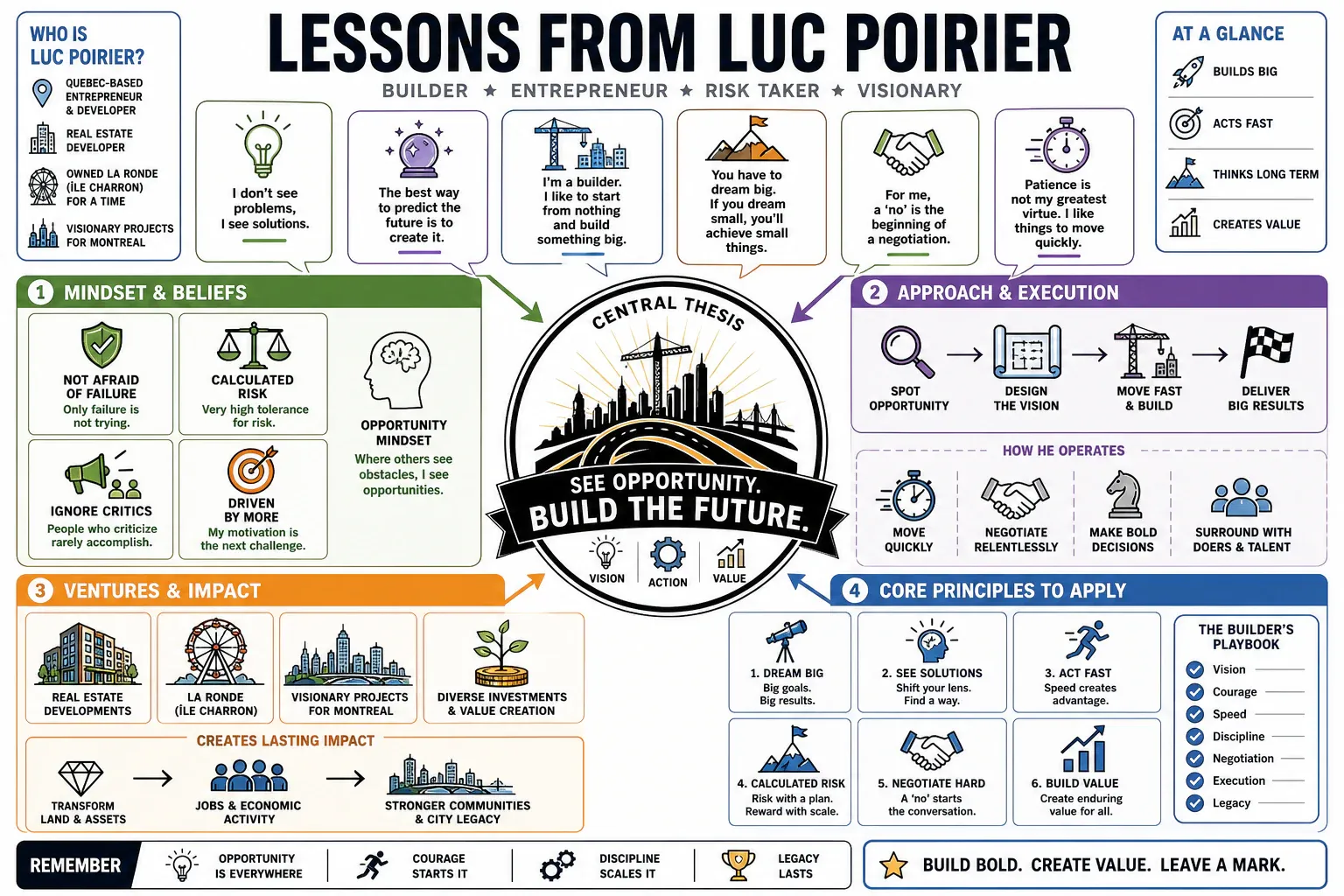
On Entrepreneurship and Mindset
Poirier describes perseverance, problem-solving and a willingness to pursue difficult projects. He also distinguishes the decisions that call for speed from the land investments that require patience. — Partenaires 12–18 — Luc Poirier Interview.
Lessons:
- Build Differently: Poirier says his interest in construction is tied to innovation, not simply adding another building. He used Rubic’s roof-first construction method as an example of testing a different way to work on a constrained urban site. — Patrice Ménard — Luc Poirier Interview.
- Match Speed to the Decision: Poirier distinguishes acting quickly when a decision is needed from expecting a quick payoff. In land development, he says, years can pass before value is realized, so decisiveness and patience have different jobs. — Luc Poirier — Action and Patience.
- Expect Difficulty, Then Follow Through: Poirier describes perseverance as continuing through the problems that come with a project. His point is to find a way forward and finish what was started, not that trying makes failure impossible. — Partenaires 12–18 — Luc Poirier Interview.
- Recognize Your Own Risk Tolerance: Poirier describes having a high tolerance for risk, including financing methods he expressly says he would not recommend to others. His experience is a reminder to distinguish an individual’s appetite for risk from a generally suitable investment strategy. — Patrice Ménard — Luc Poirier Interview.
- Let the Challenge Motivate You: Poirier says that the changing challenges of land development are what he enjoys about his work. Difficult projects interest him because they are different from one another, rather than because every project promises an easy financial reward. — Partenaires 12–18 — Luc Poirier Interview.
Further lessons:
- Adopt a Solution-Oriented Mindset: Poirier describes creating value by assembling a workable project around land with demolition, contamination or other constraints. The practical focus is on the work needed to overcome a problem, not the assumption that every problem has an economical solution. — Partenaires 12–18 — Luc Poirier Interview.
- Scale Your Ambition: Poirier’s stated company mission is to think big and far ahead. That supports setting an ambitious direction, without turning the size of a dream into a guarantee of the size of the eventual result. — Poirier — Company Vision.
- Reframe Rejection: In his account of the former children’s-hospital negotiations, Poirier says an initially unlikely bid became more attractive because it carried different conditions. The example shows why a rejected or unpromising offer may merit another look when the terms change. — Patrice Ménard — Luc Poirier Interview.
On Real Estate and Investment Strategy
Poirier’s land-development accounts emphasize identifying a possible future use for a site and working through the constraints that stand in the way. The result depends on financing, permissions, environmental issues and demand, not on the purchase of land alone. — CoStar — The Former Brick Quarry.
Lessons:
- Look Beyond an Unwanted Asset’s First Appearance: Poirier’s former-quarry project illustrates his interest in sites others dismiss. In his CoStar interview, he described earning revenue from accepted fill before a possible later development; the report also identifies environmental, approval and demand risks. — CoStar — The Former Brick Quarry.
- A Preference Is Not an Absolute Rule: Poirier has described concentrating on land development, but that is not a literal ban on owning buildings. In his 2025 La Presse interview, he explained an office-complex purchase that attracted him through its surplus land and the surrounding area’s growth prospects. — La Presse — Place Laval Acquisition.
- Allow Time for Land Value to Develop: Poirier says land can require years of waiting before anything happens. He sees patience as a possible advantage when others prefer quicker opportunities, while treating it as part of the work rather than evidence that every long-held site will succeed. — Luc Poirier — Action and Patience.
- Treat Public Approvals as Part of the Project: Poirier’s proposed Sorel-area bridge depended on government authorizations and municipal support as well as private initiative. The example makes public decisions part of feasibility, rather than showing that government involvement guarantees an investor’s return. — Journal de Montréal — Sorel Toll-Bridge Proposal.
Further lessons:
- Find Value in Complexity: Poirier looks for sites whose existing problems deter other buyers, then develops a plan to change what can be done with them. Demolition, contamination and planning constraints are part of that work; they are costs and risks to resolve, not automatic sources of profit. — Partenaires 12–18 — Luc Poirier Interview.
- Anticipate Future Demand: Poirier linked his interest in Place Laval to development in the surrounding area and the people it could attract. That illustrates assessing an asset in the context of future local demand, without assuming that forecast growth or occupancy is guaranteed. — La Presse — Place Laval Acquisition.
- Secure Attractive Entry Terms: Poirier’s account of his hospital-site bid emphasizes the combination of price and conditions, not price alone. A lower offer can appeal to a seller if its terms differ, but accepting fewer conditions also leaves the buyer carrying more uncertainty. — Patrice Ménard — Luc Poirier Interview.
- Scale the Opportunity, Not Just the Unit Count: Poirier says he now prefers fewer, larger sites with significant potential rather than a large number of projects. He emphasizes the bottom line over the number of doors, rather than claiming that every large development has the same overhead as a small one. — Partenaires 12–18 — Luc Poirier Interview.
On Wealth and Money
Poirier describes freedom and time with family as important reasons for building wealth. His choice of business activities has changed with those priorities. — Partenaires 12–18 — Luc Poirier Interview.
Lessons:
- Separate Project Scale from Personal Wealth: Poirier described exploring a large acquisition with bank financing and other investors. A proposal’s total value is therefore not the same thing as the proposer’s own net worth, and exploring such a deal does not mean it was completed. — Niry’s Podcast — Luc Poirier.
- Build a Capital Base for the Next Stage: Poirier describes the Île Charron transaction as a turning point that provided capital for later ventures. His account also includes years of financing pressure beforehand, rather than presenting later wealth creation as simply adding zeros. — Partenaires 12–18 — Luc Poirier Interview.
- Separate Investment from Daily Management: Poirier describes holding interests in businesses managed by others while concentrating his own work on land development. The distinction is between supplying capital and running every operation personally, not between earning money and doing no work. — Niry’s Podcast — Luc Poirier.
Further lessons:
- Use Financing and Partnerships Deliberately: Poirier has used lenders and partners to pursue opportunities beyond the cash he could provide alone. He also warns that some of his early financing methods were unsuitable for others, so leverage should not be confused with a risk-free shortcut. — Patrice Ménard — Luc Poirier Interview.
- True Wealth Is Freedom: Poirier describes freedom of choice and time with family as central reasons for building wealth. He changed the kind of work he did to protect that freedom, rather than treating a bigger business as an end in itself. — Partenaires 12–18 — Luc Poirier Interview.
- Diversify Your Investments and Knowledge: Poirier’s business history spans real estate, computing, distribution and other sectors. That breadth is part of his experience, but it does not establish that his holdings are equally diversified today or protected from every sector downturn. — Poirier — Company Vision.
On Visionary Projects and Society
Poirier has proposed large urban and transport projects, but a proposal is not a completed development. His public accounts distinguish the idea from the approvals and support it would need. — Journal de Montréal — Les projets de Luc le millionnaire.
Lessons:
- Keep Ambitious Proposals Distinct from Delivered Projects: In a 2015 radio interview, Poirier discussed a stadium as one possible use for a Montréal site and a separate privately financed tunnel idea. These were proposals with conditions, not proof that every large idea had been built. — Journal de Montréal — Les projets de Luc le millionnaire.
- Recognize That Views on Success Are Contested: Poirier has expressed frustration with what he sees as hostility toward visible financial success in Quebec. That is his interpretation of public attitudes, not a factual rule that critics are unsuccessful or that criticism should be ignored. — Niry’s Podcast — Luc Poirier.
- Connect a Project to Community Value: In his signed bridge letter, Poirier argued that a project should improve connections and local quality of life. He also made permits and social acceptance conditions of the proposal, rather than treating its claimed public benefit as already established. — Luc Poirier — Bridge Open Letter.
- Be Specific About Infrastructure Funding: Poirier’s 2015 bridge proposal combined user tolls with a requested government payment replacing ferry expenditure. It supports examining who would pay for a proposed link, not a blanket claim that users alone would fund it or that tolls are always the best model. — Journal de Montréal — Sorel Toll-Bridge Proposal.
- Test an Innovation Despite Initial Skepticism: Poirier says Rubic’s unfamiliar construction method initially struggled to attract partners. He describes starting with a limited project to see how it worked, rather than assuming that opposition itself proves an idea is innovative or commercially sound. — Patrice Ménard — Luc Poirier Interview.
Sources
These lessons draw on direct interviews, first-person accounts and company material. The English wording is paraphrased rather than presented as verbatim quotation.
- Patrice Ménard: Direct source. — Entrevue Luc Poirier — Patrice Ménard (20 April 2018).
- Partenaires 12–18: Direct source. — Entrevue avec Luc Poirier, entrepreneur — Partenaires 12–18 (26 November 2024).
- Poirier: Company statement. — About Poirier — History, Vision, Mission and Values.
- Luc Poirier: Direct source. — Pont Sorel-Tracy–Lanoraie 2028 : une invitation au dépassement — Signed Open Letter (March 2018).
- Additional direct sources: Selected originals. — Les projets de Luc le millionnaire — Jean-Philippe Daoust (1 December 2015). — On encourage beaucoup l’action et la rapidité en affaires — Luc Poirier’s First-Person Post. — Immobilier commercial : Luc Poirier achète les tours de bureaux de la Place Laval — Megan Foy (11 June 2025).