Lessons from Luca Ferrari
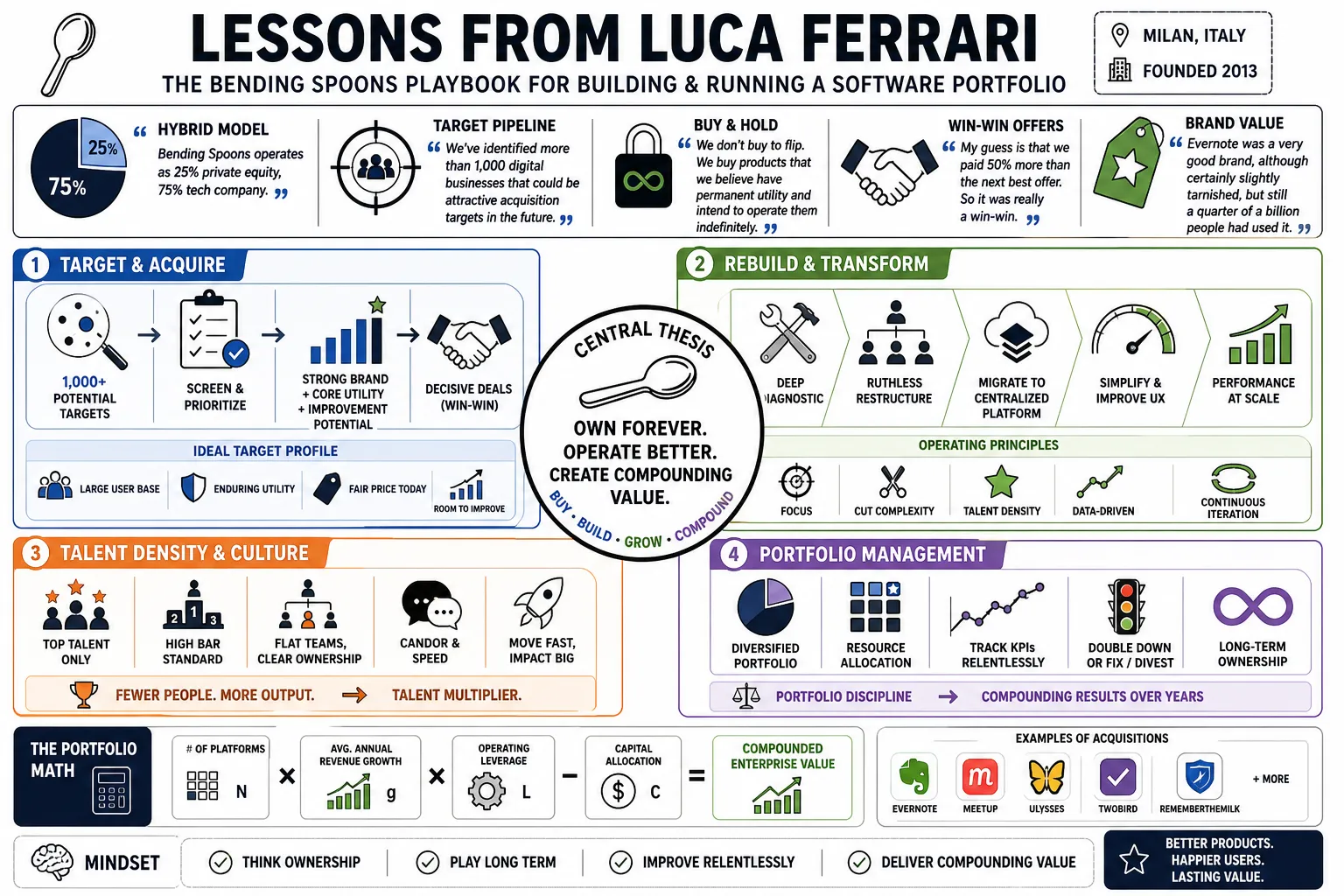
As co-founder and CEO of Milan-based Bending Spoons, Luca Ferrari runs consumer software like a private equity firm. He buys apps like Evernote and Meetup and rebuilds them to operate on a centralized platform. The following insights detail his approach to talent density, restructuring acquisitions, and the math behind managing a software portfolio.
Part 1: The Bending Spoons Playbook
- On the hybrid model: "Bending Spoons operates as 25% private equity, 75% tech company, acquiring digital businesses to own and operate forever while completely transforming them." — Source: [Invest Like the Best]
- On target selection: "We've identified more than 1,000 digital businesses that could be attractive acquisition targets in the future." — Source: [The Economic Times]
- On the buy-and-hold philosophy: "We don't buy to flip. We buy products that we believe have permanent utility and intend to operate them indefinitely." — Source: [20VC]
- On acquiring Evernote: "My guess is that we paid 50% more than the next best offer. So it was really a win-win." — Source: [Taming the Trunk]
- On brand value: "Evernote was a very good brand, although certainly slightly tarnished, but still a quarter of a billion people had used it. A strong brand gives you a foundation you can't easily build from scratch." — Source: [Taming the Trunk]
- On ignoring consensus: "If everyone agrees an acquisition target is flawless, it is probably priced to perfection. We look for assets with obvious flaws that we specifically know how to fix." — Source: [Invest Like the Best]
- On turnaround speed: "The initial transition is the hardest part. You have to move decisively to restructure the cost base and migrate the product to your own stack." — Source: [The DealMakers Show]
- On market fragmentation: "The software market is full of orphaned products. They found product-market fit years ago but the original founders got tired. That is where we step in." — Source: [Forbes]
- On scale economies: "Every time we acquire a company, we aren't adding redundant overhead. We are running it through a central platform that gets more efficient with every new asset." — Source: [20VC]
Part 2: Talent Density and Hiring
- On extreme selectivity: "We saw 800,000 job applications for 250 hires. Talent density is the only thing that allows us to manage so many complex products centrally." — Source: [Invest Like the Best]
- On cognitive ability: "We index heavily on raw intelligence and adaptability rather than deep experience in one specific, narrow domain." — Source: [The Neon Show]
- On the interview process: "Our hiring process is deliberately grueling. We want people who enjoy hard problems, and the best way to find them is to give them hard problems before they even start." — Source: [Sifted]
- On avoiding mediocre hires: "A false positive in hiring is far more damaging than a false negative. We would rather miss out on ten great people than hire one person who lowers the bar." — Source: [20VC]
- On retaining top performers: "You keep the best people by surrounding them with other great people and giving them problems that stretch their capabilities to the breaking point." — Source: [Invest Like the Best]
- On geographical hubs: "Milan has been an incredible base for us. It is not Silicon Valley, which means when we find amazing talent here, they tend to stay with us longer." — Source: [TechCrunch]
- On evaluating ambition: "We look for a specific kind of drive. We want people who are deeply unsatisfied with the status quo and feel a personal need to optimize things." — Source: [The DealMakers Show]
- On managing out underperformers: "If someone isn't meeting the bar, letting them go quickly is a kindness to them and a necessity for the rest of the team who relies on them." — Source: [20VC]
- On early career bets: "Some of our best leaders joined us straight out of university. If you give high-agency young people immediate responsibility, they figure it out." — Source: [The Neon Show]
- On continuous assessment: "Hiring correctly is only the first step. You have to maintain the standard every single day, which requires a culture of constant feedback." — Source: [Invest Like the Best]
Part 3: Operating and Restructuring
- On centralizing operations: "We don't operate our acquisitions as separate silos. We migrate them onto the Bending Spoons platform, which handles everything from billing to analytics." — Source: [TechCrunch]
- On deep layoffs at acquired targets: "When we buy a company, we often have to let the original team go. It is brutal but necessary to bring the product into our centralized efficiency model." — Source: [Forbes]
- On legacy code: "You cannot be sentimental about legacy infrastructure. We rewrite what needs rewriting so the product can scale securely and efficiently." — Source: [20VC]
- On pricing power: "Many founders underprice their products because they are afraid of churn. We test pricing rigorously and align it with the actual value delivered." — Source: [Invest Like the Best]
- On feature bloat: "Acquired products often have years of accumulated features that nobody uses. We aggressively deprecate things that add complexity without value." — Source: [The DealMakers Show]
- On the Meetup acquisition: "Meetup is a community institution, but it needed serious operational discipline to ensure it could survive and thrive for the next decade." — Source: [TechCrunch]
- On managing the transition period: "The first 100 days post-acquisition are critical. We move fast to integrate, rip out redundant software, and stabilize the core offering." — Source: [Sifted]
- On customer reaction: "Users will complain when you change a beloved product or raise prices. If the core utility remains strong and the app gets faster and more reliable, they stay." — Source: [Invest Like the Best]
- On maintaining quality: "Restructuring costs doesn't mean neglecting the product. We often ship more updates with our centralized team of 50 than the previous company did with 500." — Source: [20VC]
- On standardizing growth: "Marketing, SEO, and localization are solved problems for us. We just plug the newly acquired product into our existing machine." — Source: [The Neon Show]
Part 4: Product and Technology
- On internal tooling: "We build our own tools for almost everything. Relying on third-party software for core operational levers introduces dependencies we don't want." — Source: [Invest Like the Best]
- On utilizing artificial intelligence: "AI is not a feature we bolt on for marketing. It is a fundamental shift in how we analyze data, write code, and optimize ad spend across our portfolio." — Source: [Forbes]
- On the Remini success: "With Remini, we proved that if you apply world-class technology to a consumer problem like photo enhancement, the virality takes care of itself." — Source: [TechCrunch]
- On simplicity: "The best mobile apps do one or two things flawlessly. Complexity is the enemy of retention." — Source: [The DealMakers Show]
- On localization: "Translating an app is not true localization. You have to adapt the pricing, the marketing, and the user experience to the specific cultural context of that market." — Source: [20VC]
- On platform risk: "When you build on iOS and Android, you are a tenant. You have to be obsessively compliant and build products that Apple and Google want to feature." — Source: [Invest Like the Best]
- On technical debt: "We pay down technical debt aggressively in the first year of an acquisition. You can't run a profitable, long-term asset on a fragile codebase." — Source: [The Neon Show]
- On subscription models: "We strongly prefer subscription revenue. It aligns our incentives with the user. We only get paid if they keep finding the product useful." — Source: [Sifted]
- On testing variables: "We don't guess what the user wants. We test every variable, from the color of the paywall button to the onboarding copy, until the data gives us the answer." — Source: [20VC]
Part 5: Capital Allocation and Growth
- On raising debt: "We use debt to finance acquisitions because we buy cash-generating assets. Equity is too expensive when you know exactly how to turn a product profitable." — Source: [Forbes]
- On compound interest: "Bending Spoons is a compounding machine. Every dollar of free cash flow is immediately evaluated for its highest return, which is usually buying another product." — Source: [Invest Like the Best]
- On valuation discipline: "We have walked away from hundreds of deals. If the math doesn't work for our required rate of return, we don't care how prestigious the brand is." — Source: [The DealMakers Show]
- On the IPO question: "We will go public when it makes strategic sense for our capital structure, not just as an exit event for founders." — Source: [TechCrunch]
- On bootstrapping early on: "In the beginning, we funded ourselves by building our own apps. That constraint forced us to learn user acquisition and monetization at a microscopic level." — Source: [20VC]
- On private equity dynamics: "Traditional private equity firms struggle in consumer software because they lack the engineering capacity to fix the product. That is our structural advantage." — Source: [Invest Like the Best]
- On capital efficiency: "We measure success by revenue per employee. By centralizing operations, we can scale top-line growth without proportionally scaling headcount." — Source: [Sifted]
- On patience in acquisitions: "Sometimes we watch a company for years before acquiring it. We wait until they hit a wall and are ready to sell at a rational price." — Source: [The Neon Show]
- On market cycles: "When the venture capital market cools down, our model thrives. Companies that relied on cheap equity to cover bad unit economics become prime targets for us." — Source: [Forbes]
Part 6: Culture, Candor, and High Performance
- On radical candor: "We don't do office politics. If you disagree with a decision, you are expected to say so directly, regardless of your title." — Source: [Invest Like the Best]
- On the truth: "The primary objective of any meeting is to get to the truth as quickly as possible. Ego is just friction in that process." — Source: [20VC]
- On working hard: "We do not pretend this is an easy place to work. It requires intense focus and long hours because we are trying to do something extraordinarily difficult." — Source: [Sifted]
- On compensation: "We pay at the very top of the market because one exceptional engineer is worth ten average ones. It is actually cheaper to overpay the best." — Source: [The DealMakers Show]
- On internal transparency: "We share financials and strategy deeply across the team. You can't ask people to make owner-level decisions if you treat them like basic employees." — Source: [TechCrunch]
- On disagree and commit: "Debate is encouraged, but once a decision is made, you execute it as if it were your own idea. Sabotage by compliance is not tolerated." — Source: [Invest Like the Best]
- On continuous learning: "The pace of change in mobile tech means whatever you knew three years ago is obsolete. We only hire people who learn obsessively." — Source: [The Neon Show]
- On remote work: "We value in-person collaboration heavily. The bandwidth of communication and the speed of problem-solving when people are in the same room is undeniable." — Source: [20VC]
- On avoiding complacency: "Success breeds comfort, and comfort kills companies. We manufacture urgency even when things are going well." — Source: [Forbes]
- On alignment: "Every single person at the company understands exactly how their daily work impacts the core financial metrics of the business." — Source: [Invest Like the Best]
Part 7: Leadership and Decision Making
- On founder psychology: "As a founder, you have to continually fire yourself from your old jobs. What made you successful at ten people will destroy the company at a thousand." — Source: [20VC]
- On objective reality: "Data doesn't care about your narrative. We force our leaders to look at the raw numbers before they are allowed to spin a story about them." — Source: [Invest Like the Best]
- On emotional detachment: "You have to detach your ego from the product. If a feature you loved isn't working, you kill it without a second thought." — Source: [The DealMakers Show]
- On speed versus precision: "For reversible decisions, we move incredibly fast. For irreversible ones, like a major acquisition, we analyze until it hurts." — Source: [TechCrunch]
- On taking responsibility: "When things go wrong, the leadership team takes the blame. When things go right, the individual contributors get the credit." — Source: [Sifted]
- On minimizing bureaucracy: "We actively hunt down and destroy unnecessary processes. If a meeting doesn't result in a decision, it shouldn't have happened." — Source: [The Neon Show]
- On strategic focus: "It is very easy to get distracted by shiny new platforms. We stick to our playbook and only expand when we have a clear, mathematical edge." — Source: [20VC]
- On handling criticism: "When we make drastic cuts at acquired companies, we take a lot of public heat. You have to develop a thick skin and trust your internal logic." — Source: [Forbes]
- On delegation: "You can delegate authority, but you cannot delegate the final accountability. I am ultimately responsible for every misstep this company makes." — Source: [Invest Like the Best]
Part 8: Long-Term Vision and Mindset
- On the ultimate goal: "We are trying to build one of the most successful companies of all time. We are not interested in a quick exit." — Source: [Sifted]
- On the European ecosystem: "You do not need to be in Silicon Valley to build a global tech behemoth. Milan offers us distinct advantages in loyalty and focus." — Source: [TechCrunch]
- On compounding relationships: "Reputation in acquisitions is everything. If you are known as a fair buyer who moves quickly and honors terms, you get the first call on the best deals." — Source: [Invest Like the Best]
- On surviving crises: "During the early days of the pandemic, we built Italy's contact tracing app for free. Sometimes you use your technical leverage simply because it is the right thing to do." — Source: [Forbes]
- On category expansion: "We started with simple utilities, moved into creative tools like Remini, and now manage complex productivity suites like Evernote. The underlying physics of software remain the same." — Source: [20VC]
- On the infinite game: "Business is an infinite game. There is no finish line where you win; you just get to keep playing at higher and higher levels of complexity." — Source: [The DealMakers Show]
- On structural advantages: "Our biggest moat isn't our code; it is our organizational design. It is very hard for a traditional company to replicate our pace of execution." — Source: [The Neon Show]
- On resilience: "The path to building something massive is paved with hundreds of small, painful failures. If you can't digest failure quickly, you won't last." — Source: [Invest Like the Best]
- On defining success: "Success for us is looking back in thirty years and seeing a portfolio of category-defining products that were saved and scaled by our team." — Source: [20VC]