Luigi Zingales is an economist at the University of Chicago Booth School of Business who studies the intersection of finance, economics, and politics. He is best known for distinguishing between "pro-market" policies that foster competition and "pro-business" policies that protect corporate incumbents. His work details how regulatory capture and rent-seeking threaten both economic growth and democratic institutions.
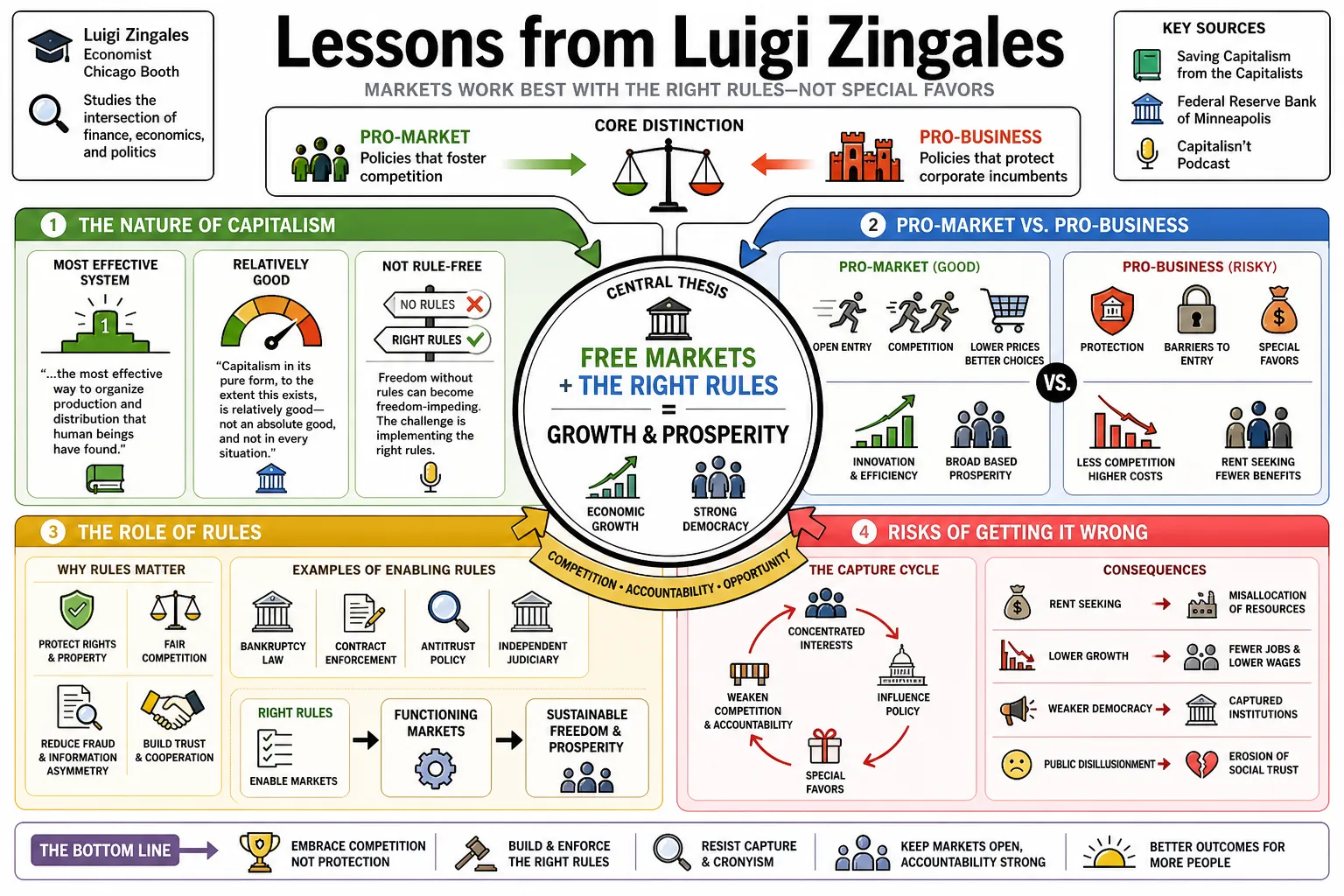
Part 1: The Nature of Capitalism
- On the system's effectiveness: "Capitalism, or more precisely, the free market system, is the most effective way to organize production and distribution that human beings have found." — Source: Saving Capitalism from the Capitalists
- On the relative value of capitalism: "Capitalism in its pure form, to the extent this exists, is relatively good—not an absolute good, and not in every situation. But relatively good." — Source: Federal Reserve Bank of Minneapolis
- On the need for rules: Capitalism does not function best with no rules at all; free markets rely on frameworks like bankruptcy law to function, and the challenge lies in implementing the right rules to prevent the system from becoming freedom-impeding. — Source: Capitalisn't Podcast
- On public perception: "While free markets, particularly free financial markets, fatten peoples' wallets, they have made surprisingly little inroads into their hearts and minds." — Source: Saving Capitalism from the Capitalists
- On the paradox of capitalists: "Capitalism's biggest problem is the executive in pinstripes who extols the virtues of competitive markets with every breath while attempting to extinguish them with every action." — Source: Saving Capitalism from the Capitalists
- On internal threats: Capitalism is often threatened from within by incumbent industrialists and financiers who, despite operating within a capitalist system, become enemies of free markets because competition threatens their established positions. — Source: American Economic Association
- On unequal starting points: A well-functioning economy requires active policy to ensure fair competition and equal starting points, preventing structural barriers from hindering social mobility. — Source: Capitalisn't Podcast
- On the fragility of markets: Free markets are a delicate political construct that must be actively defended against those who benefit most from subverting them. — Source: A Capitalism for the People
- On market failures: Markets fail when external costs are not internalized, which is why appropriate taxation and regulation are necessary components of a functional capitalist system. — Source: ProMarket
Part 2: Pro-Market vs. Pro-Business
- On the core distinction: Ending crony capitalism requires understanding the difference between a pragmatic, pro-market dispensation and a dogmatically pro-business one. — Source: City Journal
- On policy confusion: "It's very bad when, as policymakers, we confuse the interests of a businessman with the interest of the market itself." — Source: Business Insider
- On the goals of lobbying: "Most lobbying is pro-business, in the sense that it promotes the interests of existing businesses, not pro-market in the sense of fostering truly free and open competition." — Source: National Affairs
- On business vs. competition: Pro-business policies protect the interests of incumbent firms, often through subsidies and barriers to entry, which actively stifles the competition that pro-market policies seek to protect. — Source: Stigler Center
- On conservative economic policy: Many politicians who claim to defend the free market are actually defending the specific interests of large corporations against potential competitors. — Source: A Capitalism for the People
- On corporate welfare: Providing subsidies to specific businesses is not a defense of capitalism; it is a distortion that harms the overall market ecosystem. — Source: EconTalk
- On entry barriers: True pro-market policy focuses on lowering barriers to entry for new firms rather than protecting the profit margins of existing ones. — Source: ProMarket
- On the nature of competition: Firms naturally hate competition because it reduces their profits; therefore, trusting businesses to self-regulate competition is a fundamental mistake. — Source: Saving Capitalism from the Capitalists
- On the political alignment of business: Large businesses often align with heavy regulation because they have the resources to comply, whereas smaller competitors do not. — Source: Capitalisn't Podcast
- On feeding the animals: "We should post something of this kind on Capitol Hill as well—with the difference being that the sign would read, 'Please don't feed the businesses.' That's not because we don't like business. Quite the opposite: we love [the market]... by enacting restrictions, ensuring that markets remain competitive." — Source: City Journal
Part 3: Crony Capitalism and Rent-Seeking
- On defining crony capitalism: The term refers to an economy in which companies prosper on the basis of their influence with government officials rather than their ability to succeed in the marketplace. — Source: Federal Reserve Bank of Richmond
- On government size and rent-seeking: "When government is small and relatively weak, the most effective way to make money is to start a successful private-sector business. But the larger the size and scope of government spending, the easier it is to make money by diverting public resources." — Source: A Capitalism for the People
- On the Medici effect: Historical examples, such as the Medici family, illustrate how political capture and monopoly-rent seeking can completely destroy a region's economic prosperity. — Source: Forbes India
- On the Italian model: The United States is at risk of descending into the same type of stagnant, nepotistic system observed in Italy, robbing the country of its potential for economic growth. — Source: Federal Reserve Bank of Richmond
- On financial rent-seeking: "Unfortunately 'only those financiers who enjoy rents can afford to pay for the heavy lobbying. Thus in the face of public resentment only the noncompetitive and clubbish finance can survive.'" — Source: New Financial
- On the distortion of merit: Crony capitalism destroys the cultural belief in meritocracy, as citizens recognize that success is driven by political connections rather than hard work or innovation. — Source: London School of Economics
- On rent extraction: When a company’s profits come from government protection rather than consumer preference, it extracts value from society instead of creating it. — Source: EconTalk
- On the cost of complexity: Complex tax codes and regulations are often designed deliberately to create rents for connected insiders who can navigate the loopholes. — Source: A Capitalism for the People
- On restoring trust: The only way to restore public trust in the economic system is to ruthlessly eliminate the mechanisms that allow rent-seeking to flourish. — Source: ProMarket
Part 4: Monopoly and Competition
- On the political dangers of concentration: "There are two main reasons why I am concerned about concentration of economic power in the United States. One is that concentration of business unavoidably leads to some kind of socialism... The other is that a concentrated system is inefficient, compared with a system of free competition." — Source: Truth on the Market
- On the ultimate goal of antitrust: "Yet the most powerful argument in favor of antitrust law is one that is rarely made: antitrust law reduces the political power of firms." — Source: A Capitalism for the People
- On democratic antitrust: Antitrust enforcement must consider the impact of market concentration on the marketplace of ideas and political influence, rather than focusing solely on short-term consumer prices. — Source: Harvard Law School
- On the limits of the Chicago School: The Chicago School's influence narrowed the scope of antitrust enforcement over the last several decades, losing sight of its historical roots in protecting democratic institutions. — Source: Stigler Center
- On unchecked private power: "It recognized that unchecked private economic power may be as injurious to individual freedom and other liberal values as unchecked political power and that the two may be mutually constitutive." — Source: University of Chicago
- On corporate resources: "In some cases, these large corporations had private security forces that rivaled the best secret services, public relations offices that dwarfed a US presidential campaign headquarters, more lawyers than the US Justice Department, and enough money to capture... a majority of the elected representatives." — Source: American Economic Association
- On tech kill zones: Dominant technology platforms can suppress startup entry and innovation by operating in a "kill zone," necessitating more robust regulatory scrutiny to protect future competitors. — Source: Capitalisn't Podcast
- On monopsony power: Monopoly power does not just harm consumers through higher prices; it also harms workers through reduced wages and fewer employment options. — Source: ProMarket
- On the state and big business: If private concentrations grow too strong, the inevitable outcome is either that big business captures the state or the state takes over big business. — Source: Truth on the Market
Part 5: Corporate Governance and Shareholder Welfare
- On shareholder value: "It is hard to understand this behavior [shareholder engagement on environmental and social issues] using the dominant corporate governance paradigm based on shareholder value maximization... To overcome these weaknesses we propose the criterion of shareholder welfare maximization." — Source: National Bureau of Economic Research
- On Friedman's oversight: "If consumers and owners of private companies take social factors into account and internalize externalities in their own behavior, why would they not want the public companies they invest in to do the same?" — Source: ProMarket
- On shareholder voting suppression: "There is almost complete silence about a more imminent and no less important form of vote suppression: the attempt to limit shareholder votes... The House proposal is the intellectual child of a long tradition in economics and finance... that regards maximization of shareholder value as the sole proper objective." — Source: Harvard Law School Forum on Corporate Governance
- On incomplete contracts: "I argue that it makes sense to discuss corporate governance only in an incomplete contract world. In this world, the notion of corporate governance is intrinsically related to the definition of the firm." — Source: National Bureau of Economic Research
- On the limits of delegation: Investors should be able to delegate the financial management of their assets without forfeiting their right to express moral or social preferences regarding how those assets are used. — Source: Capitalisn't Podcast
- On corporate political spending: Shareholders are often forced to fund corporate political lobbying that contradicts their own political views, a structural failure of modern governance. — Source: ProMarket
- On institutional investors: Large index funds and institutional investors hold massive voting power but often lack the incentive to actively challenge management on governance failures. — Source: Stigler Center
- On boards of directors: Corporate boards often function more as a rubber stamp for the CEO rather than an independent check on executive power and a true representative of shareholder interests. — Source: A Capitalism for the People
- On ESG metrics: While social objectives matter, the current ESG framework is often a marketing tool that fails to accurately measure or improve actual corporate externalities. — Source: Capitalisn't Podcast
- On shareholder democracy: True corporate governance reform requires implementing mechanisms that allow retail investors to easily express their preferences on major corporate actions. — Source: ProMarket
Part 6: Populism and Democracy
- On the enemy of democracy: The great enemy of democracy is monopoly in all its forms, as economic concentration inevitably distorts political representation. — Source: University of Chicago
- On the roots of populist anger: "An increasingly 'winner-take-all economy' diminishes hope, stifling innovation and inspiring those left behind to elect leaders who further dismantle the mechanisms of the market." — Source: Federal Reserve Bank of Minneapolis
- On pro-market populism: Instead of rejecting populist energy, societies should channel it into a "pro-market" populism that breaks up monopolies and restores fair competition, similar to the trust-busting era. — Source: A Capitalism for the People
- On political liberty: Drawing on historical economic traditions, political liberty can survive only within an effectively competitive economic system. — Source: Stigler Center
- On democratic backsliding: Without fair competition, economic concentration leads to a temptation to expropriate and redistribute wealth, which can trigger democratic backsliding. — Source: ProMarket
- On the social license of business: If capitalism does not produce wealth and opportunity for the majority of citizens, it loses its social license to operate within a democracy. — Source: Global Finance Magazine
- On elite disconnect: The rise of populism is largely a predictable response to the failure of political and economic elites to address the real grievances of the working class. — Source: Capitalisn't Podcast
- On the danger of cronyism: When citizens view the economic system as rigged, they become willing to abandon democratic norms in search of a strongman who promises to punish the elites. — Source: A Capitalism for the People
- On the mutual dependence: Healthy democracy and healthy capitalism are mutually dependent; one cannot survive long if the other becomes corrupted. — Source: Fordham University
Part 7: Regulation and Institutional Capture
- On regulatory capture: Agencies intended to act in the public interest frequently serve the interests of the industries they are supposed to regulate, a phenomenon known as regulatory capture. — Source: University of Chicago
- On the revolving door: The movement of personnel between regulatory agencies and the industries they oversee creates an implicit conflict of interest that biases regulation toward incumbents. — Source: A Capitalism for the People
- On complex rules: "The more complex the rules, the easier it is for special interests to dictate them and for incumbents to comply with them." — Source: ProMarket
- On data transparency: Increased transparency in economic data and government contracts is a necessary prerequisite to reducing rent-seeking and corruption. — Source: A Capitalism for the People
- On counterbalancing power: Private enforcement mechanisms, such as class-action lawsuits, are crucial tools to counterbalance the power of special interests when public regulators fail. — Source: Georgetown University
- On decentralized rule-making: To prevent corruption in rulemaking, society should look toward decentralized systems to ensure rules are designed to keep markets open rather than to favor powerful incumbents. — Source: City Journal
- On financial regulation: Effective financial regulation should focus on simplicity and high capital requirements rather than thousands of pages of detailed rules that banks can easily game. — Source: Capitalisn't Podcast
- On the role of subsidies: Government subsidies rarely correct market failures; more often, they are political payoffs to organized constituencies at the expense of unorganized taxpayers. — Source: EconTalk
- On regulatory uncertainty: Businesses often complain about regulatory uncertainty, but they frequently lobby to maintain ambiguous rules if it allows them to exploit loopholes. — Source: Stigler Center
- On fixing the system: The goal of regulation should not be to punish business, but to set clear, uniformly applied boundaries that force companies to compete on price and quality. — Source: Federal Reserve Bank of Minneapolis
Part 8: The Economics Profession and Academia
- On the duty of economists: Economists should not just interpret the world but should speak out against behavior that is legal but immoral, such as lobbying for special treatment. — Source: ProMarket
- On academics as whistleblowers: "Zingales quotes Justice Louis Brandeis saying: 'Publicity is justly commended as a remedy for social and industrial diseases.' Academics can act as whistleblowers for the financial industry by drawing public attention to bad practice." — Source: New Financial
- On academic capture: The economics profession itself is susceptible to capture by corporate interests, particularly when research is funded by the industries being studied. — Source: A Capitalism for the People
- On ideological blind spots: Economists often fall in love with the theoretical elegance of free markets and fail to recognize when actual markets have been distorted by political power. — Source: Capitalisn't Podcast
- On teaching ethics: Business schools must do a better job of teaching the political economy of business, ensuring students understand the systemic damage caused by rent-seeking. — Source: University of Chicago Booth School of Business
- On data access: When academics rely on proprietary corporate data for their research, they face a strong implicit pressure not to publish findings that reflect poorly on the data provider. — Source: ProMarket
- On the focus of research: Economic research too often focuses on mathematical optimization while ignoring the institutional and political foundations that make markets work in the first place. — Source: EconTalk
- On diversity in economics: A lack of diversity in the economics profession limits the scope of questions being asked and prevents the field from fully understanding the distributional impacts of policy. — Source: Capitalisn't Podcast
- On the purpose of the discipline: The ultimate goal of studying economics is not to defend the status quo, but to figure out how to structure rules so that human pursuit of self-interest broadly benefits society. — Source: A Capitalism for the People