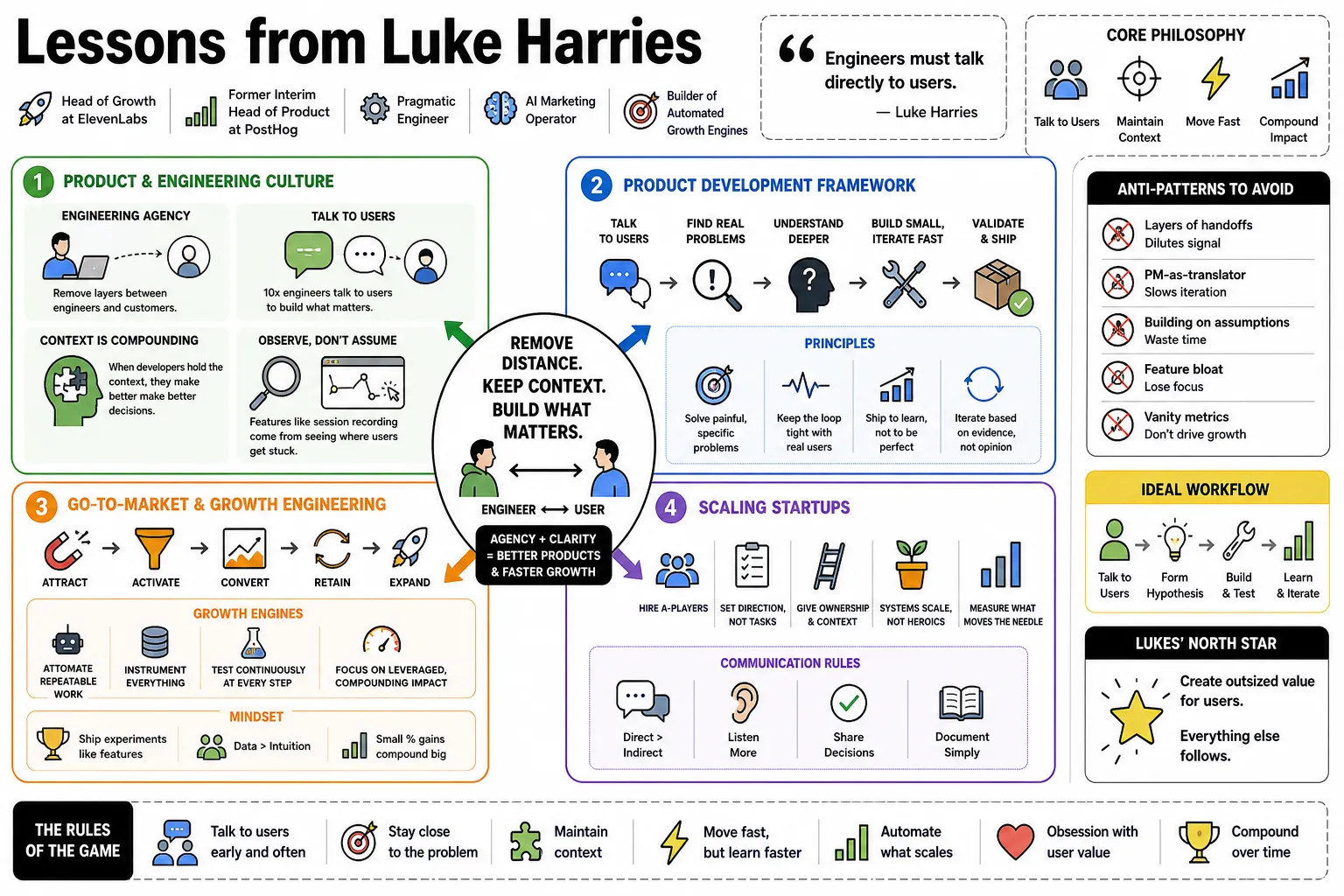
Lessons from Luke Harries
Luke Harries, Head of Growth at ElevenLabs and former interim head of product at PostHog, takes a strictly pragmatic approach to engineering and AI marketing. He built his reputation on automated growth engines and a simple rule: engineers must talk directly to users. This profile breaks down his frameworks for product development, go-to-market execution, and startup scaling.
Part 1: Product & Engineering Culture
- On engineering agency: "The most effective way to increase an engineer's agency is to remove the traditional layers between them and the customer." — Source: [PostHog Blog]
- On talking to users: "10x engineers don't just write code; they talk to users directly to maintain context and build what actually matters." — Source: [Harries.co]
- On the PM-to-engineer ticket workflow: "Relying on product managers to translate user needs into Jira tickets often dilutes the original signal and slows down iteration." — Source: [PostHog Blog]
- On building core features: "Features like session recording are born not from top-down mandates, but from engineers observing exactly where users get stuck." — Source: [PostHog Blog]
- On maintaining context: "When developers hold the context of the user's problem, they make better micro-decisions during the implementation phase." — Source: [20VC]
- On continuous feedback: "Tightening the feedback loop between the person writing the code and the person using the product is the ultimate productivity hack." — Source: [Harries.co]
- On removing friction: "You have to systematically eliminate any process that prevents an engineer from quickly jumping on a call with a customer." — Source: [PostHog Blog]
- On product intuition: "Engineering intuition is sharpened by exposure to the raw, unedited frustration of a user trying to accomplish a task." — Source: [Lenny's Newsletter]
- On shipping speed: "Direct user interaction gives teams the confidence to ship faster because they aren't waiting for a third party to validate the direction." — Source: [PostHog Blog]
- On technical debt: "Sometimes what looks like technical debt is actually just the cost of iterating rapidly alongside user feedback." — Source: [Harries.co]
Part 2: The AI Marketing Stack
- On marketing automation: "By integrating custom GPTs and AI agents into our daily workflows, we've essentially built a parallel, automated marketing team." — Source: [Lenny's Newsletter]
- On cost efficiency: "Automating repetitive marketing tasks with AI has saved us well over $140,000 annually while increasing our output." — Source: [Lenny's Newsletter]
- On agency reliance: "With the right AI tooling and internal processes, startups can completely eliminate their reliance on expensive external marketing agencies." — Source: [20VC]
- On generating case studies: "We use AI transcription and custom prompts to turn raw customer interviews into polished case studies in a fraction of the time." — Source: [Lenny's Newsletter]
- On localization: "AI-driven translation tools allow us to launch content globally and simultaneously, effectively removing the language barrier for growth." — Source: [ElevenLabs]
- On WhatsApp integrations: "Connecting AI agents directly to WhatsApp channels creates a seamless interface for our team to execute complex marketing workflows on the go." — Source: [Lenny's Newsletter]
- On Model Context Protocol (MCP): "Using MCPs allows us to connect our AI assistants directly to our internal data, making their outputs highly contextual and immediately usable." — Source: [Lenny's Newsletter]
- On content volume: "The bottleneck is no longer content creation; it is curation and distribution. AI solves the former so you can focus on the latter." — Source: [20VC]
- On rapid prototyping: "We use AI to spin up landing page copy and ad creatives in minutes, allowing us to test multiple angles before committing engineering resources." — Source: [Harries.co]
Part 3: Launch Strategies & Playbooks
- On the 7-part launch playbook: "A successful product launch isn't a single event; it is a structured, seven-step sequence designed to maximize visibility and momentum." — Source: [20VC]
- On daily shipping: "The goal of a high-growth team should be to ship and communicate new value to users on a daily basis." — Source: [Lenny's Newsletter]
- On horizontal product strategy: "When your product appeals to multiple verticals, your launch strategy must segment messaging without fragmenting the core brand identity." — Source: [20VC]
- On building hype: "Hype is manufactured through consistency. Regular, high-quality releases condition your audience to pay attention when you have something major to announce." — Source: [Harries.co]
- On coordinating launches: "A launch requires synchronized effort across marketing, product, and developer relations to ensure the message hits all channels simultaneously." — Source: [ElevenLabs]
- On post-launch momentum: "The days immediately following a launch are essential; you need pre-planned follow-up content to keep the conversation going." — Source: [20VC]
- On developer experience (DX): "For technical products, the launch must include flawless documentation and immediate access to working code samples." — Source: [GitHub]
- On activating community: "Your earliest users are your best marketers. Give them the assets and the platform to share your launch for you." — Source: [Lenny's Newsletter]
- On measuring launch success: "Don't just look at day-one traffic; measure the sustained lift in active users and API calls a week after the announcement." — Source: [PostHog Blog]
- On iteration post-launch: "Treat the launch as the starting line. The feedback you get in the first 48 hours should dictate your next two weeks of engineering." — Source: [20VC]
Part 4: Redefining the Product Manager Role
- On operating without traditional PMs: "You can scale a highly effective product organization without traditional Product Managers if you empower engineers with growth-led directives." — Source: [20VC]
- On the PM as an enabler: "If a PM exists in a modern engineering team, their job should be to clear roadblocks and facilitate user research, not to dictate solutions." — Source: [PostHog Blog]
- On growth-led product teams: "Embedding growth metrics directly into the product team's core KPIs eliminates the friction between building features and acquiring users." — Source: [20VC]
- On product ownership: "True product ownership means the person writing the code also feels responsible for the user's ultimate success or failure." — Source: [Harries.co]
- On the danger of proxies: "Whenever someone acts as a proxy between the builder and the customer, meaningful nuance is lost in translation." — Source: [PostHog Blog]
- On decentralized decision making: "Pushing product decisions to the edges of the organization allows teams to move faster than centralized planning could ever support." — Source: [Lenny's Newsletter]
- On defining requirements: "The best requirements documents are written collaboratively by engineers and users, not handed down from a separate planning department." — Source: [PostHog Blog]
- On cross-functional alignment: "When engineers understand the business model and the growth mechanisms, they naturally build products that drive the company forward." — Source: [20VC]
- On transitioning away from PMs: "Removing the PM role forces a temporary period of discomfort that ultimately results in a more autonomous and resilient engineering culture." — Source: [Harries.co]
Part 5: Growth and Scaling
- On horizontal growth: "Scaling a horizontal AI platform requires you to identify the specific, high-value use cases within each vertical and market to them directly." — Source: [20VC]
- On compounding marketing efforts: "The best growth channels are those that compound over time, like SEO and developer tools, rather than one-off paid campaigns." — Source: [Lenny's Newsletter]
- On SEO strategy: "Treat your documentation and your API references as your most valuable SEO assets." — Source: [Harries.co]
- On validating ideas: "Before you build the full product, use low-code tools and AI to validate that the market actually wants what you are selling." — Source: [Lenny's Newsletter]
- On the role of developer experience: "For an API-first company, exceptional developer experience is the most effective acquisition channel you have." — Source: [ElevenLabs]
- On scaling operations: "You can't scale a growth team by just adding headcount; you have to scale the systems and automation that support them." — Source: [20VC]
- On rapid experimentation: "The velocity of your growth is directly correlated to the number of marketing experiments you can run and analyze each week." — Source: [PostHog Blog]
- On user retention: "Acquisition is meaningless if the core product loop doesn't immediately demonstrate value and pull the user back in." — Source: [Harries.co]
- On aligning sales and growth: "Marketing and growth should provide so much value and context that the sales conversation feels like a natural continuation of the product experience." — Source: [20VC]
- On early-stage traction: "In the early days, do things that don't scale to get your first users, then use software to automate those exact same actions." — Source: [Lenny's Newsletter]
Part 6: Automation and Operational Efficiency
- On internal tooling: "Investing time in building custom internal tools pays off exponentially by removing the repetitive manual work from your team's day." — Source: [Lenny's Newsletter]
- On connecting systems: "The real magic of AI in operations happens when you connect large language models to your existing databases and communication channels." — Source: [Harries.co]
- On operational efficiency: "A small team armed with the right AI workflows can out-execute a traditional marketing department five times its size." — Source: [20VC]
- On daily habits: "Force yourself to ask 'How can I automate this?' every time you find yourself performing the same task twice in one week." — Source: [Lenny's Newsletter]
- On prompt engineering for teams: "Creating standardized, highly refined prompts for your team ensures consistent quality and saves everyone from starting from scratch." — Source: [ElevenLabs]
- On reducing dependencies: "When anyone on the team can use an AI agent to query data or generate assets, you eliminate the bottleneck of waiting for specialized departments." — Source: [PostHog Blog]
- On workflow optimization: "Map out your entire content creation process and systematically replace the most tedious steps with AI automation." — Source: [Lenny's Newsletter]
- On managing complexity: "As your organization grows, automation is the only way to prevent your operational complexity from crushing your speed." — Source: [Harries.co]
- On the future of work: "The most valuable employees of the future will be those who know how to manage and orchestrate swarms of AI agents." — Source: [20VC]
Part 7: Founding and HealthTech Innovation
- On identifying underserved markets: "We founded Fella Health because we realized that men’s obesity treatment was a massive, systemic issue that the existing wellness industry was completely ignoring." — Source: [Y Combinator]
- On combining disciplines: "My background in pre-med and computer science allowed me to see how machine learning could be applied directly to complex healthcare challenges." — Source: [Harries.co]
- On early product iteration: "In healthtech, the stakes are higher, but the principle remains the same: get a safe, minimum viable solution to patients and iterate based on their outcomes." — Source: [Y Combinator]
- On destigmatizing care: "Part of the challenge in building a men's health platform is designing an experience that removes the stigma and makes seeking treatment feel empowering." — Source: [Y Combinator]
- On the Y Combinator experience: "YC forces you to strip away all the vanity metrics and focus intensely on the only thing that matters: building something people want and are willing to pay for." — Source: [Harries.co]
- On integrating medical expertise: "A successful healthtech startup requires a seamless partnership between the engineers writing the code and the board-certified doctors delivering the care." — Source: [Y Combinator]
- On personalized health coaching: "Medication alone isn't a silver bullet; it has to be paired with behavioral changes and personalized coaching to achieve long-term success." — Source: [Y Combinator]
- On applying AI to medicine: "My early work on cancer detection taught me that AI is best used not to replace doctors, but to give them superpowers and scale their expertise." — Source: [Harries.co]
- On startup pivots: "You have to be deeply committed to the problem you are solving, but entirely flexible about the specific product you build to solve it." — Source: [Y Combinator]
Part 8: The Future of AI in Sales and Content
- On the evolution of voice AI: "Voice technology is moving past simple text-to-speech and entering a phase where AI can understand context, emotion, and pacing in real-time." — Source: [ElevenLabs]
- On the end of traditional SDRs: "With the current capabilities of voice AI, we are rapidly approaching the point where inbound Sales Development Representatives can be entirely replaced by intelligent agents." — Source: [20VC]
- On personalized sales: "AI allows you to deliver a perfectly tailored, interactive sales pitch to every single inbound lead at any time of day." — Source: [20VC]
- On synthetic media: "The goal of synthetic media isn't to create fake content, but to drastically lower the barrier to entry for storytellers and creators worldwide." — Source: [ElevenLabs]
- On multilingual content: "We are entering an era where a creator can record a video in English and instantly distribute it in twenty different languages with their exact voice and emotion preserved." — Source: [ElevenLabs]
- On AI in gaming: "Dynamic, AI-generated voice lines will completely change the gaming industry by allowing for infinite, unscripted interactions with non-player characters." — Source: [Harries.co]
- On the ethics of voice AI: "As we build these powerful tools, it is our responsibility to implement safeguards that protect against misuse while keeping the technology accessible to creators." — Source: [ElevenLabs]
- On API accessibility: "The true impact of AI will be realized when the most advanced models are available via simple APIs that any developer can integrate in an afternoon." — Source: [GitHub]
- On the pace of innovation: "The timeline for AI capabilities isn't measured in years anymore; it is measured in weeks. If your strategy doesn't account for that velocity, you are already behind." — Source: [20VC]