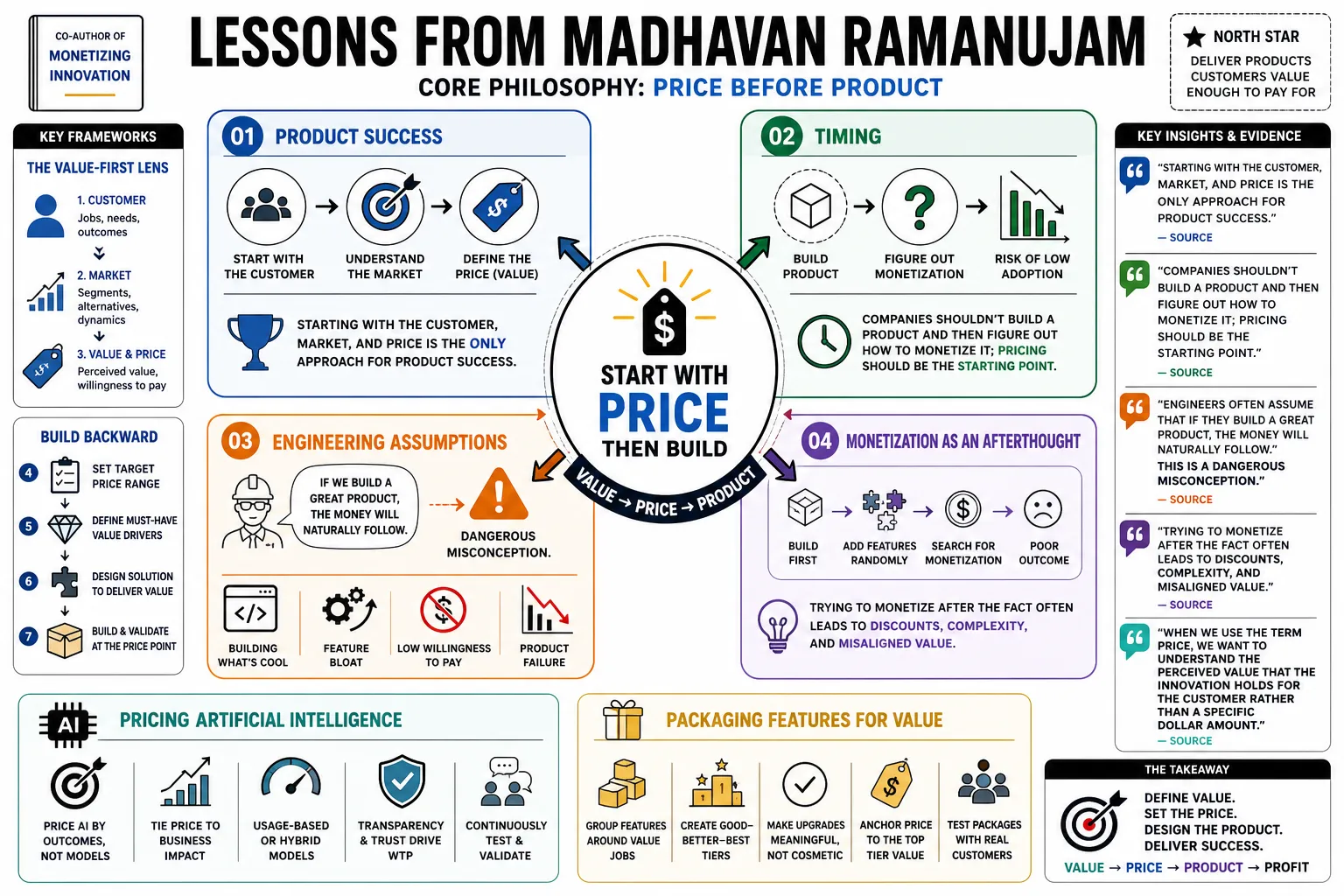
Lessons from Madhavan Ramanujam
Madhavan Ramanujam, a senior partner at Simon-Kucher and co-author of Monetizing Innovation, argues that companies should figure out a customer's willingness to pay before they write any code. This profile details his frameworks for preventing product failures, packaging features, and pricing artificial intelligence.
Part 1: The Core Philosophy: Price Before Product
- On Product Success: "Starting with the customer, market, and price is the only approach for product success." — Source: [Goodreads]
- On the Definition of Price: "When we use the term price, we want to understand the perceived value that the innovation holds for the customer rather than a specific dollar amount." — Source: [Goodreads]
- On Timing: "Companies shouldn't build a product and then figure out how to monetize it; pricing should be the starting point." — Source: [Metronome]
- On Building Backward: "Determine what the customer is willing to pay first, and then design the product around that price point." — Source: [First Round Review]
- On Engineering Assumptions: "Engineers often assume that if they build a great product, the money will naturally follow. This is a dangerous misconception." — Source: [First Round Review]
- On Monetization as an Afterthought: "Trying to slap a price onto a finished product is the single biggest reason new innovations fail in the market." — Source: [Marketing Journal]
- On Operationalizing Price: "Price is an indicator of value, and operationalizing that value requires a deep, qualitative understanding before writing any code." — Source: [Lenny's Podcast]
- On the True Cause of Failure: "Innovations fail when they are not designed around the right price, not because the technology itself didn't work." — Source: [Goodreads]
- On Strategic Alignment: "You have to bring pricing out of the finance department and into the product development room." — Source: [Simon-Kucher]
- On Enduring Value: "A successful innovation strategy ensures that the product delivers value the customer recognizes and is willing to pay for on day one." — Source: [First Round Review]
Part 2: Understanding Willingness to Pay
- On Early Validation: "Founders must validate willingness to pay early using prototypes or wireframes, simulating the sales conversation before building." — Source: [Lenny's Podcast]
- On the Danger of Hypotheticals: "Do not ask customers 'Would you pay for this?' because hypothetical questions yield unreliable, biased answers." — Source: [Product Talk]
- On Situational Framing: "Frame conversations around situational value. Ground the discussion in reality by using mock-ups to help the customer evaluate the actual offering." — Source: [Metronome]
- On Hard Conversations: "If you cannot convince a customer of the product's value using a wireframe, you won't be able to do it after it's fully built." — Source: [SeedToScale]
- On the WTP Threshold: "Willingness to pay isn't a single maximum number; it is about identifying the price threshold that triggers a purchase decision." — Source: [First Round Review]
- On Value Measurement: "You measure willingness to pay to gauge exactly how much oxygen your product has in the market." — Source: [Marketing Journal]
- On Uncovering Reality: "The goal of a willingness to pay discussion is not to force a number out of a customer, but to uncover what trade-offs they are willing to make." — Source: [First Round Review]
- On Budget Constraints: "When you talk about willingness to pay, you also have to discover whose budget the money is actually coming from." — Source: [Lenny's Podcast]
- On WTP Dynamics: "Willingness to pay shifts over time. It is a metric you must revisit as the market matures and alternatives emerge." — Source: [Simon-Kucher]
- On Sales Simulations: "Having the sales conversation before the product exists is the ultimate litmus test for product-market fit." — Source: [NFX Podcast]
Part 3: The Four Types of Monetization Failure
- On Overall Failure Rates: "Approximately 72 percent of new product innovations fail to meet their financial goals because they don't align with market expectations." — Source: [Marketing Journal]
- On Feature Shock: "Cramming too many features into a product causes Feature Shock, leading to an over-engineered, confusing, and overpriced solution." — Source: [OpenView]
- On the Cause of Feature Shock: "Feature shock happens when companies try to please everyone, resulting in a bloated product that doesn't fully satisfy anyone." — Source: [Marketing Journal]
- On Minivation: "Minivation occurs when you have the right product for the right market, but you price it too low to capture its full revenue potential." — Source: [NFX Podcast]
- On Leaving Money on the Table: "Companies fall into the minivation trap because they lack the courage to charge a price that reflects the true value of what they've built." — Source: [First Round Review]
- On Hidden Gems: "Hidden gems are potentially blockbuster products that fail to succeed simply because they are starved of resources or blocked by internal politics." — Source: [OpenView]
- On Overlooking Potential: "A hidden gem usually falls outside a company's core business, so executives ignore it instead of giving it a proper go-to-market push." — Source: [Marketing Journal]
- On Undead Products: "An 'undead' product is one that is launched despite having virtually no market demand; it is effectively dead on arrival." — Source: [Simon-Kucher]
- On Technical Feasibility vs. Viability: "Undead products happen when organizations fail to separate what is technically possible from what is commercially viable." — Source: [Marketing Journal]
- On the Wrong Answer: "An undead product is usually a brilliant engineering answer to a question no customer was actually asking." — Source: [First Round Review]
Part 4: Product Design and Feature Prioritization
- On the 20/80 Axiom: "Roughly 20 percent of a product's features drive 80 percent of a customer's willingness to pay." — Source: [NFX Podcast]
- On Taking Things Away: "Product configuration requires the guts to take away features, rather than blindly adding whatever customers ask for." — Source: [Goodreads]
- On Value-Added Functionality: "Curb the instinct to please customers by giving away value-added functionality unless they are willing to pay for it." — Source: [Goodreads]
- On Power Features: "Focus relentlessly on the power features that actually move the needle for your buyers." — Source: [Lenny's Podcast]
- On Feature Bloat: "Every feature you add comes with a maintenance cost and a cognitive cost for the user; if it doesn't add monetary value, kill it." — Source: [First Round Review]
- On Product Roadmaps: "Your product roadmap should be dictated by what the market will pay for next, not by what your engineering team wants to build next." — Source: [SeedToScale]
- On MVP Misconceptions: "A Minimum Viable Product should not mean a product priced minimally. It means testing the core value proposition at a viable price point." — Source: [NFX Podcast]
- On R&D Efficiency: "When you know willingness to pay upfront, your R&D organization becomes vastly more efficient because they stop building useless things." — Source: [Simon-Kucher]
- On Simplicity: "Sometimes the most valuable product configuration is the simplest one, provided it directly solves a high-stakes problem." — Source: [First Round Review]
Part 5: Customer Segmentation and Value
- On One-Size-Fits-All: "Don't force a one-size-fits-all solution. One-size-fits-all usually translates to one-size-fits-none." — Source: [Strategyzer]
- On Segmenting by Value: "You should build segments based on differences in your customers' willingness to pay instead of traditional demographics." — Source: [Goodreads]
- On Intensity of Need: "Segment your market by the intensity of the customer's need. Those with a burning problem will tolerate a higher price." — Source: [First Round Review]
- On Differentiation: "Value-based pricing means differentiating based on the outcome provided to the specific customer segment, rather than the input costs." — Source: [Simon-Kucher]
- On Packaging: "Good packaging groups features into distinct tiers that align perfectly with the boundaries of your customer segments." — Source: [Metronome]
- On Firmographics: "Firmographics like company size or industry can be misleading; focus instead on what the company actually values in their day-to-day operations." — Source: [First Round Review]
- On Serving the High End: "Never ignore the high end of the market. There is almost always a segment willing to pay a premium for a superior or white-glove experience." — Source: [Lenny's Podcast]
- On Stripped-Down Needs: "Conversely, acknowledge the segment that wants a stripped-down, budget version. Build a distinct product for them instead of discounting your premium offering." — Source: [Marketing Journal]
- On Customization Limits: "Mass customization without distinct segmentation creates chaos in the sales process and dilutes your value proposition." — Source: [SeedToScale]
Part 6: Monetization Models: How You Charge
- On How vs. How Much: "A common mistake is focusing only on the price point rather than the pricing model. How you charge is often more important than how much." — Source: [Strategyzer]
- On Aligning Models: "The right pricing model aligns the way you capture value with the way the customer experiences value." — Source: [Metronome]
- On Subscription vs. Usage: "Subscriptions are great for predictable value, but usage-based models often capture more upside when the product's value scales infinitely." — Source: [Lenny's Podcast]
- On Per-Seat Pricing: "Per-seat pricing is a legacy metric. It often penalizes adoption and fails to track the actual business outcome generated." — Source: [NFX Podcast]
- On Choosing the Metric: "Your pricing metric must be easy to understand, easy to measure, and directly correlated to the customer's success." — Source: [First Round Review]
- On the Profitable Growth Mindset: "Move away from single-engine strategies like relying entirely on user growth and adopt a mindset that integrates pricing and packaging into the growth engine." — Source: [Simon-Kucher]
- On Frictionless Buying: "Your pricing model should remove friction from the buying process. If the customer needs a spreadsheet to understand their bill, your model is too complex." — Source: [SeedToScale]
- On Hybrid Models: "Increasingly, the most successful companies deploy a hybrid model combining a base platform fee with a usage-based component for upside." — Source: [Metronome]
- On Continual Optimization: "Monetization isn't a set-it-and-forget-it exercise. You must evolve your model as your product's capabilities expand." — Source: [Simon-Kucher]
Part 7: Conducting Pricing Interviews
- On Interview Preparation: "Before the interview, conduct a study hall. Ensure the interviewee fully understands the product through a brief demo or summary before asking for feedback." — Source: [Product Talk]
- On Avoiding Defensiveness: "When presenting a price in an interview, be quiet and let the customer react. Their immediate emotional response is pure data." — Source: [First Round Review]
- On Asking for Acceptable Ranges: "Instead of asking for a specific number, try to find the range where a price feels acceptable versus prohibitively expensive." — Source: [Lenny's Podcast]
- On Trade-off Exercises: "Force customers to make trade-offs during the interview. Ask them to build their ideal product using a constrained budget of points." — Source: [Marketing Journal]
- On Finding Dealbreakers: "Use interviews to discover the absolute dealbreakers. These are the missing features that would drop a customer's willingness to pay to zero." — Source: [SeedToScale]
- On Interview Framing: "State explicitly that you are sharing early concepts. This gives customers the psychological safety to be brutally honest." — Source: [Product Talk]
- On Qualifying Participants: "Make sure you are interviewing the actual economic buyer. Getting pricing feedback from a user who lacks budget control is practically useless." — Source: [First Round Review]
- On Listening for 'Nice-to-Haves': "When a customer calls a feature a 'nice-to-have,' translate that immediately to 'zero willingness to pay.'" — Source: [NFX Podcast]
- On Iterative Testing: "Don't do one big batch of interviews. Test, tweak the price and the pitch, and then test again with a new cohort." — Source: [Simon-Kucher]
Part 8: AI Pricing and the Autonomy-Attribution Matrix
- On the AI Pricing Shift: "AI disrupts traditional SaaS pricing because the value isn't in logging in; the value is in the work being done for you." — Source: [NFX Podcast]
- On Capturing Value: "AI companies must avoid the 'grow now, monetize later' trap and should aim to capture a much higher percentage of the value they create, often 25 to 50 percent." — Source: [Lenny's Podcast]
- On Autonomy: "In the Autonomy-Attribution framework, Autonomy measures the degree to which the AI can operate entirely independently to deliver a finalized result." — Source: [Metronome]
- On Attribution: "Attribution is your ability to clearly measure the exact value the AI generated and explicitly link it back to your product." — Source: [Metronome]
- On Low Autonomy Systems: "For tools with low autonomy and low attribution like basic co-pilots, seat-based pricing often remains the most practical standard." — Source: [NFX Podcast]
- On High Autonomy Systems: "High autonomy and high attribution is the holy grail. This environment allows for charging based purely on the outcome or resolution." — Source: [Lenny's Podcast]
- On Outcome-Based Pricing: "When an AI system can reliably do the work of a human and you can prove it, you should charge for the work output, not the software access." — Source: [NFX Podcast]
- On Value Stories: "Founders of AI startups must craft compelling value stories that align their pricing model directly with the metric the customer cares about most." — Source: [SeedToScale]
- On Day One Priorities: "Whether you are building legacy software or generative AI, the fundamental rule remains that monetization must be a design priority from day one." — Source: [Simon-Kucher]