Maggie Crowley is a former Olympic speed skater turned product leader who has held senior roles at companies like Drift, TripAdvisor, and Toast. She is best known for hosting the "Build" podcast and popularizing the "one-pager" as a tool to ruthlessly simplify customer problems before execution. This collection synthesizes her core philosophies on teamwork, strategic pacing, and the unglamorous realities of shipping software.
Part 1: Product Strategy & The Big Picture
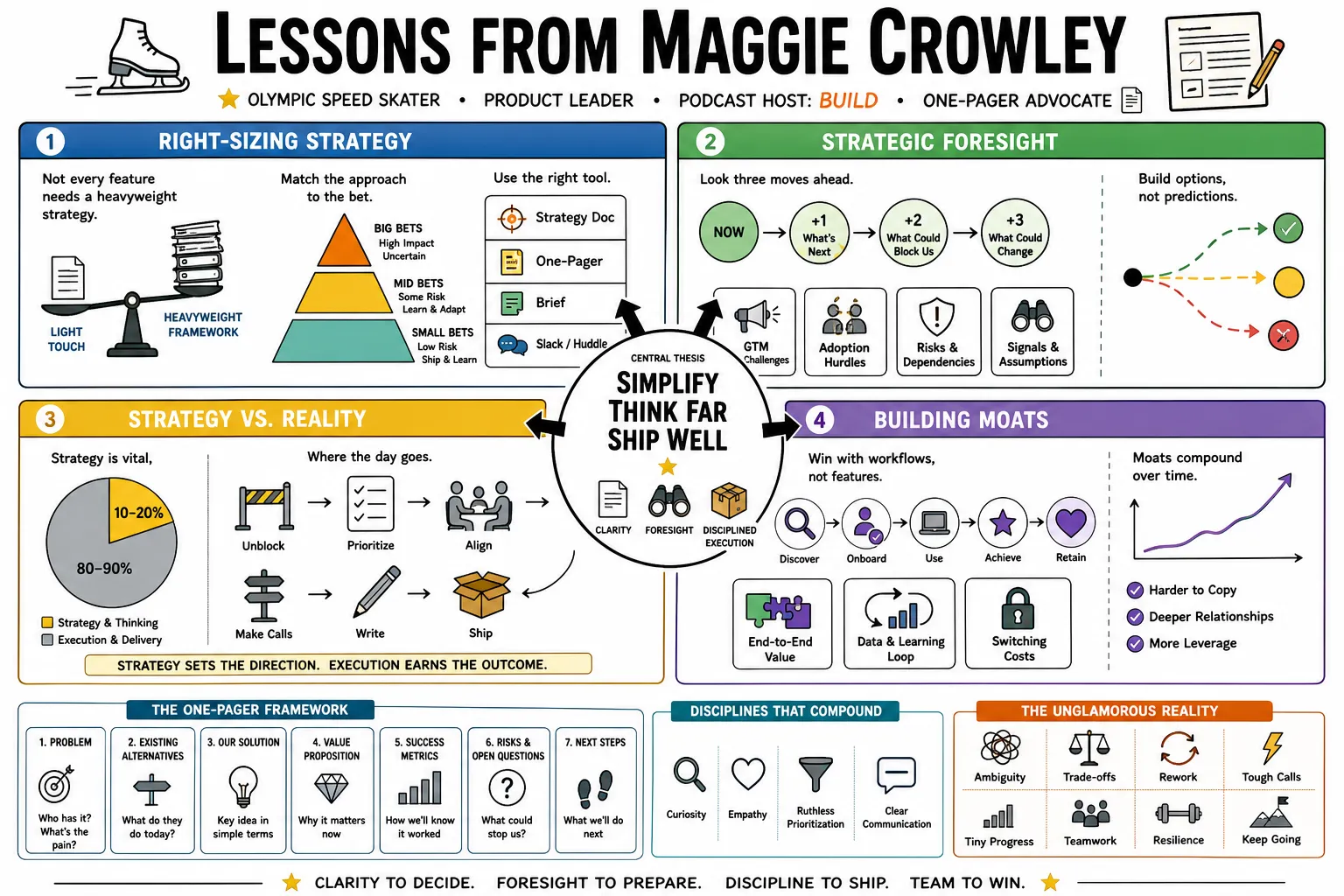
- On Right-Sizing Strategy: "Not every single feature needs a grand, formal strategy document. Save the heavyweight strategic frameworks for the bets that actually warrant them." — Source: Lenny's Podcast
- On Strategic Foresight: "A strong product manager must be able to look three moves ahead, anticipating go-to-market challenges, adoption hurdles, and potential risks before they materialize." — Source: Build Podcast
- On Strategy vs. Reality: "Strategy is vital, but it often occupies a much smaller portion of a product manager's day-to-day job than the industry discourse suggests." — Source: Lenny's Podcast
- On Building Moats: "Design products as cohesive, end-to-end workflows rather than isolated features to create a genuine product-based moat." — Source: Substack Notes on Build
- On Simplification as Strategy: "Strategy isn't about adding complexity. Often, the best strategic move is stripping away unnecessary friction until the core value is obvious." — Source: ProdMgmt World
- On Prioritization: "With all the processes, rituals, frameworks, goals, methods, systems, shapes, milestones, maps, and prioritization math, it's a miracle there's time left to actually get anything done." — Source: Productboard
- On Competitive Advantage: "Always start your strategic thinking by grounding it in business goals and your specific competitive advantage, rather than just copying what others are doing." — Source: Mind the Product
- On Validating Bets: "Setting a direction is only the first half of strategy; the second half is rigorously validating whether your bets are actually paying off." — Source: Airfocus
- On The Full Landscape: "Effective strategy writing involves understanding the entire product landscape, not just your specific slice of the feature set." — Source: Lenny's Newsletter
Part 2: Customer Centricity & Research
- On Empathy: "Feeling the customer's problem deeply is the foundational domain of a product manager. If you don't feel it, you can't solve it." — Source: ProdMgmt World
- On Problem Definition: "Before you even think about a solution, you have to be completely aligned on what the actual customer problem is." — Source: Medium
- On Customer Calls: "There is no substitute for getting on the phone and directly hearing the friction in a customer's voice." — Source: Build Podcast
- On Scope: "Customer research shouldn't just tell you what to build; it should tell you exactly what you can afford to leave out." — Source: Productboard
- On Idea Origins: "While customer insight is the key to generating good ideas, never forget that teamwork is the key to actually executing them." — Source: Liminary
- On Listening: "The best PMs don't just listen to what customers ask for; they listen for the underlying workflow breakdown that prompted the request." — Source: Mind the Product
- On Feedback Loops: "You need the discipline to follow up on results and customer feedback long after the initial excitement of a launch has faded." — Source: Lenny's Podcast
- On User Workflows: "Stop looking at features in a vacuum. Look at the entire journey the user takes to accomplish their goal." — Source: Substack Notes on Build
- On True Pain Points: "If a problem doesn't cause active pain or cost money, it might not be worth solving right now." — Source: Build Podcast
Part 3: The Art of the One-Pager
- On The One-Pager's Purpose: "The one-pager is the ultimate tool to define and scope customer problems before anyone writes a line of code." — Source: Medium
- On Alignment: "Use the one-pager to align teams and increase focus on the user, fostering collaboration rather than just dictating requirements." — Source: Medium
- On Brevity: "If you can't explain the problem and the proposed value in a single page, you don't understand it well enough yet." — Source: Productboard
- On Forced Clarity: "Writing a one-pager forces you to strip away all the fluff and confront the actual mechanics of the problem." — Source: Build Podcast
- On Cross-Functional Buy-In: "A well-written one-pager is how you get engineering, design, and marketing to nod their heads before the work even starts." — Source: Mind the Product
- On Preventing Bloat: "The constraint of a single page is a feature, not a bug. It naturally prevents scope creep." — Source: Medium
- On Living Documents: "A one-pager isn't a static contract; it's a living artifact that grounds the team as new information arises." — Source: Productboard
- On Accessibility: "Write your one-pagers so that anyone in the company, from sales to support, can read it and instantly grasp the 'why'." — Source: Build Podcast
- On Replacing Heavy PRDs: "The one-pager is the antidote to the 30-page PRD that no one ever actually reads." — Source: Medium
- On Starting Rituals: "Make the review of the one-pager the official starting ritual for any new initiative to ensure everyone is on the same page." — Source: Mind the Product
Part 4: Shipping, Execution, & Craft
- On Excellence: "If it's worth doing, it's worth doing well." — Source: Lenny's Newsletter
- On Execution as the Job: "Execution and ownership—handling the unglamorous day-to-day work—is a core domain of being a PM." — Source: ProdMgmt World
- On Carrying the Water: "Great PMs are willing to 'carry the water'—doing the unglamorous tasks like QA, support tickets, and sales calls to ensure the product succeeds." — Source: Liminary
- On Shaping: "Shaping and craft are about translating a high-level strategy into executable, logical architecture." — Source: ProdMgmt World
- On Post-Mortems: "Honest post-mortems are the secret to building better performing products and more resilient teams." — Source: Productboard
- On Speed vs. Quality: "Moving fast doesn't mean breaking things carelessly; it means moving with intention and high standards." — Source: Build Podcast
- On Follow-Through: "The discipline to monitor metrics and fix bugs long after the launch party is what separates amateurs from professionals." — Source: Lenny's Podcast
- On Breaking Down Work: "A key execution skill is the ability to break down massively complex projects into the smallest, most important next tasks." — Source: ProdMgmt World
- On The Grind: "Do not underestimate the sheer amount of grinding required to get a product from zero to one." — Source: Lenny's Newsletter
- On Process Overload: "Don't let rituals, maps, and prioritization math get in the way of actually shipping software." — Source: Productboard
Part 5: Communication, Writing, & Storytelling
- On Simplifying: "Great writing is frequently just the result of simplifying your thinking." — Source: Lenny's Podcast
- On Storytelling: "Copywriting and storytelling aren't just for marketing; they are core competencies for product management." — Source: Apple Podcasts - Build
- On Complexifiers: "Avoid being a 'complexifier.' The best PMs take complicated situations and distill them into clear, simple communication." — Source: Medium
- On Influence: "Communication and influence are how you align stakeholders when you have zero actual authority over them." — Source: ProdMgmt World
- On Explaining the 'Why': "If you can explain complex ideas simply, you can win over any room." — Source: Build Podcast
- On Internal Marketing: "You have to market your product internally to your sales and support teams just as aggressively as you market it externally." — Source: Mind the Product
- On Clarity: "Ambiguity is the enemy of execution. Your job as a PM is to write clearly enough to eliminate ambiguity." — Source: Productboard
- On Documentation: "Operational excellence relies heavily on clear documentation that scales as the team grows." — Source: Mind the Product
- On Narrative: "Every product launch needs a narrative. If the team doesn't know the story, the customer certainly won't." — Source: Build Podcast
Part 6: Leading Teams & Cross-Functional Alignment
- On Emotional Labor: "Product managers serve as the emotional center of their teams. You have to manage the team's energy as much as the backlog." — Source: Liminary
- On Optimism: "Product Managers need to balance relentless optimism with the reality of hard work." — Source: Lenny's Podcast
- On True Teamwork: On Product Love, Crowley describes Drift product work as a partnership among product management, design, engineering, and a squad-aligned customer advocate, with the goal of keeping teams autonomous while still close to customer feedback. — Reference: Product Love transcript on Drift squads combining PM, design, engineering, and customer advocate roles
- On Leadership as Behavior: "Leadership is defined by a set of behaviors and actions, not by the title on your business card." — Source: Mind the Product
- On Disagreeing: "A crucial team dynamic is the ability to disagree passionately behind closed doors and commit fully once a decision is made." — Source: Lenny's Newsletter
- On Trust: "You build cross-functional alignment by consistently doing what you say you are going to do." — Source: Build Podcast
- On Shielding the Team: "Part of being the emotional anchor is absorbing the organizational chaos so the engineering team can focus." — Source: Liminary
- On Shared Goals: "Cross-functional friction usually disappears when everyone is genuinely evaluated against the exact same business goal." — Source: Mind the Product
- On Rituals: "Use rituals to scale culture and communication, but discard them the moment they become performative overhead." — Source: Productboard
Part 7: The PM Role & Core Competencies
- On Simplifiers vs. Complexifiers: "Elite PMs are 'simplifiers' who reduce noise; average PMs are 'complexifiers' who add to it." — Source: Medium
- On Broad Skill Sets: "Product managers need a broad, adaptable skill set because the nature of the job changes depending on the lifecycle of the product." — Source: Lenny's Newsletter
- On The Five Domains: "Mastering PM requires balancing customer insight, strategy, shaping, communication, and execution." — Source: ProdMgmt World
- On Accountability: "The PM is ultimately accountable for the outcome, even though they rely entirely on others to build it." — Source: Build Podcast
- On Problem Solving: "Your primary job isn't writing tickets; your primary job is solving business problems for customers." — Source: Medium
- On Adaptability: "The best PMs can seamlessly shift from a high-level strategic board meeting to debugging a user flow in the same afternoon." — Source: Lenny's Podcast
- On Ego: "Leave your ego at the door. The product's success is the only metric that matters, not whose idea it was." — Source: Build Podcast
- On Doing the Work: "Sometimes being a PM means just opening up a spreadsheet and doing the manual data entry no one else wants to do." — Source: Liminary
- On Defining the Role: "The PM role is whatever the team needs it to be in order to ship successfully on any given day." — Source: Productboard
Part 8: Career Growth & Hiring
- On Diverse Experience: "Diverse experiences in different stages of a product's lifecycle are invaluable for career growth." — Source: Lenny's Podcast
- On Interviewing for Backbone: "When evaluating candidates, look for people who have 'backbone' but can also demonstrate they know how to disagree and commit." — Source: Lenny's Newsletter
- On Discussing Failure: In the same Product Love transcript, Crowley says athletics taught her to manage failure: you do not win every race, setbacks are frequent, and the resilience to keep showing up maps directly to product work. — Reference: Product Love transcript on managing failure, setbacks, resilience, and grit
- On Career Progression: "Moving from a junior to a senior PM isn't just about doing the same things better; it's about fundamentally changing how you approach ambiguity." — Source: Lenny's Podcast
- On Hiring Simplifiers: "The number one trait to look for when hiring a product manager is their ability to take a messy prompt and structure it cleanly." — Source: Medium
- On Continuous Learning: "The best product leaders treat their own careers like a product—constantly iterating, seeking feedback, and acquiring new skills." — Source: Build Podcast
- On Ownership in Interviews: "Look for candidates who use 'I' when talking about mistakes and 'we' when talking about wins." — Source: Lenny's Newsletter
- On Domain Expertise: "You can teach someone a specific industry domain, but you cannot easily teach them product sense and grit." — Source: Build Podcast
- On Managing Up: "As you grow in your career, managing up and communicating with executives becomes just as critical as managing the backlog." — Source: ProdMgmt World
- On The Ultimate Test: "The ultimate test of a product leader is not the products they ship, but the quality of the teams they build." — Source: Lenny's Podcast