Lessons from Maor Shlomo
After scaling the enterprise data platform Explorium, Israeli entrepreneur Maor Shlomo went solo to bootstrap Base44, a natural language coding tool Wix bought for $80 million just six months after launch. This profile collects his thoughts on the shift toward natural language development and how to operate lean under pressure.
Part 1: The Solo Founder Experience
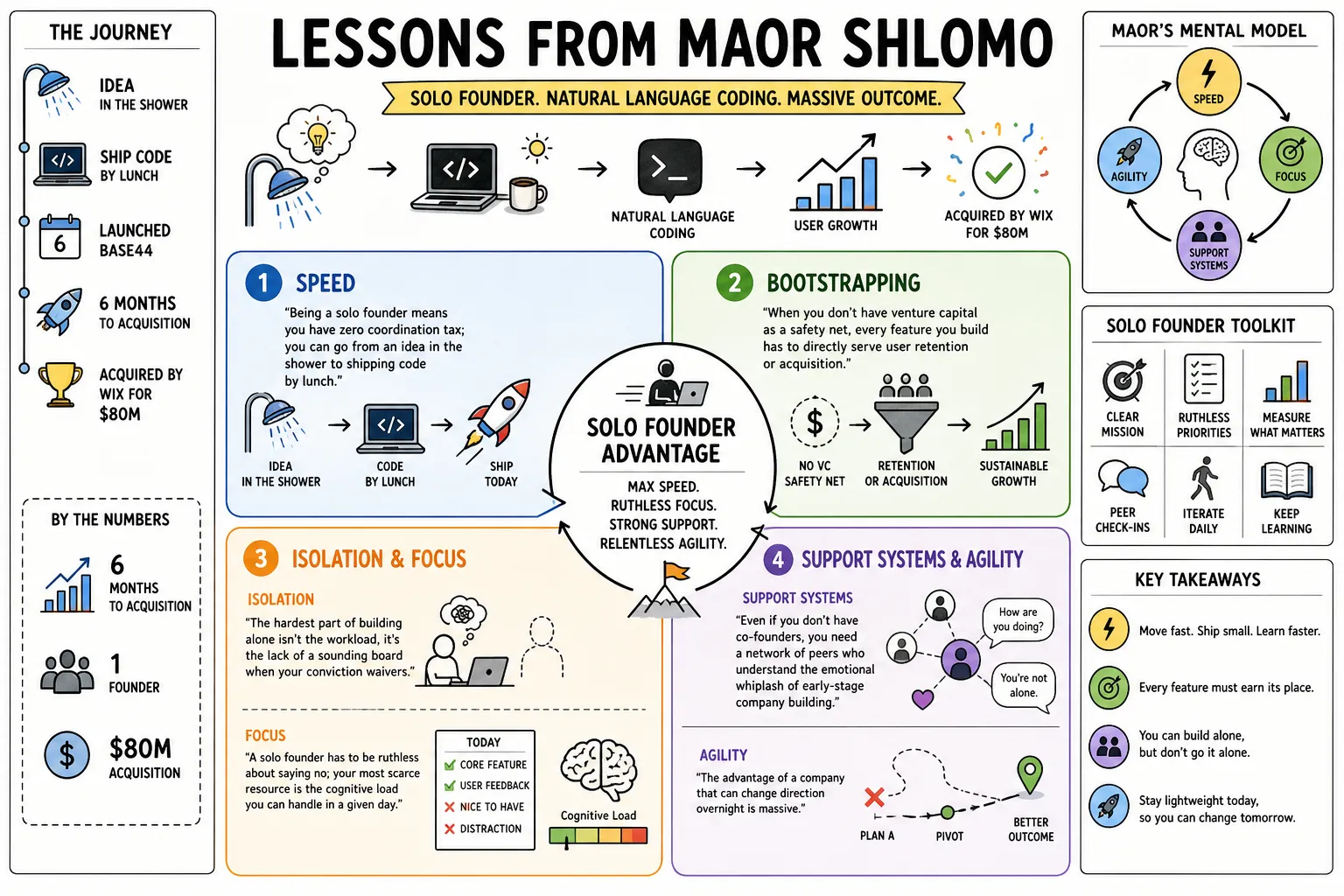
- On Speed: "Being a solo founder means you have zero coordination tax; you can go from an idea in the shower to shipping code by lunch." — Source: [20VC]
- On Bootstrapping: "When you don't have venture capital as a safety net, every feature you build has to directly serve user retention or acquisition." — Source: [Lenny's Newsletter]
- On Isolation: "The hardest part of building alone isn't the workload, it's the lack of a sounding board when your conviction waivers." — Source: [20VC]
- On Focus: "A solo founder has to be ruthless about saying no; your most scarce resource is the cognitive load you can handle in a given day." — Source: [Lenny's Newsletter]
- On Support Systems: "Even if you don't have co-founders, you need a network of peers who understand the emotional whiplash of early-stage company building." — Source: [The Times of Israel]
- On Agility: "The advantage of a company of one is the ability to pivot the entire product strategy based on a single user conversation, without holding an all-hands meeting." — Source: [Inc. Magazine]
- On Scope: "I intentionally constrained Base44's initial scope because I knew I had to maintain the entire codebase myself." — Source: [Lenny's Newsletter]
- On Customer Empathy: "When you handle every support ticket yourself, you build a much deeper, visceral understanding of what is actually broken in your product." — Source: [20VC]
- On Capital: "My experience at Explorium taught me how to deploy capital, but Base44 taught me how much you can achieve without it." — Source: [Calcalist]
- On Discipline: "Bootstrapping forces a discipline that artificial runway often masks; you only eat what you kill." — Source: [20VC]
Part 2: Vibe Coding and AI
- On Natural Language: "Writing software is shifting from syntax memorization to natural language instruction; the compiler is now a conversational agent." — Source: [The New Stack]
- On Vibe Coding: "Vibe coding isn't about ignoring logic, it's about abstracting the boilerplate so the builder can focus entirely on the user experience." — Source: [Inc. Magazine]
- On AI Capabilities: "The models are getting good enough that the bottleneck is no longer the AI's ability to code, but the human's ability to articulate what they want." — Source: [20VC]
- On Base One: "We built our own proprietary model because relying entirely on off-the-shelf APIs created too much latency for a truly fluid building experience." — Source: [The New Stack]
- On Accessibility: "AI lowers the floor for creation while raising the ceiling for complexity, allowing non-engineers to build functional applications." — Source: [Lenny's Newsletter]
- On The New Developer: "The developer of tomorrow looks more like a product manager who happens to direct AI agents rather than someone writing functions from scratch." — Source: [Inc. Magazine]
- On Prompting: "Good prompt engineering is just clear communication; if you can't explain a feature to another human, an AI won't build it correctly either." — Source: [The New Stack]
- On Iteration: "The magic of AI-driven development is the iteration cycle; you can generate, test, and discard entire architectures in minutes." — Source: [20VC]
- On Code Quality: "The AI will generate messy code if you let it; part of vibe coding is knowing when to step in and enforce structural constraints." — Source: [Inc. Magazine]
- On Tooling: "We are moving from IDEs that check your syntax to environments that suggest entire product directions." — Source: [The New Stack]
Part 3: Data Science and External Data
- On Data Blind Spots: "Organizations fail not because their internal data is bad, but because they are entirely blind to the external signals shaping their market." — Source: [Forbes]
- On Predictive Power: "The most accurate predictions happen at the intersection of your proprietary data and the broader internet's context." — Source: [The Times of Israel]
- On Data Acquisition: "Don't gather data just to have it; acquire data that specifically reduces uncertainty in your highest-stakes decisions." — Source: [Forbes]
- On Machine Learning: "A machine learning model is only as intelligent as the variety of the data it consumes." — Source: [The Times of Israel]
- On The Enterprise: "Selling data tools to the enterprise requires proving ROI before you ever integrate; you have to show them the answer before they buy the calculator." — Source: [Forbes]
- On External Context: "Internal data tells you what your customers did yesterday; external data helps you predict what they will do tomorrow." — Source: [Forbes]
- On Feature Engineering: "The hardest part of data science isn't selecting the algorithm, it's finding the right features that actually capture the real-world phenomena." — Source: [The Times of Israel]
- On Scaling Data: "When building Explorium, we realized that normalizing thousands of disparate data sources was a bigger technical moat than the predictive models themselves." — Source: [Forbes]
- On Signal vs Noise: "More data does not equal more insight; the goal is to filter out the noise before it poisons the model." — Source: [The Times of Israel]
- On Analytics: "Analytics dashboards are useful for retrospectives, but true data science should be actively directing future operations." — Source: [Forbes]
Part 4: Rapid Growth Without Paid Marketing
- On User Acquisition: "We hit four hundred thousand users without spending on ads by making the product naturally output artifacts that users wanted to share." — Source: [Lenny's Newsletter]
- On Virality: "True virality isn't a referral program; it's a core loop where using the product inherently exposes it to others." — Source: [20VC]
- On Margins: "In the early days of hyper-growth, obsessing over unit economics can slow down the land grab; margins can be fixed later, but momentum cannot." — Source: [20VC]
- On Product-Led Growth: "Your interface has to do the heavy lifting of a sales team; if a user can't find value in two minutes, they bounce." — Source: [Lenny's Newsletter]
- On Community: "Building in public attracted our early adopters; people want to follow a story, not just sign up for a tool." — Source: [Lenny's Newsletter]
- On Friction: "Every required click in the onboarding flow halves your activation rate; we removed everything that wasn't strictly necessary to start building." — Source: [20VC]
- On Retention: "High growth means nothing if the bucket is leaking; we tracked feature usage over daily active users to measure real retention." — Source: [Lenny's Newsletter]
- On Feedback Loops: "When a user complains on social media, treating it as an engineering priority rather than a PR problem turns detractors into advocates." — Source: [20VC]
- On Scaling: "The systems that get you to ten thousand users will break at a hundred thousand; you have to rebuild the engine while driving." — Source: [Lenny's Newsletter]
Part 5: Navigating Crisis and Service
- On Perspective: "Serving in the army reserves puts business stress into perspective; a server outage is solvable, a real-world crisis requires a different kind of resilience." — Source: [Lenny's Newsletter]
- On Focus Under Fire: "When you only have a few hours a day to work on your startup while on duty, you learn very quickly what actually moves the needle." — Source: [Calcalist]
- On Compartmentalization: "The ability to switch contexts between high-stakes military service and writing software requires intense mental boundaries." — Source: [The Times of Israel]
- On Urgency: "The uncertainty of the region created an artificial timeline in my head; I felt an intense urgency to prove Base44's value immediately." — Source: [Lenny's Newsletter]
- On Dealmaking: "Negotiating an acquisition while navigating military reserve duty forces you to cut out all the posturing and focus only on the core terms." — Source: [Calcalist]
- On Team Dependency: "Being away forced me to realize how resilient the systems needed to be; the product had to survive without my constant intervention." — Source: [The Times of Israel]
- On Motivation: "Building something new was a counterweight to the difficulties happening in the physical world; it was a space where I still had control." — Source: [Lenny's Newsletter]
- On Constraints: "Extreme constraints, like limited time and high stress, often yield the most elegant architectural decisions." — Source: [Calcalist]
- On Survival: "Founders talk about perseverance, but true perseverance is continuing to ship code when the environment around you is entirely unpredictable." — Source: [The Times of Israel]
Part 6: Building and Scaling Products
- On Simplicity: "The hardest engineering challenge is making something complex feel simple to the end user." — Source: [Inc. Magazine]
- On The First Version: "If you are not slightly embarrassed by your first release, you spent too long polishing things that users might not even want." — Source: [The Times of Israel]
- On Architecture: "Build monoliths early; microservices are an optimization for large teams, not for finding product-market fit." — Source: [The New Stack]
- On Listening: "Don't build exactly what users ask for; understand the underlying friction that caused them to ask for it, and solve that instead." — Source: [Lenny's Newsletter]
- On Speed vs Quality: "Move fast on the user experience, but be deliberate and slow when changing the underlying data schema." — Source: [20VC]
- On Defensibility: "In the AI era, your UI is not a defensive barrier; your barrier is the specific workflows you deeply understand and optimize." — Source: [Inc. Magazine]
- On Feature Bloat: "Every new button you add dilutes the attention of the user; subtraction is often the best product strategy." — Source: [The Times of Israel]
- On Metrics: "Track the time it takes for a user to experience their first functional moment with the product; everything else is secondary." — Source: [Lenny's Newsletter]
- On Debt: "Technical debt is a tool, like financial debt; it's useful to use for speed, as long as you plan for the repayment." — Source: [The New Stack]
Part 7: Leadership and Efficiency
- On Execution: "Ideas are cheap; the delta between a good idea and a successful company is entirely execution and stamina." — Source: [The Times of Israel]
- On Hiring: "At Explorium, I learned that hiring too fast solves immediate pain but creates long-term cultural dilution." — Source: [Forbes]
- On Meetings: "A culture of continuous meetings is usually a symptom of unclear ownership and a lack of trust." — Source: [The Times of Israel]
- On Delegation: "True delegation isn't handing off tasks; it's handing off the authority to make mistakes." — Source: [Forbes]
- On Clarity: "As a CEO, your main job is repeating the core mission so often that the newest hire can recite it in their sleep." — Source: [The Times of Israel]
- On Transparency: "Hiding bad news from your team doesn't protect them; it robs them of the context they need to help solve the problem." — Source: [Forbes]
- On Focus: "Efficiency isn't doing more things faster; it's aggressively choosing which things don't need to be done at all." — Source: [The Times of Israel]
- On Culture: "Culture is not what you write on the wall; it is the behavior you tolerate when deadlines are tight." — Source: [Forbes]
- On Self-Correction: "The best leaders are the ones who can look at a strategy they defended yesterday and abandon it today if the data proves them wrong." — Source: [The Times of Israel]
Part 8: Acquisitions and The Future
- On Selling: "Selling the company wasn't the goal; the goal was finding the right vehicle to scale the product to millions of users faster than I could alone." — Source: [Calcalist]
- On Alignment: "An acquisition only works if the acquiring company’s DNA is fundamentally aligned with the product you’ve built." — Source: [20VC]
- On Valuation: "Valuations are temporary, but the strategic fit of an acquisition determines whether the product survives long-term." — Source: [Calcalist]
- On Integration: "Post-acquisition, the biggest risk is that the bureaucracy of the larger company crushes the agility that made the startup valuable." — Source: [20VC]
- On the AI Landscape: "We are in the dial-up phase of AI; what seems magical today will be standard infrastructure in three years." — Source: [Inc. Magazine]
- On Future Builders: "The next generation of unicorns won't be built by armies of engineers, but by small teams utilizing massive AI capabilities." — Source: [The New Stack]
- On Automation: "Software will eventually write itself; the human role will transition strictly to architecture, taste, and QA." — Source: [Inc. Magazine]
- On Legacy: "I want to be remembered for building tools that removed the friction between having an idea and holding a functional product." — Source: [Calcalist]
- On The Next Chapter: "The end of a startup is just the release of capital and talent back into the ecosystem to build the next thing." — Source: [20VC]