Lessons from Marco Zappacosta
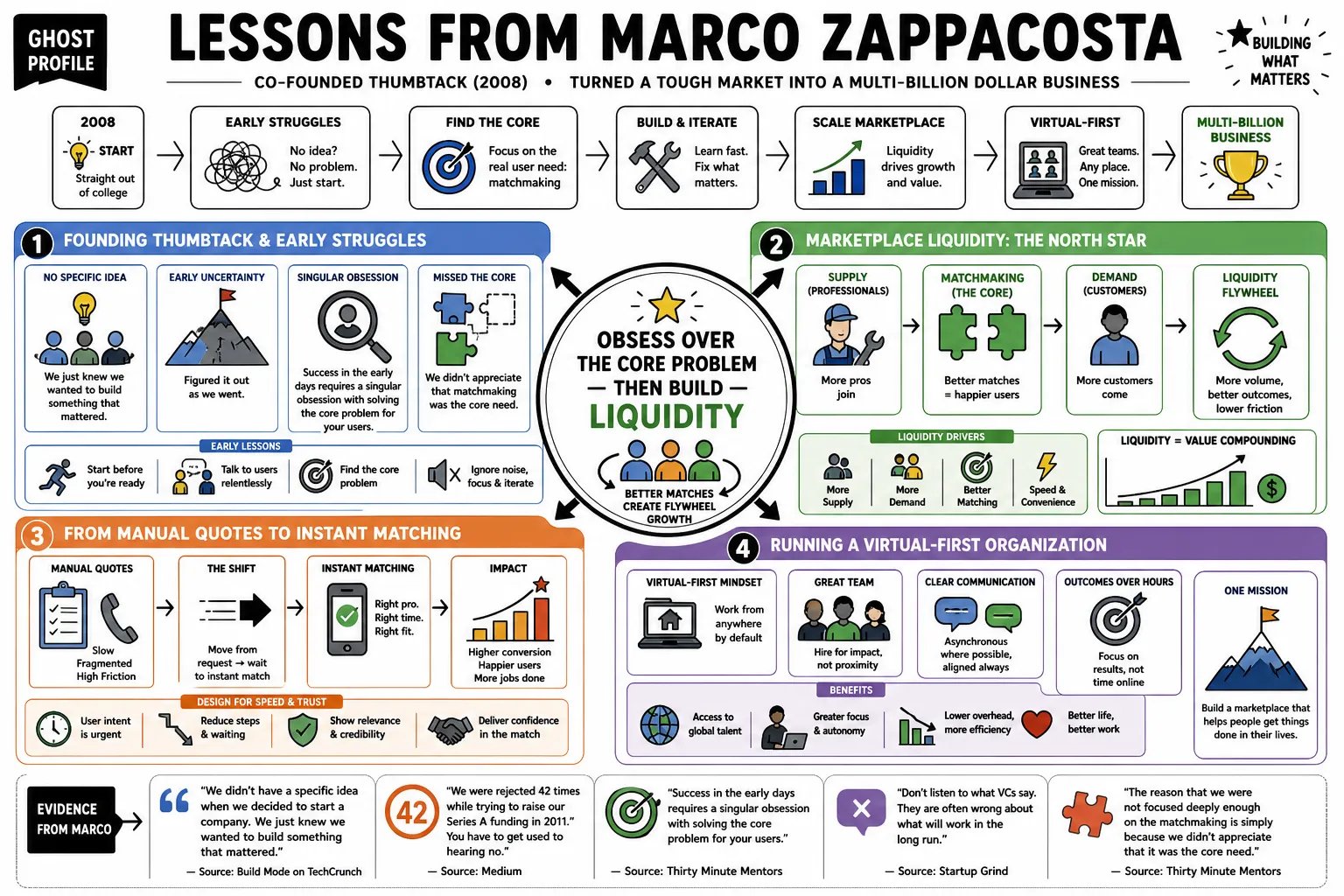
Marco Zappacosta co-founded Thumbtack straight out of college in 2008, turning a difficult local services market into a multi-billion dollar business. This profile covers his approach to marketplace liquidity, the shift from manual quotes to instant matching, and his commitment to running a virtual-first organization.
Part 1: Founding Thumbtack & Early Struggles
- On the initial idea: In the NFX marketplace interview, Zappacosta says Thumbtack came out of starting a company first, then hunting for a problem that technology would inevitably solve, which led the team to the painfully broken experience of hiring local service pros. — Reference: NFX transcript on starting the company before the idea and zeroing in on local-services matching as the inevitable problem to solve
- On fundraising rejection: "We were rejected 42 times while trying to raise our Series A funding in 2011. You have to get used to hearing no." — Source: Medium
- On singular obsession: "Success in the early days requires a singular obsession with solving the core problem for your users." — Source: Thirty Minute Mentors
- On ignoring venture capitalists: "Don't listen to what VCs say. They are often wrong about what will work in the long run." — Source: Startup Grind
- On early mistakes: "The reason that we were not focused deeply enough on the matchmaking is simply because we didn't appreciate that it was the core need." — Source: NFX
- On sticking to a broad category: "Everyone told us to narrow our focus to one specific service category, but we stayed broad because we believed it was the only way to succeed at scale." — Source: First Round Review
- On setting realistic expectations: "Big, impactful businesses take a long time to build. You have to set realistic expectations for that timeline to maintain your mindset." — Source: Thirty Minute Mentors
- On being a first-time founder: "There are mountains of advice out there for first-time founders, and learning how to filter it is your first real test." — Source: First Round Review
- On early product design: "We started as a digital bulletin board because that was the most obvious way to connect people at the time." — Source: Thumbtack Blog
Part 2: Marketplace Dynamics & Liquidity
- On the single most important feature: "Liquidity is the single most important feature for a marketplace, particularly in its early stages." — Source: The Marketplace Guide
- On solving the cold start problem: "You have to create network-independent value for your supply side before you have any demand." — Source: NFX
- On providing standalone tools: "We built a profile builder for Craigslist that offered value to pros even before we had a significant customer base to send them." — Source: NFX
- On Craigslist's durability: "Craigslist proved that liquidity, rather than beautiful design or safety features, is the primary driver of marketplace durability." — Source: The Marketplace Guide
- On prioritizing supply: "If you don't have the professionals ready to do the work, no amount of customer demand will save your marketplace." — Source: Mixergy
- On the core need of matchmaking: "So far and above everything else, matchmaking is where we should have focused longer and harder earlier." — Source: NFX
- On latency in transactions: "Manual quote-based systems have inherent latency that will eventually cap your growth potential." — Source: Thumbtack Blog
- On building trust: In Founders in Arms, Zappacosta argues that local services carry unusually high trust thresholds because customers care about confidence, peace of mind, and certainty, so the platform has to structure decisions around reducing that anxiety. — Reference: Founders in Arms transcript on local services being driven by trust, confidence, and certainty
- On transitioning away from bulletin boards: "A digital bulletin board is profitable and easy to build, but it cannot deliver the speed modern consumers expect." — Source: Thumbtack Blog
Part 3: The Pivot to Instant Matching
- On switching engines mid-flight: "We changed the business model, switching engines mid-flight while still going all-out to support the hundreds of thousands of pros and millions of customers who rely on us." — Source: Thumbtack Blog
- On pressing pause during high growth: "We were growing at over 80 percent year-over-year, yet we decided to press pause to completely overhaul the product." — Source: Thumbtack Blog
- On recognizing inherent limits: "The old model was profitable but it was inconsistent and slow, and we knew it would eventually limit our potential." — Source: Thumbtack Blog
- On removing friction: "By removing the friction of waiting for multiple individual quotes, we were able to streamline the booking process completely." — Source: Thumbtack Blog
- On rebuilding from scratch: "We essentially had to rebuild the core product from scratch to achieve the speed and reliability required to scale effectively." — Source: The Marketplace Guide
- On the hardest transition: "Moving to instant matching was the hardest transition in our company's history, but it was absolutely necessary." — Source: Thumbtack Blog
- On automation in booking: "We developed technology that automatically matches customers with qualified professionals based on job preferences, availability, budget, and location." — Source: US Chamber of Commerce
- On increasing response rates: "Instant matching drastically increased our response rates and allowed professionals to serve more customers efficiently." — Source: The Marketplace Guide
- On making a liquidity move: "The shift to instant matching was fundamentally a liquidity move designed to clear the market faster." — Source: The Marketplace Guide
- On the customer experience: "We wanted to make hiring a local professional as easy as buying a book online." — Source: Medium
Part 4: Leadership & Self-Awareness
- On knowing yourself: "Leadership begins with knowing yourself, well before you worry about running meetings or setting company goals." — Source: Quora
- On the existential threat: "The CEO's job is constantly focusing on whatever is currently the existential risk to the business." — Source: Y Combinator
- On admitting imperfection: "I'm under no illusions that I'm hiring perfect people, but I want to make sure I'm hiring people who are self-aware of being imperfect." — Source: Cup of Zhou
- On shifting priorities: "In the early days, the focus was entirely on building the supply and demand network. Later, the challenge shifted to refining the product experience." — Source: Y Combinator
- On handling layoffs: "Maintaining team confidence during difficult times like layoffs requires total transparency about why the business needs to change." — Source: First Round Review
- On board management: "Managing a board is about bringing them along on your thought process instead of merely reporting numbers at the end of the quarter." — Source: First Round Review
- On managing time as CEO: "You have to build a personal framework for prioritizing your time, or the loudest problems will consume your entire day." — Source: First Round Review
- On staying the course: "When things get hard, you have to remember why you started and trust that the problem you are solving still matters." — Source: Thirty Minute Mentors
- On tactics versus strategy: "It is very easy to get caught up in the tactics of being a founder and lose sight of the overarching strategy." — Source: Quora
Part 5: Building & Hiring a Team
- On executive leadership: "Hiring executives requires a different approach than hiring early employees. You are looking for people who can build systems, rather than simply execute tasks." — Source: First Round Review
- On borrowing playbooks: "For standard functions like G&A, recruiting, and leveling, you do not need to reinvent the wheel. Borrow from established playbooks." — Source: First Round Review
- On the special flower fallacy: "First-time founders often mistakenly believe their company is special in every single way. It isn't." — Source: First Round Review
- On attracting talent from giants: "To attract talent from major tech companies, you have to offer them a level of ownership and impact they can no longer get at a massive corporation." — Source: Fast Company
- On empowering great people: "As the company grew, my priority shifted from building the product myself to hiring and empowering great people to build it." — Source: Y Combinator
- On evaluating fit: "When evaluating candidates, pay close attention to how they talk about their past failures. That tells you everything about their self-awareness." — Source: Cup of Zhou
- On the evolution of the CEO role: "Your job as a CEO completely changes every few years as the company scales. You have to continually fire yourself from old jobs." — Source: Thirty Minute Mentors
- On trusting your gut over advice: "When it comes to your core business strategy, you must be prepared to ignore conventional wisdom if it contradicts your unique insight." — Source: First Round Review
- On the one-and-done career path: "Building a company directly out of college shapes your approach to leadership because you are learning how to manage at the exact same time you are learning how to work." — Source: First Round Review
Part 6: Virtual-First Culture & Future of Work
- On reimagining work: "Since we completely reimagined our way of working, Thumbtack has been incredibly intentional about building out a virtual-first culture." — Source: Thumbtack Blog
- On deliberate management: In his remote-work conversation with Gleb Tsipursky, Zappacosta says virtual-first leadership works only when managers become much more deliberate about how they bring people together, communicate expectations, and design collaboration. — Reference: Remote-first interview transcript on leaders needing to be more deliberate in virtual work
- On remote productivity: In the World Financial Review interview, Zappacosta points to Thumbtack survey data showing that 75% of both leaders and employees reported increased productivity with remote work, which he uses to challenge blanket return-to-office assumptions. — Reference: World Financial Review interview on 75% of leaders and employees reporting increased productivity with remote work
- On in-person gatherings: Thumbtack's virtual-first page stresses that virtual-first does not mean virtual-only: the company still expects regular in-person gatherings throughout the year to build real connections, align teams, and move business goals forward. — Reference: Thumbtack virtual-first page on regular in-person gatherings for connection and business momentum
- On attracting talent anywhere: "Operating virtually is a strategic advantage that allows us to attract top talent regardless of location, moving beyond the limitations of a single physical office." — Source: Fast Company
- On challenging the RTO narrative: "Mandating a return to the office ignores the reality that people want flexibility, and flexibility can actually improve the quality of their output." — Source: Thumbtack Blog
- On what you build versus where you sit: "The best work isn't about where you sit. It is about what you build." — Source: Thumbtack Blog
- On permanent evolution: "We view the virtual-first model as a permanent evolution of how our company operates, devoid of any temporary pandemic-era thinking." — Source: Thumbtack Blog
- On explicit processes: Thumbtack's own virtual-first guidance says success depends on setting clear expectations, building trust, holding people accountable, and relying on flexible structured systems rather than informal office osmosis. — Reference: Thumbtack virtual-first page on clear expectations, trust, accountability, and structured systems
- On culture and cohesion: In the same remote-first interview, Zappacosta says distributed companies have to intentionally create culture and cohesion instead of assuming it will emerge from hallway interactions or ad hoc office habits. — Reference: Remote-first interview transcript on intentionally building culture and cohesion rather than relying on hallways
Part 7: Empowering Local Professionals
- On the entrepreneurial spirit: "The entrepreneurial spirit of independent professionals is the most precious resource we have as a society." — Source: Breezy HR
- On transforming the economy: "Independent local professionals are the ones transforming the economy from the ground up." — Source: Breezy HR
- On convenience and confidence: "Thumbtack is about giving people the convenience and confidence they need to hire someone to do a job." — Source: Wonder of Tech
- On finding the right price: "Our goal is simple: help the customer find the right pro at the right price with minimal friction." — Source: Wonder of Tech
- On the future of work: "We believe the future of work is going to be dominated by local services and non-routine tasks." — Source: US Chamber of Commerce
- On AI as a complement: Zappacosta's framing in Founders in Arms is that the harder and more important question is not just what AI substitutes for, but what it complements and newly enables for people and businesses. — Reference: Founders in Arms transcript on AI being easier to see as a substitute than as a complement
- On AI-proof trades: In the Summation interview, Zappacosta describes the trades and other jobs that interface with the real world as a relative safe harbor in the AI era, because physical execution remains much harder to automate than pure software work. — Reference: Summation transcript on the trades being a relative safe harbor because they interface with the real world
- On supporting pros: "Here at Thumbtack, it is our job to help these independent professionals get to where they want to be." — Source: Breezy HR
- On democratizing software: In Founders in Arms, Zappacosta says many small businesses are still early in basic digital adoption, from getting online to marketing themselves and running back-office workflows, which is why better software access for local pros remains such a large opportunity. — Reference: Founders in Arms transcript on small businesses still needing help getting online, marketing digitally, and adopting back-office tools
Part 8: Advice for First-Time Founders
- On when to innovate: "Know exactly when to borrow from existing company playbooks and when you actually need to innovate from scratch." — Source: First Round Review
- On trusting your instincts: "If your gut contradicts conventional wisdom regarding your core product, you have to follow your gut." — Source: First Round Review
- On filtering advice: "Learning to filter the mountains of advice you receive is the most important skill a young founder can develop." — Source: First Round Review
- On persistence: "You will face a wall of rejection early on. Your persistence is the only thing that will get you to the other side." — Source: Medium
- On the value of naivete: "Starting a company right out of school means you don't know what you don't know, which can actually be a massive advantage. You aren't afraid of the impossible." — Source: First Round Review
- On building the machine: "Eventually, you stop building the product directly and start building the machine that builds the product." — Source: Y Combinator
- On pacing yourself: "Building a durable company is a marathon. If you sprint the first mile, you will never finish the race." — Source: Thirty Minute Mentors
- On early capital: "The money you raise early on is just a tool to prove your core thesis, meaning it is not an absolute validation that your thesis is correct." — Source: Startup Grind
- On team alignment: "Your team has to be aligned on what you are building and why you are building it in the first place." — Source: First Round Review
- On the long game: "If you want to build something that lasts, you have to be willing to do the boring, unglamorous work for years on end." — Source: Thirty Minute Mentors