Lessons from Maria Sharapova
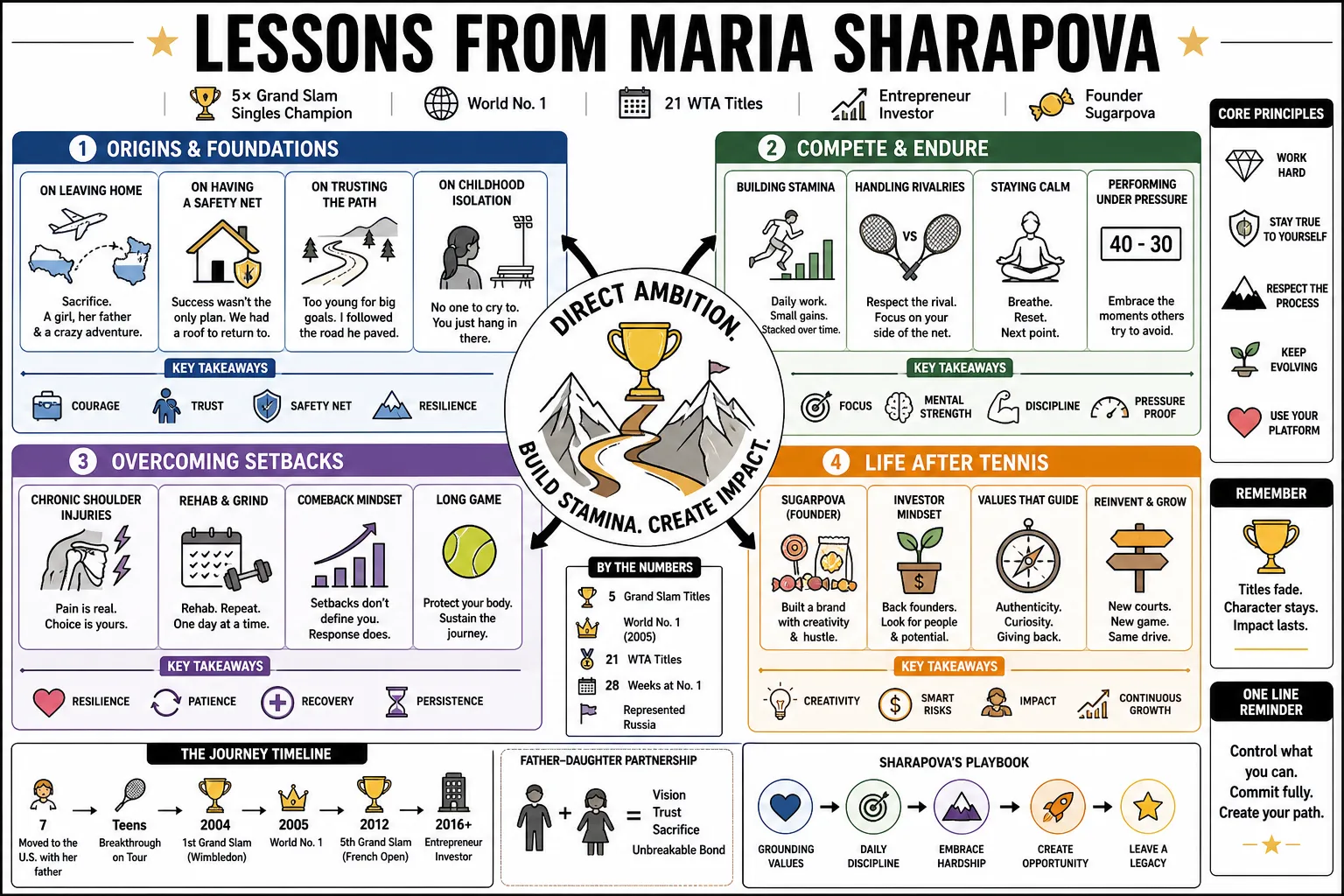
Maria Sharapova moved from Russia to the United States at age seven to pursue professional tennis, eventually winning five Grand Slam singles titles and reaching world No. 1. Beyond her athletic career, she navigated severe chronic shoulder injuries, founded the candy brand Sugarpova, and transitioned into an investor and entrepreneur. This profile compiles her insights on building stamina, navigating intense rivalries, and directing ambition into life after sports.
Part 1: Origins and Foundations
- On leaving home: "I hope people take away every kind of lesson, good and bad. This is a story about sacrifice, what you have to give up. But it's also just the story of a girl and her father and their crazy adventure." — Source: [Unstoppable: My Life So Far]
- On having a safety net: "Success wasn't our only plan or my parents' plan. If it didn't work out, we could go back to a lifestyle where we had a roof over our head." — Source: [Bloomberg The Deal]
- On trusting the path: "I was too young to really have those big goals, but I followed this road that he paved for me." — Source: [Bloomberg The Deal]
- On childhood isolation: "If you don't have a mother to cry to, you don't cry. You just hang in there, knowing that eventually things will change." — Source: [Unstoppable: My Life So Far]
- On the simplicity of the game: "At the beginning, it's all you have: a simple forehand, a simple backhand. It's all you have at the end, too." — Source: [Unstoppable: My Life So Far]
- On paternal conviction: "You had conviction in your decisions, and you never looked back. You were tough, and you repeatedly expected me to raise my standards." — Source: [International Tennis Hall of Fame]
- On parental support: "Along the way, you never forgot your most important role: to be my father, it is a gift I am deeply grateful for." — Source: [International Tennis Hall of Fame]
- On early discipline: "The experience of moving to a new country and starting from zero gave me a work ethic that I relied on for the rest of my life." — Source: [Armchair Expert Podcast]
- On decisive action: "We didn't have the resources, but we had conviction. When someone like Navratilova tells you what you need to do, you figure out a way to do it." — Source: [Unstoppable: My Life So Far]
Part 2: The Mental Game
- On controlling the narrative: "You can't control what people say about you and what they think about you. You can't plan for bad luck. You can only work your hardest and do your best and tell the truth." — Source: [Unstoppable: My Life So Far]
- On ignoring the noise: "The true test for a professional athlete is filtering out external expectations to focus entirely on execution." — Source: [Armchair Expert Podcast]
- On the isolation of success: "Achieving at the highest level often means spending long hours in solitude, which can create a bubble that requires deliberate effort to step out of." — Source: [Armchair Expert Podcast]
- On knowing your strengths: "I am a concise speaker who prefers to observe. I would rather not fill the oxygen with words just for the sake of it." — Source: [Armchair Expert Podcast]
- On dropping stubbornness: "Sometimes, you have to let go of that stubbornness in order for there to be more beautiful things in your life to open up." — Source: [The Tim Ferriss Show]
- On match psychology: "You do not have to be the best player in the world to win. You only have to be better, on that day, than the person across from you." — Source: [Unstoppable: My Life So Far]
- On facing fear: "Managing fear requires acknowledging it rather than fighting it, using the adrenaline as a tool for sharp focus rather than a reason to retreat." — Source: [The Tim Ferriss Show]
- On avoiding distraction: "I learned to treat the space within the lines of the tennis court as a sanctuary where outside opinions and expectations could not reach me." — Source: [The Tim Ferriss Show]
- On emotional regulation: "Handling conflict in relationships and professional environments requires the same calm observation I practiced during high-stakes matches." — Source: [Armchair Expert Podcast]
Part 3: Work Ethic and Discipline
- On her true talent: "That was my gift. Not strength or speed. Stamina. I never got bored. Whatever I was doing, I could keep doing it forever." — Source: [Unstoppable: My Life So Far]
- On bouncing back: "You learn that the great players are not those who don't get knocked down. Everyone gets knocked down. They are those who get up just one more time than they've been knocked down." — Source: [Unstoppable: My Life So Far]
- On outworking problems: "I truly believed I could repair my ligaments and my tendons in my shoulder just if I worked harder." — Source: [Vanity Fair]
- On the necessity of repetition: "Building a world-class skill requires the willingness to execute the exact same mundane drills thousands of times without losing focus." — Source: [The Tim Ferriss Show]
- On early success: "At age fifteen, I began to win, and win consistently. My serve propelled me into a golden era, some of the best years of my career." — Source: [Vanity Fair]
- On continuous improvement: "My father was tough, and repeatedly expected me to raise my standards. That expectation of constant growth became my own internal baseline." — Source: [International Tennis Hall of Fame]
- On training tactics: "Effective practice is not about physical exertion alone; it is about mental endurance and the ability to stay present during tedious tasks." — Source: [The Tim Ferriss Show]
- On outlasting opponents: "I won many of my matches simply by being willing to stay on the court longer and endure more discomfort than my competitors." — Source: [Unstoppable: My Life So Far]
- On the grind: "You can't rely on natural talent; you have to put in the hours when no one is watching, over and over again." — Source: [The Tim Ferriss Show]
Part 4: Competition and Rivalry
- On the drive to win: "I want to beat everyone. It's the not being beaten. Ribbons and trophies get old, but losing lasts." — Source: [Unstoppable: My Life So Far]
- On hating defeat: "I hate it. Fear of defeat is what really drives many of us." — Source: [Unstoppable: My Life So Far]
- On the value of losing: "Losing is the teacher of every champion." — Source: [Unstoppable: My Life So Far]
- On Serena Williams: "I think Serena hated me for being the skinny kid who beat her, against all odds, at Wimbledon. I think she hated me for taking something that she believed belonged to her." — Source: [Unstoppable: My Life So Far]
- On vulnerability in rivals: "Mostly I think she hated me for hearing her cry. She's never forgiven me for it." — Source: [Unstoppable: My Life So Far]
- On competitive longevity: "Sustaining a rivalry at the top of a sport requires a short memory for defeats and a long memory for the tactical lessons learned." — Source: [Unstoppable: My Life So Far]
- On the nature of a match: "A tennis match requires constant adjustments and the physical stamina to outlast the person across the net." — Source: [The Tim Ferriss Show]
- On ignoring the hype: "I viewed my opponents objectively, focusing purely on their tactical weaknesses rather than their media narratives or past achievements." — Source: [Armchair Expert Podcast]
- On the psychology of winning: "Winning is about breaking down the problem across the net faster than they can break you down." — Source: [Unstoppable: My Life So Far]
Part 5: Dealing with Adversity and Injury
- On severe pain: "I'd hit for 15 minutes and it would feel as if my arm was going to fall off." — Source: [Vanity Fair]
- On the price of success: "I would eventually pay a price for that serve and the tremendous pressure it put on my shoulder." — Source: [Vanity Fair]
- On surgical recovery: "I think I'm doing a lot better than other people that have had shoulder surgery in their careers. Some people have never come back." — Source: [Vanity Fair]
- On medical setbacks: "He actually couldn't believe that I've been playing this long with this injury. I was not very thrilled to hear that my medical team did not see this tear in my shoulder back in April." — Source: [Unstoppable: My Life So Far]
- On playing through limits: "Preparing for a match often required extreme numbing procedures just to get onto the court, showcasing the hidden physical costs of professional sports." — Source: [Vanity Fair]
- On aging in sports: "Toward the end of my career, I tried very, very hard to get my body back in shape and injury-free." — Source: [Vanity Fair]
- On accepting physical boundaries: "Acknowledging that the body is failing can be far more difficult mentally than enduring the physical pain itself." — Source: [Armchair Expert Podcast]
- On finding perspective in injury: "Time away from the court during recovery periods allowed me to develop the business acumen that would fuel my post-tennis career." — Source: [Forbes]
- On resilience: "The ability to return to the top tier of tennis after multiple shoulder surgeries required a blind faith in my own capacity to heal and adapt." — Source: [Unstoppable: My Life So Far]
Part 6: Business and Sugarpova
- On authentic branding: "Sugarpova was born from my childhood memories of bringing unique gummy candies from the United States back to my friends in Russia." — Source: [Forbes]
- On operational involvement: "Rather than just licensing my name, I insisted on being deeply involved in day-to-day operations, including packaging design and product development." — Source: [WSJ Magazine]
- On transferable skills: "The strict discipline and intense focus required on the tennis court translate directly into building and scaling a company." — Source: [Forbes]
- On marketing stunts: "We explored legally changing my last name to Sugarpova for the US Open as a bold marketing tactic, recognizing the power of media buzz for a startup." — Source: [Forbes]
- On adapting the product: "As consumer trends shifted, we pivoted the brand's focus towards better ingredients, demonstrating a willingness to evolve the business model." — Source: [WSJ Magazine]
- On expansion: "You have to know when to grow; expanding the line from gummies to chocolate was a calculated move based on understanding our customer base." — Source: [Forbes]
- On acting as an investor: "Beyond my own company, I utilized my earnings and expertise to take strategic advisory roles in wellness brands like Tonal, Therabody, and Supergoop!" — Source: [Bloomberg The Deal]
- On financial independence: "Building businesses while still playing allowed me to approach the end of my athletic career with financial security and a clear sense of purpose." — Source: [The Tim Ferriss Show]
- On product passion: "A successful business requires the same irrational passion you need to win a Grand Slam; you have to care about the details nobody else sees." — Source: [Forbes]
- On learning on the job: "Entering the business world required checking my ego at the door and being willing to ask fundamental questions in boardrooms where I was the least experienced person." — Source: [WSJ Magazine]
Part 7: Transition and Retirement
- On the weight of a career: "How do you leave behind the only life you've ever known?" — Source: [Vanity Fair]
- On saying goodbye: "Tennis, I'm saying goodbye." — Source: [Vanity Fair]
- On the gifts of the sport: "It gave me a life. It gave me a family. It gave me fans." — Source: [Vanity Fair]
- On looking back: "I acknowledge the untold tears and unspeakable joys that defined my 28-year journey in professional tennis." — Source: [Vanity Fair]
- On moving forward: "I am ready for my next chapter, my next mountain to climb." — Source: [Vanity Fair]
- On leaving on her own terms: "Retiring via a carefully crafted essay rather than a press conference allowed me to control my narrative and articulate my complex emotions accurately." — Source: [Vanity Fair]
- On shifting identities: "Transitioning out of sports requires actively dismantling the identity of the athlete to make room for the identity of a multifaceted individual." — Source: [Armchair Expert Podcast]
- On motherhood and focus: "After having my child, my priorities naturally recalibrated, shifting my intense drive toward raising my family and managing targeted investments." — Source: [Armchair Expert Podcast]
- On finding a new voice: "I launched the Pretty Tough podcast to explore the dynamics of ambition and leadership among high-achieving women, turning my curiosity outward." — Source: [Pretty Tough Podcast]
- On the permanence of drive: "The hunger to achieve doesn't disappear when you retire from a sport; it simply looks for a new arena to conquer." — Source: [Vanity Fair]
Part 8: Life Philosophy and Legacy
- On building mental armor: "Standing on a court alone teaches you to rely entirely on your own internal dialogue to navigate high-pressure situations." — Source: [The Tim Ferriss Show]
- On the illusion of public opinion: "Basing your self-worth on what the public says or thinks is a futile exercise; focus entirely on the quality of your own effort." — Source: [Unstoppable: My Life So Far]
- On parental boundaries: "One of the most difficult but essential steps in my career was my father knowing exactly when to step back from being a coach and simply return to being a father." — Source: [International Tennis Hall of Fame]
- On playing through the pain: "If you love the game enough, you find a way to adapt to the limitations your body sets for you, rather than walking away at the first sign of decline." — Source: [Vanity Fair]
- On having a backup plan: "Knowing you can survive if everything fails gives you the freedom to play without crippling pressure." — Source: [Bloomberg The Deal]
- On evolving ambitions: "Achieving your childhood dreams forces you to find new sources of motivation to sustain a decades-long career." — Source: [Unstoppable: My Life So Far]
- On trusting the journey: "Success rarely looks like a straight line; it is built on a foundation of missteps and forced resets." — Source: [Unstoppable: My Life So Far]
- On continuous learning: "The willingness to be a beginner again, whether in business or podcasting, is the ultimate safeguard against stagnation." — Source: [WSJ Magazine]
- On self-reliance: "Moving away from a heavily structured coaching environment forced me to develop my own internal compass for decision-making." — Source: [Armchair Expert Podcast]
- On legacy: "The true measure of a career is the resilience required to withstand the losses and keep playing, rather than the hardware collected." — Source: [Vanity Fair]