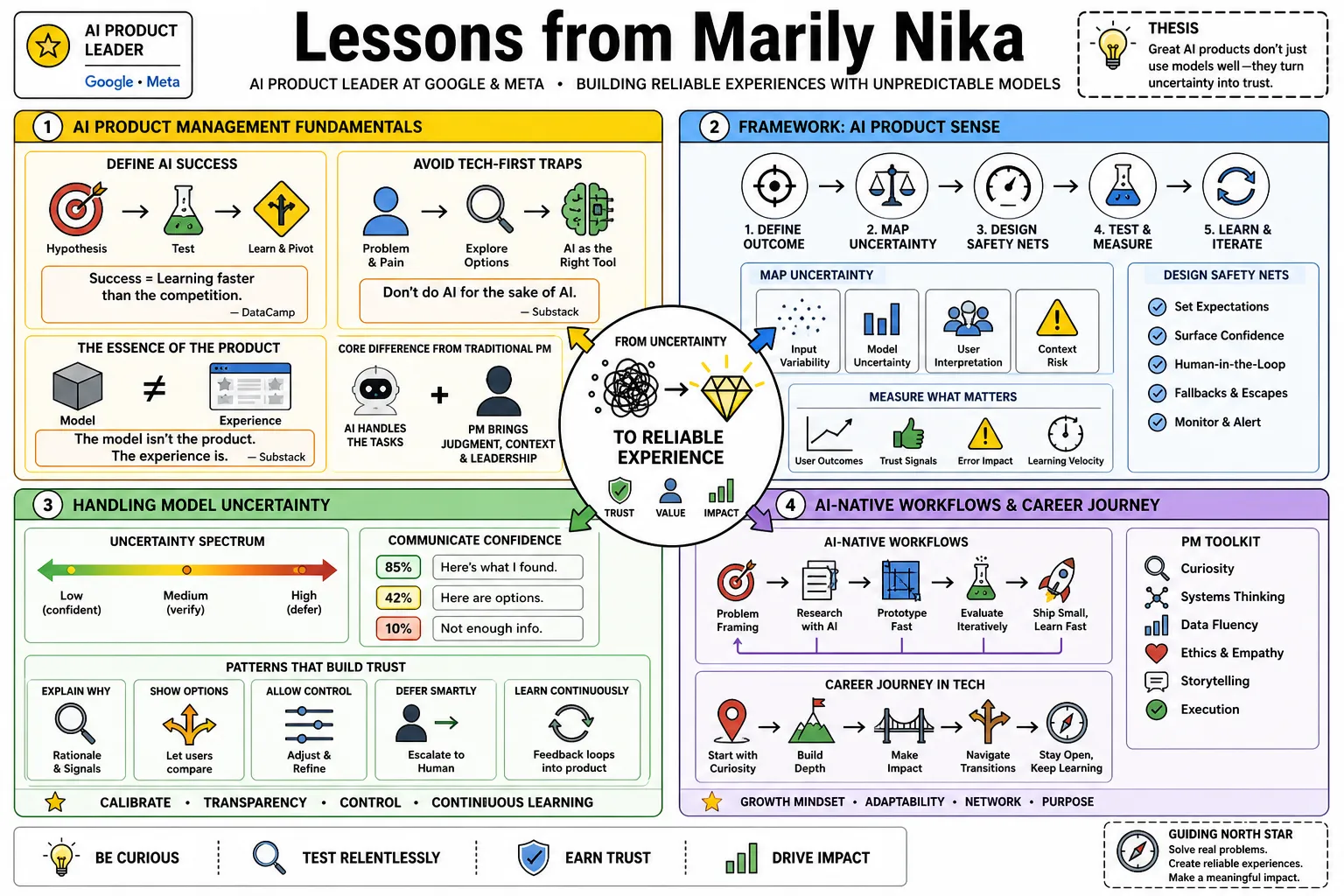
Marily Nika is an AI product leader who has built machine learning products at Google and Meta. She is known for her frameworks on "AI Product Sense," teaching product managers how to translate unpredictable, probabilistic models into reliable user experiences. This compilation organizes her specific methods for handling model uncertainty, adopting AI-native workflows, and navigating career transitions in tech.
Part 1: AI Product Management Fundamentals
- On defining AI success: "In traditional product management, we think, 'ok we're launching, we're getting hundreds or millions of users. Awesome.' Whereas in AI product management, success may be, 'we made a hypothesis, we tested it out, we figured out that it's not gonna work, and we pivoted.'" — Source: DataCamp
- On avoiding tech-first traps: "Don't do AI for the sake of AI. Start with the problem and pain point first, then determine if a smart solution is the right approach." — Source: Substack
- On the essence of the product: "The model isn't the product. The experience is." — Source: Substack
- On the core difference from traditional PM: AI handles the tasks, but product managers provide the necessary judgment, context, and leadership. — Source: Maven
- On the reality of AI outputs: It is essential to teach leadership and stakeholders that AI is inherently probabilistic rather than deterministic. — Source: Creator Economy
- On early validation: "Never build AI into your MVP. Fake the AI with a Figma prototype to validate the idea first." — Source: Product Builder
- On utilizing AI in daily work: "Good product managers do not let technology do their jobs for them. They use it to clear the clutter so they can spend more time on what matters most." — Source: Substack
- On the evolution of the field: Nika argues that AI product management is becoming core product management work: all PMs will need to understand when AI is the right solution and when hype distracts from user pain. — Reference: O'Reilly Radar interview with Marily Nika
- On avoiding distractions: "Don't get distracted by the noise. Get curious." — Source: Substack
- On AI as a collaborator: AI enhances human capabilities in product development rather than serving as a direct replacement for intuition and decision making. — Source: Lenny's Newsletter
Part 2: Navigating AI Uncertainty and Probabilities
- On modern PM interviews: Candidates at top tech companies are evaluated on how they work with uncertainty rather than on clever prompts or model trivia. — Source: Lenny's Newsletter
- On handling imperfect information: Effective AI product managers make clear product choices even when the underlying models are guessing. — Source: Lenny's Newsletter
- On translating models to UX: Nika defines AI product sense as understanding what a model can do, where it fails, and how to turn that uncertainty into product behavior users can trust. — Reference: Lenny's Newsletter guide by Marily Nika
- On uncovering failure modes: Product teams must implement proactive routines to discover how a model fails before users encounter those errors in production. — Source: Lenny's Newsletter
- On generative hallucinations: Nika shows that generative models often force structure onto messy inputs, so AI PMs have to test for confident invention before users encounter it in production. — Reference: Lenny's Newsletter guide on AI failure modes
- On managing the cost envelope: Nika's AI PM curriculum explicitly treats cost, quality, guardrails, and evals as product decisions, not only engineering implementation details. — Reference: Maven AI PM bootcamp syllabus
- On designing for limitations: Nika recommends designing guardrails where model behavior breaks, including constraints, retrieval, clarifying questions, and explicit fallback behavior. — Reference: Lenny's Newsletter guide on design guardrails
- On setting the quality bar: Assessing specific strategic context factors dictates whether the minimum quality threshold for an AI feature should be raised or lowered. — Source: Lenny's Newsletter
- On the value of hypothesis testing: Getting a definitive answer to an AI hypothesis is a successful outcome even if the answer means abandoning the initial idea. — Source: DataCamp
Part 3: The Problem First Approach
- On prioritizing users over hype: The excitement of new AI technology must never distract product teams from solving validated user needs. — Source: Product Builder
- On identifying the right solution: Only after thoroughly understanding a user pain point should a product manager evaluate if an AI-driven solution makes sense. — Source: Substack
- On MVP design: Prototyping an AI experience without writing code allows teams to gauge user reactions before committing expensive engineering resources. — Source: Product Builder
- On staying grounded: Empathizing with the users is the primary job regardless of how advanced the underlying machine learning becomes. — Source: Medium
- On avoiding shiny object syndrome: Teams must resist the urge to integrate a large language model strictly because competitors are doing it. — Source: Medium
- On the danger of tech-centric thinking: Building a feature solely to showcase a new model capability usually leads to products that fail to find market fit. — Source: Substack
- On the role of human empathy: Technology generates options, but human empathy determines which option actually solves the user's practical problem. — Source: Maven
- On rigorous validation: User testing is highly critical in AI development because the system's responses are dynamic and impossible to fully map out in advance. — Source: Lenny's Newsletter
- On keeping features focused: A successful AI feature does one thing exceptionally well rather than attempting to solve multiple unrelated problems with a generic model. — Source: Substack
- On defining the core value: If the AI elements were removed from the product entirely, the core value proposition should still be clearly identifiable. — Source: Product Builder
Part 4: AI Product Sense and Minimum Viable Quality
- On establishing Minimum Viable Quality: Product managers must define clear, measurable performance thresholds that an AI feature must meet before it reaches users. — Source: Lenny's Newsletter
- On treating AI as an investment: AI implementations require strict measurement, observability, and continuous evaluation to justify the business cost. — Source: Product Builder
- On building user trust: Nika warns that user trust cracks when a model guesses under ambiguity, so trustworthy AI products should surface uncertainty instead of hiding it behind confident output. — Reference: Lenny's Newsletter guide on ambiguity and trust
- On recognizing model limits: Strong AI product sense includes knowing exactly when a model is guessing and designing the UX to handle that uncertainty gracefully. — Source: Lenny's Newsletter
- On proactive evaluation: Nika's course centers eval plans, failure-mode spotting, guardrails, cost, and quality, making evaluation part of the product-development loop from the beginning. — Reference: Maven AI PM bootcamp on evals and product sense
- On continuous learning: The product's architecture should allow the team to learn from user interactions to iteratively improve the model's accuracy over time. — Source: Maven
- On balancing speed and safety: Setting the right quality bar requires balancing the need to move fast with the obligation to provide a reliable user experience. — Source: Lenny's Newsletter
- On metric selection: Traditional engagement metrics often fail to capture the true value of an AI interaction, requiring teams to define entirely new success criteria. — Source: DataCamp
- On graceful degradation: Nika's preferred behavior for ambiguous inputs is humble clarity: ask for missing information, state uncertainty, and avoid inventing facts, owners, or commitments. — Reference: Lenny's Newsletter example of trustworthy AI behavior
Part 5: The Evolving Role of the Product Manager
- On maintaining your edge: AI changes a product manager's value by shifting their daily focus from execution tasks to strategic judgment. — Source: Maven
- On upskilling: Nika teaches PMs to build technical intuition without becoming engineers, covering how LLMs behave, how AI systems differ from traditional software, and where failure modes appear. — Reference: Maven AI PM bootcamp on AI literacy for PMs
- On shifting mindsets: Managing a product requires a transition from deterministic software roadmaps to probabilistic, experimental lifecycles. — Source: Creator Economy
- On challenging the status quo: A core requirement of the role is the willingness to challenge existing paradigms and advocate for novel solutions. — Source: Medium
- On the importance of creativity: Product managers must conceptualize solutions that have never been done before by leveraging new technical capabilities. — Source: Medium
- On cross-functional leadership: Inspiring engineering and data science teams is increasingly crucial when navigating complex AI implementations. — Source: Medium
- On analytical rigor: Maintaining an analytical mindset is essential for measuring the nuanced impacts of machine learning models on user behavior. — Source: Medium
- On embracing the unknown: Effective builders lean into the uncertainty of AI and use it as an opportunity for rapid discovery and learning. — Source: Substack
- On the future of writing: The product manager's role is shifting from drafting documents from scratch to editing and curating AI-generated drafts. — Source: Lenny's Newsletter
Part 6: Tooling and the AI-Native Workflow
- On tool-hopping: Leveraging a compounding workflow of different AI applications significantly accelerates product development cycles. — Source: Lenny's Newsletter
- On accelerating discovery: Nika describes using AI tools for user research, spec generation, and UI mockups to move from idea to prototype in hours while still grounding the work in product judgment. — Reference: O'Reilly Radar on Nika's rapid prototyping workflow
- On using custom assistants: Creating tailored models for writing requirements or analyzing feedback helps maintain consistency and saves hours of manual work. — Source: Lenny's Newsletter
- On reducing clutter: Technology's highest purpose in the workplace is clearing away administrative tasks to carve out space for deep strategic thinking. — Source: Substack
- On rapid prototyping: Tools that generate interfaces from text prompts enable teams to visualize concepts and test hypotheses without waiting on design resources. — Source: Lenny's Newsletter
- On research efficiency: Nika's rapid prototyping workflow includes using tools like Perplexity to mine user pain points and turn research signals into faster product exploration. — Reference: O'Reilly Radar on AI-assisted user research
- On workflow integration: Nika treats AI as a slider rather than a switch: teams decide how much assistance belongs in research, prototyping, polish, and implementation instead of applying it blindly everywhere. — Reference: O'Reilly Radar on AI as a product workflow slider
- On leveraging AI for analytics: Data tools powered by natural language processing democratize access to complex product insights across the entire team. — Source: Creator Economy
- On the limits of automation: While software can draft documents and analyze data, the final strategic decisions must always remain in human hands. — Source: Maven
- On continuous experimentation: Builders should constantly test new AI tools in their personal workflows to build intuition for how these technologies might serve users. — Source: Substack
Part 7: Career Transitions and Skill Building
- On switching careers: "Not only is it not 'bad' to switch fields, but it's very common and also celebrated in tech." — Source: Medium
- On lateral movement: Professionals should move laterally into adjacent roles, using their past experiences as a competitive advantage rather than starting entirely from scratch. — Source: Business Insider
- On learning by doing: A necessary shift for career growth is moving from feeling unready to deciding to jump in and learn the necessary skills on the job. — Source: Medium
- On technical literacy: Nika's teaching emphasizes PM-relevant technical intuition: understand LLM behavior, hallucinations, brittleness, cost blowups, and evals well enough to lead credible product conversations. — Reference: Maven AI PM bootcamp on technical intuition
- On the value of diverse backgrounds: Non-traditional backgrounds bring unique perspectives that are highly effective for solving complex, multidisciplinary technical problems. — Source: Medium
- On finding mentors: Actively seeking out mentors and professional communities is critical for navigating the unwritten rules of the technology industry. — Source: Womanthology
- On holding onto aspirations: "You really can’t (and shouldn’t!) let go of dreams!" — Source: Medium
- On building influence: Establishing technical influence without formal authority requires deep empathy for the engineering process and clear communication of the vision. — Source: Reddit
- On the continuous learning curve: The rapid pace of technological advancement means that successful builders must commit to being lifelong students. — Source: Maven
Part 8: Empowerment and Leadership
- On taking initiative: "Women need to shift from thinking 'I'm not ready to do that' to thinking 'I want to do that — and I'll learn by doing it.'" — Source: Medium
- On the impact of socialization: Nika's Womanthology interview discusses family, peers, education, and mass media as socialization forces that shape whether young women see technical careers as normal and available. — Reference: Womanthology interview with Marily Nika
- On community building: Empowering others through dedicated communities creates a support system that helps participants navigate industry barriers. — Source: Medium
- On leading through uncertainty: True leadership means projecting confidence in the process of discovery even when the technological outcomes remain unknown. — Source: Maven
- On advocating for users: A leader's most important function is relentlessly advocating for the user's needs in the face of purely technical pressures. — Source: Medium
- On democratizing AI: Nika describes her mission as democratizing AI education for PMs and teams, pairing her Google and Meta AI experience with courses, workshops, and public resources. — Reference: Maven profile for Dr. Marily Nika
- On resilience: The path to shipping successful products is paved with failed experiments, making resilience a highly valuable leadership trait. — Source: DataCamp
- On ethical responsibility: Leaders have a strict responsibility to ensure their tools do not amplify biases or cause unintended harm to vulnerable populations. — Source: DataCamp
- On the future of women in tech: Creating pathways for more women to enter technical leadership is necessary to ensure products are built by teams reflecting the real world. — Source: Women PM