Lessons from Mark Blyth
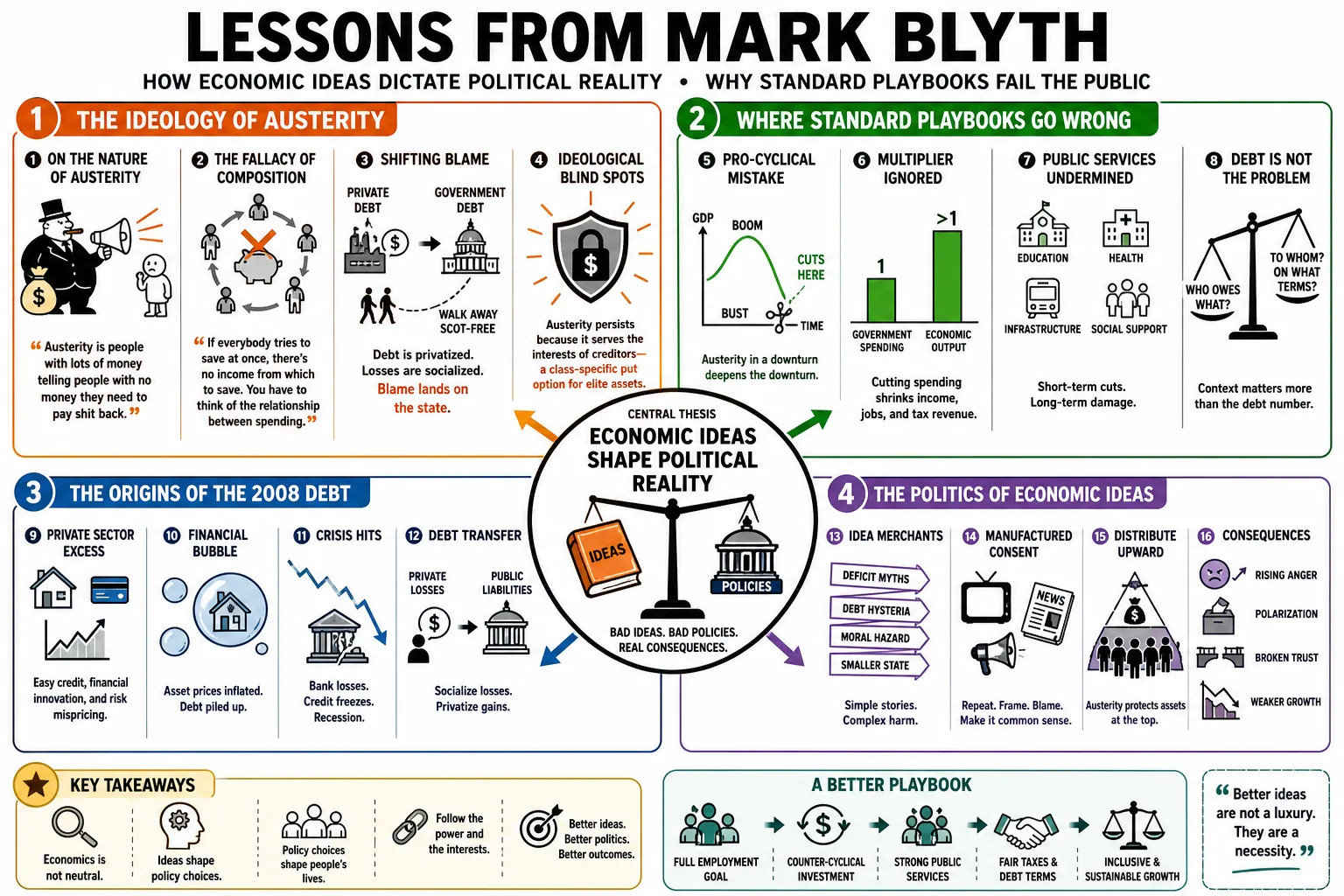
Brown University political economist Mark Blyth studies how economic ideas dictate political reality. He is known for dissecting the failures of austerity and tracing how shifting global markets drive political anger. This collection breaks down his case for why standard economic playbooks consistently fail the public.
Part 1: The Ideology of Austerity
- On the nature of austerity: "Austerity is people with lots of money telling people with no money they need to pay shit back." — Source: [Reddit AMA]
- On the fallacy of composition: "If everybody tries to save at once, there’s no income from which to save. You have to think of the relationship between spending." — Source: [TVO The Agenda]
- On shifting blame: "Through these actions, private debt was rechristened as government debt while those responsible for generating it walked away scot-free, placing the blame on the state, and the burden on the taxpayer." — Source: [Talks at Google]
- On ideological blind spots: "Austerity persists as a policy choice because it aligns with the interests of creditors, effectively serving as a class-specific put option to protect elite assets." — Source: [Truthout Interview]
- On the origins of the 2008 debt: "The sovereign debt crisis was not caused by an orgy of government spending, but was the direct result of bailing out, recapitalizing, and adding liquidity to a broken banking system." — Source: [Progressive Geographies]
- On historical amnesia: "Proponents of austerity continually forget that the welfare state was constructed precisely because the free-market austerity policies of the 1920s and 1930s resulted in widespread collapse and the rise of fascism." — Source: [Dialogos Media Transcript]
- On the gold standard: "You cannot run a gold standard (where the only way to adjust is through internal deflation) in a democracy." — Source: [Goodreads: Austerity]
- On debt as a relationship: "Debt is always a two-way street; for every irresponsible borrower, there is an equally irresponsible lender who should bear part of the risk." — Source: [Truthout Interview]
- On moral framing: "Framing economic recessions as moral failings of profligate states allows creditors to demand repayment at the expense of social stability." — Source: [Dialogos Media Transcript]
- On the persistence of bad ideas: "Austerity survives despite its track record because it is a highly convenient narrative for those who hold the debt, shielding them from the consequences of their own lending practices." — Source: [Talks at Google]
Part 2: The Failures of Austerity in Practice
- On real-world outcomes: "In general, the deployment of austerity as economic policy has been as effective in bringing us peace, prosperity, and crucially, a sustained reduction of debt, as the Mongol Golden Horde was in furthering the development of Olympic dressage." — Source: [Goodreads: Austerity]
- On the dual failure: "The policy of austerity has twin goals… reducing growth in public debt and boosting investor confidence. On both counts, the eurozone's attempts have been an unmitigated failure." — Source: [Equitable Growth]
- On the sniff test: "Austerity as a route to growth and as the correct response to the aftermath of a financial crisis does not pass the sniff test." — Source: [Goodreads: Austerity]
- On internal devaluation: "When countries cannot devalue their currency, they are forced to devalue their society by slashing wages and public services, creating a self-defeating spiral of reduced consumption." — Source: [Exploring Economics]
- On the hemlock diet: "Implementing austerity to heal a broken economy is akin to prescribing a diet of hemlock to cure a sick patient; the treatment accelerates the decline." — Source: [The Guardian]
- On social costs: "Cutting public services to pay off bank debts disproportionately harms the lowest earners, stripping away the social safety net precisely when it is needed most." — Source: [Truthout Interview]
- On self-defeating logic: "You cannot cut your way to growth; when the public sector slashes spending during a private sector contraction, the entire economy shrinks, making the debt-to-GDP ratio worse." — Source: [TVO The Agenda]
- On ideological blockades: "The insistence on cutting budgets in the face of recession is driven by ideological blockades rather than empirical evidence, leading to persistent stagnation." — Source: [Exploring Economics]
- On the recovery myth: "Economies that eventually recover after austerity do so not because of the cuts, but usually because a central bank intervenes to inject liquidity into the system." — Source: [Talks at Google]
- On lost decades: "Committing to permanent fiscal contraction guarantees lower long-term growth trajectories, effectively choosing stagnation over recovery." — Source: [Equitable Growth]
Part 3: Angrynomics and the Economics of Emotion
- On the roots of public anger: "The effects of recession and a secular trend in inequality provide legitimate economic reasons for anger." — Source: [Blinkist: Angrynomics]
- On permanent uncertainty: "The deregulation of finance and the dominance of technology monopolies have eroded personal stability, placing ordinary citizens in a state of near permanent uncertainty that fuels systemic anger." — Source: [Medium Review]
- On moral versus tribal anger: "It is essential to distinguish between righteous, moral anger at an unjust system and tribal anger that is manipulated for political gain." — Source: [Real Progressives]
- On the macro-micro disconnect: "Economics increasingly fails to explain why the daily pressures of life feel heavier even when official data shows that income per capita is rising." — Source: [Stanford Report]
- On elite narratives: "There is a profound inconsistency between the models elites use to justify the status quo and the lived reality of those facing wage stagnation and precarity." — Source: [APB Speakers]
- On Citizens' Wealth Funds: "Establishing sovereign wealth funds that distribute dividends to citizens is a practical way to directly address economic insecurity and reduce public anger." — Source: [APB Speakers]
- On data dividends: "If digital monopolies profit massively from harvesting personal data, generating a mechanism to return a portion of that value to the public could ease economic stress." — Source: [APB Speakers]
- On bipartisan distress: "The solutions required to address the anger generated by modern capitalism must bypass traditional left-right political divides and focus on material security." — Source: [Stanford Report]
- On ignored grievances: "When mainstream political parties ignore the material decline of the working class, they create a vacuum that is inevitably filled by explosive, anti-establishment frustration." — Source: [Blinkist: Angrynomics]
Part 4: Inflation and Central Bank Mythology
- On the standard playbook: "The conventional response of central banks to inflation—raising interest rates to induce unemployment—is a blunt instrument often based on flawed, outdated models." — Source: [Brown University News]
- On the deflationary coalition: "Central bank policies frequently align with the interests of a deflationary coalition of asset holders who prioritize price stability and austerity over wage growth and full employment." — Source: [Substack: Mark Blyth]
- On inflation narratives: "Central banks construct deliberate narratives about the causes of price increases—often blaming public spending or wages—to justify their specific policy interventions." — Source: [Taylor & Francis Online]
- On shifting paradigms: "The fantasy of the pre-2008 era, where central banks believed they could perfectly tune the economy with small interest rate adjustments, is definitively over." — Source: [New Books Network]
- On supply-side drivers: "Modern inflation is frequently driven by tangible supply-side shocks, geopolitical conflicts, and climate disruptions, which cannot be fixed simply by making borrowing more expensive." — Source: [Independent Institute]
- On the politics of price indices: "How inflation is measured is inherently political, and the specific metrics chosen by policymakers dictate who bears the costs of economic adjustments." — Source: [Substack: Mark Blyth]
- On corporate pricing power: "Discussions of inflation that ignore greedflation or the ability of concentrated corporations to pass costs onto consumers miss a central driver of the modern economy." — Source: [Carbon Brief]
- On the illusion of control: "Central bankers act as if they have a simple knob to turn inflation up or down, masking the reality that their primary mechanism operates by hurting the labor market." — Source: [The Nation]
- On demographic shifts: "The changing global labor supply, driven by aging populations, means the deflationary pressures of the past few decades are reversing, rendering old monetary strategies obsolete." — Source: [Brown University News]
Part 5: Capitalism's Hardware and Software
- On economic regimes: "The world economy is like a supercomputer that churns through trillions of calculations... The hardware is the markets, institutions, and regulatory regimes that make up the economy. The software is the governing economic ideas of the day." — Source: [Reddit AMA]
- On systemic resets: "When the operating software of the economy develops too many bugs—such as extreme inequality or stagnant wages—we reach a Control-Alt-Delete moment that forces a system reboot." — Source: [Reddit AMA]
- On shifting models: "It’s capitalism, Jim, just not as we know it." — Source: [Age of Economics]
- On textbook economics: "Teaching students that the dominant strategy in economic models is to defect simply trains them to replicate selfish behavior, effectively altering reality to affirm the model." — Source: [Substack: Mark Blyth]
- On ideas as institutions: "Institutions are not self-evident structures; they are crystallized ideas regarding how society and markets ought to be organized." — Source: [Economic Sociology]
- On times of uncertainty: "During profound crises, actors cannot rely on past data to determine their interests; instead, they rely on new economic ideas to make sense of the chaos and rebuild institutions." — Source: [Crooked Timber]
- On the power of ideas: "Leaving ideas out of your explanation of structural economic change means you will fail to understand the true drivers of political transformation." — Source: [Goodreads: Great Transformations]
- On German exports: "The problem with keeping up with the Germans is that German industrial exports have the lowest price elasticities in the world. In plain English, Germany makes really great stuff that everyone wants and will pay more for in comparison to all the alternatives." — Source: [Goodreads: Austerity]
- On the 1970s transition: "The shift away from the post-war welfare state was not inevitable; it was an active project by business interests using neoliberal ideas to dismantle constraints on capital." — Source: [Johns Hopkins University Press]
- On defining the crisis: "The group that successfully defines the nature of an economic crisis gains the political authority to dictate the structural reforms that follow." — Source: [Economic Sociology]
Part 6: Populism and the End of Neoliberalism
- On the logic of populism: "Populism is not a sudden fluke or irrational spasm, but a highly predictable consequence of a neoliberal growth regime that systematically failed to deliver broad-based prosperity." — Source: [Social Europe]
- On capitalist legitimation: "Growth is the primary mechanism of capitalist legitimation; when that growth slows and its benefits concentrate at the top, the political center cannot hold." — Source: [CBC News]
- On the new normal: "Treating populist electoral victories as temporary aberrations is a fundamental error; they represent the breakdown of the prevailing political-economic order." — Source: [Social Europe]
- On capitalist democracy: "There is an inherent tension between the structural power of capital and the democratic agency of citizens, leading to outcomes where policy serves firms rather than voters." — Source: [Cambridge University Press]
- On structural privilege: "The modern economic architecture often resembles a system of capitalism for the poor and socialism for the rich, where losses are socialized and profits are privatized." — Source: [YouTube Lecture]
- On rejecting the status quo: "When the establishment continuously tells struggling populations that their declining living standards are necessary for market efficiency, voters will eventually elect anyone promising to break the system." — Source: [ResearchGate]
- On political vacuums: "Mainstream center-left parties abandoned their working-class bases to chase globalization, creating the exact political void that right-wing populism stepped into." — Source: [Social Europe]
- On macro versus micro: "The disconnect between aggregate macroeconomic indicators looking healthy and the microeconomic reality of household debt is the primary engine of modern political revolt." — Source: [Captivate.fm Interviews]
- On the failure of technocracy: "Believing that deeply political distributional problems can be solved by technocratic management ignores the reality that people will eventually vote against their managers." — Source: [CBC News]
Part 7: The Eurozone and Structural Flaws
- On the Eternal Recession Mechanism: "Indeed, the European Exchange Rate Mechanism was sometimes referred to as the European 'Eternal Recession Mechanism,' such was its deflationary impact." — Source: [Goodreads: Austerity]
- On the Goldilocks dilemma: "Europe is trapped in a dilemma where the rules are too tight to permit debt resolution and growth in the periphery, but too loose to satisfy the rigid fiscal demands of the core." — Source: [Equitable Growth]
- On the impossibility of the Euro: "Designing a monetary union without a fiscal union forces all economic adjustments onto the labor market, making it structurally hostile to the welfare state." — Source: [Exploring Economics]
- On shifting debt: "The Eurozone crisis was fundamentally a banking crisis masked as a sovereign debt crisis, allowing Northern European banks to be bailed out via loans ostensibly given to Southern European states." — Source: [Harvard University Press]
- On nationalist resentments: "By removing economic policy from democratic control and installing rigid fiscal rules, the EU architecture actively breeds nationalist and anti-system resentments." — Source: [Exploring Economics]
- On internal deflation: "Without control over a currency to absorb shocks, countries like Greece and Spain were forced to brutally deflate their own economies to satisfy external creditors." — Source: [Goodreads: Austerity]
- On moral hazard: "The architects of the Eurozone fixated on the moral hazard of governments overspending, completely ignoring the greater moral hazard of under-regulated banks taking catastrophic risks." — Source: [Harvard University Press]
- On institutional rigidity: "The Eurozone’s reliance on rigid, pro-cyclical rules prevents it from deploying the massive, coordinated fiscal stimulus necessary to escape deep recessions." — Source: [Equitable Growth]
- On democratic deficits: "When unelected institutions like the Troika have the power to override domestic parliaments regarding budget cuts, the concept of European democracy is severely compromised." — Source: [Brown University News]
Part 8: Climate Transition and the Carbon Coalition
- On the carbon coalition: "I wonder the extent to which [this] serves as a good sort of lens for thinking about the United States, in the sense that you have a huge number of states who all happen to be red, who happen to be the ones that are part of what you could call the Carbon Coalition." — Source: [Rhodes Center Podcast]
- On business models in politics: "Modern American politics is best understood not merely as an ideological clash, but as a battle between the entrenched business models of the extraction economy and the emerging green economy." — Source: [Marketplace]
- On the illusion of normalcy: "There is no 'getting back to normal' with climate breakdown. The expectation that we can maintain our current lifestyle by simply switching energy sources is a dangerous fantasy." — Source: [The Guardian]
- On carbon taxation: "The underlying economics dominating climate policy – carbon taxation – is bad economics, even worse politics, and flies in the face of the evidence of almost every policy that has actually worked." — Source: [Philosophy of Money]
- On green edges: "Merely adding green edges to the existing economic model, like recycling and modest efficiency gains, is entirely insufficient to handle the structural threat of global warming." — Source: [APB Speakers]
- On the political economy of denial: "Climate opposition is rarely just about scientific skepticism; it is a coherent, highly profitable defense strategy by industries and regions that face extinction in a post-carbon world." — Source: [UCLA Center for Social Theory]
- On fiscal straitjackets: "Adhering to balanced budget rules and debt brakes prevents governments from making the massive, immediate public investments required to transition away from fossil fuels." — Source: [Programmable Mutter]
- On global isolation: "By catering to the domestic carbon coalition and resisting decarbonization, the United States risks isolating itself economically as Asia and Europe aggressively develop the green technologies of the future." — Source: [Foreign Policy Analysis]
- On technocratic limits: "Treating the climate transition as a purely technical problem solvable by market nudges ignores the brutal political warfare required to dislodge trillion-dollar fossil fuel interests." — Source: [Age of Economics]