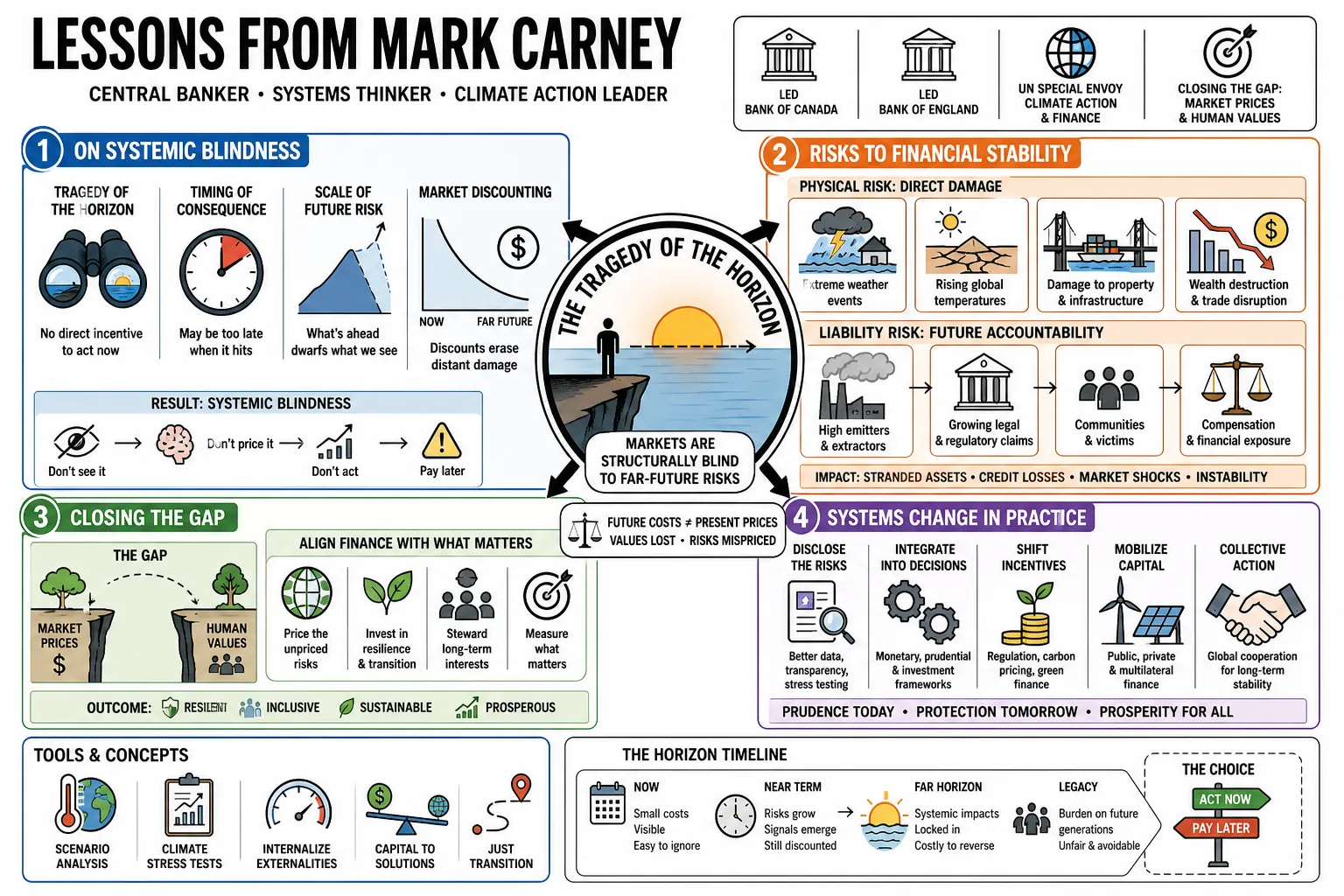
Lessons from Mark Carney
Mark Carney led the central banks of Canada and England before becoming the UN Special Envoy on Climate Action and Finance. He coined the "Tragedy of the Horizon" to explain why markets are structurally unequipped to handle the systemic financial risks of climate change. This profile examines his practical attempts to close the gap between market prices and human values.
Part 1: The Tragedy of the Horizon
- On systemic blindness: "Climate change is the tragedy of the horizon… imposing a cost on future generations that the current generation has no direct incentive to fix." — Source: [Lloyd's of London Speech]
- On the timing of consequence: "Once climate change becomes a defining issue for financial stability, it may already be too late." — Source: [Extinction Rebellion UK]
- On the scale of future risk: "The challenges currently posed by climate change pale in significance compared with what might come." — Source: [The Guardian]
- On physical risk: Extreme weather events and rising global temperatures inflict direct damage on property and trade infrastructure to destroy wealth. — Source: [Mainstreaming Climate]
- On liability risk: Companies that extract or emit heavily will increasingly face compensation claims from those who suffer the physical and economic losses of climate change. — Source: [Corporate Knights]
- On transition risk: Abrupt policy shifts to a lower carbon economy will strand assets and reprice carbon heavy business models. — Source: [Financial Stability Board]
- On measurement and management: "By managing what gets measured, we can break the Tragedy of the Horizon." — Source: [Bank of England]
- On market information: Better reporting builds a virtuous circle of understanding tomorrow's risks and correctly pricing today's. — Source: [KPA Advisory]
- On short termism: Financial systems are naturally biased toward business cycles of a few years and are misaligned with the decades long physics of climate change. — Source: [The Shift Project]
- On stranded assets: Markets must account for fossil fuels that cannot be burned if we are to meet climate targets to avoid a sudden collapse in asset prices. — Source: [BBC News]
Part 2: Value and Values
- On the price and value disconnect: "We are living Oscar Wilde's aphorism, knowing the price of everything but the value of nothing, at incalculable costs to our society." — Source: [The Guardian]
- On market faith: "Capitalism loses its sense of moderation when the belief in the power of the market enters the realm of faith." — Source: [Jubilee Fund]
- On societal influence: "The values of the market have become the values of society, often to our detriment." — Source: [Goodreads]
- On moral sentiments: Economic value has become separated from moral value and corroded the social fabric by turning citizens into mere consumers. — Source: [BBC Reith Lectures]
- On the pandemic: The pandemic demonstrated that when forced society will prioritize human life over economic output to reveal our true underlying values. — Source: [Christian Thinking Space]
- On human capital: A resilient society measures success by the health and education of its people rather than just aggregate gross domestic product. — Source: [Policy Alternatives]
- On purposeful business: Companies driven by a clear social purpose ultimately generate more durable financial returns than those focused solely on quarterly profits. — Source: [Melissa Silber CPA]
- On the financialization of everything: When market logic is applied to every human interaction we erode the trust and solidarity that markets themselves require to function. — Source: [Scribd]
- On systemic resilience: True value creation builds buffers against shocks rather than optimizing for maximum efficiency at the edge of failure. — Source: [Bank of Canada]
Part 3: Sustainable and Green Finance
- On net zero as an opportunity: "If you are making investments, coming up with new technologies, changing the way you do business, all in service of reducing and eliminating that threat, you are creating value." — Source: [United Nations]
- On the urgency of action: "While there is still time to act, the window of opportunity is finite and shrinking." — Source: [CBC News]
- On mainstreaming green finance: "'Green' finance cannot conceivably remain a niche interest over the medium term." — Source: [Bank for International Settlements]
- On the goal of sustainable finance: Success will be achieved when sustainable finance is simply finance and is fully integrated into everyday capital allocation. — Source: [Uncommons Podcast]
- On asset valuation: A modern financial system must use environmental risk as a core variable to accurately value assets. — Source: [IMF]
- On the role of disclosure: Standardized reporting like the TCFD is the plumbing required to let capital flow toward climate solutions. — Source: [University of Toronto]
- On market transitions: The financial sector must proactively turn the tap on for green finance while carefully managing the phase out of high carbon assets. — Source: [House of Commons Canada]
- On rewarding leaders: Markets will disproportionately reward companies that lead the net zero transition and punish those that lag behind. — Source: [Green Central Banking]
- On intergenerational thinking: Investment decisions must be evaluated based on the welfare of future generations and the preservation of a livable planet. — Source: [CSE Net]
Part 4: Central Banking and Monetary Policy
- On the limits of central banking: "Long-run prosperity is not in the gift of central bankers. It depends on a much wider set of initiatives of our elected representatives, and ultimately, on the actions of the private sector." — Source: [Bank of England]
- On monetary policy burden: For years following the financial crisis monetary policy was forced to be the only game in town and masked structural economic issues. — Source: [The Guardian]
- On price versus financial stability: "Price stability does not guarantee financial stability. Price stability can be associated with excessive credit growth and emerging asset bubbles." — Source: [Bank of Canada]
- On intertwined goals: Economic stability and financial stability are inextricably linked and pursuing one without the other risks achieving neither. — Source: [Macleans]
- On forward guidance: "While transparency is critical... forward policy guidance is best used sparingly by central banks in normal times." — Source: [Bank of Canada]
- On the art of central banking: "Central banking is an art as well as a science... money is more of an art grounded in values of trust, resilience, dynamism, solidarity and sustainability." — Source: [Bank for International Settlements]
- On political pressure: Central banks are often simultaneously accused of being ineffective and too powerful placing their mandates under intense public scrutiny. — Source: [Conversations with Tyler]
- On banking as a vocation: The financial sector must return to viewing banking as a vocation with strong ethical controls rather than a mere mechanism for extracting profit. — Source: [Bill Britten Reviews]
- On fiscal responsibility: Politicians cannot rely solely on low interest rates to boost growth and must use government policy and fiscal stimulus as essential tools. — Source: [The Guardian]
- On money as a social convention: The value of money relies on a social contract of trust making the central bank a curator of that trust. — Source: [BIS]
Part 5: Cryptocurrencies and the Future of Money
- On the failure of cryptocurrencies: "The short answer is they are failing... cryptocurrencies act as money, at best, only for some people and to a limited extent." — Source: [The Block]
- On bitcoin as a store of value: The volatility of bitcoin puts it all over the map and renders it entirely ineffective as a reliable store of value or medium of exchange. — Source: [TradingView]
- On private money in democracies: "It is simply untenable in democracies that the core of the monetary system could be based on forms of electronic private money." — Source: [Juno News]
- On speculative mania: The surge in crypto assets represents a global speculative mania that requires strict regulatory scrutiny. — Source: [CBC News]
- On regulatory parity: Cryptocurrencies must be held to the exact same standards of consumer protection and anti money laundering as the rest of the financial system. — Source: [CTV News]
- On central bank digital currencies: "The most likely future of money is a central bank stablecoin, known as a central bank digital currency." — Source: [Forbes]
- On financial inclusion: A well designed state backed digital currency can increase financial inclusion and combat economic crime better than decentralized private networks. — Source: [Digital Watch]
- On stablecoin regulation: Private stablecoins must guarantee equivalent protections to commercial bank money including strict liquidity requirements. — Source: [The Block]
- On sovereign control: The issuance of money is a fundamental sovereign right that cannot be outsourced to algorithms controlled by anonymous private actors. — Source: [Goodreads]
- On technological distraction: The fascination with blockchain often distracts from the fundamental economic realities that dictate whether a currency functions effectively. — Source: [Goodreads]
Part 6: Inequality and the Social Contract
- On the social contract: Inclusive capitalism is "fundamentally about delivering a basic social contract comprised of relative equality of outcomes; equality of opportunity; and fairness across generations." — Source: [Bank for International Settlements]
- On broken promises: The basic social contract is breaking down because economic growth has consistently failed to translate into rising living standards for the majority. — Source: [Bank for International Settlements]
- On the economics of equality: "Relative equality is good for growth." — Source: [Policy Alternatives]
- On institutional trust: Growing domestic inequality is the primary driver behind the erosion of public trust in democratic and financial institutions. — Source: [Jubilee Fund]
- On domestic divides: While global inequality between developed and developing nations has narrowed the widening wealth gap within individual societies threatens political stability. — Source: [Bank for International Settlements]
- On investing for the many: Societies with a fairer distribution of wealth are more likely to direct capital toward public goods rather than protecting elite interests. — Source: [Policy Alternatives]
- On generational fairness: True inclusive capitalism demands that we do not borrow living standards from our children to finance consumption today. — Source: [Goodreads]
- On human distillation: Market forces alone treat individuals merely as units of labor and consumption and fail to recognize human dignity. — Source: [The Guardian]
- On shared prosperity: Economic policies must be explicitly designed to ensure that the dividends of technological progress are shared across the income spectrum. — Source: [Goodreads]
Part 7: Leadership and Crisis Management
- On the definition of leadership: "Leadership is the acceptance of responsibility rather than the assumption of power." — Source: [Goodreads]
- On ideological pragmatism: "Just as there are no atheists in foxholes, there are no libertarians in financial crises." — Source: [Goodreads]
- On navigating crises: Effective crisis management requires governments to rapidly abandon rigid ideologies in favor of aggressive and practical interventions. — Source: [CBC News]
- On systemic buffers: The time to build resilience and capital buffers is during economic expansion rather than when the crisis has already arrived. — Source: [Bank of England]
- On clear communication: In periods of panic transparent and decisive communication from central authorities is the only way to halt contagion. — Source: [Bank of Canada]
- On institutional credibility: Trust in institutions is hard to gain and easy to lose because it relies on a track record of competence rather than just rhetoric. — Source: [Goodreads]
- On global coordination: Financial and climate crises do not respect borders and make coordinated international leadership a mathematical necessity for survival. — Source: [IMF]
- On facing reality: A leaders first job is to acknowledge structural failures like the tragedy of the horizon rather than relying on temporary fixes. — Source: [Bank of England]
- On public service: Technocratic leadership must ultimately serve the public interest and translate complex financial stability into everyday security for citizens. — Source: [Macleans]
Part 8: Market Fundamentalism and Reimagining Capitalism
- On market limits: "Unchecked market fundamentalism devours the social capital essential for the long-term dynamism of capitalism itself." — Source: [Policy Alternatives]
- On the nature of markets: Markets are highly effective mechanisms for coordination but they are terrible masters when treated as an end goal. — Source: [Coverfire]
- On moral capitalism: We must reimagine capitalism by placing morality and ethics at the core of finance rather than treating them as external considerations. — Source: [Jubilee Fund]
- On systemic redesign: Tweaking the edges of the current system is insufficient because we need fundamental changes to how we calculate and reward economic success. — Source: [Scribd]
- On community value: The relentless pursuit of individual profit has eroded the communal structures and shared environments that sustain humanity. — Source: [BBC Reith Lectures]
- On externalized costs: Capitalism must be forced to internalize the costs it currently dumps on society and particularly carbon emissions and environmental degradation. — Source: [Mainstreaming Climate]
- On financial humility: The financial sector must recognize that it is a derivative of the real economy and not the ultimate driver of human progress. — Source: [Goodreads]
- On aligning incentives: If we want to solve global challenges we have to align the massive power of private capital with clear and long term societal goals. — Source: [United Nations]
- On a sustainable future: Reclaiming our values means consciously choosing to design a market society that serves people and the planet rather than extracting from them. — Source: [Goodreads]