Lessons from Mark Pincus
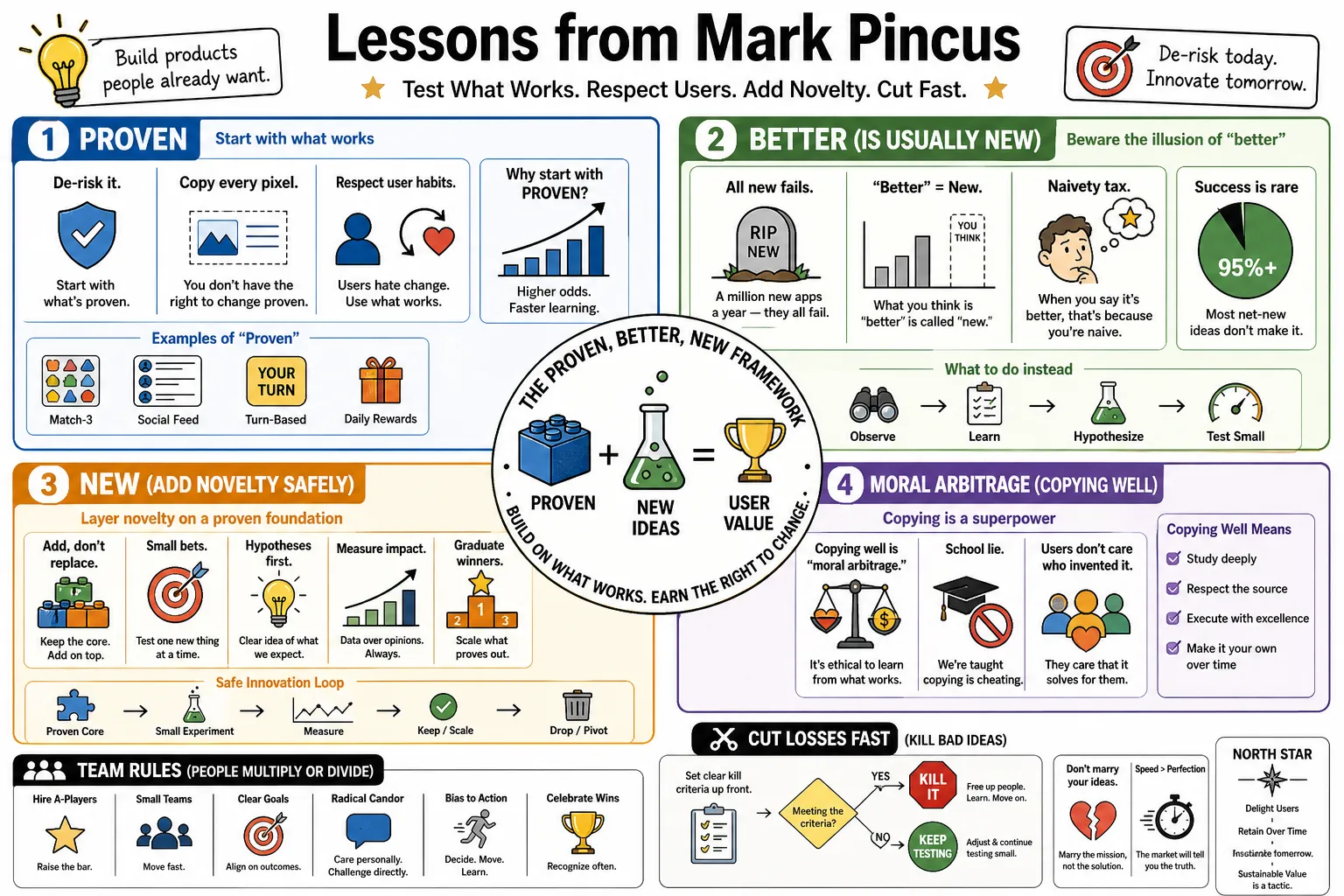
Mark Pincus founded Zynga and built massive social games like FarmVille and Words with Friends. This collection outlines his strict "Proven, Better, New" framework for testing consumer products, alongside his specific rules for managing teams and cutting losses on failing ideas.
Part 1: The Proven, Better, New Framework
- On the futility of pure invention: "All new fails. If all new worked, we'd be using new stuff all the time... A million new apps a year — they all fail." — Source: [StartupArchive]
- On starting with what works: "De-risk it. Start with what's proven. You don't have the right to change proven. You should copy every pixel of an experience that already works." — Source: [StartupArchive]
- On the arrogance of better: "What you think is 'better' is called 'new.' When you say it's better, that's because you're naive." — Source: [StartupArchive]
- On moral arbitrage: "Copying well is 'moral arbitrage.' Most product builders resist copying because we're taught in school that copying is cheating." — Source: [Lenny's Podcast]
- On respecting user habits: The best product makers understand that users hate change, and will use what already works to accelerate testing of their net-new ideas. — Source: [Lenny's Podcast]
- On adding novelty safely: Once a proven foundation is refined to a level where everyone loves it, then you can introduce the new elements to stand out. — Source: [Sourcery]
- On the sequence of innovation: The proven and better stages must be fully validated before any new features are layered on. — Source: [Lenny's Podcast]
- On testing variants: Instead of betting the entire company on a massive unproven concept, break ideas into atomic units and test multiple variants of the new alongside the proven. — Source: [Podscripts]
- On mitigating startup risk: The core purpose of the "Proven, Better, New" methodology is systematically reducing the existential risk of building consumer products. — Source: [EnterpriseZone]
Part 2: Product Strategy and Building Hits
- On killing mediocre products: You must ruthlessly kill B+ products, even if they have millions of users, because they distract your team from building true A+ hits. — Source: [Masters of Scale]
- On long-term value: "From the beginning... I wanted to build a company that could sustain not for two years or four years or even ten years but be something that really matters over time the way Amazon and Google and others have." — Source: [AZ Quotes]
- On retention over virality: Long-term success in consumer technology is dictated primarily by day 365 retention rather than initial viral explosions. — Source: [Mark Pincus Product Talk]
- On user behavior: Stay obsessed with user needs by watching what people actually do, which often contradicts what they claim to want in surveys. — Source: [Sourcery]
- On pixel-level focus: "Micromanagement is beautiful, and you should do it as long as you can. The best product CEOs are in the minutiae of pixel-level details." — Source: [Lenny's Podcast]
- On achieving enthusiasm: The standard for better is refining a product until 10 out of 10 users say they will absolutely use it. — Source: [Mark Pincus Product Talk]
- On paradoxical ambition: Being less ambitious regarding the initial scope of a product is often the most reliable path to achieving the most ambitious long-term outcomes. — Source: [Mark Pincus Startup Advice]
- On target audiences: "You're trying to win the hearts and minds of nurses in Indiana... you're not trying to win awards and respect from your peers." — Source: [StartupHub.ai]
- On testing speed: The modern product environment requires moving significantly faster to test ideas and utilizing AI to rapidly accelerate the learning cycle. — Source: [GamesBeat]
- On avoiding vanity features: Building for industry awards rather than the practical needs of average users is a fatal mistake for consumer founders. — Source: [StartupHub.ai]
Part 3: Decision Making and Instincts
- On founder intuition: Your underlying instincts about a market are likely right 95% of the time, but the specific ideas you generate from them are wrong 75% of the time. — Source: [Lenny's Podcast]
- On the goal of the entrepreneur: "As entrepreneurs, we are on a journey to try and isolate our winning instincts from our losing ideas." — Source: [PocketGamer]
- On data-driven rigor: Data-driven testing is the necessary antidote to a founder's personal bias and prevents them from falling in love with a bad idea. — Source: [Tim Ferriss Blog]
- On building conviction: Developing true conviction in your instincts requires rigorous testing rather than blind faith. — Source: [Medium]
- On making hard choices: Leaders cannot be stoic and stubborn to the point of going down with a bad idea just to prove their initial courage. — Source: [Substack]
- On separating ego from ideas: A necessary skill is recognizing when an idea fails and separating your personal identity from the product's failure. — Source: [PocketGamer]
- On realism versus optimism: Kill hope before hope kills you, a mindset that requires cutting losses early when the data clearly shows an idea is failing. — Source: [Mark Pincus Founder Interview]
- On democratic dictatorship: Solicit constant feedback from your team, but ultimately maintain the authority to make unpopular final decisions. — Source: [Mark Pincus Founder Interview]
- On avoiding consensus: Needing to be popular or seeking universal agreement on product direction usually leads to watered-down outcomes. — Source: [Mark Pincus Startup Lessons]
- On iterative implementation: Rely on intuition for the broad strokes of your strategy, but remain entirely flexible regarding the specific implementation. — Source: [CryptoBriefing]
Part 4: Founder Strategy and Control
- On clarity of purpose: "Not having a clear goal leads to death by a thousand compromises." — Source: [Quora]
- On maintaining vision: Protecting the initial vision of a product is necessary to prevent the gradual erosion caused by constant concessions. — Source: [Tim Ferriss Blog]
- On board dynamics: Protecting founders from the occasionally short-sighted impulses of their own investors is essential for long-term growth. — Source: [GamesBeat]
- On protecting control: Retaining founder control in deal-making is about securing the necessary power to survive turbulent scaling periods. — Source: [Mark Pincus Founder Control]
- On incumbent weakness: "Big incumbents are forced to chase only billion-dollar ideas, which is precisely why a startup can win." — Source: [Lenny's Podcast]
- On avoiding the death spiral: If you do not know exactly what you are trying to achieve, every small operational compromise will slowly kill the company's distinct value. — Source: [Tim Ferriss Blog]
- On achievable improvements: "The best outcomes rely on bold but achievable product improvements" rather than chasing purely conceptual paradigm shifts. — Source: [Traders Union]
- On early-stage focus: The primary goal in the early days is finding an atomic unit of value that users refuse to give up. — Source: [Podscripts]
- On navigating uncertainty: The modern startup reality requires a founder mode obsession with what users actually engage with. — Source: [Podscripts]
- On ignoring peer pressure: True product execution often looks unglamorous to your peers but feels essential to your target demographic. — Source: [StartupHub.ai]
Part 5: Failure and Evolution
- On the value of failure: "I think failing is the best way to keep you grounded, curious, and humble." — Source: [QuoteFancy]
- On the danger of success: "Success is dangerous because often you don't understand why you succeeded. You almost always know why you've failed." — Source: [QuoteFancy]
- On learning from early networks: Tribe became three different industries, but one failed company, highlighting the danger of lacking a singular focus. — Source: [Sourcery]
- On failing fast: The inability to fail fast early in his career taught him the necessity of building products that can be validated before hiring thirty people. — Source: [Forbes]
- On natural evolution: Moving from social media networks to social gaming was a natural progression to solve the problem of online friction. — Source: [QuoteFancy]
- On the frustration of social platforms: He pivoted to games partly because he believed people would argue less if they were cooperating in a game environment. — Source: [Forbes]
- On building the antithesis: Zynga Poker was designed as the direct antithesis of Tribe, shifting from a broad network to a highly focused user experience. — Source: [PocketGamer]
- On missing massive trends: He recognized in hindsight that his early network had the seeds of multiple distinct industries but failed because it tried to do all of them at once. — Source: [Substack]
- On reflection time: A major benefit of failure is that it provides the necessary time and space to deeply analyze what went wrong and how to improve. — Source: [QuoteFancy]
Part 6: Leadership and Agency
- On CEO aspirations: The transition requires aspiring to become an exceptional CEO rather than relying entirely on engineering skills. — Source: [AZ Quotes]
- On hiring criteria: "I like to bet on people, especially those who have taken risks and failed in some way, because they have more real-world experience. And they're humble." — Source: [AZ Quotes]
- On unconventional talent: Actively seek out and hire individuals with broken resumes who show high potential and a hunger to prove themselves. — Source: [GamesBeat]
- On radical agency: Give employees a level of agency and responsibility that feels slightly uncomfortable to see what they are truly capable of achieving. — Source: [Business Insider]
- On decentralized power: Push decision-making authority down to the individuals who are closest to the actual problems and the user feedback. — Source: [Fast Company]
- On corporate frustration: His leadership philosophy was born out of his own early-career frustrations with the lack of empowerment in traditional hierarchies. — Source: [Fast Company]
- On the failure machine: Leaders must build organizational cultures that act as failure machines, capable of rapidly testing and discarding ideas without stigma. — Source: [GamesBeat]
- On challenging teams: True leadership involves stretching people beyond their perceived limits by trusting them with massive tasks early on. — Source: [Business Insider]
- On parenting and leadership: He applies his concepts of high agency and responsibility to how he raises his children in the modern era. — Source: [Lenny's Podcast]
Part 7: Business Growth and Predictability
- On public company valuation: "Clearly as you move to being a public company, probably even more than growth, there is a huge value based on predictability." — Source: [QuoteFancy]
- On sustainable business: The ultimate objective is building an enduring institution that matters over decades rather than securing a quick exit. — Source: [AZ Quotes]
- On rejecting scale: The mandate to ignore scale is a reminder to prioritize the quality and necessity of the product experience over merely chasing vanity metrics. — Source: [GamesBeat]
- On tactical focus: While the industry glorifies massive innovation, actual business growth relies on specific and actionable improvements. — Source: [Traders Union]
- On the reality of the market: Founders must accept that users are inherently lazy and resistant to change, making frictionless onboarding essential to growth. — Source: [Lenny's Podcast]
- On the timeline of validation: You should not scale the team or the marketing budget until the core loop is completely proven and loved by a small group. — Source: [Forbes]
- On protecting the core: As a company grows, leadership must fiercely protect the original product philosophy from being diluted by new management layers. — Source: [Tim Ferriss Blog]
- On unscalable tactics: Early growth often requires engaging in highly manual hiring and user acquisition tactics to establish a foothold. — Source: [Sourcery]
- On building massive products: Achieving extreme scale requires a strict adherence to a framework, rather than throwing random ideas at the wall and hoping one goes viral. — Source: [Sourcery]
Part 8: Mindset and Realism
- On personal reinvention: His realization of the death by a thousand compromises came during a period in his late twenties when he felt washed up and had to entirely rebuild his career. — Source: [Tim Ferriss Blog]
- On reclaiming power: Entrepreneurship is fundamentally about reclaiming your personal power and cutting through the noise to build your own vision. — Source: [Tony Robbins Review]
- On avoiding the middle ground: Being too stubborn to quit a failing idea, yet too afraid to pivot aggressively, traps founders in a painful and stagnant middle ground. — Source: [Substack]
- On the necessity of speed: Operating at the speed of play requires moving fast enough to outpace your own doubts and the market's inertia. — Source: [GamesBeat]
- On confronting reality: A founder's primary job is to confront the raw reality of their metrics, even when it directly contradicts their deepest hopes. — Source: [Mark Pincus Metrics Interview]
- On early struggle: Facing career failures and being pushed out of early roles provides the necessary grit to handle the intense pressure of scaling a startup. — Source: [Tim Ferriss Blog]
- On the theory of the game: Building consumer products is a massive game, and success requires understanding its underlying rules rather than relying on luck. — Source: [Reid Hoffman Review]
- On the danger of consensus: If everyone agrees with your new product idea, it is probably too safe to generate a meaningful outcome. — Source: [Mark Pincus Startup Lessons]
- On continuous learning: The journey of a founder is a constant loop of testing assumptions, killing bad ideas, and refining winning instincts. — Source: [Masters of Scale]