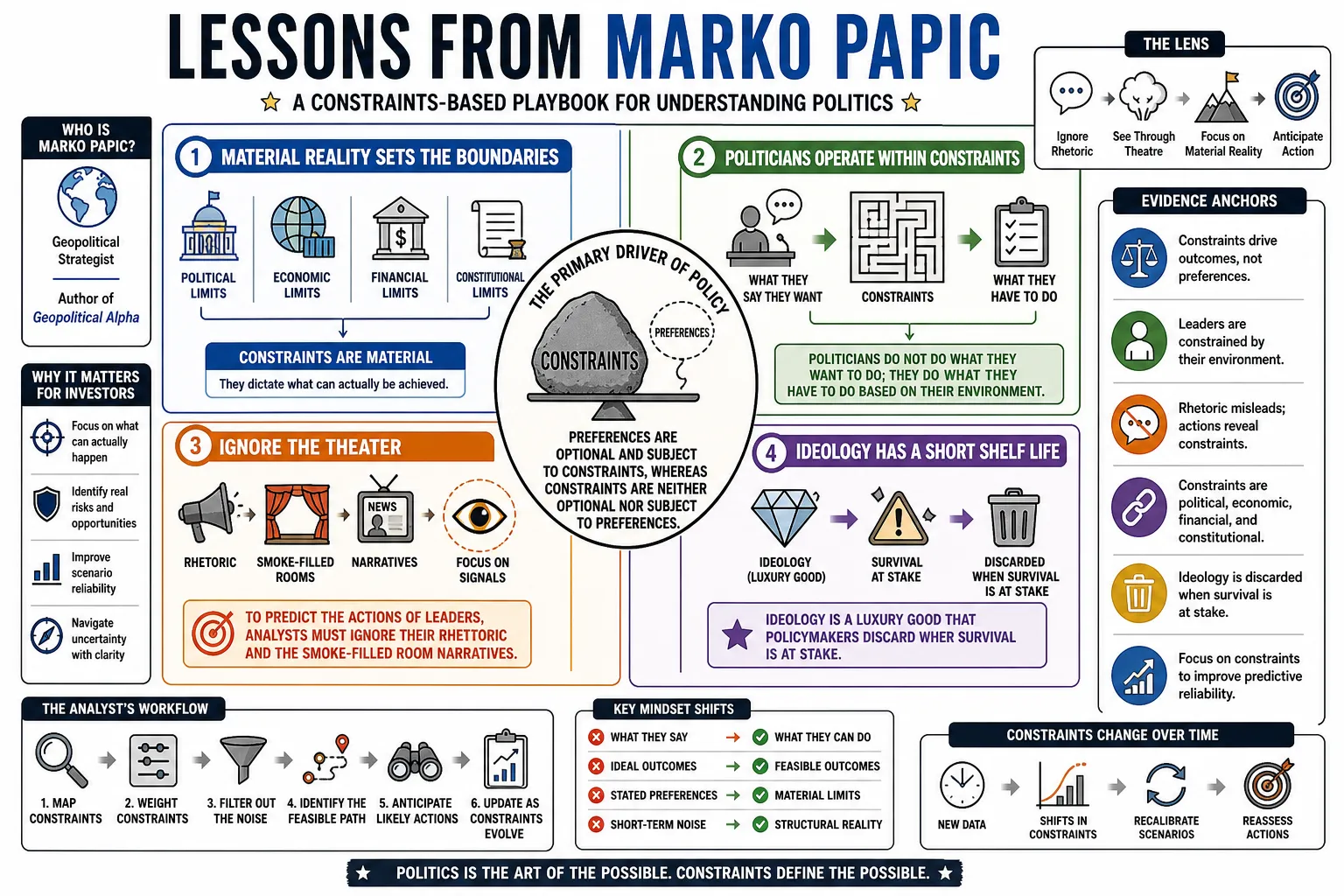
Marko Papic is a geopolitical strategist and the author of Geopolitical Alpha. His work outlines a method for investors to analyze politics by measuring the material limits on government action rather than listening to the stated desires of politicians. This approach shifts the focus away from ideology and toward the practical boundaries that dictate what nations can actually achieve.
Part 1: The Constraints-Based Framework
- On the primary driver of policy: "Preferences are optional and subject to constraints, whereas constraints are neither optional nor subject to preferences." — Source: [Geopolitical Alpha]
- On the illusion of choice: "Politicians do not do what they want to do; they do what they have to do based on their environment." — Source: [Clocktower Group]
- On ignoring political theater: "To predict the actions of leaders, analysts must ignore their rhetoric and the smoke-filled room narratives." — Source: [CFA Institute]
- On material reality: "Constraints are material. They are political, economic, financial, and constitutional limits that dictate what can actually be achieved." — Source: [Top Traders Unplugged]
- On the limits of ideology: "Ideology is a luxury good that policymakers discard when survival is at stake." — Source: [Capital Allocators]
- On predictive reliability: "Basing analysis on what a leader claims they will do is a recipe for losing money; focus on what the system allows them to do." — Source: [MacroVoices]
- On the definition of constraints: "A constraint is an independent variable that restricts the set of available options for a decision-maker." — Source: [Geopolitical Alpha]
- On overestimating intent: "The market constantly overprices the personal intent of foreign leaders and underprices the domestic constraints they face." — Source: [Invest Like the Best]
- On objective analysis: "Geopolitical analysis fails when it relies on reading tea leaves or psychoanalyzing leaders rather than quantifying boundaries." — Source: [Meb Faber Research]
- On shifting focus: "Shift your focus from the stated goals of the state to the measurable hurdles standing in its way." — Source: [BCA Research]
Part 2: Median Voter Theorem and Political Behavior
- On maintaining power: "Regardless of their personal ideologies, policymakers are forced to move toward the position of the median voter to remain in office." — Source: [Geopolitical Alpha]
- On the center of gravity: "The median voter dictates the center of political gravity, forcing even extreme politicians to moderate their policies in practice." — Source: [Medium]
- On populism's boundaries: "Populists often campaign on the fringes but govern near the center because the economic reality of the median voter demands it." — Source: [Clocktower Group]
- On election forecasting: "Do not forecast who will win an election; forecast what the median voter wants, because the winner will eventually have to deliver it." — Source: [Top Traders Unplugged]
- On policy continuity: "The demands of the median voter ensure a high degree of policy continuity even when the governing party changes." — Source: [MacroVoices]
- On political mandate: "A politician’s true mandate is rarely found in their manifesto, but in the unstated economic anxieties of the middle class." — Source: [Capital Allocators]
- On the limits of extremism: "Extremist policies fail to materialize in democracies because they violate the economic safety requirements of the average citizen." — Source: [Geopolitical Alpha]
- On regime survival: "Even in autocracies, the regime must eventually satisfy a critical mass of the population to avoid a legitimacy crisis." — Source: [Invest Like the Best]
- On economic voting: "Voters vote their pocketbooks, and politicians adjust their policies to keep those pocketbooks full." — Source: [Meb Faber Research]
- On market reactions to elections: "Markets often panic over political rhetoric, forgetting that the median voter acts as a permanent shock absorber against radical change." — Source: [BCA Research]
Part 3: Betting Against the Spread
- On market consensus: "Investors should not try to predict the outcome of a geopolitical game; instead, identify gaps between market expectations and the most likely outcome." — Source: [Geopolitical Alpha]
- On finding alpha: "Geopolitical alpha is found by betting against the spread, not by simply knowing more facts than everyone else." — Source: [CFA Institute]
- On mispriced risk: "When the market prices in an apocalypse based on political rhetoric, the constraints-based investor buys the asset." — Source: [Clocktower Group]
- On the folly of certainty: "Geopolitics is about finding where the consensus view is fundamentally flawed, rather than forecasting the future with absolute certainty." — Source: [Top Traders Unplugged]
- On avoiding binary bets: "Avoid betting on who will win a conflict; bet on the economic realities that both sides will be forced to accept." — Source: [MacroVoices]
- On sentiment vs reality: "The spread you are betting against is usually the difference between media-driven sentiment and the boring structural constraints of governance." — Source: [Capital Allocators]
- On exploiting panic: "Political crises create market dislocations because institutional investors overreact to headlines rather than analyzing the underlying constraints." — Source: [Invest Like the Best]
- On the nature of surprises: "A geopolitical surprise is rarely an unpredictable black swan; it is usually an ignored constraint finally asserting itself." — Source: [Meb Faber Research]
- On disciplined contrarianism: "Betting against the spread requires the discipline to ignore compelling narratives in favor of dry, material facts." — Source: [BCA Research]
Part 4: The End of the Goldilocks Era
- On the shift in risk: "The era where geopolitics could be treated as an exogenous risk that investors could safely ignore is permanently over." — Source: [Geopolitical Alpha]
- On macroeconomic integration: "Geopolitical analysis must now be integrated into the core investment process, functioning like modern instrumentation for a pilot." — Source: [BCA Research]
- On the return of history: "We are transitioning from a unipolar, hyper-globalized world into one where political friction is the primary driver of macroeconomic trends." — Source: [Clocktower Group]
- On structural inflation: "The end of the geopolitical Goldilocks era means the return of structural inflation, driven by redundant supply chains and nationalist industrial policies." — Source: [MacroVoices]
- On market complacency: "Investors who grew up in the 1990s and 2000s are poorly equipped for a world where state intervention supersedes free-market efficiency." — Source: [Capital Allocators]
- On the new normal: "Volatility is no longer a temporary deviation caused by politics; politics is the baseline generator of ongoing volatility." — Source: [Top Traders Unplugged]
- On the death of laissez-faire: "Governments are reasserting their role in the economy, ending the decades-long assumption that capital will always flow to its most efficient use." — Source: [Invest Like the Best]
- On the necessity of adaptation: "You can no longer build a durable portfolio by simply assuming that global trade and political stability will naturally expand." — Source: [Meb Faber Research]
- On the cost of friction: "The peace dividend has been spent; the future involves paying a premium for security over efficiency." — Source: [CFA Institute]
Part 5: Multipolarity and Global Order
- On the multipolar reality: "We have entered a multipolar world where the United States can no longer dictate terms or easily form unilateral coalitions." — Source: [Invest Like the Best]
- On the benefits of competition: "Multipolarity, while perilous, can drive unprecedented technological innovation and productivity as great powers compete for supremacy." — Source: [Clocktower Group]
- On middle powers: "In a multipolar system, middle powers gain disproportionate influence by playing great powers against each other." — Source: [MacroVoices]
- On the U.S.-China dynamic: "The U.S. and China are not engaged in a new Cold War; they are engaged in a multipolar competition where other nations refuse to take sides." — Source: [Capital Allocators]
- On regionalization: "Global supply chains are not dying, but they are regionalizing as spheres of influence solidify around major economic poles." — Source: [Top Traders Unplugged]
- On the erosion of hegemony: "American hegemony ended not with a bang, but through a gradual diffusion of economic and military power across the globe." — Source: [Geopolitical Alpha]
- On emerging markets: "A multipolar world creates unique opportunities in emerging markets that can successfully navigate the space between competing superpowers." — Source: [Magic Markets]
- On global institutions: "Post-WWII institutions are losing their effectiveness because they were designed for a unipolar world that no longer exists." — Source: [Meb Faber Research]
- On the nature of conflict: "War in a multipolar world is often proxy-based and economic, fought through tariffs, technology bans, and resource hoarding." — Source: [BCA Research]
Part 6: Macroeconomics and Geopolitics
- On fiscal dominance: "We are moving into an era of fiscal dominance, where government spending driven by political necessity outweighs central bank monetary policy." — Source: [MacroVoices]
- On inflation as a tool: "Inflation is more than an economic phenomenon; it is often a political pressure valve used to manage unpayable sovereign debts." — Source: [Clocktower Group]
- On industrial policy: "The return of industrial policy means that capital expenditure will be directed by national security priorities rather than pure return on equity." — Source: [Invest Like the Best]
- On energy markets: "Energy is the ultimate constraint; geopolitical power is fundamentally derived from the ability to secure and distribute cheap energy." — Source: [Top Traders Unplugged]
- On the weaponization of finance: "The use of the U.S. dollar and payment systems as weapons will inevitably accelerate the search for alternative global financial architectures." — Source: [Capital Allocators]
- On demographic constraints: "Demographics serve as an absolute economic constraint, dictating growth potential and limiting the aggression of aging nations." — Source: [Geopolitical Alpha]
- On capital flows: "In a geopolitically fractured world, capital flows will increasingly follow political alliances rather than just seeking the highest yield." — Source: [Meb Faber Research]
- On the green transition: "The shift to green energy is less about climate ideology and more about establishing energy independence in a competitive geopolitical arena." — Source: [BCA Research]
- On resource nationalism: "Expect a rise in resource nationalism as countries realize that controlling critical minerals is more valuable than controlling financial assets." — Source: [Magic Markets]
Part 7: Prince vs. Fortuna
- On individual agency: "No amount of virtù will help the Prince overcome fortuna; external material realities are far better indicators of outcomes than the individuals themselves." — Source: [Geopolitical Alpha]
- On the Great Man theory: "The Great Man theory of history is useless for investors because it relies on predicting the whims of individuals rather than the structural forces binding them." — Source: [Substack]
- On analyzing dictators: "Even absolute autocrats are bound by the realities of their economy, the loyalty of their military, and the tolerance of their elites." — Source: [Clocktower Group]
- On ignoring speeches: "When a leader gives a speech, ignore the adjectives and look for the verbs that align with their nation's material capabilities." — Source: [Top Traders Unplugged]
- On systemic inertia: "Systems have profound inertia; a new leader can rarely steer the ship of state significantly off its historically determined course." — Source: [Capital Allocators]
- On the illusion of control: "Leaders often claim credit for economic booms and blame foreign actors for busts, but both are usually driven by structural forces beyond their control." — Source: [MacroVoices]
- On behavioral economics in politics: "Politicians, like investors, are subject to behavioral biases, but their institutional constraints prevent those biases from completely derailing policy." — Source: [Invest Like the Best]
- On diagnosing failure: "Policy failures occur when leaders mistake their personal preferences for their nation's actual capacity to execute." — Source: [Meb Faber Research]
- On predictive frameworks: "A sound geopolitical framework treats leaders as interchangeable variables reacting to fixed constants." — Source: [BCA Research]
Part 8: Practical Geopolitical Investing
- On investment horizons: "Geopolitical constraints usually manifest over an 18 to 24-month horizon, making them highly relevant for tactical asset allocation." — Source: [Geopolitical Alpha]
- On avoiding noise: "To generate alpha, you must filter out the daily noise of cable news, focusing only on data that alters the underlying constraints." — Source: [CFA Institute]
- On scenario probabilities: "Do not build scenarios based on what you think is right; assign probabilities based on what the constraints dictate is possible." — Source: [Clocktower Group]
- On sizing positions: "Geopolitical bets should be sized based on the asymmetry of the market’s misunderstanding, not on the absolute certainty of the outcome." — Source: [Top Traders Unplugged]
- On contrarian timing: "The best time to buy a geopolitically distressed asset is when the narrative is uniformly apocalyptic but the material constraints point to a resolution." — Source: [MacroVoices]
- On European integration: "Europe's structural constraint is that it must integrate further during crises to survive, making bets against the Eurozone historically poor trades." — Source: [Invest Like the Best]
- On defining the null hypothesis: "Start your analysis by assuming the status quo will hold; only shift your view when a new, insurmountable constraint appears." — Source: [Capital Allocators]
- On cross-asset impacts: "Geopolitics rarely affects just one asset class; a true constraints-based view requires looking at the interplay between bonds, equities, and commodities." — Source: [Meb Faber Research]
- On the role of the analyst: "The geopolitical analyst’s job is not to be an exotic storyteller, but a disciplined accountant of power and limitations." — Source: [Magic Markets]
- On long-term survival: "Survival in modern markets requires accepting that the rules of the game are written by politics, even if the score is kept in dollars." — Source: [BCA Research]