On Marketing Philosophy and Strategy
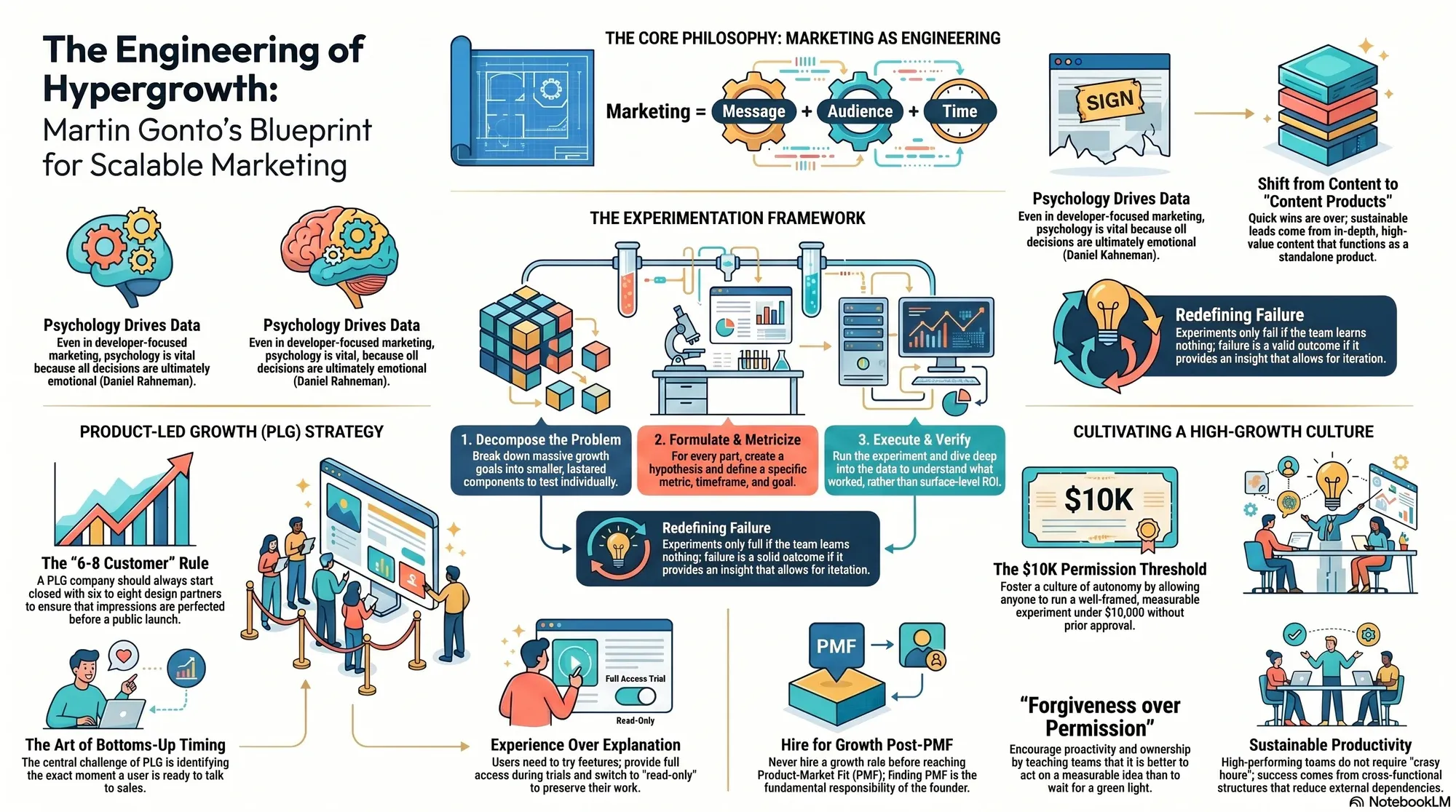
- "Marketing is all about sending the right message to the right audience at the right time." A foundational principle that Gonto emphasizes, suggesting an engineering approach to decompose this challenge into smaller, manageable experiments. [1]
- "I'm a software engineer that now works on Marketing. Wait, what? Yes, I found a way to combine my two passions and apply my engineering thinking model to marketing." This quote encapsulates Gonto's unique and effective approach to the marketing discipline. [1]
- "We can react and learn from the data, and make better decisions by using those data engineering principles and applying the scientific method. You can improve and get to success faster by looking at data and using that to learn and become better." [2]
- "Even when you sell to developers, psychology is key to marketing, because as Daniel Kahneman says, all decisions are emotional." A key learning from his time at Auth0, highlighting the importance of understanding human behavior. [3]
- "Marketing isn't what it used to be. Most marketers are now asked to measure everything and show ROI, but nobody ever talks about how to improve the strategies and tactics' ROI." Gonto advocates for a deeper level of analysis beyond surface-level metrics. [4]
- "Thinking more out of the box instead of just following playbooks is something that I think is important." He encourages a move away from generic strategies to more creative, tailored approaches. [5]
- "Our job at marketing is education and also partly to get people to try out the platform." This highlights his belief in the power of the product itself as a marketing tool.
- "The era of the 'quick wins' in content marketing is long gone. Learn how to drive new leads by creating Content Products." Gonto advocates for creating in-depth, valuable content that functions as a product in itself. [6]
- "Your target market is absolutely unique. Just like everyone else." A reminder of the importance of deep, specific persona development. [6]
- On Distribution Through Existing Habits: Distribution starts by understanding where the target market already spends attention and fitting into those habits repeatedly, rather than expecting a good product to create its own channel. — Evergrow — The $6.5 Billion Marketing Playbook
- On Being Different Before Being Better: In a noisy market, a distinctly scrappy or unconventional approach can create more attention than being only marginally better than everyone else. — Evergrow — The $6.5 Billion Marketing Playbook
- On Utility Before Signup: Give prospects useful, individualized value before asking them to sign up; an immediate diagnostic or comparison earns attention better than generic personalization. — Evergrow — The $6.5 Billion Marketing Playbook
- On Brand and Taste as Moats: As AI makes marketing tactics easier to copy, durable differentiation shifts toward brand, judgment, and taste—the choices that cannot be reproduced from a prompt alone. — Evergrow — The $6.5 Billion Marketing Playbook
- On Stories With a Point of View: Real stories create empathy, but attention comes from pairing them with a perspective that is recognizably your own. — Evergrow — The $6.5 Billion Marketing Playbook
- On Visible Human Signals: In an AI-saturated channel, small imperfections such as informal casing or an occasional typo can signal that a person actually made the message. — Evergrow — The $6.5 Billion Marketing Playbook
- On Owning a Specific Community: Become the trusted expert inside a narrowly chosen ecosystem by teaching at its events, building relationships with its core contributors, and helping the people who shape it. — WorkOS — Driving Growth Through DevRel
- On Trust Through Honest Disqualification: Recommend your product only when it is genuinely useful; telling someone they do not need it yet can build the trust that brings them back when the fit becomes real. — WorkOS — Driving Growth Through DevRel
- On Solving the Searcher's Blocker: Content should answer the problem users search for when they are blocked, not merely define the category in language the company wishes they cared about. — WorkOS — Driving Growth Through DevRel
- On Native Placement Over Interruptions: When sponsoring tools a community already uses, earn a useful native mention at the moment of need instead of buying an interruptive banner. — WorkOS — Driving Growth Through DevRel
On Growth and Experimentation
- "When I think about growth as a term... is applying the scientific method to KPIs." A succinct definition of his growth philosophy. [2]
- "A lot of people take failure as something wrong, but failure is not wrong if you learn something. A lot of companies just break this experimentation or learning culture by making failure a bad thing." [2]
- "Experiments only fail if you learn nothing." This is a core tenet of his approach to experimentation, emphasizing the value of learning from every outcome. [1]
- "Qualitative information is a lot more important than quantitative information in growth." Gonto stresses the need to understand the 'why' behind the data. [2][3]
- "If you have an experiment and you have an idea you want to try it out, it's well framed, you've done your research, you understand, you have a gut feeling but you have a way to measure it, as long as it's less than 10K, you can just try it and do it without approval." A practical way to foster a culture of experimentation. [3]
- "Brave people are not the people who are not scared, brave people are the people who are scared but do it anyway. The other are just unconscious." On the importance of taking calculated risks. [3]
- "If you don't take any big risk, it will never work." A strong statement on the necessity of bold moves for significant growth. [3]
- "An experiment is about getting a very big problem, decomposing it into smaller parts, for each of those parts using both qualitative and quantitative information create a hypothesis of something that you think you can do to change or to improve." A clear framework for conducting experiments.
- "Publish, internally, the experiments you've done, what you've learned and what you failed at because if you start showing it to everybody on the team, you start creating a culture of experimentation." [7]
- "When somebody fails at something, you do not give them shit. It's more about have you learned anything? If they haven't learned anything, you can fire them, but if they learned something, that means that at least they can iterate." A direct approach to managing failure and learning. [3]
- "Doing A/B tests is a lot easier in a B2C than in a B2B. If you're Instagram and you have hundreds of millions of users, you can test anything." A crucial distinction for B2B marketers to understand. [3]
- On Creative GTM Over Universal Frameworks: Frameworks cannot supply a unique growth strategy; advantage comes from understanding the company's actual problem deeply enough to invent an approach competitors will not copy by default. — Churn.fm — Anti-Retention Metrics and Next Best Actions
- On a Portfolio of Ecosystem Bets: Place early bets on emerging communities before they become established, knowing that a few will compound dramatically and others will disappear. — WorkOS — Driving Growth Through DevRel
On Product-Led Growth (PLG)
- "The idea of product growth is that people can first maybe use the product, start to play and then if they are interested, end up buying it." A simple and clear definition of PLG. [8]
- "A product growth company should always start with design partners, you should always start closed with six to eight customers." This is a critical piece of advice for startups looking to implement a PLG model. [3]
- "First impressions I think matter a lot and you can only get first impressions once." The rationale behind starting with a closed group of design partners. [3]
- "If you do a product-led growth and bottoms-up that means that you will get the users coming to the product, in most cases users who are trying something out do not want to be bothered." A key insight into the mindset of a PLG user. [3]
- "How do I know when they are ready to talk to somebody? And then at that point talk to them and try to convince them to buy. That is the art that exists in bottoms up." The central challenge and opportunity in monetizing PLG. [3]
- "I'm a big believer on experience. So it's like okay if you explain me a feature but I cannot try it out then how do I know if I like it if I will connect with it or why?" The importance of hands-on product experience in PLG. [3]
- "They have access to everything, once the trial ends maybe you give them access read-only so they can still see what they've done but not create new things." A specific tactic for trial-to-paid conversion. [3]
- On Sequencing Complexity After Commitment: A feature can improve retention once users are committed yet destroy it when introduced too early; product sequencing should reflect readiness, not only feature value. — Churn.fm — Anti-Retention Metrics and Next Best Actions
- On Guardrails Around Advanced Features: When an advanced feature repeatedly derails new users, hide it, delay it, or warn them until their product knowledge and commitment can absorb the complexity. — Churn.fm — Anti-Retention Metrics and Next Best Actions
On Company Culture and Team Building
- "Ideally, I think [growth] should be interspersed among all functions." His preference for an integrated approach to growth within an organization. [3]
- "When organizations grow they become risk averse, they stop innovating and they become much slower." A common problem that Gonto aims to solve. [6]
- "A lot of times by managing incorrectly we make it harder to scale our organization." Highlighting the critical role of management in a company's growth trajectory. [6]
- "You can create a productive team without asking your team to work crazy hours." A statement on sustainable work culture. [6]
- "Stop assuming you know what other people think, and just ask them what they really think!" A simple yet powerful tip for combating imposter syndrome and fostering open communication. [6]
- "It's better to ask for forgiveness than permission. You have an idea and a way to measure it? Just try it out!" A slogan that encourages proactivity and ownership. [9]
- "I would never hire somebody for growth before product-market fit. I think that before product-market fit, it's the job of the founder to get to see if there's product-market fit." A clear guideline on when to hire the first growth role. [3]
- "If the founder can't do what needs to be done to find product-market fit, I think they will never succeed." A stark reality check for startup founders. [3]
- "Have leaders set the tone for teams to follow." The importance of leadership in establishing a culture of experimentation. [2]
- "Cross-functional teams share goals and thus have less external dependencies on others. This makes it easier to adhere to a framework." A practical tip for structuring teams for success. [7]
- On Separating DevRel Strengths: Do not treat developer relations as one interchangeable role; separate people who excel at technical writing from those who excel at speaking and community relationships. — WorkOS — Driving Growth Through DevRel
- On Designing a Tour of Duty: An entry-level role becomes more attractive when it is framed as a clear tour of duty with training, exposure, and a credible path into the role the person ultimately wants. — WorkOS — Driving Growth Through DevRel
- On Auditioning Through Real Work: A paid contributor program can become a high-signal hiring funnel because both sides experience the actual work before committing to a full-time role. — WorkOS — Driving Growth Through DevRel
On Leadership and Management
- "Ask them if they learned something new. If they learned something new, then it's okay." A leader's response to a team member's failure. [7]
- "I think having a budget so that people can take risks and just do it." A tangible way for leaders to empower their teams. [3]
- "What does Gonto know now that he wishes he had known when he entered the world of growth?" A question he often reflects on, indicating a continuous learning mindset. [10]
On Data and a Scientific Approach
- "Decompose your problem into smaller pieces." The first step in his engineering-inspired problem-solving framework. [1]
- "Formulate a hypothesis for each." A critical step in applying the scientific method to marketing. [1]
- "Define a metric, a timeframe, and a goal." Essential components for any meaningful experiment. [1]
- "Verify the data. Experiments only fail if you learn nothing. Verify metrics and dive deep to understand what worked and what didn't." The crucial final step in the experimental loop. [1]
- "In circumstances with little data, he establishes a baseline understanding of target customers with qualitative data instead." A practical approach for early-stage startups. [2]
- "As the quantitative data accumulates but before you reach significance, he suggests making these gut calls as a way to train the muscles for making data-driven decisions." A nuanced take on the interplay between data and intuition. [2]
- "I created like a GPT from it so now when I want to do something new I can ask it questions like hey I'm thinking about this did I f*ck up on something on this in the past or can I just do it." An innovative way to leverage past learnings. [3]
- "The main idea to me is that an experiment is about getting a very big problem decomposing it into smaller parts." A reiteration of his core problem-solving methodology.
- On Instrumenting First Feature Use: Record when each user first touches every important feature so the sequence of product adoption can be studied instead of inferred from aggregate activity. — Churn.fm — Anti-Retention Metrics and Next Best Actions
- On Comparing Timing Across Cohorts: Compare retained and lost cohorts across adoption windows—from the first hour through later months—to find features whose timing separates durable use from churn. — Churn.fm — Anti-Retention Metrics and Next Best Actions
- On Explaining the Quantitative Gap: Once cohort data reveals a suspicious timing gap, inspect session recordings or other qualitative evidence to understand the confusion behind the pattern before changing the product. — Churn.fm — Anti-Retention Metrics and Next Best Actions
Learn more:
- PLG 101- Lessons Learned from scaling Auth0 · Zoom - Luma
- Marketing Experiments with Martin “Gonto” Gontovnikas - Userlist
- Martin Gontovnikas (Gonto): The Biggest Mistakes Startups Make When Scaling into Enterprises | E1115 - YouTube
- strategy — Gonto
- GTM 28: How Auth0 Took Big Risks To Avoid Pipeline Plateau with Martin Gontovnikas
- Grow With It - Acast
- Martin Gontovnikas - Auth0
- Growth Hacking Strategies for Startups: Simple Tips and Examples - YouTube
- Genesys Growth
- 20Growth: How to Master Product-Led Growth, The Biggest Mistakes Startups Make When Scaling into Enterprises, How to Assess "Bets" in Growth; Which to Take and Which Not with Gonto, Interim CMO @Vercel - 20VC
- The $6.5 Billion Marketing Playbook: How to Win in the Age of AI
- Driving Growth Through DevRel
- How Anti-Retention Metrics and Next Best Actions Boost Retention