Lessons from Martin Mignot
Martin Mignot is an Index Ventures Partner who backed Deliveroo, Revolut, and TIER Mobility in their early days. Known for his "Not Optional" campaign for stock option reform, he has spent over a decade documenting how founders actually manage growth and transatlantic expansion. These notes cover his approach to valuations, hiring, and the realities of building global software and logistics companies.
Part 1: The Asymmetry of Markets
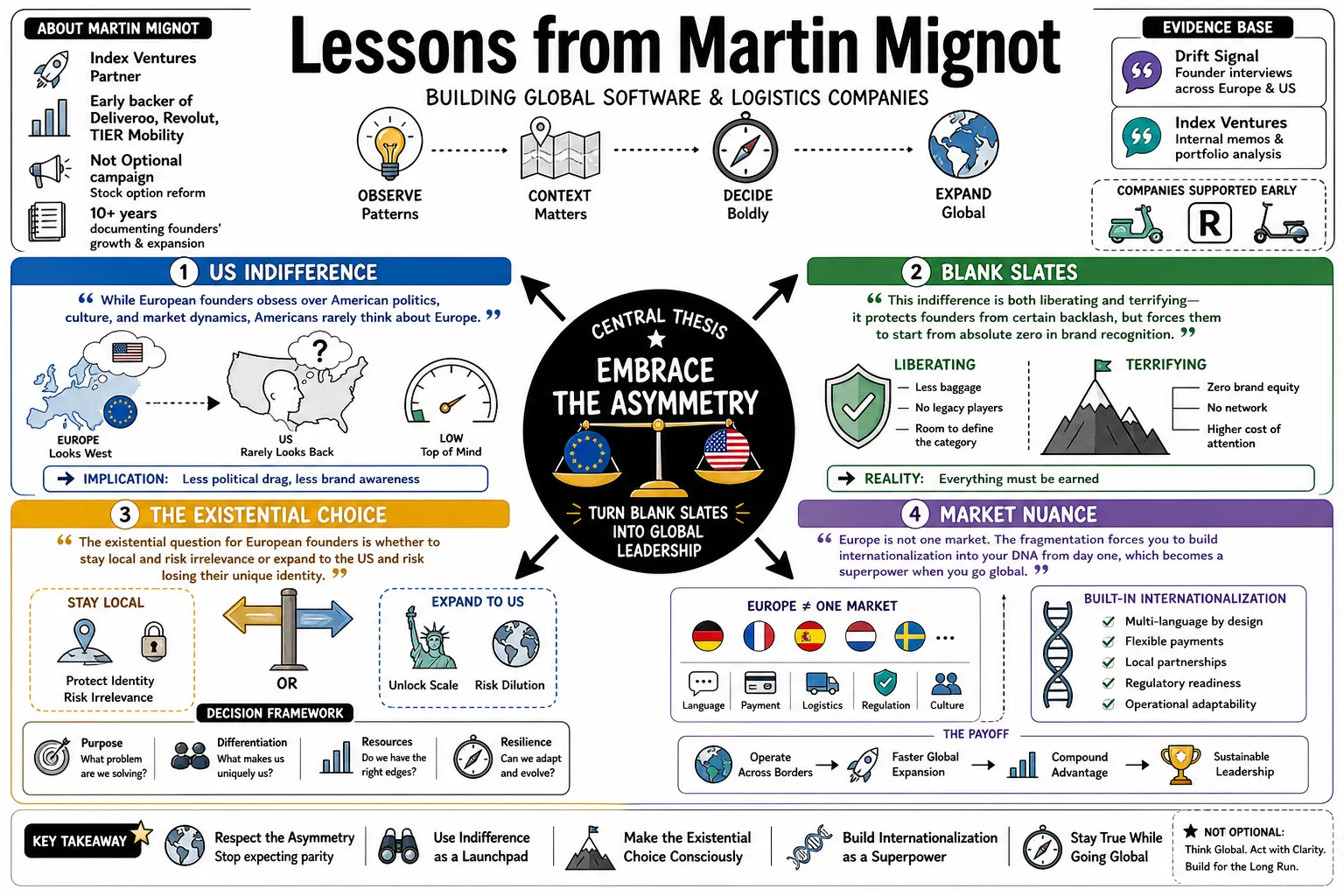
- On US Indifference: "While European founders obsess over American politics, culture, and market dynamics, Americans rarely think about Europe." — Source: Drift Signal
- On Blank Slates: "This indifference is both liberating and terrifying—it protects founders from certain political backlashes but forces them to start from absolute zero in brand recognition." — Source: Index Ventures
- On the Existential Choice: "The existential question for European founders is whether to stay local and risk irrelevance or expand to the US and risk losing their unique identity." — Source: Drift Signal
- On Market Nuance: "Europe is not one market. The fragmentation forces you to build internationalization into your DNA from day one, which becomes an asset later." — Source: Sifted
- On US Listing Preferences: "If we had to do the Deliveroo listing again, most likely I would advocate for listing in the US, given the deeper pool of capital and investor expertise." — Source: Sifted
- On UK Public Markets: "Just looking at the P&L in some of these fast-growing businesses is a basic mistake; London needs better analysts to understand high-growth tech." — Source: Evening Standard
- On Tech Sentiments: "The idea that the UK does not need high-growth tech companies is a crazy thing to say." — Source: Evening Standard
- On US Talent Pools: "The US market offers a depth of executive talent that has scaled companies from $100M to $1B before, something still rare in Europe." — Source: Index Ventures
- On Capital Differences: "In the US, you are raising money based on the vision of how big it can get; in Europe, you are often raising based on the metrics you already have." — Source: 20VC
- On First Impressions: "You only get one chance to launch in the US. If you go too early and fail, it sets a narrative that is very hard to reverse." — Source: Drift Signal
Part 2: The US Expansion Playbook
- On the Telescope Strategy: "The 'Telescope' archetype works for self-serve models where you focus on the US market while keeping your core leadership and headcount in Europe." — Source: Index Ventures
- On the Magnet Approach: "The 'Magnet' utilizes the US—specifically hubs like the Bay Area—to attract specialized talent, supplementing European technical hubs with early US hires." — Source: Index Ventures
- On the Pendulum Shift: "In the 'Pendulum' model, organizations delay their US launch until they have significant traction, then shift into a distributed model across both regions." — Source: Index Ventures
- On Anchoring Operations: "The 'Anchor' archetype is common for enterprise software, where you effectively anchor leadership and sales in the US to capture the majority of the total addressable market." — Source: Index Ventures
- On Strategy Mismatch: "Choosing the wrong archetype for your business model can lead to wasted resources and failed expansion attempts." — Source: Drift Signal
- On Founder Relocation: "The 'Transplant' requires a complete shift where the founders and core operations move to the US to ensure success on the ground." — Source: Index Ventures
- On Go-to-Market Readiness: "Before expanding, honestly evaluate your Product-Market Fit and localization needs to select the strategy that aligns with long-term growth." — Source: The VC Corner
- On Adapting Sales: "You cannot just copy-paste a European sales playbook into the US; the buying cycle and aggressiveness required are entirely different." — Source: Drift Signal
- On Timing: "There is no 'one-size-fits-all' path. Failing to identify your expansion archetype leads to misaligned hiring and product delays." — Source: Index Ventures
Part 3: Valuation Mechanics and Investment Philosophy
- On the DCF Model: "When evaluating potential investments, the four variables of Revenue, Growth, Margin, and Risk are the only components required to build a Discounted Cash Flow model." — Source: Medium
- On Assessing Revenue: "Generating large revenues requires operating in a sufficiently large market where customers are willing to pay a high enough price." — Source: Medium
- On Defensibility as Risk: "Risk relates directly to the defensibility or moat of the business, which translates financially to the Weighted Average Cost of Capital (WACC)." — Source: Medium
- On Growth Mechanics: "The largest outcomes stem from core products that allow the company to grow faster over time while reducing customer acquisition costs through network effects." — Source: Medium
- On Valuation Benchmarks: "The DCF model represents the closest available proxy for estimating a company's fair value and assessing if it can exit for over $1 billion." — Source: Medium
- On Business vs. Manager: "It is generally wiser to bet on business momentum rather than the brilliance of a manager." — Source: Medium
- On Rare Exceptions: "There are rare exceptions where an entrepreneur’s vision is so exceptional that it warrants following them into even a mediocre-looking business." — Source: Medium
- On Charlie Munger's Influence: "There are striking parallels between Charlie Munger’s investment philosophy and the approach taken at modern venture firms." — Source: Medium
- On Network Intelligence: "For a partner at a top firm, the most valuable asset isn't the capital itself, but the collective network and the speed at which intelligence can be operationalized." — Source: Deal Agent
Part 4: Scaling Through Chaos and Company Culture
- On Internal Communications: "Invest in internal communications early—typically once a company hits 50 to 75 employees—to manage the inevitable chaos of scaling." — Source: Index Ventures
- On Organizational Predictability: "Revolut stood out early on for its operational predictability and its detailed, data-driven approach to every problem." — Source: Connecting the Dots
- On Data-Rich Environments: "The board packs at the most successful companies I've backed are the most data-rich I’ve ever seen." — Source: Connecting the Dots
- On Building the Machine: "You have to build the machine that builds the machine; relying on measurable outcomes and playbooks helps reduce middle management layers." — Source: Connecting the Dots
- On Office Politics: "When you run an organization based entirely on data and measurable outcomes, you naturally eliminate office politics." — Source: Connecting the Dots
- On the 50-Person Hurdle: "The transition from 10 to 50 employees is where most cultures break; it requires moving from implicit knowledge to explicit processes." — Source: Index Ventures
- On Hiring the Right Stage: "An executive who scaled a company from 500 to 5000 people will often fail if dropped into a 20-person startup." — Source: Index Ventures
- On Communication Debt: "Just like technical debt, startups accumulate communication debt. If left unchecked, it paralyzes decision-making." — Source: Index Ventures
- On First-Principles Thinking: "A first-principles approach to company building prevents you from inheriting the flaws of legacy businesses in your sector." — Source: Connecting the Dots
Part 5: Talent Acquisition and the 'Not Optional' Campaign
- On Equity as a Tool: "Employees are increasingly sophisticated and willing to trade salary for ownership; stock options must be a strategic tool." — Source: Index Ventures
- On the European Disadvantage: "Punitive and complex tax rules regarding employee stock options prevent European startups from effectively competing with US tech giants." — Source: Sifted
- On the 'Not Optional' Campaign: "Reforming stock option policies across Europe is an existential requirement for the ecosystem to mature." — Source: Not Optional
- On Competing for Talent: "You cannot build a generation-defining company if you cannot offer your early employees a meaningful slice of the pie." — Source: Not Optional
- On Legislative Friction: "For years, European legislators treated startup equity as a tax loophole rather than an engine for wealth creation and innovation." — Source: Business Insider
- On the Flywheel Effect: "When employees make money from successful exits, they reinvest it as angel investors or founders, creating the ultimate ecosystem flywheel." — Source: Not Optional
- On Pan-European Rules: "Creating a cohesive, pan-European approach to equity remains a critical priority to prevent founders from dealing with 27 different legal systems." — Source: Sifted
- On French Reforms: "Adjusting rules in France to be more startup-friendly proved that government and tech ecosystems can align for mutual benefit." — Source: Forbes
- On Liquid Incentives: "An option is only valuable if there is a path to liquidity; otherwise, it is just paper money that cannot compete with a tech giant's salary." — Source: Not Optional
- On Democratizing Wealth: "Employee ownership is the most effective way to distribute the wealth generated by the tech sector to the broader economy." — Source: Silicon Republic
Part 6: High-Volume and Micromobility Theses
- On Low-Margin Models: "A high-volume, low-profit strategy is often necessary to aggressively expand market size and establish dominance." — Source: Business Insider
- On Rider Efficiency: "In logistics networks like food delivery, maximizing rider efficiency through data is the only path to long-term profitability." — Source: Business Insider
- On the Micromobility Thesis: "The shift toward micromobility is driven by the fundamental inefficiency of using a two-ton metal box to move one person across a crowded city." — Source: Micromobility Podcast
- On Hardware and Software: "Successful mobility companies must bridge the gap between durable hardware and seamless, consumer-grade software." — Source: Forbes
- On Urban Infrastructure: "We are investing in companies that align with the inevitable transformation of city infrastructure away from cars." — Source: Business Insider
- On Regulatory Moats: "In regulated markets like micromobility, the ability to partner with local governments becomes a primary competitive advantage." — Source: Sifted
- On Unit Economics: "If the unit economics of a single scooter or delivery do not work on a micro level, no amount of scale will fix the macro math." — Source: Micromobility Podcast
- On Changing Habits: "Investing in mobility and food delivery is a bet on the permanent alteration of consumer habits in urban environments." — Source: Business Insider
- On Logistics Density: "The magic of local delivery networks only unlocks when you reach a critical density of demand in a specific neighborhood." — Source: Business Insider
Part 7: "Born Global" and Early-Stage Mechanics
- On Starting Global: "It is far easier to be born global than to try and become global as an afterthought years down the line." — Source: Drift Signal
- On Global Expansion Vectors: "Rather than expanding sequentially one country at a time, sometimes the best strategy is to launch everywhere, monitor traction, and reinvest where it works." — Source: Connecting the Dots
- On SME Markets: "Long neglected by early tech waves, Small and Medium-sized Enterprises have become the new primary target for software startups." — Source: Index Ventures
- On Early Trajectory: "The decisions made in the first twelve months of a startup's life dictate its ceiling five years later." — Source: Index Ventures
- On Market Definition: "If you define your market too narrowly in the early days, you risk building an architecture that cannot support horizontal expansion." — Source: Medium
- On Founder Ambition: "European founders have shifted from aiming for a local exit to explicitly aiming to build global category leaders." — Source: Sifted
- On Minimum Viable Products: "The concept of an MVP has changed; today, consumers expect a high level of polish even from a day-one beta product." — Source: Pitch
- On Speed of Execution: "Speed is the only structural advantage an early-stage company has over an incumbent." — Source: 20VC
- On Capital as Fuel: "Venture capital should be treated as rocket fuel for a machine that already works, not as a runway to figure out if the machine works." — Source: 20VC
Part 8: Founder Psychology and Board Dynamics
- On Founder Self-Awareness: "Entrepreneurs must deeply identify their own gaps and tendencies, and proactively work to complement them with the right team." — Source: Index Ventures
- On Executive Blind Spots: "The most dangerous blind spot for a technical founder is underestimating the complexity of building a sales organization." — Source: Index Ventures
- On the Role of the Board: "A board member's job is not to run the company, but to ask the questions the founder is too deep in the weeds to see." — Source: 20VC
- On Managing Founder Burnout: "Scaling a massive business is a marathon sprint; managing founder psychology and preventing burnout is a core responsibility of an investor." — Source: 20VC
- On Founder Disputes: "Most co-founder conflicts do not stem from malice, but from a failure to clearly delineate responsibilities as the company scales." — Source: Index Ventures
- On Adapting Roles: "A founder must be willing to fire themselves from multiple jobs as the company grows, handing over their responsibilities to specialists." — Source: Index Ventures
- On Truth-Telling: "The best relationships between founders and investors are built on uncomfortable transparency during the hardest moments." — Source: 20VC
- On Learning from Failure: "You often learn more from the company that failed to find Product-Market Fit than the one that caught lightning in a bottle on day one." — Source: Medium
- On Vision vs. Reality: "It is the founder's job to hold the long-term vision while the team executes on the short-term, gritty reality of getting there." — Source: Connecting the Dots
- On Enduring Partnerships: "Venture capital is essentially a decade-long marriage; you must fundamentally respect the person across the table." — Source: 20VC