Matan Grinberg is the co-founder and CEO of Factory, an AI lab building autonomous software engineering agents called "Droids." Before founding the company and raising over $220 million, he spent a decade researching string theory and quantum physics at UC Berkeley and Princeton. This profile organizes his core ideas on the enterprise "token hangover," shifting from AI copilots to fully autonomous workflows, and rethinking how modern software teams operate.
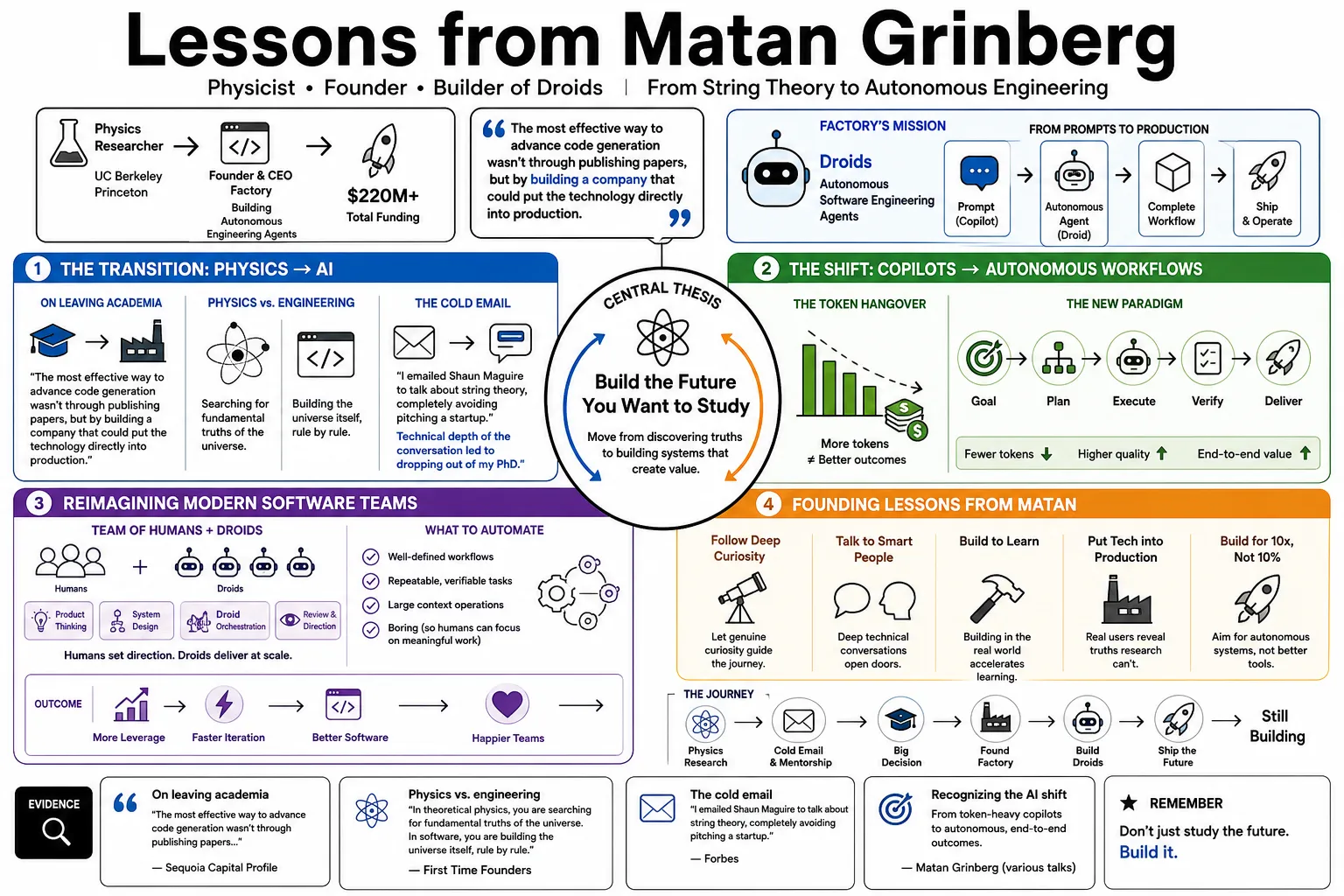
Part 1: The Transition from Physics to AI
- On leaving academia: Forbes reports that Grinberg was a Berkeley PhD student who dropped out a little over a week after an early Sequoia conversation, teamed up with Eno Reyes, and built Factory instead, which supports the broader lesson that he chose company-building and deployment over a purely academic path. — Reference: Forbes profile of Factory
- On physics vs. engineering: "In theoretical physics, you are searching for fundamental truths of the universe. In software, you are building the universe itself, rule by rule." — Source: First Time Founders
- On the cold email to Sequoia: "I emailed Shaun Maguire to talk about string theory, completely avoiding pitching a startup. The technical depth of that conversation is what ultimately led to the decision to drop out of my PhD." — Source: Forbes
- On recognizing the AI shift: "When I saw the early capabilities of program synthesis, it became clear that the fundamental bottleneck of translating human intent into machine execution was about to collapse." — Source: The Room Podcast
- On rigorous problem solving: "Studying general relativity trains you to hold massively complex, interacting systems in your head without losing track of the boundary conditions. Building agentic AI requires the exact same mental muscle." — Source: First Time Founders
- On academic constraints: "Academia rewards theoretical elegance. The AI transition we are in right now requires brute-force engineering and immediate, practical application." — Source: The Next Wave Podcast
- On transferring skills: "The math changes, but the methodology stays identical. You form a hypothesis, you test it against reality, and you iterate until the system stabilizes." — Source: First Time Founders
- On timing the market: Forbes says Grinberg moved from that initial founder conversation to dropping out, building a demo, and raising a Sequoia pre-seed in barely more than a week, which supports the timing lesson that he acted aggressively when he believed the market window for automating software engineering had opened. — Reference: Forbes profile of Factory
- On co-founding with Eno Reyes: "We met at Princeton and realized we shared the exact same frustration with how repetitive software development had become. We knew the solution was completely different labor." — Source: The Room Podcast
Part 2: Defining "Agent-Native" Engineering
- On agent-native workflows: "Being agent-native means the software development lifecycle is designed from day one assuming non-human intelligence will execute the majority of the mechanical tasks." — Source: McKinsey Interview
- On the concept of 'Droids': "We call them Droids because they aren't simply autocomplete engines. They are discrete entities with specific roles like a QA Droid or a Refactoring Droid that operate independently." — Source: The Next Wave Podcast
- On surface-agnostic development: "Developers shouldn't have to change where they work. Whether it is in the IDE, the terminal, or Slack, the agent needs to meet the engineer at their preferred surface." — Source: The Next Wave Podcast
- On replacing repetitive tasks: "The goal is to eliminate the drudgery. No one actually enjoys writing boilerplate tests or manually updating documentation across ten repositories." — Source: The Room Podcast
- On continuous integration of AI: "In an agent-native environment, code review is a continuous, asynchronous dialogue between the human architect and the Droid executing the plan." — Source: McKinsey Interview
- On structural determinism: "Agents need predictable environments. You can't drop an LLM into a messy, undocumented legacy codebase and expect magic. The infrastructure must be prepared for autonomy." — Source: The Next Wave Podcast
- On state management: "The hardest part of building Droids is maintaining the context window and state across a sprawling, multi-file enterprise repository." — Source: The Next Wave Podcast
- On shifting from tools to team members: "A compiler is a tool. A Droid is a teammate. You assign it a ticket, it opens a pull request, and you review its work. The mental model has to change." — Source: McKinsey Interview
- On the limits of current agents: "Agents today still struggle with deep architectural ambiguity. They are excellent at tactical execution but require human oversight for strategic system design." — Source: The Next Wave Podcast
Part 3: The "Token Hangover" and Enterprise ROI
- On the token hangover: "Enterprises bought millions of dollars in AI compute without a clear plan for integration. Now they are waking up to massive bills and asking where the actual return is." — Source: 20VC Podcast
- On the ROI reckoning: "The era of flashy pilot programs is over. CFOs are now demanding that AI tools demonstrate hard, measurable reductions in operational costs or direct increases in output." — Source: 20VC Podcast
- On operational metrics: "If you can't map your AI deployment to an increase in deployment frequency or a decrease in mean time to recovery, you are paying for novelty." — Source: 20VC Podcast
- On token maxing: "You have to extract the maximum possible utility out of every token processed. It is about chaining calls intelligently to avoid redundant computation." — Source: 20VC Podcast
- On the open-source vs. proprietary debate: "For enterprise ROI, it doesn't matter if you use Anthropic, OpenAI, or Llama. What matters is the orchestration layer you build around the model to make it reliable." — Source: 20VC Podcast
- On evaluating AI vendors: "Enterprises are learning the hard way that a slick UI wrapper around an API is a weak enterprise product. They need deep, workflow-level integrations." — Source: McKinsey Interview
- On the cost of context: "Feeding an entire codebase into a context window every time you make a query is financially ruinous at scale. You need semantic search and precise chunking to make unit economics work." — Source: 20VC Podcast
- On budget reallocation: "We are seeing IT budgets shift from purely experimental research buckets into core engineering operational expenses, which raises the bar for vendor performance." — Source: 20VC Podcast
- On managing expectations: "You have to walk executives back from the sci-fi cliff. AI won't run your entire company tomorrow, but it can absolutely automate forty percent of your QA testing today." — Source: McKinsey Interview
- On the ultimate metric: "At the end of the day, ROI in software engineering comes down to shipping reliable features to users faster. If your AI doesn't do that, turn it off." — Source: 20VC Podcast
Part 4: Autonomous Droids vs. Traditional Copilots
- On the copilot ceiling: "Copilots are fantastic for writing the next ten lines of a function, but they fundamentally cannot manage a multi-step migration across a distributed system." — Source: The Next Wave Podcast
- On breaking the IDE boundary: "As long as the AI is trapped inside the IDE waiting for the user to press a button, its utility is capped. Autonomy requires the agent to run in the background." — Source: The Room Podcast
- On synchronous vs. asynchronous AI: "Copilots force the developer to babysit the generation process synchronously. Agents allow the developer to delegate a task asynchronously and return when it is done." — Source: The Next Wave Podcast
- On the danger of over-reliance: "If an engineer mindlessly accepts copilot suggestions, the codebase degrades. Autonomous agents force better code quality because the human must review the completed pull request objectively." — Source: McKinsey Interview
- On intent formulation: "Using a copilot requires you to hold the micro-intent in your head. Managing a Droid allows you to operate at the level of macro-intent." — Source: The Next Wave Podcast
- On compounding value: "A copilot saves seconds per keystroke. An autonomous agent saves hours per ticket. The compounding effect on team velocity is an order of magnitude different." — Source: The Room Podcast
- On error handling: "A copilot errors out by giving you bad syntax. An agent errors out by going down a rabbit hole for twenty minutes. Building guardrails for the latter is much harder." — Source: The Next Wave Podcast
- On workflow disruption: "Transitioning from copilot to agent is a fundamental disruption to how an engineering team organizes its daily standup." — Source: McKinsey Interview
- On the final state: "Eventually, the term copilot will feel as archaic as spellcheck. The default assumption will be that the machine executes the labor autonomously." — Source: The Next Wave Podcast
Part 5: Rethinking the Developer Experience
- On developer fatigue: "We burn out our best engineers by making them do the digital equivalent of digging ditches. The developer experience is broken because of the volume of maintenance work." — Source: The Room Podcast
- On the true cost of context switching: "Every time an engineer stops architecting to fix a minor dependency conflict, the company loses money. Agents exist to protect human focus." — Source: The Room Podcast
- On redefining the 10x engineer: "The 10x engineer of the future is the person who can most effectively orchestrate a fleet of AI agents." — Source: The Next Wave Podcast
- On onboarding: "New engineers spend weeks reading docs to understand a codebase. An AI agent can compress that onboarding by answering hyper-specific architectural queries instantly." — Source: McKinsey Interview
- On legacy code: "Nobody wants to touch a ten-year-old monolithic application. Deploying agents to refactor and modernize legacy systems is highly effective." — Source: The Next Wave Podcast
- On documentation: "Code documentation is universally terrible because it is written after the fact. Agents write documentation dynamically as the code is committed, ensuring it never goes stale." — Source: The Next Wave Podcast
- On debugging: "Debugging is basically hypothesis testing. Agents can run through the first ten obvious hypotheses in seconds, leaving the human to solve the genuinely novel problems." — Source: The Next Wave Podcast
- On the joy of programming: "By removing the drudgery, we actually make programming more fun. Engineers get to spend their days solving hard logical puzzles." — Source: The Room Podcast
- On tooling sprawl: "We have too many dashboards, too many alerts, too many disconnected tools. The agent serves as a unifying interface layer over the entire developer stack." — Source: The Next Wave Podcast
- On the feedback loop: "The faster the feedback loop between writing code and seeing it run, the better the product. Agents compress that loop by automating the build and test phases." — Source: McKinsey Interview
Part 6: Systems, Code Generation, and Synthesis
- On program synthesis: "We are moving from a paradigm of writing explicit instructions to a paradigm of defining constraints and letting the system synthesize the solution." — Source: First Time Founders
- On hallucination in code: "A hallucinated fact in text is annoying. A hallucinated function call in production brings down the system. The standards for precision in code generation are absolute." — Source: 20VC Podcast
- On deterministic boundaries: "You have to wrap non-deterministic LLMs in highly deterministic orchestration logic; the model guesses, and the compiler verifies." — Source: The Next Wave Podcast
- On multi-agent coordination: "A single agent trying to do everything fails. You need a swarm approach where one agent writes the code, another reviews it, and a third writes the tests." — Source: The Next Wave Podcast
- On context retrieval: "Generating good code is entirely about providing the right context. If the agent doesn't know how your database schema is structured, its output is useless." — Source: The Next Wave Podcast
- On the limits of benchmarks: "Public coding benchmarks are saturated and easily gamed. The only benchmark that matters is whether the agent can resolve a real bug in a massive, private repository." — Source: 20VC Podcast
- On test-driven development: "Agents excel in TDD environments. If you provide strict tests, the agent will loop until it generates code that passes. It enforces discipline." — Source: The Next Wave Podcast
- On building SaaS apps from scratch: "We are approaching the point where you can describe a basic software architecture in natural language and the agent will scaffold the entire frontend, backend, and database within minutes." — Source: The Next Wave Podcast
- On managing technical debt: "Agents don't complain about cleaning up technical debt. You can set a Droid to continuously upgrade dependencies in the background without burning human capital." — Source: McKinsey Interview
- On language translation: "Migrating a codebase from Python to Go manually takes months. An agent can do the heavy lifting of syntactic translation, leaving humans to manage the semantic architecture." — Source: The Next Wave Podcast
Part 7: Startup Strategy and Founder Psychology
- On founder intensity: "If you want to build a generational company, you have to operate at a clock speed that feels unreasonable to normal people." — Source: 20VC Podcast
- On sleep optimization: "We bought Eight Sleep covers for our employees because sleep is the ultimate performance enhancer. If I want my team executing at peak cognitive capacity, optimizing their recovery is a business expense." — Source: 20VC Podcast
- On competing with incumbents: "Startups win by focusing on a hyper-specific wedge. The hyperscalers are building horizontal platforms; we are building vertical depth in engineering workflows." — Source: Forbes
- On venture capital: "Raising massive rounds isn't an achievement; it's a massive liability. The pressure to generate returns on that valuation fundamentally changes how you must operate." — Source: Forbes
- On the value of polymaths: "The best early-stage hires are polymaths who can jump from backend infrastructure to prompt engineering to customer support in the same afternoon." — Source: 20VC Podcast
- On speed of execution: "In AI, your moat is your velocity. The models will get better, the competitors will copy your user interface. You only survive by shipping faster than they can comprehend." — Source: 20VC Podcast
- On building for enterprises: "Selling to the enterprise is brutal. You have to pass security reviews, compliance checks, and legal audits before your product ever touches a single line of their code." — Source: McKinsey Interview
- On dealing with ambiguity: "A founder's job is to absorb massive amounts of ambiguity and translate it into clear, tactical priorities for the engineering team." — Source: First Time Founders
- On customer feedback: "Users often don't know what they want until they see it fail. You have to ship imperfect agents, watch where they break in the user's workflow, and iterate instantly." — Source: The Room Podcast
Part 8: The Future of Software Organizations
- On team structure: "In five years, an engineering pod won't be six developers and a product manager. It will be two senior architects, a product manager, and twenty autonomous agents." — Source: The Next Wave Podcast
- On the evolving role of the PM: "Product managers will interact directly with agents. They will write the spec, and the agent will build the prototype before an engineer even looks at it." — Source: The Next Wave Podcast
- On junior developers: "The traditional path of learning by fixing small bugs is disappearing. We have to figure out how to train junior engineers when the agents are doing all the introductory work." — Source: McKinsey Interview
- On the democratization of software: "When anyone can dictate logic to an agent and get a working application, the barrier to entry for building software drops to zero." — Source: The Next Wave Podcast
- On systemic fragility: "If an entire organization relies on language models to write its code, and the underlying model changes, the whole system could degrade. We need strict testing frameworks to prevent catastrophic failure." — Source: 20VC Podcast
- On the value of human judgment: "Agents have no taste. They don't know what a good user experience feels like. The premium on human empathy and design intuition will skyrocket." — Source: The Next Wave Podcast
- On hyper-productivity: "We are about to see two-person startups achieve the output of hundred-person companies. The scale provided by autonomous agents is unprecedented." — Source: Forbes
- On continuous software: "Software will stop being something you release in versions. It will be a fluid, continuously adapting organism updated in real-time by agents monitoring user behavior." — Source: The Next Wave Podcast
- On the long-term vision: Factory's own positioning describes the company as an agent-native software development platform where AI coding agents automate coding, testing, and deployment, which supports the broader lesson that Grinberg is aiming toward increasingly autonomous systems that take on more of the software-building workflow. — Reference: Factory homepage