Lessons from Matt Clancy / Matthew Clancy
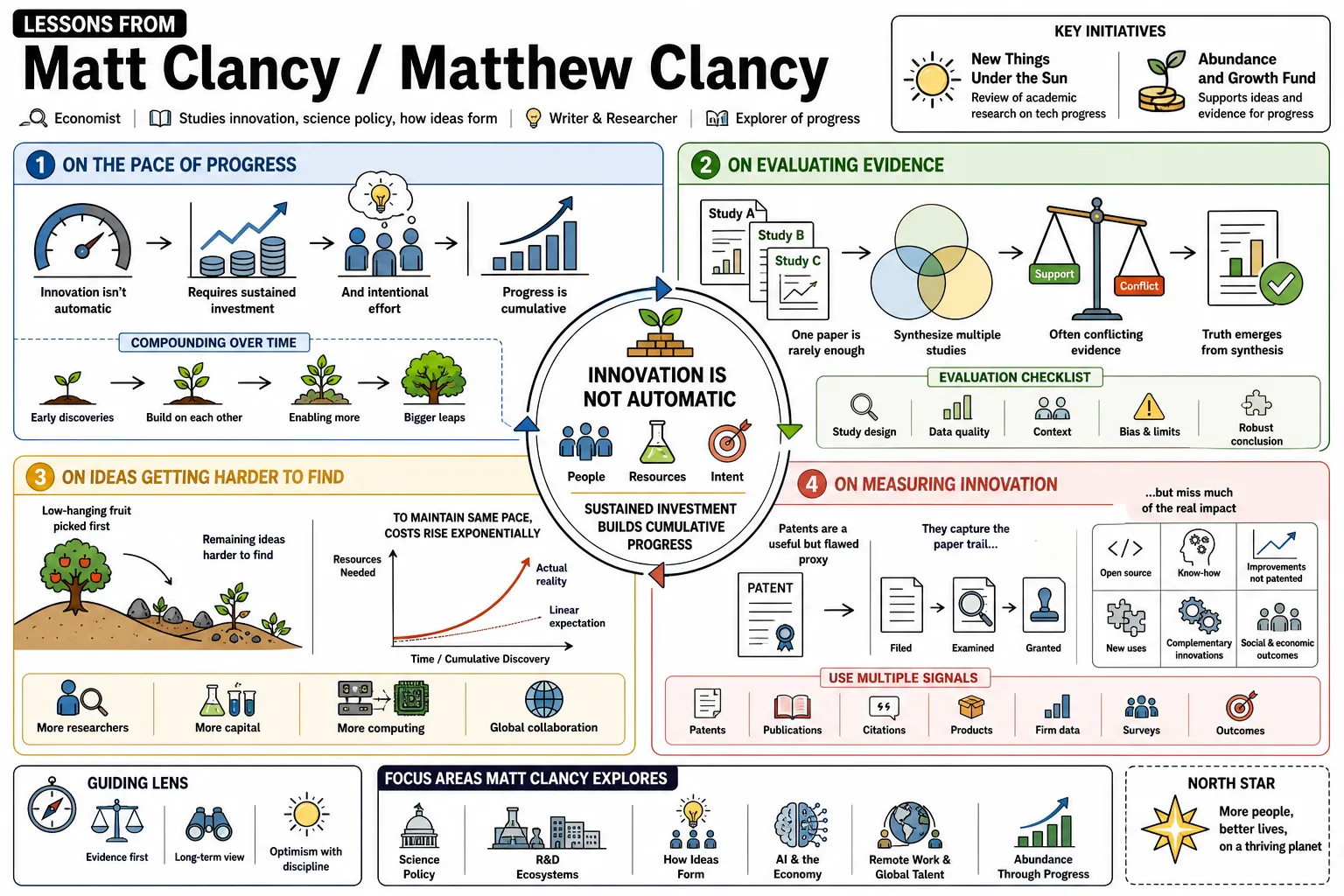
Matt Clancy is an economist who studies the mechanics of innovation, science policy, and how new ideas form. He created "New Things Under the Sun," an ongoing review of academic research on technological progress, and directs the Abundance and Growth Fund. This profile draws on his writing and interviews to examine how science is funded, why progress is getting harder, and how AI and remote work alter invention.
Part 1: The Economics of Innovation
- On The Pace of Progress: "Innovation isn't an automatic feature of the economy; it is a cumulative process that requires sustained investment and intentional effort." — Source: [What's New Under the Sun]
- On Evaluating Evidence: "When answering questions about innovation, a single paper is rarely enough. The truth usually emerges from synthesizing multiple, sometimes conflicting, academic studies." — Source: [What's New Under the Sun]
- On Ideas Getting Harder to Find: "As we pick the low-hanging fruit of discovery, maintaining the same rate of technological progress requires exponentially more researchers and resources." — Source: [What's New Under the Sun]
- On Measuring Innovation: "Patents are a useful but flawed proxy for innovation; they capture the paper trail of ideas, but miss the tacit knowledge that never gets formalized." — Source: [What's New Under the Sun]
- On The Nature of Invention: "Invention is fundamentally combinatorial. It is less about discovering something entirely new and more about finding novel ways to combine existing pieces of knowledge." — Source: [What's New Under the Sun]
- On The Value of Literature Reviews: "There is a massive gap between academic research on innovation and the practitioners who could use it; living literature reviews help bridge that divide." — Source: [What's New Under the Sun]
- On Innovation Clusters: "While local clusters have historically driven innovation through knowledge spillovers, the nature of how ideas spread is changing as communication costs fall." — Source: [What's New Under the Sun]
- On Productivity Stagnation: "The slowdown in economic productivity is partly explained by the fact that our research efforts are yielding diminishing returns compared to the golden age of the twentieth century." — Source: [Macroscience Podcast]
- On Innovation as a System: "We shouldn't view innovation as a series of isolated breakthroughs, but as an adaptive ecosystem where early discoveries reduce the cost of later ones." — Source: [Institute for Progress]
- On The Economic Engine: "Technological progress is the primary driver of long-term economic growth and the surest path to lowering the cost of living for housing, energy, and healthcare." — Source: [Coefficient Giving]
Part 2: Science Policy and Funding
- On Funding Mechanisms: "The way we fund science heavily influences what gets discovered. An over-reliance on grant peer review can systematically bias against highly novel, high-risk research." — Source: [Institute for Progress]
- On Grant Lotteries: "To reduce bias and the administrative burden on researchers, partially randomized grant lotteries for proposals that meet a baseline quality threshold are a viable alternative to traditional scoring." — Source: [What's New Under the Sun]
- On Institutional Diversity: "A healthy science ecosystem requires a diversity of funding models. We need traditional grant agencies, focused research organizations, and fast-grants operating in parallel." — Source: [Institute for Progress]
- On The Cost of Bureaucracy: "Researchers spend an alarming percentage of their time writing grants rather than doing science. Streamlining this process is a low-hanging fruit for science policy." — Source: [Hear This Idea Podcast]
- On Government Intervention: "Because the social returns to research and development far exceed the private returns, there is a clear economic justification for robust public funding of fundamental research." — Source: [What's New Under the Sun]
- On Targeted Funding: "While basic science is crucial, targeted funding to push specific technologies across the commercialization valley of death is often necessary." — Source: [Institute for Progress]
- On Immigration Policy: "High-skilled immigration is one of the most effective levers a country has for boosting its domestic innovation capacity." — Source: [What's New Under the Sun]
- On Metascience: "We need more experiments on how we conduct science itself. Metascience isn't just about critique; it's about finding empirically better ways to organize discovery." — Source: [Institute for Progress]
- On The Long Term: "Policy changes in science funding operate on a lag. The decisions we make today about how to allocate research dollars won't bear full economic fruit for decades." — Source: [Open Philanthropy]
Part 3: Artificial Intelligence as an Inventive Tool
- On AI as a General Purpose Technology: "Artificial intelligence is not just another invention; it is an invention that changes how we invent, acting as a general-purpose technology for research itself." — Source: [What's New Under the Sun]
- On Prediction in Science: "At its core, much of scientific research involves predicting which experiments are worth running. AI significantly lowers the cost of this prediction phase." — Source: [What's New Under the Sun]
- On The Singularity: "While AI will accelerate innovation, explosive multi-fold increases in economic growth remain unlikely in the short term because research relies on physical constraints and human bottlenecks." — Source: [Asterisk Magazine]
- On Augmentation vs. Replacement: "In the near term, AI is best understood as a tool that augments the productivity of researchers rather than replacing the human scientist entirely." — Source: [The Economics Show]
- On The Limits of AI: "Even if an AI can generate thousands of novel hypotheses, those ideas still must be tested in the real world, where regulatory, physical, and economic frictions exist." — Source: [Asterisk Magazine]
- On Combinatorial Explosions: "AI excels at searching through vast combinatorial spaces, like protein folding or materials science, that are far too large for human researchers to brute-force." — Source: [What's New Under the Sun]
- On Diminishing Returns: "It remains an open question whether AI can permanently overcome the burden of knowledge, or if AI-driven research will eventually hit its own diminishing returns." — Source: [Macroscience Podcast]
- On AI in Literature Reviews: "AI tools are increasingly capable of parsing vast amounts of academic literature, helping researchers navigate the ever-growing frontier of human knowledge." — Source: [What's New Under the Sun]
- On Historical Analogies: "Historically, tools that made the inventive process more efficient, like the microscope or the computer, led to sustained periods of increased innovation. AI fits this historical pattern." — Source: [What's New Under the Sun]
Part 4: Geography and Remote Collaboration
- On The Death of Distance: "While cities have historically held a monopoly on knowledge spillovers, digital tools are steadily eroding the penalties associated with remote collaboration." — Source: [What's New Under the Sun]
- On Remote Innovation: "Individual productivity often holds steady or improves in remote work, but the kind of collaborative creativity that drives breakthrough innovation faces unique hurdles without physical proximity." — Source: [Then Do Better Podcast]
- On Building Networks: "Physical proximity remains disproportionately valuable for establishing new relationships, even if existing professional networks can be easily maintained over distance." — Source: [What's New Under the Sun]
- On Distributed Teams: "The historical record shows that breakthrough innovations rarely came from distributed teams, but modern communication infrastructure might finally be breaking that historical rule." — Source: [What's New Under the Sun]
- On The Global Talent Pool: "The greatest advantage of remote work for innovation is the ability to assemble highly specialized teams by tapping into a global labor market." — Source: [Then Do Better Podcast]
- On Academic Collaboration: "Academia provides a strong leading indicator for the future of work: scientists have been successfully producing high-level, frontier knowledge across vast distances for decades." — Source: [What's New Under the Sun]
- On Serendipity: "We often romanticize the spontaneous moments of innovation. The challenge for remote organizations is to engineer digital environments that replicate that serendipity." — Source: [What's New Under the Sun]
- On Urban Economics: "If remote work allows innovators to leave high-cost superstar cities without sacrificing productivity, it could democratize the geography of innovation." — Source: [What's New Under the Sun]
- On The New Normal: "Remote work shouldn't be viewed merely as a crisis response, but as a viable, long-term operational model that changes how organizations approach research." — Source: [Then Do Better Podcast]
Part 5: The Burden of Knowledge and Combinations
- On The Frontier of Knowledge: "As humanity accumulates more information, it takes longer for new researchers to reach the frontier of their field before they can make original contributions." — Source: [What's New Under the Sun]
- On The Death of the Renaissance Man: "The sheer volume of necessary prior knowledge has made it nearly impossible to master multiple disciplines, forcing scientists into ever-narrower specializations." — Source: [What's New Under the Sun]
- On Team Size: "Because individuals can no longer hold all the necessary knowledge in their heads, modern innovation increasingly relies on larger, highly specialized teams." — Source: [What's New Under the Sun]
- On Educational Delays: "One visible symptom of the burden of knowledge is the increasing average age at which scientists make their first major discovery or receive their first major grant." — Source: [What's New Under the Sun]
- On Combinatorial Innovation: "Most new technologies aren't created from scratch; they are novel combinations of existing, well-understood components applied to a new problem." — Source: [What's New Under the Sun]
- On Division of Labor: "Specialization isn't necessarily a flaw. A sharp division of labor allows experts to trade specific insights, which can actually accelerate discovery in complex fields." — Source: [80,000 Hours Podcast]
- On Paradigm Shifts: "The burden of knowledge isn't absolute. During major paradigm shifts, old knowledge is rendered obsolete, temporarily lowering the barrier to entry for newcomers." — Source: [What's New Under the Sun]
- On Cross-Pollination: "The most impactful innovations often occur when an idea is borrowed from one highly specialized domain and applied to a completely different field." — Source: [What's New Under the Sun]
- On Innovation Costs: "The increasing difficulty of pushing the technological frontier explains why we must invest more resources today just to maintain historical rates of progress." — Source: [What's New Under the Sun]
- On Software Exceptions: "Fields like software and digital technology have historically offered shortcuts to the frontier, allowing rapid innovation without decades of formal training." — Source: [What's New Under the Sun]
Part 6: Agricultural Innovation and Spillovers
- On Agricultural Progress: "Agricultural productivity is a remarkable success story of applied research, demonstrating how sustained science can vastly increase output without increasing inputs." — Source: [The Roots of Agricultural Innovation]
- On Knowledge Spillovers: "More than half of the knowledge that drives agricultural innovation actually originates outside of the agricultural sector itself." — Source: [The Roots of Agricultural Innovation]
- On Proximity of Ideas: "While agriculture borrows heavily from other fields, the most useful knowledge tends to come from scientific domains that are conceptually adjacent to farming." — Source: [The Roots of Agricultural Innovation]
- On Patent Evidence: "By analyzing patent citations and text, we can build a literal paper trail showing how abstract scientific concepts move from basic research into applied farming technologies." — Source: [The Roots of Agricultural Innovation]
- On Role of the Private Sector: "Private-sector research plays an increasingly dominant role in driving agricultural productivity, often building upon the foundational research funded by the public sector." — Source: [What's New Under the Sun]
- On Historical Lags: "The impact of new knowledge on agricultural yields isn't immediate. There is often a significant time lag between a scientific discovery and its measurable effect on farm productivity." — Source: [What's New Under the Sun]
- On Text Analysis: "Tracking the migration of specific phrases through patent text provides a much clearer picture of how new ideas permeate an industry than relying on citations alone." — Source: [The Roots of Agricultural Innovation]
- On Interdisciplinary Value: "The heavy reliance of agriculture on external knowledge proves that funding broad, basic science yields unpredictable but vital benefits across seemingly unrelated industries." — Source: [What's New Under the Sun]
- On Sustainable Growth: "Innovation is the only mechanism that allows agriculture to feed a growing global population while simultaneously reducing its environmental footprint." — Source: [Coefficient Giving]
Part 7: Risk, Reward, and Progress
- On Perseverance in Science: "If you're going through hell, keep going. Even when confronting the risks of technological acceleration, the rational path is often to push forward to find the solutions." — Source: [80,000 Hours Podcast]
- On Risk Aversion: "There is a growing concern that our scientific institutions and culture have become too risk-averse, favoring safe, incremental research over bold, uncertain leaps." — Source: [The Economics Show]
- On The Value of Progress: "Despite the real risks associated with new technologies, the historical track record strongly suggests that scientific progress is a net positive for human flourishing." — Source: [80,000 Hours Podcast]
- On Solving Induced Problems: "Technology often creates new problems, but history shows that the most effective way to solve those induced problems is usually through further technological innovation." — Source: [80,000 Hours Podcast]
- On Cultural Stagnation: "When a society loses its appetite for risk in the realm of ideas, it risks falling into a broader cultural and economic stagnation." — Source: [The Economics Show]
- On Asymmetry of Outcomes: "In research, the downside is usually capped at the loss of the grant money, but the upside of a true breakthrough is theoretically boundless." — Source: [Institute for Progress]
- On Measuring the Unseen: "It is easy to measure the costs of a failed experiment, but it is nearly impossible to quantify the immense opportunity cost of the bold experiments we never fund." — Source: [What's New Under the Sun]
- On Navigating Hell: "When humanity faces systemic risks, halting progress leaves us vulnerable. Advancing science gives us the tools to engineer our way out of the danger." — Source: [80,000 Hours Podcast]
- On Optimism: "Optimism in innovation policy isn't about ignoring risks; it's about maintaining a profound belief in the human capacity to solve increasingly complex problems." — Source: [Coefficient Giving]
Part 8: Institutional Reform and the Future of Science
- On Motivation for Science: "Ultimately, the pursuit of scientific understanding is driven not just by economic incentives, but by an innate human drive to reduce suffering and expand our capabilities." — Source: [What's New Under the Sun]
- On Designing Institutions: "Institutions for innovation must be designed as adaptive systems. They need the flexibility to abandon failing strategies and scale up what works." — Source: [Hear This Idea Podcast]
- On The Abundance Agenda: "The goal of innovation policy should be abundance: leveraging technological progress to radically lower the cost of living and increase the quality of life." — Source: [Coefficient Giving]
- On Progress Studies: "The emerging field of progress studies aims to understand the mechanics of human advancement so that we can intentionally engineer faster, safer technological growth." — Source: [Institute for Progress]
- On Reforming Peer Review: "Peer review is excellent for ensuring rigor, but terrible for identifying breakthroughs. We must supplement it with alternative models that reward variance and unorthodoxy." — Source: [Institute for Progress]
- On The Ecosystem View: "You cannot fix science by tweaking one variable. Funding, publishing, immigration, and academic culture are all interconnected parts of a complex ecosystem." — Source: [Institute for Progress]
- On Role of Philanthropy: "Private philanthropy has a unique role to play in science funding because it can act faster, take on higher variance projects, and bypass political bureaucracy." — Source: [Open Philanthropy]
- On Scientific Talent: "The most scarce resource in the innovation economy is not capital, but highly capable, creative human talent deployed in the right environments." — Source: [What's New Under the Sun]
- On Knowledge Spillovers as Public Goods: "Because knowledge is non-rivalrous, ideas developed in one context inevitably leak out to enrich society as a whole, making innovation the ultimate public good." — Source: [What's New Under the Sun]
- On Future of Discovery: "We are building the scaffolding for the next era of discovery. By reforming our institutions and integrating tools like AI, we can ensure the frontier of knowledge continues to expand." — Source: [What's New Under the Sun]