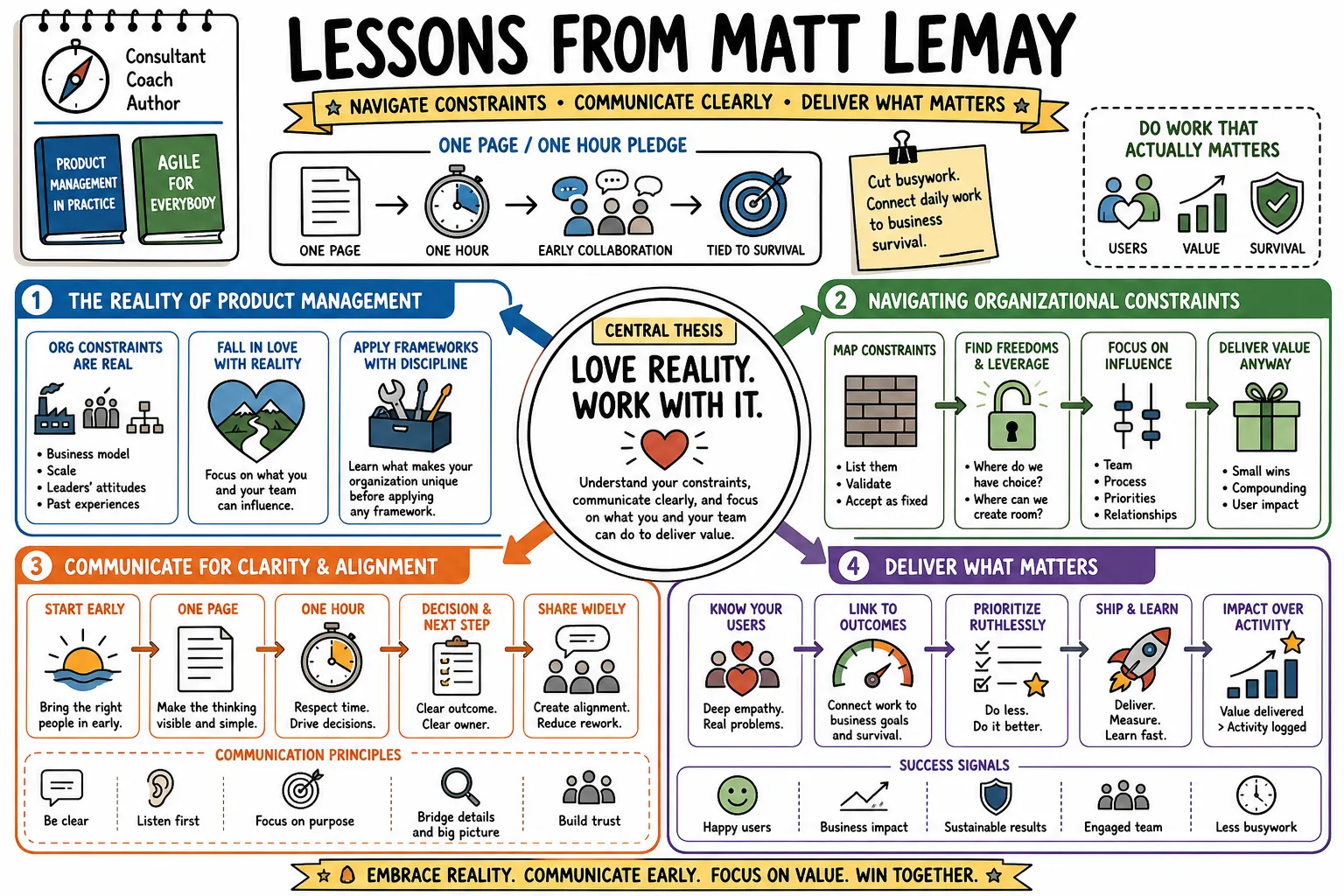
Lessons from Matt LeMay
Matt LeMay is a consultant, coach, and the author of Product Management in Practice and Agile for Everybody. He created the "One Page / One Hour" pledge to cut busywork and force earlier collaboration, tying daily tasks directly to business survival. This profile catalogs his advice on navigating organizational constraints and communicating clearly to do work that actually matters.
Part 1: The Reality of Product Management
- On organizational constraints: "The truth is that all organizations have some fixed constraints to work within. Those constraints might be a function of their business model, their scale, or the attitudes and experiences of their leaders." — Source: Product Management in Practice
- On falling in love with reality: "Recognizing that your particular organization's fixed constraints are unlikely to change allows you to refocus your attention on all the things you and your team can do to deliver value to your users. I've come to think of this process as 'falling in love with reality.'" — Source: Product Management in Practice
- On applying frameworks: "The best product managers always take time to learn about what makes an organization unique before they start implementing or even suggesting specific best practices." — Source: Medium
- On incremental change: "When they do start implementing those best practices, they start small and build incrementally." — Source: Product Management in Practice
- On the nature of the job: "Product management is inherently messy and undefined; trying to turn it into a clean, predictable science usually backfires." — Source: Mind the Product
- On avoiding the visionary trap: "Product management is a connective role focused on delivering user value, rather than a visionary role." — Source: Mind the Product
- On invisibility: "If a product manager is doing their job well, they are often invisible because their work should empower the team and reflect the team's collective output rather than individual recognition." — Source: The Product Experience Podcast
- On the futility of perfect roadmaps: "No amount of perfect planning can survive first contact with a complex organization's changing priorities." — Source: Mind the Product
- On understanding constraints first: "Before asking what the product should be, ask what the organization is actually capable of building and supporting." — Source: Product Management in Practice
Part 2: The CORE Connective Skills
- On defining CORE: "The true work of a product manager relies on CORE skills: Communication, Organization, Research, and Execution." — Source: Product Mastery Now
- On communication over methodology: "How you talk to your engineers and stakeholders matters far more than which specific agile framework you use." — Source: Product Management in Practice
- On the value of organization: "Keeping a team organized and aligned is not administrative overhead; it is the fundamental value a PM provides." — Source: Medium
- On research as a daily habit: "Research extends beyond formal user testing phases; it is a continuous process of learning what the team and the market actually need." — Source: Sudden Compass
- On execution without ego: "Execution means doing whatever unglamorous tasks are required to unblock the team and keep the project moving forward." — Source: Product Mastery Now
- On technical expertise vs connective skills: "Being a former engineer might help you understand technical constraints, but without connective skills, you cannot manage a product effectively." — Source: Product Management in Practice
- On the mini-CEO myth: "Challenging the idea of the PM as a mini-CEO, the role is actually supportive and connective, facilitating alignment rather than commanding it." — Source: Mind the Product
- On continuous alignment: "The job is never done when it comes to keeping disparate groups on the same page; alignment decays over time and must be maintained." — Source: Medium
- On the daily reality of PM work: "The day-to-day work is mostly answering questions, clarifying goals, and ensuring everyone has what they need to succeed." — Source: The Product Experience Podcast
Part 3: One Page / One Hour Collaboration
- On the fundamental pledge: "Commit to spending no more than one page and one hour working on any deliverable before sharing it with colleagues." — Source: One Page One Hour
- On reducing busywork: "The pledge minimizes time spent in silos and prevents the tendency to over-polish documents before getting feedback." — Source: One Page One Hour
- On early sharing: "By sharing work in an early and unfinished state, teams can collaborate more effectively and influence the direction of a project sooner." — Source: Mind the Product
- On exposing misalignment: On The Informed Life, LeMay explains that the bigger and more strategic the work is, the more important it becomes to use a One Page / One Hour approach and involve more people earlier, because an unfinished one-page artifact invites collaboration before ideas harden into polished deliverables. — Reference: The Informed Life transcript on One Page / One Hour for strategic work and earlier collaboration
- On usefulness over polish: "The goal is to focus on whether a deliverable is actually useful to the team rather than making it look impressive." — Source: One Page One Hour
- On the illusion of finish: "Teams often spend weeks on elaborate documents that feel too finished to invite meaningful critique, making people hesitant to offer feedback." — Source: Mind the Product
- On increasing velocity: "Capping solo work at one hour heavily reduces the cycle time between working alone and working as a team." — Source: The Conversation Factory
- On living documents: "Treat documents as living artifacts to be shaped together rather than static presentations to be defended against criticism." — Source: One Page One Hour
- On the flexibility of the page: "The one page constraint is flexible; it can be text, charts, or sketches, but the forced brevity is the point." — Source: Medium
- On breaking perfectionism: "The constraints specifically target the anxiety of perfectionism that causes individuals to hide their work until it feels safe." — Source: One Page One Hour
Part 4: The Truth About Agile
- On the origins of Agile: "Agile is a completely made up thing that 17 people dreamed up on a ski vacation two decades ago." — Source: Agile for Everybody
- On organizational transformation: "If you know what your organization should be doing, then why aren't you already doing it?" — Source: Medium
- On incompleteness as a trigger: "Rather than pose a threat, incompleteness acts as a trigger for action, preventing the habit of over-planning." — Source: The Conversation Factory
- On boxing phantoms: "Arguing over whether a specific practice is truly Agile or truly Scrum is like boxing phantoms; it wastes time on definitions instead of results." — Source: One Knight in Product
- On the only metric that matters for Agile: "The only question you should ask about a process is: If it's working for your team, if it's helping you deliver better outcomes?" — Source: One Knight in Product
- On Agile outside software: "Agile principles are about human collaboration and adapting to change, which means they belong in marketing, HR, and sales exactly as much as engineering." — Source: Agile for Everybody
- On the industrialization of Agile: "The industry that sells certifications often distracts from the core goal of talking to users and shipping software quickly." — Source: Agile for Everybody
- On breaking down silos: "Agile fails when it is treated as an engineering-only mandate while the rest of the company continues to operate in rigid silos." — Source: Medium
- On embracing change: "True agility is not about adhering to two-week sprints, but having the courage to abandon a bad plan when new information arrives." — Source: Agile for Everybody
Part 5: Impact-First Teams
- On the priority problem: "The biggest challenge facing many product teams today is not that their high-impact efforts are falling short, but that they are prioritizing work that has no chance of delivering meaningful business impact in the first place." — Source: Impact-First Product Teams
- On the low-impact death spiral: "Teams often fall into a trap where they focus on low-risk, low-value work to avoid scrutiny, which eventually makes them irrelevant to the business." — Source: Lenny's Podcast
- On velocity theater: "Delivering a large quantity of features that do not move business metrics is a performance that provides false comfort." — Source: Talking Roadmaps
- On clarity over comfort: "Product managers must prioritize clear, sometimes awkward communication about business outcomes over the comfort of vague, easily agreed-upon roadmaps." — Source: The Product Experience Podcast
- On justifying cost: "Product teams are expensive, and they must be able to directly justify their cost by showing measurable business impact rather than merely pointing to software output." — Source: Mind the Product
- On stopping activity-based work: "Moving away from a mindset of 'what are we building today' to 'what business problem are we solving today' is the necessary first step to impact." — Source: Impact-First Product Teams
- On simple strategy: "Instead of relying on complex OKR cascades that lose meaning at the bottom, keep team goals no more than one step away from core company objectives." — Source: Mind the Product
- On avoiding the wishlist: "Spending time negotiating feature requests and building a wishlist roadmap distracts the team from the actual value they need to deliver." — Source: Medium
- On saying yes and no: "If you're doing product management really well, you never have to say yes and you never have to say no. You're giving people options and you're helping them understand the trade-offs." — Source: Lenny's Podcast
- On measuring what matters: "Track the metrics that prove your product is helping the company survive and grow, rather than simply counting how often users click buttons." — Source: Impact-First Product Teams
Part 6: Leadership and the "CEO Test"
- On the ultimate question: "If you were the CEO of this company, would you fully fund this team?" — Source: Leah Tharin's Blog
- On self-awareness: "I have seen product teams proactively disband themselves after honestly asking the CEO test question and realizing their work didn't matter." — Source: Lenny's Podcast
- On strategic empowerment: "Don't wait for a perfect strategy from leadership; connect your work directly to what the business cares about most." — Source: Lenny's Podcast
- On treating the CEO as a customer: "You should treat your executive stakeholders as users, helping them tell the story of how your team's work aligns with the broader business success." — Source: Talking Roadmaps
- On the messy middle: "Managing up means navigating the messy middle of corporate strategy and translating high-level executive anxiety into practical team actions." — Source: Mind the Product
- On executive alignment: "Do not assume leadership knows exactly what they want; part of the job is helping them define success criteria clearly." — Source: Impact-First Product Teams
- On avoiding mandates: "Teams that sit around waiting for a top-down mandate are usually the first ones to be reorganized or cut when budgets tighten." — Source: Medium
- On business accountability: "You cannot divorce product decisions from the financial realities of the company; product managers must think like business owners." — Source: Mind the Product
- On presenting trade-offs: "When talking to leadership, never present a single solution; always present the trade-offs so they can make an informed business decision." — Source: The Product Experience Podcast
Part 7: Communication and "Playing Dumb"
- On talking to users: "In many cases, this means that your best approach is not to sound smart, but rather to play dumb and create as much space as possible for your users to communicate with you in their own words and on their own terms." — Source: Product Management in Practice
- On active listening: "The most valuable data often comes in the pauses and hesitations of a user interview, which you miss if you are rushing to sound knowledgeable." — Source: Sudden Compass
- On self-deprecation: "Be careful with self-deprecation as a social strategy; while it can disarm people, it can also undermine trust if used to deflect responsibility." — Source: Medium
- On plain language: "Avoid using product management buzzwords with stakeholders; translate your process into words they already use and understand." — Source: Product Management in Practice
- On genuine communication: "Authentic communication requires vulnerability and a willingness to admit when you do not have the answer, rather than hiding behind jargon." — Source: Medium
- On the danger of assumptions: "The moment you assume you know what a user means by a common term is the moment you stop doing effective research." — Source: Sudden Compass
- On cross-functional translation: "A product manager's primary communication task is translating the needs of sales, engineering, and design into a shared language." — Source: Product Mastery Now
- On over-communication: "You almost cannot over-communicate the why behind a decision; team alignment requires constant, repetitive reinforcement of the core goals." — Source: Medium
- On asking simple questions: "The person willing to ask the obvious, seemingly stupid question in a meeting is usually the one who uncovers the biggest point of misalignment." — Source: Mind the Product
Part 8: Human-Centric Systems and Team Dynamics
- On human needs first: "Understanding people, both the customers buying the product and the team members building it, is the foundation for all great work." — Source: Sudden Compass
- On delegating responsibility: "True delegation means handing over the responsibility for an outcome, rather than handing out a list of tasks for someone else to execute." — Source: Medium
- On thick data: "Quantitative metrics tell you what is happening, but you need qualitative, human-centric thick data to understand why it is happening." — Source: Sudden Compass
- On consulting without jargon: "The best way to help an organization change is to avoid long, jargon-heavy reports and instead work collaboratively on immediate, practical decisions." — Source: Sudden Compass
- On psychological safety: "Teams cannot move quickly or share unfinished work if they do not feel safe enough to be wrong in front of each other." — Source: One Page One Hour
- On the reality of corporate structures: "Reorgs and new frameworks rarely fix underlying issues; improving how individuals speak to and trust one another is what actually changes a company." — Source: Medium
- On empathy as a practice: "Empathy is not a personality trait you either have or lack; it is a deliberate practice of prioritizing someone else's context over your own." — Source: Product Management in Practice
- On ignoring the framework wars: "Teams that spend their energy debating the exact definition of a process are avoiding the much harder work of dealing with human conflict." — Source: Agile for Everybody
- On shared context: "A team's ability to act autonomously is directly proportional to how much context they share about the business and its customers." — Source: Mind the Product
- On simplicity in strategy: "The most effective product strategies are lean and simple, easily understood by any new hire on their first day without a dictionary." — Source: Impact-First Product Teams