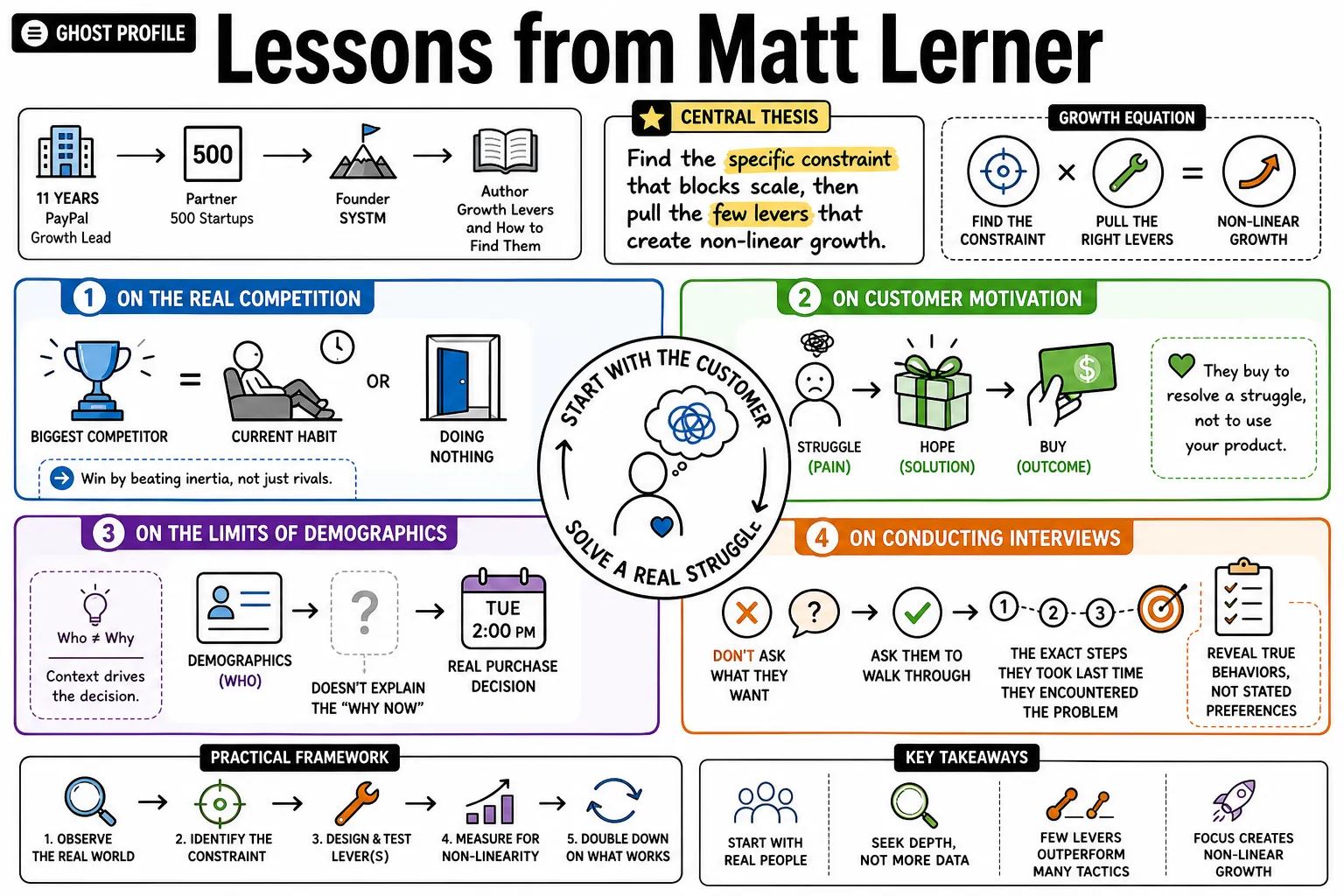
Lessons from Matt Lerner
Matt Lerner spent 11 years leading growth at PayPal and served as a partner at 500 Startups before founding SYSTM. Now the author of Growth Levers and How to Find Them, he focuses on identifying the specific constraints that block a startup's scale. This profile breaks down his practical frameworks for customer discovery, language-market fit, and finding the few actions that actually drive non-linear growth.
Part 1: Uncovering the Jobs to be Done
- On the real competition: "Your biggest competitor is not another startup; it's the customer's current habit or their decision to simply do nothing." — Source: [SYSTM]
- On customer motivation: "People don't buy your product because they want to use it. They buy it because they have a struggle, and they hope your product will resolve it." — Source: [First Round Review]
- On the limits of demographics: "Demographics might tell you who your customer is, but they will never explain why they decided to pull out their credit card on a Tuesday at 2 PM." — Source: [Lenny's Podcast]
- On conducting interviews: "When interviewing customers, don't ask them what they want. Ask them to walk you through the exact steps they took the last time they encountered the problem you are trying to solve." — Source: [Business of Software]
- On listening for the struggle: "The gold in customer interviews usually comes when they describe the workarounds and spreadsheets they hacked together before finding you." — Source: [ChartMogul]
- On asking the right questions: "Never ask 'would you use this feature?' Ask 'how are you currently solving this problem today?'" — Source: [First Round Review]
- On the purchasing journey: "Every purchase follows a path: a struggle creates a trigger, which leads to a search, which ends in a selection." — Source: [SYSTM]
- On passive discovery: "If you want to understand the Job to be Done, look at the search terms people type into Google at 2 in the morning when they are desperate for a solution." — Source: [Matt Byrom]
- On early validation: "If a prospect can't describe a recent time they experienced the problem, they are not actually a potential customer." — Source: [First Round Review]
- On solving the right problem: "Startups don't starve for lack of ideas; they drown in building features that solve problems customers don't actually care about." — Source: [Lenny's Podcast]
Part 2: Growth Levers and the 90/10 Rule
- On the 90/10 rule: "In almost any startup, 10% of the activities you do will drive 90% of your growth. Your job is to find that 10% and stop doing the rest." — Source: [SYSTM]
- On finding the bottleneck: "Growth isn't about pushing everywhere at once. It's about finding the single rate-limiting step in your funnel and focusing all your energy there." — Source: [Business of Software]
- On defining a growth lever: "A growth lever is a highly specific, repeatable action that reliably produces a disproportionate increase in your key metric." — Source: [Lenny's Podcast]
- On the danger of optimization: "Early-stage startups often waste time optimizing a broken funnel instead of discovering the core engine that will actually scale the business." — Source: [First Round Review]
- On copying tactics: "You cannot just copy the growth tactics of a successful company. Their tactics worked for their specific bottleneck at a specific moment in time." — Source: [SYSTM]
- On resource allocation: "If you identify a true growth lever, you shouldn't just put a little more effort into it. You should reorganize your entire team around it." — Source: [Matt Byrom]
- On avoiding busywork: "Being busy is the easiest way to avoid the hard work of figuring out what actually matters." — Source: [Lenny's Podcast]
- On compounding returns: "True growth levers compound over time. If a tactic requires you to start from zero every month, it’s a hustle, not a lever." — Source: [ChartMogul]
- On team structure: "Don't build a 'growth team' that operates in a silo. Growth needs to be a cross-functional discipline focused on the company's biggest constraint." — Source: [First Round Review]
- On the illusion of progress: "Shipping features feels like progress, but if those features don't move the rate-limiting step, you are just running in place." — Source: [SYSTM]
Part 3: Defining the North Star Metric
- On vanity metrics: "Revenue and profit are lagging indicators. If you optimize directly for them, you will likely destroy the customer experience in the process." — Source: [First Round Review]
- On true alignment: "A good North Star Metric measures the exact moment your product delivers value to the customer." — Source: [SYSTM]
- On measuring value: "If your product is a photo app, your metric isn't daily active users; it's the number of photos successfully shared and viewed." — Source: [Lenny's Podcast]
- On the power of a single number: "When the entire company is looking at the same number, arguments about priority disappear. The metric dictates the roadmap." — Source: [Business of Software]
- On avoiding manipulation: "Pick a metric that cannot go up unless the customer is genuinely getting what they paid for." — Source: [ChartMogul]
- On pairing metrics: "Always pair your North Star with a guardrail metric to ensure you aren't achieving growth by sacrificing quality or retention." — Source: [First Round Review]
- On customer-centric tracking: "If you want to grow, stop tracking how much value you extract from users and start tracking how much value you deliver to them." — Source: [SYSTM]
- On simplicity: "If it takes a data scientist to calculate your North Star Metric, it's too complicated for your team to rally around." — Source: [Matt Byrom]
- On goal setting: "A North Star Metric gives you permission to say no to good ideas that don't serve the core objective." — Source: [Lenny's Podcast]
- On shifting metrics: "Your North Star Metric can and should change as the company matures and the primary bottleneck shifts from activation to retention." — Source: [Business of Software]
Part 4: Mastering Language-Market Fit
- On the purpose of copy: "Copywriting is not about being clever or creative. It is about proving to the customer that you understand their problem better than they do." — Source: [First Round Review]
- On using customer words: "The best headlines are often verbatim quotes taken directly from customer interviews." — Source: [SYSTM]
- On industry jargon: "When you use corporate jargon, you are signaling to the customer that you belong to the industry, not that you understand their specific pain." — Source: [Lenny's Podcast]
- On passing the clarity test: "If a visitor can't tell exactly what you do and who you do it for within five seconds, your language-market fit is broken." — Source: [ChartMogul]
- On emotional resonance: "Don't sell the features of the drill; sell the hole in the wall. Better yet, sell the feeling of hanging a family portrait." — Source: [Matt Byrom]
- On standing out: "If your website copy could easily apply to three of your competitors, it is too generic to be effective." — Source: [First Round Review]
- On the hierarchy of messaging: "Lead with the struggle they are trying to escape, follow with the solution, and end with the outcome they desire." — Source: [SYSTM]
- On testing language: "You can test language-market fit much faster and cheaper than you can test product-market fit. Start with the words." — Source: [Business of Software]
- On drafting emails: "Write sales emails as if you are writing to a single, specific person who is having a very bad day because they don't have your product." — Source: [Lenny's Podcast]
Part 5: Experimentation and the "Sevens" Rule
- On the danger of average: "The most dangerous experiments are the ones that score a 7 out of 10. They are just good enough to keep you investing time, but they will never scale." — Source: [SYSTM]
- On killing mediocre ideas: "You have to be ruthless about cutting the 7s so you have the resources to find the 9s and 10s." — Source: [Lenny's Podcast]
- On experiment velocity: "The companies that win are not the ones with the best initial ideas; they are the ones that run the most high-quality experiments per week." — Source: [First Round Review]
- On designing tests: "An experiment is only valuable if you design it so that a failure still teaches you something definitive about customer behavior." — Source: [Business of Software]
- On minimum viability: "If it takes you a month to build a test, you are building a product, not running an experiment." — Source: [ChartMogul]
- On trusting the data: "When the data contradicts your intuition, your job is not to argue with the data. Your job is to figure out why your intuition was wrong." — Source: [Matt Byrom]
- On isolated variables: "If you change the headline, the button color, and the pricing in the same test, you will never know what actually caused the lift." — Source: [SYSTM]
- On failing fast: "Celebrate the tests that fail quickly. They saved you months of engineering time." — Source: [Lenny's Podcast]
- On the culture of testing: "Experimentation shouldn't be a phase. It needs to be the default state of how the company makes decisions." — Source: [First Round Review]
Part 6: The PayPal Years and Early Lessons
- On unscalable tactics: "At early PayPal, writing a bot to buy items on eBay and ask sellers if they accepted PayPal was unscalable, but it manually ignited the network effect." — Source: [Business of Software]
- On expensive mistakes: "Spending a million dollars on traditional user personas taught me that demographic data is useless compared to behavioral data." — Source: [First Round Review]
- On understanding the ecosystem: "PayPal grew because we understood that the friction wasn't just in sending money; the friction was the delay in the eBay transaction process." — Source: [Lenny's Podcast]
- On seizing timing: "When you find a distribution channel that works, you have to exploit it aggressively before the platform closes the loophole." — Source: [SYSTM]
- On friction as an enemy: "Every extra click or form field you add to an onboarding flow mathematically reduces the number of people who will ever experience your product's value." — Source: [Matt Byrom]
- On building trust: "In financial products, trust is the ultimate conversion driver. We had to look bigger and more secure than we actually were in the early days." — Source: [ChartMogul]
- On viral loops: "A true viral loop happens when the core function of the product naturally exposes non-users to the product's value." — Source: [Business of Software]
- On aggressive prioritization: "The early PayPal team succeeded because they were willing to ignore completely valid user complaints if those complaints didn't relate to the core growth engine." — Source: [Lenny's Podcast]
- On surviving chaos: "Hypergrowth is messy. If your operations are perfectly organized, you probably aren't growing fast enough." — Source: [SYSTM]
Part 7: Transitioning from Figuring it Out to Playbooks
- On the seed stage: "The seed stage is about discovery. You aren't executing a plan; you are searching for a repeatable engine." — Source: [First Round Review]
- On Series A readiness: "You are ready to scale when you can put a dollar into a specific channel and reliably predict how many dollars will come out the other side." — Source: [Lenny's Podcast]
- On founder transitions: "The hardest transition for a founder is moving from 'doing the work' to 'building the system that does the work.'" — Source: [SYSTM]
- On premature scaling: "Spending heavily on marketing before you have a clear understanding of your rate-limiting step is the fastest way to burn through your runway." — Source: [Business of Software]
- On the role of playbooks: "A playbook isn't a rigid set of rules; it's a documented baseline of what works so the team can start experimenting at a higher level." — Source: [ChartMogul]
- On hiring for stages: "The person who is brilliant at finding product-market fit is rarely the same person who is brilliant at optimizing a mature funnel." — Source: [Matt Byrom]
- On institutional memory: "As you scale, document your failed experiments. New hires will try to repeat the same mistakes if they don't know what you've already ruled out." — Source: [First Round Review]
- On managing complexity: "Growth adds complexity. Your job as a leader is to ruthlessly prune that complexity so the team can stay focused on the core levers." — Source: [Lenny's Podcast]
- On predictable revenue: "You don't have a playbook until you can accurately forecast your revenue based on top-of-funnel inputs." — Source: [SYSTM]
Part 8: Mindset and Organizational Focus
- On shiny object syndrome: "The most common disease in startups is abandoning a lever that is working to chase a new tactic you read about in a blog post." — Source: [First Round Review]
- On strategic discipline: "Strategy is not about what you choose to do. It is entirely about what you have the discipline to not do." — Source: [Lenny's Podcast]
- On founder psychology: "Founders often gravitate toward the tasks they enjoy, rather than the uncomfortable tasks that actually move the bottleneck." — Source: [Business of Software]
- On communication: "If you haven't repeated the North Star Metric so many times that your team is making fun of you for it, you haven't communicated it enough." — Source: [SYSTM]
- On celebrating inputs: "Don't just celebrate revenue milestones. Celebrate the team when they run a perfectly designed experiment, regardless of the outcome." — Source: [ChartMogul]
- On customer proximity: "The moment the leadership team stops talking directly to customers is the moment the product starts drifting away from language-market fit." — Source: [Matt Byrom]
- On embracing constraints: "A lack of resources is an advantage in the early days. It forces you to find the 10% that actually matters instead of doing the 90% that doesn't." — Source: [First Round Review]
- On intellectual honesty: "You have to foster a culture where people are safe to admit that a feature they spent a month building had zero impact on the core metric." — Source: [Lenny's Podcast]
- On the ultimate goal: "Growth is not a hack or a trick. True growth is the natural byproduct of consistently resolving a meaningful struggle for your customers." — Source: [SYSTM]