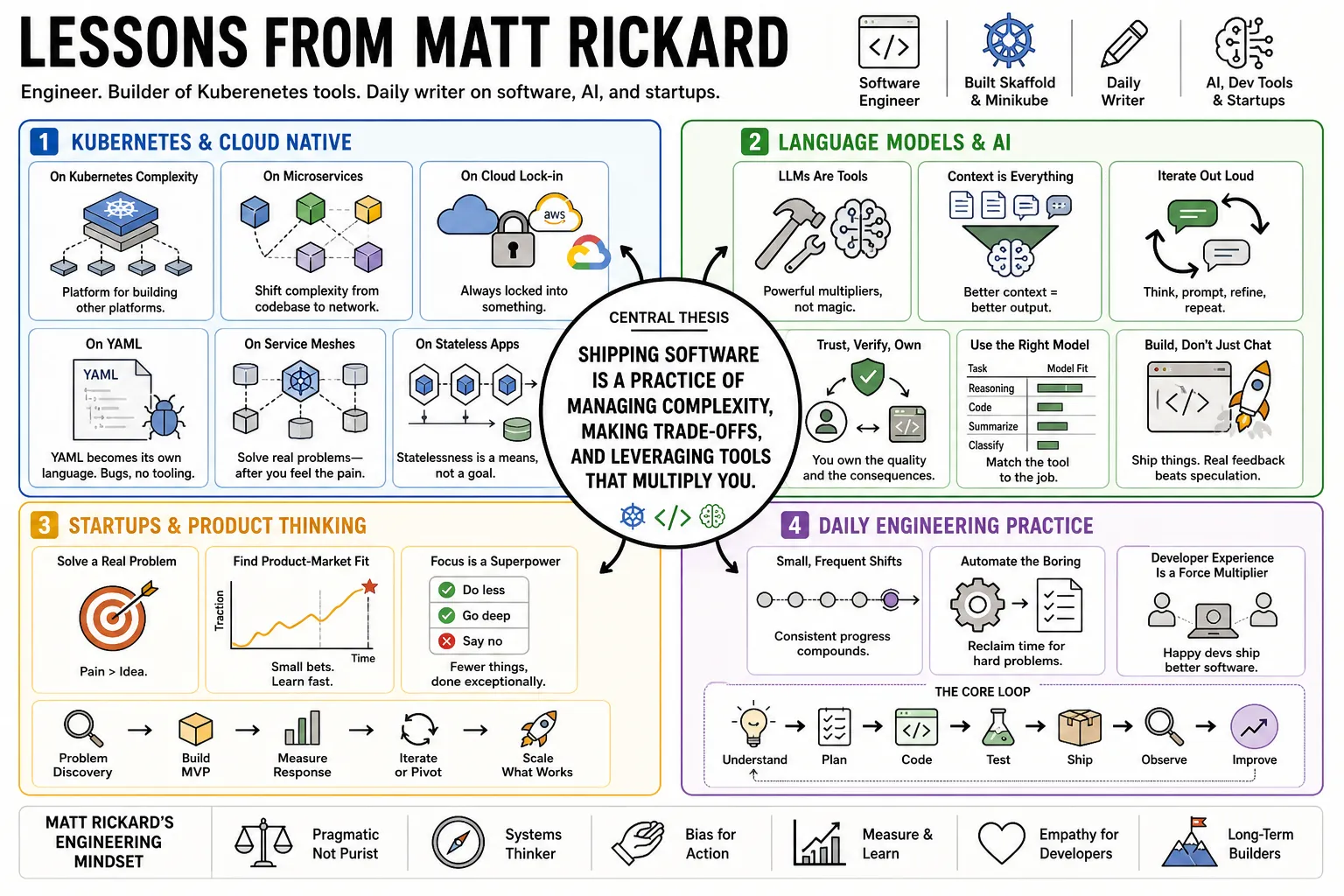
Lessons from Matt Rickard
Matt Rickard is a software engineer and writer who helped build Kubernetes tools like Skaffold and Minikube at Google. He publishes a daily blog on software engineering, AI, and startups. The insights below outline his practical take on developer experience, language models, and the daily work of shipping code.
Part 1: Kubernetes and Cloud Native
- On Kubernetes Complexity: "Kubernetes is less of a deployment target and more of a platform for building other platforms." — Source: [Matt Rickard's Blog]
- On Microservices: "Adopting microservices before your organizational chart requires them often shifts complexity directly from the codebase into the network." — Source: [Matt Rickard's Blog]
- On Cloud Lock-in: "True cloud agnosticism is a myth; you are always locked into something, even if it is simply your own abstractions." — Source: [Matt Rickard's Blog]
- On YAML: "Configuration via YAML in Kubernetes eventually becomes its own programming language, complete with all the bugs but lacking the necessary tooling." — Source: [Matt Rickard's Blog]
- On Service Meshes: "A service mesh solves real network observability problems, but only after you have scaled enough to actually experience those problems." — Source: [Matt Rickard's Blog]
- On Stateless Applications: "Statelessness makes scaling trivial, but all applications have state somewhere; the hard part is deciding which layer has to deal with it." — Source: [Matt Rickard's Blog]
- On Container Orchestration: "Orchestration tools succeeded primarily because they standardized the deployment unit across entirely different environments." — Source: [Matt Rickard's Blog]
- On Kubernetes Defaults: "The default settings in Kubernetes are rarely what you want in production; they are optimized for getting a cluster running quickly." — Source: [Matt Rickard's Blog]
- On Distributed Systems: "In a distributed system, failures are continuous background noise you must design around, rather than exceptions to be caught." — Source: [Matt Rickard's Blog]
- On Infrastructure as Code: "Treating infrastructure as code means applying the exact same testing and review standards to it that you apply to application logic." — Source: [Matt Rickard's Blog]
Part 2: Developer Tools and Experience
- On Developer Experience: "If the inner loop of development takes longer than a few seconds, engineers will context switch, and you lose their focus entirely." — Source: [The Kubernetes Podcast]
- On Skaffold: "The goal of Skaffold was to make developing on Kubernetes feel as fast and iterative as local development." — Source: [The Kubernetes Podcast]
- On Local Environments: "Local development environments rarely mirror production perfectly; the goal is to get close enough to catch logical errors before CI." — Source: [Matt Rickard's Blog]
- On Tooling Abstraction: "Good developer tools hide the orchestration complexity until the exact moment the developer needs to see it." — Source: [Matt Rickard's Blog]
- On Continuous Integration: "Slow CI pipelines are an organizational tax that compounds every time an engineer pushes code." — Source: [Matt Rickard's Blog]
- On Minikube: "Lowering the barrier to entry for running a cluster locally was necessary for Kubernetes to gain mainstream developer adoption." — Source: [The Kubernetes Podcast]
- On Debugging Containers: "Debugging a containerized application requires a different mental model; you are inspecting a closed system rather than a local process." — Source: [Matt Rickard's Blog]
- On Developer Workflows: "Standardizing workflows across a team often matters more than the specific tools you choose." — Source: [Matt Rickard's Blog]
- On Configuration Sprawl: "Every new tool adds a configuration file to the repository root, eventually burying the actual application code." — Source: [Matt Rickard's Blog]
- On Empathy in Tooling: "Building tools for other engineers requires understanding their daily frustrations, rather than only solving the theoretical computer science problem." — Source: [Matt Rickard's Blog]
Part 3: AI and Large Language Models
- On System 1 Thinking: "LLMs operate similarly to human System 1 thinking—fast, pattern-matching, and associative, but lacking deep, multi-step logical deduction." — Source: [Matt Rickard's Blog]
- On Prompt Engineering: "Prompt engineering is less about finding magic phrases and more about clearly defining constraints and context for the model." — Source: [Matt Rickard's Blog]
- On Nondeterminism: "Building software with LLMs forces engineers to handle nondeterministic outputs in systems that historically expected rigid structures." — Source: [Matt Rickard's Blog]
- On Code Generation: "AI coding assistants are excellent at writing boilerplate, which shifts the engineer's role from typing syntax to reviewing logic." — Source: [Matt Rickard's Blog]
- On RAG vs Fine-tuning: "Retrieval-Augmented Generation is usually a better starting point than fine-tuning because it grounds the model in specific, updatable facts." — Source: [Matt Rickard's Blog]
- On Hallucinations: "Model hallucinations are a feature of their design; they are built to generate plausible text, rather than to verify absolute truth." — Source: [Matt Rickard's Blog]
- On Context Windows: "Expanding context windows changes how we interact with models, allowing us to pass entire codebases instead of carefully extracted snippets." — Source: [Matt Rickard's Blog]
- On AI Commoditization: "As foundational models converge in capability, the real value moves to the application layer and the proprietary data used for context." — Source: [Matt Rickard's Blog]
- On Evaluating AI: "Testing LLM applications requires new frameworks, as traditional unit tests cannot easily handle semantic equivalence." — Source: [Matt Rickard's Blog]
- On AI Agents: "Agents that can execute tools autonomously are powerful, but they require strict sandboxing to prevent catastrophic cascading failures." — Source: [Matt Rickard's Blog]
Part 4: Open Source Development
- On Open Source Maintainers: "The hardest part of maintaining a popular open-source project is managing the human elements—issue triage, community expectations, and contributor burnout." — Source: [Changelog Podcast]
- On Corporate Sponsorship: "When large companies back open-source projects, the development velocity increases, but the roadmap often shifts toward enterprise needs." — Source: [Matt Rickard's Blog]
- On Kubeflow: "Building machine learning tools on Kubernetes required bridging the gap between data scientists and infrastructure engineers." — Source: [Matt Rickard's Blog]
- On PR Review Culture: "A healthy open-source project needs reviewers who can quickly say no to scope creep while keeping contributors motivated." — Source: [Matt Rickard's Blog]
- On Forking: "Forking is a safety valve in open source, but it usually indicates a failure in project governance or a fundamental disagreement on direction." — Source: [Matt Rickard's Blog]
- On API Stability: "In open source, breaking an API is breaking a promise to your users; you have to exhaust all other options first." — Source: [Matt Rickard's Blog]
- On Documentation: "Good documentation is often the distinguishing factor between a useful open-source tool and an abandoned repository." — Source: [Matt Rickard's Blog]
- On Dependency Hell: "Importing a small utility library in open source carries the hidden cost of transitive dependencies and potential security vulnerabilities." — Source: [Matt Rickard's Blog]
- On Open Core Models: "The open-core business model requires a careful balancing act to ensure the free version is useful enough to drive adoption without cannibalizing the paid product." — Source: [Matt Rickard's Blog]
Part 5: Software Engineering Philosophy
- On Mastery: "Mastery in programming isn't about knowing syntax; it's about building an intuition for how systems fail under load." — Source: [Changelog Podcast]
- On Simplicity: "Simple code is harder to write than complex code because it requires fully understanding the problem domain first." — Source: [Matt Rickard's Blog]
- On Technical Debt: "Technical debt is a tool. You can borrow against the future to ship today, but eventually, you have to pay the interest." — Source: [Matt Rickard's Blog]
- On Build vs Buy: "Engineers naturally want to build everything in-house, but you should only build things that differentiate your core business." — Source: [Matt Rickard's Blog]
- On Rewriting Code: "Rewriting a system from scratch usually takes twice as long as estimated and introduces a new set of unknown bugs." — Source: [Matt Rickard's Blog]
- On State Management: "Most difficult bugs in large applications stem from inconsistent state management across different components." — Source: [Matt Rickard's Blog]
- On Monoliths: "A well-structured monolith is often the right choice for a new project; you can extract services later when scaling demands it." — Source: [Matt Rickard's Blog]
- On Error Handling: "Errors should be treated as first-class data structures, rather than afterthoughts printed to a log file." — Source: [Matt Rickard's Blog]
- On Code Reviews: "The best code reviews focus on architecture and edge cases, rather than syntax formatting that a linter should catch." — Source: [Matt Rickard's Blog]
Part 6: Startups and Product Building
- On Product-Market Fit: "You cannot engineer your way out of a product that nobody wants to buy." — Source: [Matt Rickard's Blog]
- On Iteration Speed: "Startups win by iterating faster than incumbents; any technical decision that slows down the deployment cycle is a risk." — Source: [Matt Rickard's Blog]
- On Premature Scaling: "Optimizing infrastructure for a million users when you only have ten is a classic engineering mistake." — Source: [Matt Rickard's Blog]
- On Engineering-Led Growth: "Building tools that developers love is a powerful distribution mechanism because engineers bring their favorite tools to every new job." — Source: [Matt Rickard's Blog]
- On Overengineering: "Overengineering happens when engineers solve for hypothetical future scale instead of the immediate business requirements." — Source: [Matt Rickard's Blog]
- On Feedback Loops: "Shortening the feedback loop between the user and the engineer is the most effective way to improve a product." — Source: [Matt Rickard's Blog]
- On Market Risk: "In early-stage startups, the primary risk is market acceptance, rather than technical feasibility." — Source: [Matt Rickard's Blog]
- On Shipping Early: "Shipping a rough feature early gives you real user data, which is more valuable than internal debate over perfection." — Source: [Matt Rickard's Blog]
- On Feature Bloat: "Every feature adds maintenance overhead; saying no to edge-case requests is necessary to keep the product usable." — Source: [Matt Rickard's Blog]
Part 7: Mathematics and Abstraction
- On Mental Models: "Studying mathematics trains you to look for the underlying abstractions and invariants in a software system." — Source: [Matt Rickard's Blog]
- On Leaky Abstractions: "All non-trivial abstractions leak; eventually, you will have to understand the layer underneath to debug a problem." — Source: [Matt Rickard's Blog]
- On Declarative Systems: "Declarative programming shifts the burden of figuring out 'how' to the system, allowing the engineer to focus on 'what'." — Source: [Matt Rickard's Blog]
- On API Design: "Designing a good API is like writing a mathematical proof; it should be logically sound, concise, and easy to follow." — Source: [Matt Rickard's Blog]
- On Probability in Systems: "In large distributed systems, unlikely edge cases become mathematical certainties that will happen daily." — Source: [Matt Rickard's Blog]
- On Graph Theory: "Understanding graph theory is essential when analyzing network topologies, service dependencies, or even social graphs." — Source: [Matt Rickard's Blog]
- On Big O Notation: "Theoretical time complexity matters, but constant factors and memory cache hits often dictate real-world performance." — Source: [Matt Rickard's Blog]
- On Functional Programming: "Even if you don't use a functional language, applying concepts like immutability and pure functions makes code easier to test." — Source: [Matt Rickard's Blog]
- On Systems Thinking: "Optimizing one part of a system without understanding the whole often moves the bottleneck somewhere else." — Source: [Matt Rickard's Blog]
Part 8: Productivity and Automation
- On Automating Last: "You should automate a process only after you have performed it manually enough times to understand its edge cases." — Source: [Matt Rickard's Blog]
- On Deep Work: "Engineering requires uninterrupted blocks of time; context switching for meetings destroys the mental state needed for complex problem-solving." — Source: [Matt Rickard's Blog]
- On To-Do Lists: "A prioritized list is only useful if you actively ignore the bottom half of it to focus on what actually matters." — Source: [Matt Rickard's Blog]
- On Writing: "Writing a design document forces you to clarify your thinking before writing a single line of code." — Source: [Matt Rickard's Blog]
- On Bad Automation: "Automating a flawed process just allows you to make mistakes at a much faster rate." — Source: [Matt Rickard's Blog]
- On Meeting Culture: "Most status update meetings can be replaced by a well-written document and async communication." — Source: [Matt Rickard's Blog]
- On Tool Fatigue: "Adopting too many productivity tools creates meta-work where managing the tools takes more time than doing the actual work." — Source: [Matt Rickard's Blog]
- On Checklists: "Checklists are a simple way to prevent recurring human errors in deployment and incident response." — Source: [Matt Rickard's Blog]
- On Focus: "Productivity is less about typing speed and more about consistently working on the tasks that impact the business." — Source: [Matt Rickard's Blog]